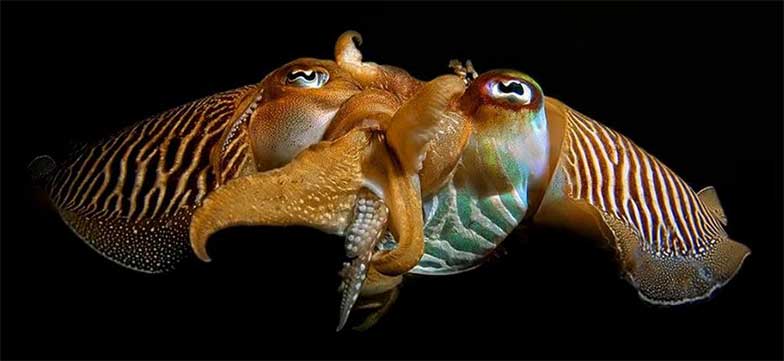
Coming this Spring, a three-episode series on PBS:

I’ll be watching it.

Coming this Spring, a three-episode series on PBS:
I’ll be watching it.

Not quite yet, though — I’m looking forward to the temperature dropping and becoming comfortably chill again.

One of the most common rhetorical games creationists play, especially those influenced by those frauds at Answers in Genesis, is to erect a phony distinction between historical science, which they claim is not a science, and observational science, which they claim is the one true kind of science. It’s a way for them to deny claims of events in the past having any credibility unless there is a direct, eye-witness, personal, written account (a restriction they blithely ignore when it comes to things like the first five days of the creation week, or the life of Jesus, which is all by second-hand accounts).
So it’s always useful to collect good summaries of how you certainly can evaluate claims about the past, and how science can legitimately study historical processes. John Wilkins adds some more arguments.
To deny that we can know the past in any sense is not science. It is in effect an admission of failure, but we need not be so pessimistic. For example, we know Caesar crossed the Rubicon with his legions. We might not know how they were dressed or if it was raining that day, but we do know it happened. Likewise, we know the earth is 3.85 billion years old since the surface hardened. The evidence is there, supported by experimental observations.

I’m about to alienate even more knee-jerk skeptics (and good riddance!) by saying something incredibly daring: post-modernism isn’t so bad. Skeptics ought to embrace it. It’s sad that so few do: Mano Singham seems to be the rare one. I think maybe because he actually understands it.
Many scientists hate what they think of as postmodernism, mainly because of its denial of the possibility of an objective truth and its questioning of the concomitant idea that knowledge is somehow progressing. The idea that scientific knowledge is not necessarily advancing towards something that we can call ‘truth’ disturbs them. This radical break with past ideas that scientific progress was necessarily leading towards truth one of Thomas Kuhn’s key ideas in his highly influential monograph The Structure of Scientific Revolutions. But rather than engage with this important idea (and it is difficult to refute and has not been done, as far as I am aware), the term ‘postmodernism’ is often used as an epithet used by scientists against their critics, the way that ‘scientism’ is used as a weapon against science.
Most people don’t seem to know anything about post-modernism other than the Sokal hoax. This was a notorious paper submitted by a physics professor to the postmodern journal, Social Text, in which he cobbled together strings of buzzwords and nonsense into a jabberwocky of a paper…and it got accepted. Cue immediate jeers and contempt for the entirety of post-modernism.
There is no excuse for the Sokal paper — it was total garbage, and the editors should have been embarrassed. But somehow it became cause to dismiss the entire field. Why, it’s as if we decided that developmental biology was a total joke because we have journals with a fondness for publishing bad science about donuts.
But you know what post-modernism is, right? It’s a skeptical approach to literature, art, even science, that attempts to deconstruct the premises and presuppositions and cultural influences on a work. It’s an acknowledgment that nothing humans create appears out of a vacuum and that perfect objectivity is an illusion. Yeah, it’s got jargon, lots of jargon, that can be abused and that allows airheads to give the illusion of wisdom by babbling in cliches, but it’s also a useful tool that is used wisely by many academics.
For instance, there’s a lot of wisdom in what Michael Bérubé has written about the subject. Try reading this one paragraph and think. It will sound very familiar to those of us who have been actively opposing the pretense of absolute objective knowledge, and suggesting that maybe there are other unscientific phenomena that we ought to engage.
Sokal’s admirers have projected almost anything they desire–and they have desired many things. In early 1997, Sokal came to the University of Illinois, and quite graciously offered to share the stage with me so that we could have a debate about the relation of postmodern philosophy to politics. It was there that I first unveiled my counterargument, namely, that the world really is divvied up into “brute fact” and “social fact,” just as philosopher John Searle says it is, but the distinction between brute fact and social fact is itself a social fact, not a brute fact, which is why the history of science is so interesting. Moreover, there are many things–like Down syndrome, as my second son has taught me–that reside squarely at the intersection between brute fact and social fact, such that new social facts (like policies of inclusion and early intervention) can help determine the brute facts of people’s lives (like their health and well-being).
I had to emphasize that one sentence in the middle because it says so much about why the demarcation problem is non-trivial, but that last sentence is also essential — what we shall do with science and technology is as important as the science and technology themselves.
There have been many battles and many books published both for and against a postmodernist view of science, and I think the opposition is largely wrong. Post-modernism did not begin and end with Sokal. And while there is a painful amount of lefty nuttiness in post-modernist circles, there’s also a lot that’s worth learning.
A couple of physicists had clearly read Paul Gross and Norman Levitt’s then-recent book, Higher Superstition: The Academic Left and Its Quarrels with Science, a free-swinging polemic against science studies, feminism, Jeremy Rifkin, jargon, and much more, and they were mightily pissed off about this Andrew Ross fellow, who had written a science-studies book, Strange Weather, which he dedicated to “all the science teachers I never had. It could only have been written without them.”
Well, yes, I had to admit, Ross’s dedication was rather cheeky. But it was not in itself evidence that Ross did not know his subject matter. Besides, I added, when in Strange Weather Ross called for science “that will be publicly answerable and of some service to progressive interests,” and Gross and Levitt responded by writing, “ ‘Of some service to progressive interests’ seems reasonably clear, if frighteningly Stalinist in tone and root,” weren’t Gross and Levitt being kind of…nutty? Hysterical, perhaps? What was wrong with wanting medicine or engineering or environmental science to be publicly answerable and of some service to progressive interests? Why shouldn’t we try to build a world that affords greater public access to people with disabilities, for instance? And since conservatives had even then largely abandoned their early-twentieth-century commitment to conserve the Earth’s natural resources, wasn’t “environmental science” now a “progressive ” in and of itself? It’s not as if Ross was calling for a Liberation Astronomy. Would Ross’s sentence sound out of place in a bulletin issued by the Union of Concerned Scientists?
Science has to be answerable to public interest, and the goals of scientists (and atheists!) should include progressive values. We live to make a better world, right? So why should we not respect and appreciate a critical analysis of the social context of what we do?
I’m happy to accept Bérubé’s deal.
So these days, when I talk to my scientist friends, I offer them a deal. I say: I’ll admit that you were right about the potential for science studies to go horribly wrong and give fuel to deeply ignorant and/or reactionary people. And in return, you’ll admit that I was right about the culture wars, and right that the natural sciences would not be held harmless from the right-wing noise machine. And if you’ll go further, and acknowledge that some circumspect, well-informed critiques of actually existing science have merit (such as the criticism that the postwar medicalization of pregnancy and childbirth had some ill effects), I’ll go further too, and acknowledge that many humanists’ critiques of science and reason are neither circumspect nor well-informed. Then perhaps we can get down to the business of how to develop safe, sustainable energy and other social practices that will keep the planet habitable.
I’ll also extend the deal and say that we are obligated to pursue a humanist agenda ourselves — that simply accumulating deeper understanding of the universe without consideration of our place in it is ultimately destructive. I’m reminded of my late genetics mentor, George Streisinger, who considered ethical issues as important as the science, and spoke out in the 1980s about what were the important concerns.
I see the danger of global nuclear war as imminent. The use of poison warfare, the widespread use of chemicals that may be hazardous, the lack of any serious attempt to deal with population growth, the lack of any real concern about the just incredibly unequal distribution of wealth.
People have to be part of our equations.

Once they can hold a shotgun, we’re doomed. Or the octopuses are.
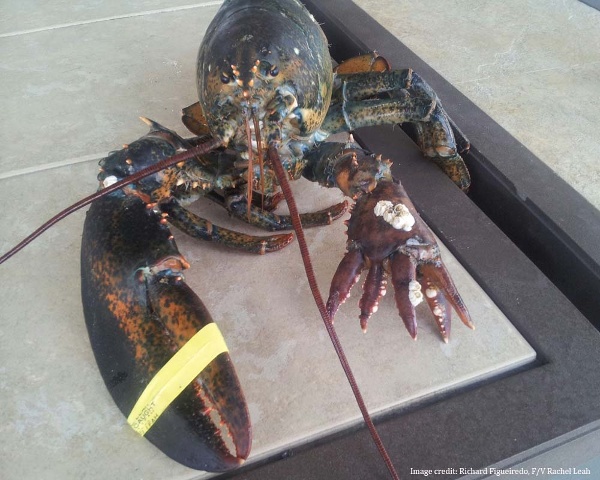
One annoying thing is that the news report keeps saying it has multiple claws. No, it does not. It has two big chelipeds, the correct number, and it has a number of walking claws or pereiopods that look about right. The left cheliped is weird: I can’t tell for sure, but it either has mirror-image duplication of the propodus and dactylus, or multiple duplications of the dactylus. The latter would be interesting; that would suggest a failure of the proximal-distal patterning information in the claw.
Someone more knowledgeable in the fine-grained morphology of lobster claws ought to do a labeling of the digit identities for us.


Read this story about abortions: it’s not anti-choice. It’s anti-science and anti-medicine. It’s appalling. She contrasts brutal “Western Science” with its machines (and also its caring people: ignore her colorful descriptions of the technology, and her experience with people in the abortion clinic was one where she was asked if she was sure she wanted it, and a woman who tried to help her afterwards) with “natural healing” in which she takes a few gentle herbs and just visualizes shedding the walls of her uterus, and magically her pregnancy disappears.
Then she babbles about how it is just fine if the “fundamentalist dickheads” burn down all the women’s clinics, because they’ll just be able to use organic natural herbal chemical-free machine-free medicine-free abortions using the magic power in women’s heads.
Jesus.
This is one of the nice things about FtB. Now you can go read Miri as a warm-up, finding parts of the essay that are worthwhile, while others suck.
Then go read Avi’s total destruction of the dangerous anti-medical quackery in the story.
It’s all good.

They’re beautiful diverse animals with a bad (and undeserved) reputation. Here’s a new species, Hemiscyllium halmahera, taking a little stroll.

“Eat, kid, you’re too skinny!”
Alternatively, there’s a distinct resemblance to Mrs. Doyle.

The The Carnival of Evolution for September is available. Good reading there, while I plod away at grading. Already.