Pharyngula
Evolution, development, and random biological ejaculations from a godless liberal


It’s true. This is what happens at a liberal arts college: worlds collide! Human sacrifice, dogs and cats living together… mass hysteria! And poets and scientists talking to one another!
This is precisely what the Christian fundamentalists are warning us of with the Blood Moon Prophecy, which is happening this weekend, and culminates with poetry in a coffeehouse on Tuesday. If ever you wanted to witness an apocalypse, get yourself to Morris stat.



Gaze upon the hidden realms of Pluto. Not here in this greatly reduced image, but go direct to NASA and get the high resolution image.

Then stare at it. Become one with Pluto.

While I appreciate the perspective on the relative investment in science, SciAm, this is a terrible graphic.
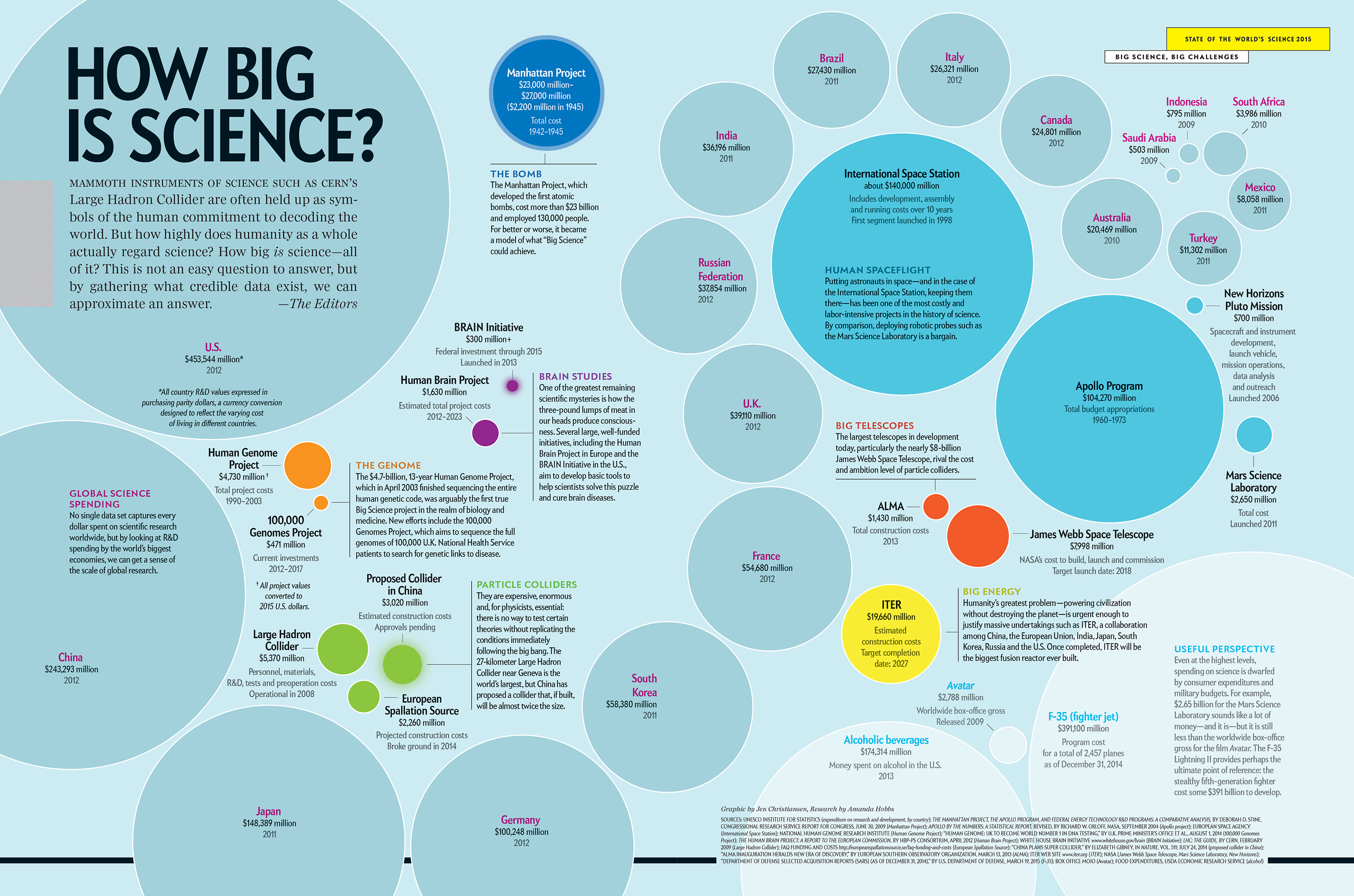
It’s interesting that the total American investment in science is slightly larger than what the military throws away on just the F-35 program, but otherwise, this image has very low information density.
Humans are lousy at comparing surface areas, and here the money spent on each project is represented by…the area of a circle. That’s poor data representation. I’m sorry, but the creator of this graphic is going to be lined up against the wall with the person who invented pie charts.
Each data point is shown as a circle drawn arbitrarily somewhere on the page. There is no information in relative location — I guess the circles were just splotched down in an arrangement that looked good to a graphic designer somewhere. Are there any relationships between any of these data?
Colors are also arbitrary. Nations are in blue, genomes are orange, brains are purple, and telescopes are red. Just because.
There is so little information in this wall of circles that it needs to be helped along with paragraphs of text dumped onto the page in teeny-tiny print, and most of that text doesn’t tell us anything about the relationships between the circles. They are just circles of varying size on a bland blue background.
A tidy table would have been more than adequate for expressing numbers.
Oh, and there is content. Let’s shut down the F-35, give all that money to the NSF, and double the amount of grant money.

Ah, don’t you love the sight of nonsensical claims getting vaporized by science? An engineer thought about Trump’s proposal to build a giant wall at the Mexican-American border. It turns out to be a non-trivial project.
Twelve million, six hundred thousand cubic yards. In other words, this wall would contain over three times the amount of concrete used to build the Hoover Dam — a project that, unlike Trump’s wall, has qualitative, verifiable economic benefits.
Such a wall would be greater in volume than all six pyramids of the Giza Necropolis — and it is unlikely that a concrete slab in the town of Dead Dog Valley, Texas would inspire the same timeless sense of wonder.
That quantity of concrete could pave a one-lane road from New York to Los Angeles, going the long way around the Earth, which would probably be just as useful.
Concrete, of course, requires reinforcing steel (or rebar). A reasonable estimate for the amount of rebar would be about 3 percent of the total wall size, resulting in a steel volume of 10,190,000 cubic feet, or about 5 billion pounds. We could melt down 4 of our Nimitz-class aircraft carriers and would probably be a few cruisers short of having enough steel.
But the challenge is far greater than simply collecting the necessary raw materials. All of these hundreds of miles of wall would need to be cast in concrete facilities, probably project-specific ones that have been custom built near the border. Then, the pre-cast wall pieces would need to be shipped by truck through the inhospitable, often roadless desert.
The men and women doing the work of actually installing the wall would have to be provided with food, water, shelter, lavatory facilities, safety equipment, transportation, and medical care, and would sometimes be miles away from a population center of any size. Sure, some people would be willing to to do the work, but at what price? Would Trump hire Mexicans?
This analysis also ignores the less sexy aspects of large-scale engineering projects: surveying, land acquisition, environmental review, geological studies, maintenance, excavating for foundations, and so on. Theoretical President Trump may be able to executive-order his way through the laser grid of lawsuits that normally impede this kind of work, but he can’t ignore the physical realities of construction.
But I don’t know — I’ve otherwise blocked Trump out of my mind for the last week or so. Is he still considered a viable candidate? Or have people yet realized that makes America look stupid?

The tobacco industry knew that cigarettes were both addictive and carcinogenic. They sold them anyway, and hired professional obfuscators and lobbyists to bury the truth.
Now we know that the oil industry is the same way. Exxon knew how much carbon was buried in oil reserves. They knew how much carbon dioxide was in the atmosphere. They were able to calculate in 1979 what burning all that oil would do to the carbon dioxide concentration.
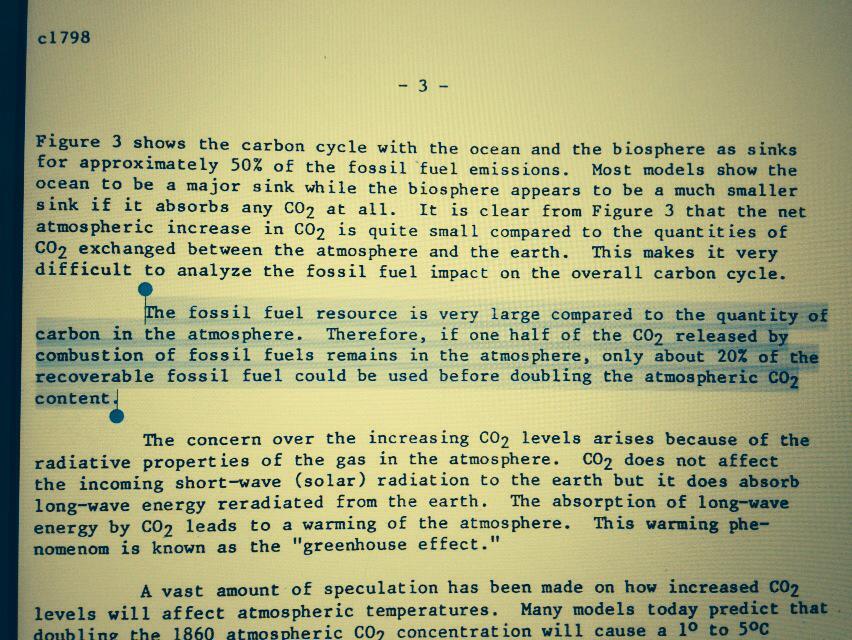
They knew. They didn’t care what its effects were. They only cared about their bottom line.
You know, the future is going to look back on rabid capitalism as one of the damning pathologies of our history.

The Intelligent Design Creationists are always getting annoyed at the third word in that label — they’re not creationists, they insist, but something completely different. They’re scientists, they think. They’re just scientists who favor a different explanation for the diversity of life on Earth than those horrible Darwinist notions. But of course, everything about them just affirms that they’re simply jumped-up creationists with airs, from their founding by an evangelical Christian, Phillip Johnson, to their crop of fellows like Paul Nelson and William Dembski, who happily profess their science-denying faith to audiences of fellow evangelicals, to their stance on every single damn discovery that comes out of paleontology and molecular biology. The real misnomer is that they work at a think-tank called the Discovery Institute, when their response to every scientific discovery that confirms evolution is a spasm of jerking knees and a chorus of “uh-uh” and “no way”.
It makes no sense. They completely lack an intellectual framework for dealing with new findings in science, so instead of explaining how Intelligent Design “Science” better explains an observed phenomenon, they instead dredge up some entirely unqualified spokesperson to mumble half-baked, pseudo-scientific excuses for why those Darwinists have it all wrong.
Case in point: Homo naledi, the newly discovered South African species. If they actually were Intelligent Design “Scientists”, they’d respond with the same puzzled happiness that real scientists do: we’re not sure where to place this species in our family tree, but it’s very exciting, and fits with our growing knowledge about the diversity of early hominins — there were lots of different species of human ancestral species and dead-end branch species living at the same time on Earth right up to less than 100,000 years ago. This fact of the fossil data has been known since I was a wee young lad growing up reading about Louis and Mary Leakey in National Geographic. That multiple hominin species coexisted and overlapped in time is part of the body of data that we have, and it fits just fine with evolutionary theory. The history of a lineage is a braided stream, with populations branching off and diverging, sometimes dying off, other times merging with other branches. And we explain this pattern with theories about common descent, genetic drift, and selection.

There’s a standard response when people feel the sticker shock at seeing the prices on brand new drugs: that cost is necessary to subsidize the expense of drug development. And that’s true! Bringing a new drug to market takes a lot of time and money and multiple levels of testing and clinical trials. It hurts to pay it, but you’re paying all the costs of development (would that companies that tear up the environment had to obey the same principle).
But now Martin Shkreli comes along, and ruins the whole defense. Shkreli bought the rights to a drug, Daraprim, and immediately jacked up the cost from $13.50/pill to $750/pill, all for a drug that cost him $1/pill to manufacture.