
The Thorny Devil and I have exactly the same expression right now.
Pharyngula
Evolution, development, and random biological ejaculations from a godless liberal

The Thorny Devil and I have exactly the same expression right now.

Disturbing.
Unfortunately, you don’t need fancy computers and high tech 5-senses interfaces to get this effect, where your reality is distorted by filters in your head. This is the human condition. We do it all the time.
Here’s an example: a comic book used to manipulate the wetware in kids’ brains to make them think gay people are wicked.

We grow up with these little modules planted in our skulls by well-meaning families and friends who also have them in their heads, and it isn’t a little box mounted on our necks that we can conveniently rip out to perceive “reality”. There ain’t no such thing possible — it’s implicit in the modeling of the world we see around us, because we don’t accurately “see” the world, we build it. Everyone is walking around in a virtual reality all the time, and what matters is how well it reflects an underlying substrate of matter and energy, how well it allows us to interact with our fellow avatars, and how much damage and how much benefit we provide to each other. This is true not just for them, fellow liberal/progressive secular humanists, but for us.
The people who made that anti-gay comic are using a version of virtual reality that creates enemies all around them, and justifies wrecking their lives. It’s also kind of crude and generates a blocky, black & white universe that doesn’t have much nuance or fine detail.
How’s yours doing?

I mean, really. This team of ‘scientists’ hijacked a valuable research submersible, strapped their gadget to it, and sent it cruising to a depth of 900 meters in the Pacific Ocean just to catch this goofy-looking purple thing.
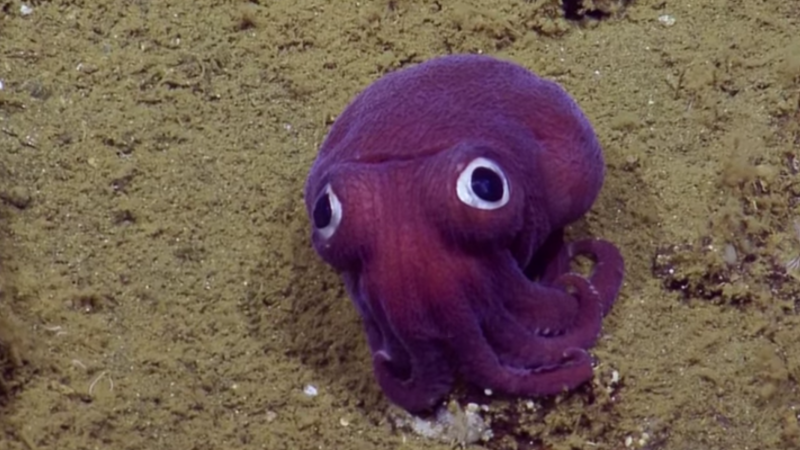
Listen to these people…buncha giggly teenagers.
I’m a bit annoyed that they went to all this trouble to find it, and then they apparently were all out of pokeballs.

I sure wish more people understood the meaning of theory in science, but at least Piers Sellers does a good job of explaining the concept. I try to hammer into my students (as my teachers hammered into me) the primacy of evidence — observation and measurement — but evidence always has to be for or against something, and that something is theory. You can’t have a theory without evidence, and you can’t have evidence without a theory to give it meaning. So I’m always happy to see another explanation of this core concept of science.
Fundamentally, a theory in science is not just a whim or an opinion; it is a logical construct of how we think something works, generally agreed upon by scientists and always in agreement with the available observations. A good example is Isaac Newton’s theory of gravitation, which says that every physical object in the universe exerts a gravity force field around itself, with the strength of that field depending on its mass. The theory—one simple equation—does a superb job of explaining our observations of how planets orbit around the sun, and was more than good enough to make the calculations we needed to send spacecraft to the moon and elsewhere. Einstein improved on Newton’s theory when it comes to large-scale astronomical phenomena, but, for everyday engineering use, Newton’s physics works perfectly well, even though it is more than three hundred years old.
One danger of the public misunderstanding of this idea is that they do equate theory and opinion; they tear down successful theories with rhetoric and ignorance, and they also elevate nonsense by labeling it, without comprehension, a theory. And I could piss in the snow and call it a book, too.
But theories are abstract, after all, so it’s easy for people to get tricked into thinking that because something is based on theory, it could very likely be wrong or is debatable in the same way that a social issue is debatable. This is incorrect. Almost all the accepted theories that we use in the physical and biological sciences are not open to different interpretations depending on someone’s opinion, internal beliefs, gut feelings, or lobbying. In the science world, two and two make four. To change or modify a theory, as Einstein’s theories modified Newton’s, takes tremendous effort and a huge weight of experimental evidence.
This is something that should be explained to everyone visiting Answers in Genesis and their horrible dishonest “museum” and “ark park”. The central argument Ken Ham always makes is a demolition of the whole concept of theory — he claims that any alternative explanation, no matter how much it ignores the evidence, is a theory, and all theories are equal, and therefore, his bizarre, highly subjective and ideologically driven interpretation of the words of his holy book are just as much deserving of the title of “theory” as the hard-earned, constantly tested, well-supported by evidence theory of evolution.
And that’s dangerous. Ken Ham uses the degradation of theory to peddle nonsense to the rubes and make money and promote his narrow religion, but as the article explains, it’s also being used to corrupt decision-making about climate that endangers every human being on the planet.

That concept is so dead. But if you know someone who still trots out the ol’ argument from personal incredulity, show them this simple video about the evolution of the eye.

How Brian Cox keeps his cool is quite impressive. Here, he’s arguing with an Australian senator and climate change denialist, Malcolm Roberts, who keeps insisting, quite rightly, that evidence is important, that evidence trumps opinion, that policy should be defined by empirical evidence…and every time Cox shows him the evidence, he simply rejects it, accusing NASA of faking the data, and arguing that the various climatoogical agencies have been colluding to “corrupt” the data.
I guess it’s a step forward that the kooks are at least acknowledging that real data is important, now we just have to carry it through to the next step, of paying attention when the data slaps them in the face.

Chalk up another black mark against North Carolina’s governor, Pat McCrory. His administration has been pretending that mountains of coal ash couldn’t possibly be contaminating drinking water in the state. Their obstinance has finally led to the resignation of one of the state’s leading scientists.
North Carolina’s state epidemiologist resigned Wednesday to protest her employer’s depiction that “deliberately misleads” how screening standards were created to test private wells near Duke Energy’s power plants.
Dr. Megan Davies’ immediate resignation after seven years on the job deepens a rift between Gov. Pat McCrory’s administration and some of the state’s top public health scientists. McCrory is a former Duke employee who is running for a second term as governor.
The millions of tons of coal ash stored at Duke’s power plants has contaminated groundwater under them. State tests last year found that cancer-causing chemicals were present in hundreds of nearby private wells, although Duke denies coal ash is the source.
So wait…where is the vanadium and hexavalent chromium, carcinogens that are found in relatively high concentration in coal ash, coming from? This is one that would be tough to blame on transgender men and women — they just don’t have the magic powers that would do that. If it’s not the coal ash, the only remaining possibility really is magic…which means we’re going to have to blame Jesus. Why does Jesus hate North Carolina? Logically, the answer must be that he hates them because they elected a wanker named McCrory.


Extrapolating from current tectonic movements, the future state of the continents has been predicted. Apparently, we’ll get a new Pangaea back again in about 250 million years.
I’m thinking I may have to hang around long enough to witness that. Who’s with me?

Every four years, Shawn Otto and his ScienceDebate organization politely suggest that science, engineering, tech, health, and environmental issues deserve a presidential debate, and every four years they’re ignored — largely because our presidential candidates are never really competent to discuss science in any detail at all (can you imagine Trump trying to bluster his way through a discussion of science and education policy?). But one thing that does get a regular response is the list of 20 science policy questions. Now there are a lot of questions I’d like to see both campaigns address.
It’s a rather quixotic effort, but it’s important to keep the pressure on. Go sign the petition at Sciencedebate.org.