End of a project

I am now committed. This morning, I got to work and started dismantling my jerry-built zebrafish facility. It was built to last, with annoying bolts everywhere, some of them quite high up on the structure, and now I can’t feel my right shoulder after all the wrench work above my head. We got the bulk of it disassembled and removed, and all that’s left right now is a lot of PVC plumbing suspended from the ceiling and going nowhere, with a huge cattle trough (the water reservoir) and a big ol’ water pump. That’ll go tomorrow, clearing up a whole bunch of bench space, which I think will be home to a new, additional incubator.

Now I need to figure out what to do with the stuff. Mary might use some of it to set up a herb garden in our sun room — it’s a lot of shelving and shallow trays. There is also a great deal of hydroponic gear I used to deliver recycled water to the tanks, and she got a glint in her eye and dreamt of a hydroponic drip system for plants…which may be overly ambitious.

But there’s no going back now. I’m going to be running an arthropod lab, rather than a fish lab, which is a bit of a change. I’m still young enough to change my research focus, right? Although not young enough to do serious physical labor without feeling like I overtaxed every muscle in my upper body.

Not a good day

The current spider egg case I was hoping to see hatch out with a new generation of spiders isn’t looking so good. I opened it up to find way too many dead eggs, and then made a time lapse to see babies just fading away. It’s sad and miserable. I’m putting it here to document my dismal Christmas eve.

I’m gonna have to cancel Christmas. There is no reason for anyone to celebrate.

Why does Santa come down the chimney?

To look for spiders, of course. Mary and I were getting into the spirit of the season and were surveying the area for spiders this morning. We were heartened by the fact that she discovered a salticid in our house — I’d given up on looking, assuming that no self-respecting spider would be out and about in late December in Minnesota, but there it was. So we donned our headgear and started scrutinizing window frames and dusty corners, and we also trooped over to the science building on campus and checked out the hallways and the basement.

Mary caught me in dynamic action pose, staring at cobwebs.

Unfortunately, the spider population was sparse or in deep hiding. We found another salticid in my office, and the husks of a few dead pholcids (lots of pholcids thriving in our basement, though), but no Theridiidae. There were also a few abandoned funnel webs outside. One problem is that the university custodial staff do a really thorough job of demolishing cobwebs and making an inhospitable environment for spiders…and I don’t think there are very many insects to eat there, except maybe in relatively unreachable places, like crawlspaces.

It’s also cold outside. I’ll be interested to see how the population changes in the Spring.

Calf Bug-ropin’ with Cowboy Vera, Spider-style

I was bragging about Vera’s great skill in capturing multiple prey in minutes, so I thought I’d show you. Basically, whenever I put live flies in the spider’s vial (I feed her 3 times a week), she is off like a shot, immediately charging in to snare them.

She reminds me a lot of my cat that way.

It was tricky keeping her in frame and in focus, but I think you’ll get an idea of how spiders use their webbing to immobilize prey.

Also, I’m going to start doing everything “spider-style”.

[Read more…]

Jordan Peterson: “venal, ugly, and intellectually dishonest”

He’s not going to be able to wiggle out of this one, although I’m sure he’ll try: Jordan Peterson is a climate change denialist. That link has all the evidence, direct quotes, tweets, etc. He praises some loon who thinks CO2 is steadily declining, leading to the extinction of all life on Earth in 2 million years, and that we ought to praise the heroic oil companies for releasing sequestered carbon and saving the planet. One of his sources is Richard Lindzen, prattling away in a Prager U video. He’s a fool on this subject, and many others.

But why would a well-educated college professor plunge so deeply into ignorance? The article has a good explanation.

But as his former mentor at UofT said, Peterson loves the rhetorical patterns of demagogues. He loves that when they said something and got roars of approval, they repeated it more loudly, and then honed in on the subset of things that got them the biggest roars.

That’s all Peterson is doing. Saying things that his audience loves to hear, reveling in their roars of approval, then repeating himself.

And since his audience is mostly younger, white, conservative men, and that audience has a strong tendency to be climate change deniers and to love trolling liberals, when he says ‘climate change stoopid’, they roar their approval.

Given that he makes a very good income out of this audience, just as Shapiro and Coulter do, this is actually smart, even if venal, ugly, and intellectually dishonest. But Peterson has shown every evidence of venality and intellectual dishonesty while spouting often ugly things — enforced monogamy anyone? — he later pretends were misunderstood for a couple of years. This is just par for the course.

Young, white, conservative men are the root of the problem, I suspect. Of a lot of problems. And it’s wealthy, older white men who are feeding them the poison.

Baby spider

Quick update: here’s a shiny new Parasteatoda postembryo. Nothing exciting happens in this video — it’s nothing but 3 minutes staring into the eyes of a baby spider. It twitches a bit. It waves a leg around, floppily. But so much is happening in its nervous system!

This is one member of the new clutch of Gwyneth’s grandchildren. I’ll be sorting them out this weekend and putting them in individual vials, and maybe by early March they’ll be making Gwyneth’s great-grandchildren.

[Read more…]

So I, too, could menstruate if I eat enough donuts?

Every once in a while, kind of like a cycle, some men on the internet get really mad about menstruation, and they start explaining how it’s filthy, unnatural, and disgusting for women to bleed from their vagina. “Why?” they wonder, and the obvious answer is that woman are unclean, they’re eating too much junk food, so menstruation must be their repulsive horrible body’s way of cleansing itself of toxins.

Obvs. I’m kind of curious about this “academia and the arts” cure, though, but not curious enough to wander over to the Art building on campus and ask the women faculty and students about their periods. I suspect they would, if they didn’t call the police, tell me that they’re perfectly normal and didn’t notice any decline in frequency when they entered college.

I’m also interested in this claim that “Men are the superior sex and they don’t have periods because we know how to look after their bodies.” So I could look for some fat lazy slob (why are you looking at me that way) watching trash TV (I didn’t!) and gossiping (I never!) and ask them if they’ve been menstruating lately (no, I’m not going to ask myself) (and no, I’ve never menstruated). I’m wondering if I could take up a diet of Twinkies and cheeseburgers now, and look as svelte as those ladies in the tampon commercials, if only I could start bleeding out of my bottom every month. It might be a fair trade.

It’s not just men who make these claims! Freelee the Banana Girl made similar arguments a while back. If you menstruate, you must have been wicked and accumulating toxins that your body needs to purge.

And don’t forget Yada the Hotep wackaloon. He got really angry when his daughter started menstruating, and went on a quest to find a magic bark and a magic diet that would make her stop. He also claims that animals don’t menstruate…except they sort of do. One way to stop menstruation is to get pregnant, and most mammals only thicken their endometrium seasonally, and typically don’t shed that tissue until they go into labor. Humans have the curse of year-round fertility, so that’s the problem, not that they menstruate, but that they are constantly preparing for a potential pregnancy.

I wrote about this before. It’s not about toxins or cleanses — it’s about maintaining a defensive boundary against those highly invasive mammalian embryos — put up a wall of soft vascularized tissue against the chance that you might get pregnant some month, and then discard it when fertilization fails to occur.

Spider Report: Vera, rodeo star

I just got back from tending my herd, who are all doing well. I’m anxious to get more egg cases, though, so I’ve been feeding them more and frequently — I gave each vial of spiders a half dozen flies today. I noticed some behavioral differences. The young adults each quickly moved on a fly, immobilized it, and settled down to biting and eating. Vera, currently the most senior spider in the colony, had a different strategy: she would scurry over to a fly, quickly wrap it up, and then move on to another. She had 5 flies immobilized and writhing in lightly webbed cocoons in about 30 seconds. It reminded me of calf-roping at the rodeo. I was impressed. Then she rubbed her forelegs together and cackled something vulgar in spider language* before moving back to her first captive and turning its guts into soup.

The embryos in the one egg sac I have are coming along nicely, showing nicely differentiated legs. I’m avoiding manipulating them much, since I’m more concerned about getting a strong, healthy third generation going, but they look to be about stage 13-14 by the standard staging series, which means I’ll probably have post-embryonic spiderlings by this weekend, and am going to have to spend a bit of time sorting them out into separate vials. This cohort of spiders are all inbred grandchildren of Gwyneth. I’m sad to say that Vera has not managed to produce any viable offspring for the colony — I did hear her sneeringly announce that she was not a breeder, and in particular wasn’t going to breed to produce servile offspring for an inferior species.

I’ll put the diagram of the developmental stages below the fold, so arachnophobes may not want to go any further, even though these are cute li’l babies in the image.

[Read more…]

Spiders in Space

Oh, the nerdity of it all. I just read about a discussion of how spider-aliens would survive in space. This is my kind of thought-experiment!

In my stellar empire, the sapient life of the home world are arachnids. Due to an oxygen-heavy world with certain evolutionary characteristics, spider-like beings developed intelligence and formed society, leading them (eventually) to start looking toward the stars. This led to the development of space suits for the pioneering arachnid astronauts.

What would these look like? How would space suits be differently designed to support arachnids?

Let us posit that the arachnids are roughly 4 feet from “spinneret” to fangs. Their legs are large enough to support them (I don’t know what that is). They’re light compared to us (maybe 25 pounds at the heaviest – bear with me on the whole square cube law deal). They have roughly equivalent technology levels to ourselves at the time of our first missions into the stars.

Just by coincidence, I’ve been reading up on spider physiology recently, so this piqued my interest. Most of the answers in that thread are pretty good.

I’d first have to state a caveat: multi-legged alien beings evolving on a distant planet will not be spiders. It’s unfair to compare limitations and abilities that they have to those of terrestrial spiders — they aren’t related! Just blowing up an Earth spider to 1.2 meters long is not a valid comparison. But OK, let’s play a game and imagine an alien “spider” that evolved from an ancestor living in a similar niche to that of our spiders. Traits that are probably relevant are:

  • Obligate carnivory. It’s a predator with a need for live food. Unless there’s a way to store frozen bug juice shakes that this species will willingly eat, this sounds like a big problem — space-faring “spiders” are going to have to bring along along bug ranches to maintain livestock. And food for said livestock. Forget the spacesuits, there are going to be some demanding requirements for life support on space ships.
  • External digestion. Why, you might ask, would they need live food? Spiders inject enzymes into their prey which break down the guts of the animal into a liquid soup that they can slurp up. The food is both the container and the meal. “Spider” Tang is going to be a tough recipe.
  • Ambush predator. This has pluses and minuses: most spiders have notably lower metabolic rates than other poikilotherms, about 70% of what is expected in animals of equivalent size. So, lower oxygen consumption — that’s great for spacecraft/spacesuit design. On the other hand, they can have extreme surges in activity, for instance, when prey is captured. Oxygen consumption is going to be somewhat unpredictable.
  • Pulmonary system. The linked discussion mentions how spiders often have a dual respiration: they have two or four book lungs in the ventral abdomen, but also many of them have a trachaeal system, an array of small tubes that penetrate the cuticle and permit atmospheric gases to flow in to the tissues. This one might not be a problem, though: trachaeal systems are less and less effective the larger the animal, and they rely more on discrete respiratory organs, like lungs, as they grow to a larger size. At 1.2 meters long, these alien “spiders” are almost certainly going to have “lungs” and “nostrils” — it’s just that if they’re like our spiders, they won’t be on the face, but low on the abdomen.
  • Respiratory pigments. This is where it becomes obvious that you can’t simply extrapolate from Earth spiders to space “spiders”. Our spiders use hemocyanin to carry oxygen, which has a significantly lower O2 carrying capacity than our hemoglobin. You’d think along the way to evolving larger size and metabolically demanding intelligence they’d have to be using a more efficient respiratory pigment…although blue-green blood is kind of cool.
  • Sensory apparatus. Look closely at a spider sometime: they are covered with hairs. These aren’t dead insulators like our hairs, either, but are all invested with nerves for mechanical and chemical sensory functions. Putting them in a suit that limits them to only visual input is going to be like dumping them into a sensory deprivation tank.
  • Motility. There is a suggestion that they could use “an enclosed pod that the spider can sit inside with legs folded and have mechanical arms/legs that support the pod and allow it to walk around.” Maybe. But that throws away many of the virtues of a space-walking “spider”. They are incredibly agile, are accustomed to maneuvering in 3 dimensions, and are beautifully adept at manipulating objects in their environment. Watch one wrap a prey item in a web — they are weaving with all 8 legs simultaneously, flipping it around and dancing about delicately. It would be a shame to limit that by stuffing the “spider” astronaut in a barrel and making it manipulate its environment with a few waldos.

It’s a fun exercise, but if we ever find such a creature I suspect it will have less similarity to our spiders than we humans do to an acorn worm, so much of the speculation is moot.

Real spiders are more interesting. As I said, I’ve been reading up on spider physiology, so here’s a diagram of the main elements of the spider circulatory system (“h” marks the heart, on the dorsal side of the abdomen.)

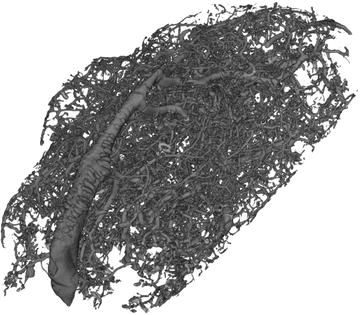
That’s the cartoon version — here’s a resin cast of the full circulatory network of the opisthosoma of Cupiennius. It blows me away that they were able to do this — Cupiennius is fairly large as spiders go, but still pretty tiny.

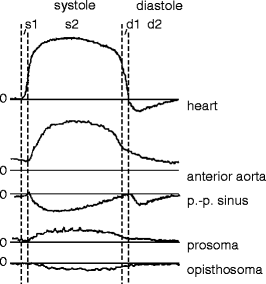
Even more impressively, people have measured the blood pressure in the spider circulatory system — no, not with an itty-bitty sphygmomanometer. I suspect they used optical methods to visualize pressure changes, but that’s a paper I haven’t tracked down yet.

Systole and diastole are still valid concepts in a spider. In case you were interested, their hearts beat at a rate of 9 to 125 beats per minute. That’s quite a range, but as I mentioned above, one of the challenges is a highly variable metabolic rate.

Ultimately, though, if you’re going to design an SF “spider”-like alien, you shouldn’t be constrained by the form and physiology of terrestrial spiders. A homeothermic creature with an endoskeleton, but with a bunch of limbs and eyes and a sclerotized cuticle, and maybe some funky spiky complex mouthparts, is going to look enough like a spider to Zapp Brannigan that that’s what he’s going to call it anyway.


Schmitz A (2016) Respiration in spiders (Araneae). Journal of Comparative Physiology B 186(4):403–415.

Wirkner CS, Huckstorf K (2013) The Circulatory System of Spiders. In: Nentwig W. (eds) Spider Ecophysiology. Springer, Berlin, Heidelberg.

Do not ever fake your data

That’s a rather fundamental lesson for scientists: do not take shortcuts with the data. It completely corrupts all your conclusions, makes your entire history suspect, and will get you fired.

A tenured biology professor at the University of Illinois at Urbana-Champaign was fired Friday, a rare punishment that essentially means a career death sentence in higher education and that has happened only once before at the state’s flagship public university.

Fei Wang, an associate professor of cell and molecular biology, was terminated following a special meeting of university trustees Friday, concluding a yearslong review of his work. Board members determined that Wang had fabricated and falsified scientific data in grant applications to the National Institutes of Health and the National Science Foundation.

You will also get zero sympathy from your colleagues.

“Prof. Wang is without question a highly intelligent, likable, and charismatic scientist,” trustees wrote in its report, released Friday. “However, the record supporting his fabrication of data and falsification of laboratory results, his submission of mouse cells rather than human cells in his data, his failure to mentor and supervise his students is overwhelming and beyond unacceptable. Prof. Wang’s misconduct has already required the university to return substantial sums of research funds to the federal government.”

He made them return grant money? He just lost any friends he might have had in the administration.