Will scientists be smarter than atheists?

Once upon a time, a small group of atheists declared that not believing in gods was not enough — that atheists should also stand up for justice, fight for equality, and oppose the fascist tendencies that were even then becoming apparent in government. They decided to set themselves apart and call their movement Atheism+, and the goal was to organize people to do more than promote the separation of church and state, but also to oppose sexism and racism.

They didn’t last long. The howls of opposition were prolonged and vicious…how dare anyone proclaim that, as atheists, they had wider, deeper interests? They were harassed out of existence. The knives came out, and the regressive, tribal atheists launched constant hate campaigns that linger on today. I still get frequently accused of being the wicked instigator of this perfidious attempt to organize SJWs who were also atheists (I wasn’t, but the idea that it was women who actually did the work was unthinkable, so I have been promoted to Atheism+ General). If you look in some places, especially YouTube, you find instead that anti-feminist jackholes rule the roost, and they do so by specifically ridiculing anyone who believes in the equality of women and minorities.

I wish Chanda Prescod-Weinstein, Sarah Tuttle, and Joseph Osmundson luck with their manifesto, We Are The Scientists Against A Fascist Government.

Science, even just within the United States, is an international enterprise; it’s an intricate multinational dialogue and financial ecosystem. The scientific community in America contains — indeed relies on — immigrants from countries around the world. We recognize that there are hierarchies of power — as with every other facet of society — within the scientific community. We must stand with those at the greatest risk, including people of color, women/gender minorities, immigrants, and those at the intersections of these identities. Attacks on those at the margins — both within and without the scientific community — are attacks on human knowledge, on the very advancement of our society.

They are attacks on all of us.

As scientists, we cannot accept this new status quo. While we are deeply concerned about what the future holds for scientists — especially scientists from traditionally-excluded communities — we are also concerned about the impact of the administration’s agenda on the broader U.S. population, the global population, and our planet’s entire ecology. We understand in this context that it might seem simpler for scientists — especially those from backgrounds that have been more readily welcomed into the scientific community — to “reach across the aisle” and work with the new administration.

But we believe it is imperative that scientists pause and consider the profound implications of this proposal.

They’re aware of the pushback they’re going to get, and have already received.

Already we have heard our scientific colleagues murmur about trying to keep our work and ourselves “apolitical.” We even saw an early, now-retracted statement from the American Physical Society (APS) that sought to capitalize on Trump’s racist dog-whistle slogan “Make America Great Again.” While APS eventually recanted their statement, we understand that it reflects a deeply flawed, but broadly held belief among scientists that bipartisanship is always the answer, even if that means power-sharing with an administration that intends to cause financial and physical harm to vulnerable members of society — many of whom are scientists, the very people doing the work they claim to want to protect.

We have also heard private rumblings about what type of scientific funding might be spared in Trump’s America: Climate change will go, but cancer research must be safe. Even if they come for cancer research, particle physics merits an independent defense. Max Planck, for example, similarly argued that Jewish theoretical physicists were different from other kinds of Jews, in an attempt to spare Jewish scientists’ lives. As we know, this protective presumption was swiftly disproved by the Holocaust, which targeted the already marginalized Roma and most widely known, European Jews.

Science has never been apolitical. The only people who claim it is are the privileged ones who benefit from the status quo.

They have a list of action items so there are things scientists can do. At the very least, sign up for the cause. This is important, every level of society must mobilize to oppose the Republican dystopia, and scientists don’t get to hide behind that cowardly ‘apolitical’ canard.

Be better than the atheists have been.

‘Watson Decoded’ didn’t do much decoding

That PBS documentary on James Watson wasn’t half bad, if you are able to abide a deep dive into the life of a man with almost Trumpian levels of self-delusion (but unlike Trump, with an actual germ of intelligence). The theme of the show, I would say, is that Watson is a man who says what he thinks, so they just let him speak.

So what does James Watson think?

He’s a scientific genius. Rosalind Franklin was an incompetent. DNA is a more important idea in biology than evolution. He’s smarter than Darwin. You are determined by your genes. No one has ever shown any evidence that environment plays a more significant role than genetics. Black people are less intelligent than white people. He regrets having to say that, but you have to speak the truth. He has black friends. He liked to surround himself with pretty girls in the lab. The stuff he said about how everyone knows black employees are inferior was said in a private conversation, and how dare that reporter publish it. His loyal wife argues that he’s not really a racist, because racists say mean things with the intent to make others miserable. Watson’s ego is immense.

I also learned a few things I didn’t know before.

His wife was an 18 year old undergraduate 20 years his junior, working in his office, when he started courting her (this would be considered a serious ethical problem now, but as we are reminded several times, the old boy network was strong.) I’ve met his wife, she was very nice, but seemed a bit frazzled by her efforts to moderate Watson’s comments when they veered off into apologetics for eugenics, as they seemed to do. He has a son with serious mental health issues and a history of behavioral problems…and Watson cared for and loved him very much, which was the one redeeming feature I took away from the show. He also has a lot of former students and colleagues who practically idolize him, but even they think he’s wrong in his genetics mania.

The way it portrayed Maurice Wilkins made him out to be a petty, spiteful little shit. How did Watson and Crick get Franklin’s crucial data? Because Wilkins was resentful of this woman working in his division, and just handed it over. Her data, not his. I guess you can get a Nobel prize for backstabbing.

There were some omissions. The program didn’t say much about his sexism — it shied away from giving any details of the objectionable lectures he was giving that led to his downfall. I would have used more quotes from The Double Helix. Those were his own words, he’s clearly proud of the book, but the way he demeaned Rosalind Franklin was blatant and deplorable. There’s a bit of that, but I would guess they were minimized because the details would have made the show too much of a hatchet job.

‘Watson Decoded’ was good journalism, just presenting the facts and letting Watson hang himself with his own words, but I worry about how some people will twist the facts. Here’s a SUPER-GENIUS who thinks BLACK GENES ARE INFERIOR, and rather than recognizing that he’s a flawed person with deep biases, as the program demonstrates, they’ll see it as a validation of racist ideas. But then, you can’t do much about people with willful, hateful prejudices, and they could have just put up a big black screen with blinking letters saying “HE’S WRONG” (as Nancy Hopkins plainly says), and those people would just ignore it anyway.

Spider update: I peeked

Just a little bit. I tore open a tiny corner of the one egg sac I have right now, and it looks like a batch of fine healthy eggs, and then I quickly folded the bit of sac over it and restored it to the incubator. I’ve been maintaining moderate humidity for it, and it seems to be working.

Otherwise, while I’ve been waiting for the spiders to reproduce, I’ve been cleaning up my lab fairly thoroughly. I threw out stuff from 15 years ago today, and the benchtops are looking tidy, and I washed a mass of dirty glassware. I’ll have to give everyone a video tour once I’m done. It’s been surprisingly pleasant doing mundane tasks around the lab space lately.

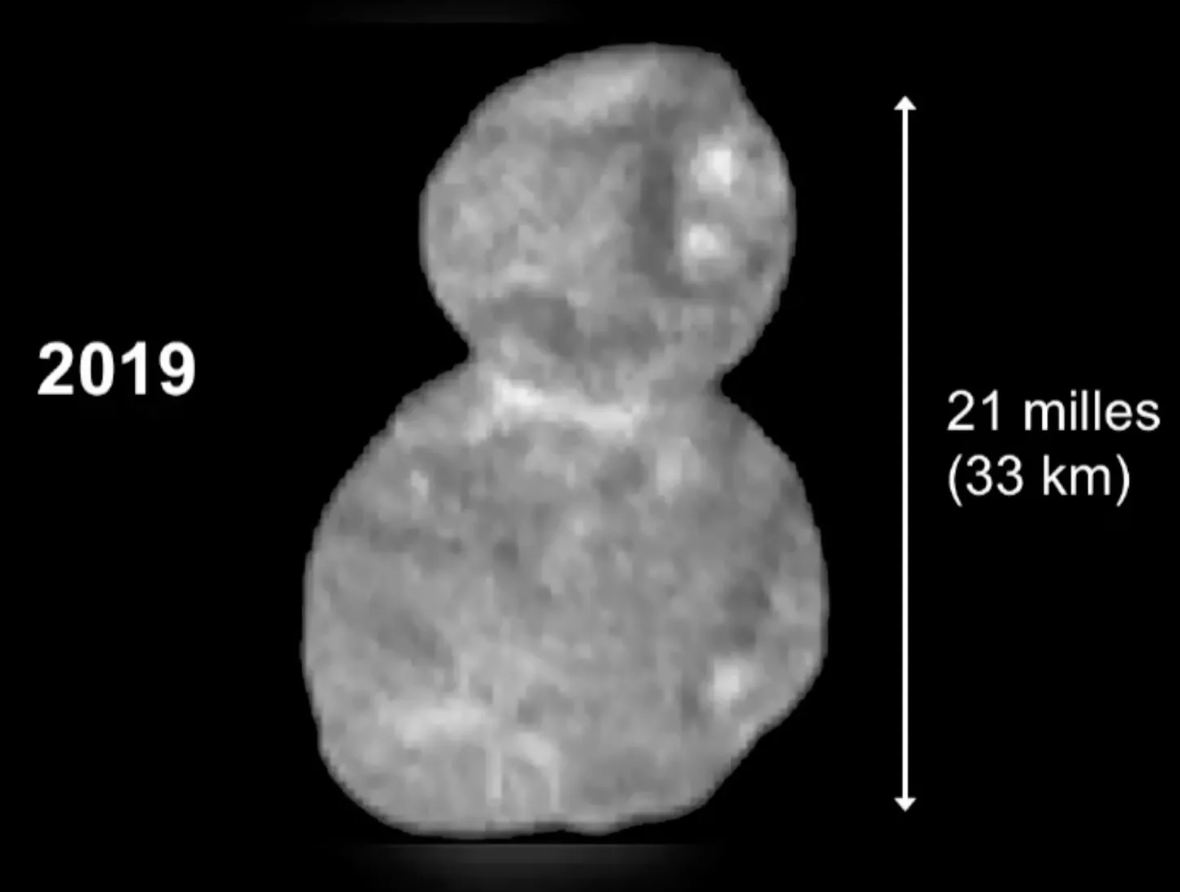
Odd rock 4.1 billion miles away

Another robot beyond the outer reaches of the solar system finds a funny-looking rock, and sends back pictures.

It zipped by at high speed and quickly gathered 50 gigabits of data, which is slowly trickling back to us — it’ll take two years to transmit the whole data set. I guess they’re still using AOL dialup out there in the Kuiper belt.

This rock is so distant and in such an empty part of interstellar space that we’ll have no reason and no opportunity to ever visit it again — so look while you can, this is probably the last time human beings will ever see it.

End-of-year spider report

Quick update, nothing exciting. The colony has been cleaned up and fed, I’ve got an egg case made on 27 December that I am not touching at all, other than to move it to chamber that I’m maintaining at a constant temperature and moderate humidity. With any luck, I’ll have spiderlings by the end of the week.

I’m still hanging on tenterhooks, though. I’m down to ONE (1) male, who gets rotated around to each of the vials (except to Vera’s — she’s a male-eater). I’m hoping a) he doesn’t get eaten, and b) I get a viable egg sac, otherwise I’m not going to have any embryos until the weather warms up and I can find new spiders around town. To get a sustainable colony, I’m thinking I have to get up to around 50ish adults, which is easily doable.

End of a project

I am now committed. This morning, I got to work and started dismantling my jerry-built zebrafish facility. It was built to last, with annoying bolts everywhere, some of them quite high up on the structure, and now I can’t feel my right shoulder after all the wrench work above my head. We got the bulk of it disassembled and removed, and all that’s left right now is a lot of PVC plumbing suspended from the ceiling and going nowhere, with a huge cattle trough (the water reservoir) and a big ol’ water pump. That’ll go tomorrow, clearing up a whole bunch of bench space, which I think will be home to a new, additional incubator.

Now I need to figure out what to do with the stuff. Mary might use some of it to set up a herb garden in our sun room — it’s a lot of shelving and shallow trays. There is also a great deal of hydroponic gear I used to deliver recycled water to the tanks, and she got a glint in her eye and dreamt of a hydroponic drip system for plants…which may be overly ambitious.

But there’s no going back now. I’m going to be running an arthropod lab, rather than a fish lab, which is a bit of a change. I’m still young enough to change my research focus, right? Although not young enough to do serious physical labor without feeling like I overtaxed every muscle in my upper body.

Not a good day

The current spider egg case I was hoping to see hatch out with a new generation of spiders isn’t looking so good. I opened it up to find way too many dead eggs, and then made a time lapse to see babies just fading away. It’s sad and miserable. I’m putting it here to document my dismal Christmas eve.

I’m gonna have to cancel Christmas. There is no reason for anyone to celebrate.

Why does Santa come down the chimney?

To look for spiders, of course. Mary and I were getting into the spirit of the season and were surveying the area for spiders this morning. We were heartened by the fact that she discovered a salticid in our house — I’d given up on looking, assuming that no self-respecting spider would be out and about in late December in Minnesota, but there it was. So we donned our headgear and started scrutinizing window frames and dusty corners, and we also trooped over to the science building on campus and checked out the hallways and the basement.

Mary caught me in dynamic action pose, staring at cobwebs.

Unfortunately, the spider population was sparse or in deep hiding. We found another salticid in my office, and the husks of a few dead pholcids (lots of pholcids thriving in our basement, though), but no Theridiidae. There were also a few abandoned funnel webs outside. One problem is that the university custodial staff do a really thorough job of demolishing cobwebs and making an inhospitable environment for spiders…and I don’t think there are very many insects to eat there, except maybe in relatively unreachable places, like crawlspaces.

It’s also cold outside. I’ll be interested to see how the population changes in the Spring.

Calf Bug-ropin’ with Cowboy Vera, Spider-style

I was bragging about Vera’s great skill in capturing multiple prey in minutes, so I thought I’d show you. Basically, whenever I put live flies in the spider’s vial (I feed her 3 times a week), she is off like a shot, immediately charging in to snare them.

She reminds me a lot of my cat that way.

It was tricky keeping her in frame and in focus, but I think you’ll get an idea of how spiders use their webbing to immobilize prey.

Also, I’m going to start doing everything “spider-style”.

[Read more…]