Every year, I have to teach students about how to properly chart data. I’ll have to use this as an example of how to do it badly.
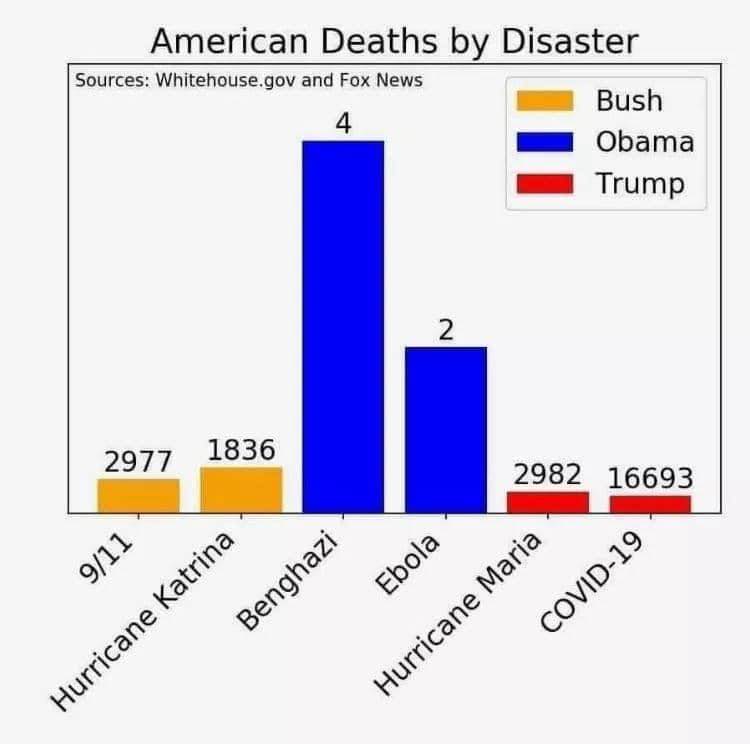
(I know, this isn’t literally put out by the White House, it’s mocking the Republican downplaying of COVID-19 deaths.)

Every year, I have to teach students about how to properly chart data. I’ll have to use this as an example of how to do it badly.
(I know, this isn’t literally put out by the White House, it’s mocking the Republican downplaying of COVID-19 deaths.)

It would be recognized by all recipients as a sign that the subject was radioactive.
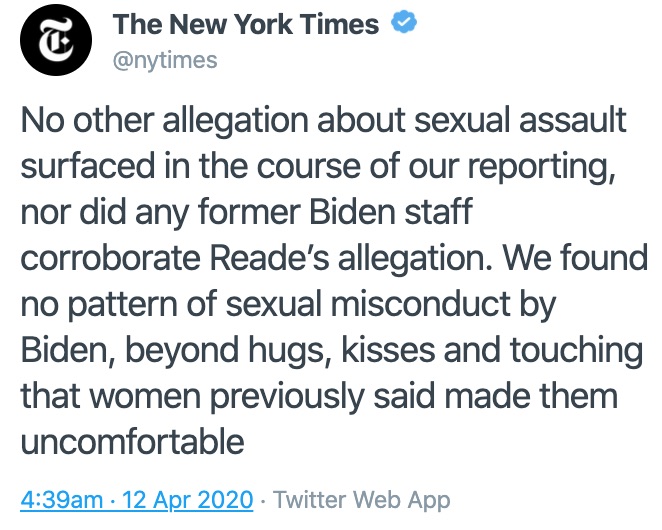
Thanks for the information, New York Times!

It’s hard to believe, but it’s a valid question. Tyler Cowen demonstrates his arrogance by questioning the validity of epidemiology, and he asks a series of stupid questions that show how little thought he has put into the subject.
a. As a class of scientists, how much are epidemiologists paid? Is good or bad news better for their salaries?
You know, there’s this thing called “Google” which economists apparently haven’t heard about yet. If you look it up, it turns out that epidemiologists work in public health — which should already tell you they don’t get absurdly rich at this job — and they make on average about $69K per year. I would ask what the point of the question is. Does their salary say something about the accuracy of their conclusions? Because, near as I can tell, salaries under capitalism have nothing to do with intellectual rigor.
The employment of epidemiologists is not contingent on whether their results are good news or bad news, but on the quality and accuracy of their work. Why? Is it different for economists?
b. How smart are they? What are their average GRE scores?
Holy shit. Cowen reveals his own ignorant biases there.
Epidemiology requires solid skills in statistics and biology, neither of which are exactly easy-peasy topics. Their GRE scores were good enough to get them into demanding academic programs. There aren’t any shortcuts.
c. Are they hired into thick, liquid academic and institutional markets? And how meritocratic are those markets?
“Thick, liquid”? That sounds like economics jargon. I have no idea what he’s talking about, and I won’t pretend to know, unlike some.
I can say that academia is only loosely meritocratic. There are a lot of built-in cultural biases that mean we get some incompetent people, and some brilliant people get excluded. The question ought to be whether epidemiology is more or less meritocratic than economics. The evidence here says “more”.
d. What is their overall track record on predictions, whether before or during this crisis?
Crack an epidemiology textbook. There are a lot of variables and a lot of case studies. Unlike in economics, failed models tend to be rapidly discarded.
e. On average, what is the political orientation of epidemiologists? And compared to other academics? Which social welfare function do they use when they make non-trivial recommendations?
Fuck me. Like most educated academics, they probably skew liberal and Democratic. Their recommendations favor maximizing public health and minimizing death and illness. That’s their job. Economists seem to be much more twisted by flaky ideological concerns.
He has more questions, but I’ve had enough. What a chuzzlewit.


I agree with Rebecca. She’s voting for Biden because he’s somewhat better than Trump, but does not think that imposes an obligation on others to do likewise.
I’m making no predictions on the outcome of the November election. I know people are apathetic about voting at all, and are going to skip the election because they cannot bear to vote for a man who sexually assaults women, and that might depress Democratic turnout. On the other hand, Trump is such an egregious incompetent that maybe we could nominate an old stick and it would win. On the next hand over, on the basis of incompetence Trump should have been crushed in the last election; right now he’s busy fanning the flames of fear and xenophobia, and his party is engaging in widespread voter suppression, so maybe he’ll win. The president is not the product of a process that optimizes for the best person to do the job at all.
I don’t know what other people will do. My plan is to unenthusiastically vote for whoever runs against Trump, to hope they make a smart choice for the VP, and to hope Biden is at best a one-term president.

He’s never more stupid than when he pretends to be smart.
TRUMP: "The germ has gotten so brilliant that the antibiotic can't keep up with it … there's a whole genius to it … not only is it hidden, but it's very smart." pic.twitter.com/oXhF2IIBYB
— Aaron Rupar (@atrupar) April 10, 2020
He thinks he’s got a “natural ability” at science. Jesus fucking christ.


David Frum is a conservative Republican, a neo-conservative cheerleader who supported George W. Bush’s disastrous war in Iraq and the Israeli occupation of Palestine, who was an apologist for Sarah Palin, worked for Rudy Giulani’s short-lived presidential campaign, etc., etc., etc. He’s a deep Republican insider, although in recent years he has been rather unhappy with the radical turn towards idiocy that he’s observed in the party.
So maybe, you think, Republicans will pay attention to Frum’s agonizingly detailed chronicling of all of Trump’s failures? Maybe? Liberals have been saying the same sorts of things about Trump for years, and they’ve all failed to penetrate, so can we dare to dream that an arch-conservative pointing out the same issues might finally get through?
Nah, we still have meatheads like Joe Rogan favoring Trump. Fox News is still making excuses for him. Ron Paul thinks Fauci should be fired for disagreeing with Trump. Rush Limbaugh thinks the coronavirus pandemic is all hype.
Frum came up with the phrase “axis of evil” to label Iran, Iraq, and North Korea. Maybe he would have been better off using it on evangelicals, billionaires, war profiteers, the Tea Party, Fox News, Wall Street, and other enemies of the people right here at home. They’ve already got an ill-gotten conclusion about the right way to run the country, and they aren’t going to change it because of piddly little annoyances like the facts, or even tens of thousands of dead. The hundreds of thousands of dead in Iraq had no effect on Frum’s views, after all.

Bernie Sanders is dropping out of the race.
Meanwhile, Paul Broun is running for the senate.
How to try to win election by stoking fear amid the COVID-19 crisis:
Former Georgia Rep. Paul Broun who is running to return to Congress just released an ad warning that “in uncertain times like these,” it’s important to protect yourself against “looting hordes from Atlanta” pic.twitter.com/bqS4rePrmP
— Marcus Baram (@mbaram) April 7, 2020
This country is so fucked.

This is Wisconsin state representative Robin Vos, who voted to keep the churches open on Easter, whose party worked to demand an election be held today.

He showed up to vote in all of that protective gear.
Robin Vos is a chickenshit Republican. Let’s see that photo making the rounds when he’s up for re-election.

I’m so sorry, neighbors to the east, but despite sensible orders to avoid congregating in groups, and despite the rising death toll of the COVID-19 pandemic, the Wisconsin and US supreme courts have decided that today’s election will proceed, and that you’ll have to congregate and risk exposure to a potentially deadly illness if you want to (checks notes) vote in a democracy.
- The Supreme Court voted 5-4 on Monday to reverse an order extending the absentee ballot deadline for voting in the Wisconsin elections scheduled for Tuesday, stepping into a back-and-forth between Democrats and Republicans in the state over when voting would take place.
- Gov. Tony Evers, a Democrat, signed an executive order suspending in-person voting in the state earlier on Monday after trying and failing to convince the GOP-dominated state legislature to postpone elections until May. His order was blocked by the Wisconsin Supreme Court in the evening.
The top court, in an unsigned opinion from which the four liberal justices dissented, reasoned that extending the date by which voters could mail absentee ballots “fundamentally alters the nature of the election.”
Some voters had taken advantage of the absentee ballot extension to vote by mail; those ballots will be destroyed, which is a perfect metaphor for how Republicans want to hold elections in the future. In an ideal Republican world, you’d all get to vote, but the electronic voting machines will, ummm, ‘translate’ what you selected into a ‘better’ decision, and if you use paper ballots, as we do in Minnesota, you’ll feed your ballots into a paper shredder rather than a tabulating machine.
Make no mistake, either: all of these decisions were made by conservative wankadoodles in our supposedly impartial, non-partisan judiciary. These actions are clearly and unambiguously the result of Republican corruption of the system.
I do appreciate the irony of a court decision ruling that enabling and encouraging more voter participation “fundamentally alters the nature of the election.” That’s not the American way!
Further irony: The Wisconsin Supreme Court met virtually to make this decision, because it wasn’t safe for them to meet physically. But they decided you peons must meet at the polling place to vote.