What will I do if a virus closes my classes?

Yikes. I just read this comment about the coronavirus shut down in Poland — 22 cases in the whole country, so all university classes are suspended for the next month. That’s taking the issue seriously and taking major steps to slow the spread of the disease.

At my university, it’s only provosts and deans and chancellors and department heads talking about contingency plans, with no imminent threat of a shut down. But it could happen! With the number of cases doubling every week, I might come back from Spring Break to find my students have been ordered to stay away. I’ve scribbled up a quick contingency plan for my genetics course, just in case.

Contingency plan for Genetics (Biol 4312)

Genetics is an unusual lab course in that it already doesn’t fit the mold of the weekly intensive lab session. We’re working with Drosophila, and are at the mercy of their 9 day reproductive cycle, so we have to be more flexible. Typically, we meet for a half hour to an hour at the scheduled lab time, during which I explain the steps that the students need to take that week. The students need to come in frequently during the course of that week to maintain their flies, set up crosses when they’re ready, and count phenotypes. Some weeks this is a light load, coming once or twice on their own time to check on flies; other weeks they may have to come in 3 or 4 times a day to collect flies for a cross; and on several occasions they have to come in for long sessions of fly screening. The variability and flexibility suggest one fairly non-disruptive way to protect students.

Staggered, scheduled lab times. To minimize exposure, I could set up specific, individual lab times for each student. Right now, it’s a free-for-all with students doing their work whenever they can, but we could switch to exclusive lab sessions for each. So far this semester we have completed one whole experiment involving 3 different crosses, so students are familiar with the details of the methods, and they are experienced enough to not need direct instruction from me; I could manage with an explicit set of detailed instructions on Canvas for the steps in the next experiment.

They would still be using a shared lab facility, so we’d couple this scheduling with instructions on using sanitizers and sterilizing lab benches with alcohol between students.

In a worst case scenario, in which the university is shut down, another alternative is:

Drosophila genetics kits. I could assemble a kit with two fly stocks, a half dozen fly bottles, a small supply of medium, some anesthetic, and a hand lens for each student or pair of students. They could then carry out the whole experiment at home, again with detailed week-by-week instructions on Canvas. Data would be shared between students online.

Potential problems: Lack of an incubator would mean developmental rates might vary significantly. A hand lens is going to make it harder for students to score phenotypes. Currently, if one student’s cross fails, they can share specimens with other students and complete the experiment; in isolation, if one cross fails, they’ll be unable to finish. The final assays are somewhat labor intensive, alleviated by the fact that a group can share the load of counting thousands of flies.

Please note that these alternatives are only feasible because the students have completed an experiment with multiple crosses in the first half of the semester, with direct instruction and demonstration from me on how to set up a cross, how to maintain flies, and how to analyze phenotypes. The second half of the semester is repeating these same methods with a very different kind of cross and different mutant phenotypes. These stop-gap procedures would not be applicable to teaching a full semester lab course in fly genetics.

Setting up staggered lab times looks like wishful thinking now, if entire countries are locking out universities in the face of the threat. I might have to spend my spring break boxing up flies and media for distribution.

Aw, jeez. South Dakota has COVID-19?

It’s cutting close to home now. South Dakota has reported FIVE putative cases of COVID-19 with one death scattered across the state, among people who had no contact with each other.

It’s entirely possible that this is a case of paranoia and misdiagnosis, since adequate testing kits have not been available, despite the fact that Trump officials keep saying it is contained. We can’t know. That’s a big part of the problem, that when science denialists are running the government they interfere with getting good information and allowing us to manage a disease effectively.

Here’s Richard Lenski’s take on the situation.

The news just came out that South Dakota — South Dakota! — has 5 presumptive cases of SARS-CoV-2 infections, including 1 death. South Dakota has lovely people and places, but it’s not exactly the center of the universe, or even of the midwest. It has ~885,000 people in total … roughly 0.3% of the US population. So a simple extrapolation to ~330 million people would imply something like 1,800 infections over the entire USA.

There’s good news and bad news. Good news: there weren’t 5 cases reported in North Dakota, which has an even lower proportion of the US population.

All the rest is bad news. We’re assuming all potential infections have been tested and discovered. We’re also looking in the rear-view mirror, time-wise. In most cases, it takes a few weeks for an infection to lead to death (when it does, which fortunately is not usually the case). Maybe a week or so to develop symptoms that would lead to someone being tested. So let’s call it a week. Well, this virus typically doubles in a week or so. So 1,800 infections a week ago (ones that have become symptomatic today) implies ~3,600 infections at present in the USA as a whole.

It’s personally worrisome, because Morris, where I live, is way out on the western edge of Minnesota, physically closer to South Dakota than we are to Minneapolis. Isolated rural communities aren’t supposed to be hotspots for pandemics, don’t you know — we leave that to the big city folks. Yet here we are, where we might have to deal with this at home.

We’ve received some concerned messages from the university administration, too. We’re supposed to develop a plan for how we’d complete lab courses if we go on lockdown, which isn’t exactly reassuring. I’ve been thinking about it, and have some less-than-satisfactory ideas about how I could wrap up the genetics course, and we’re supposed to have a meeting to discuss biology’s response tomorrow.

Our goal has to be to slow the spread of the disease to prevent medical services from being overwhelmed. Nobody is panicking — I’m already seeing conservatives mocking any response as panic — but taking necessary steps so that we don’t reach a situation that is unmanageable.

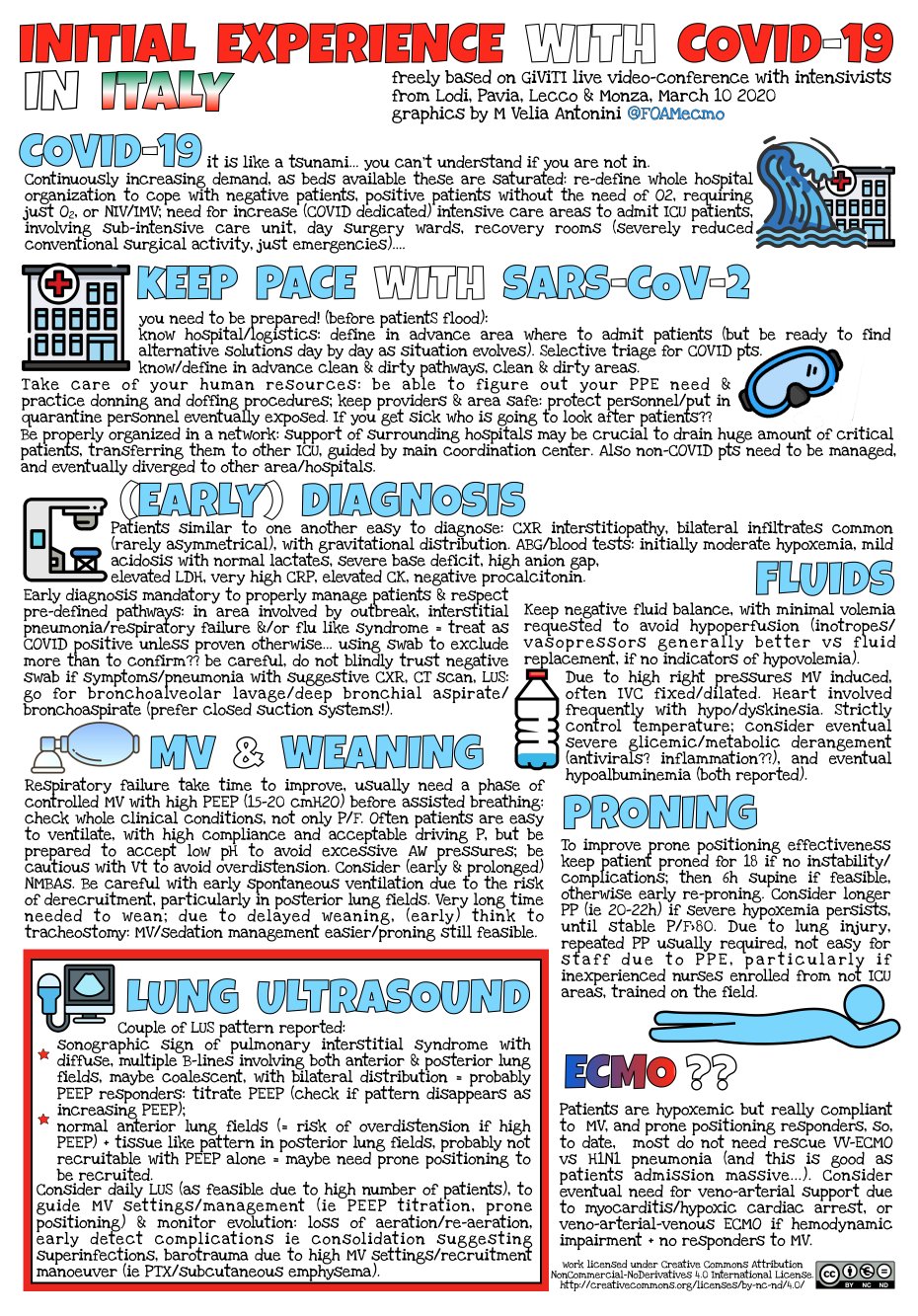
We already have examples we should be learning from, in China, in South Korea, in Italy. This rather cluttered infographic summarizes the lessons from Italy. It’s like a tsunami.

There’s a lot of medical jargon in that — I hope my local clinic is paying attention.

The dilemma: to fly or not to fly

My wife is currently in Longmont, Colorado. She is scheduled to fly back home in 10 days, which is the problem. Look at the ratfuckery our administration is up to with coronavirus recommendations. They just don’t care what the CDC says, and I trust the CDC far more than I do Trump/Pence.

The White House overruled health officials who wanted to recommend that elderly and physically fragile Americans be advised not to fly on commercial airlines because of the new coronavirus, a federal official told The Associated Press.

The Centers for Disease Control and Prevention submitted the plan as a way of trying to control the virus, but White House officials ordered the air travel recommendation be removed, said the official who had direct knowledge of the plan. Trump administration officials have since suggested certain people should consider not traveling, but have stopped short of the stronger guidance sought by the CDC.

So now Mary is considering not flying, and instead renting a car to drive back — it’s 800+ miles and 12 hours of driving. Yikes. I have concerns about that, too.

  • Maybe the CDC recommendations don’t apply to her. She’s a healthy, active 62 year old (yes, I’m a cradle-robber, and I’m not ashamed to admit it). Which also means she’s capable of the drive.
  • If she has to rent the car and return it to an airport, she’s still going to be exposed to all those diseased world travelers.
  • You may not have noticed, but this time of year has unpredictable weather. She could have to drive through a blizzard, an ice storm, or a flood.
  • She flew there, and could already be infected. She might turn into a zombie on the drive back.

I am not helped by the dithering of the incompetents in the White House. I am also not helped by the vague recommendations of the CDC; I don’t consider either of us to be elderly or physically fragile in our ability to respond to disease…although I mentioned that a high school acquaintance of ours just lost her husband to COVID-19, so maybe we are.

Indecision can have terrible consequences, and the Republicans have so thoroughly politicized what ought to be scientific decision-making that now I’m being indecisive.

Time to huddle alone in my man-cave

Now that COVID-19 cases have been reported in 28 states, I think we can say that efforts to confine it have failed. We have our first case here in Minnesota, a person returning from a trip on a cruise ship (Why do people do those cruises anymore, anyway? It’s like jumping into big bottle of culture medium and getting stirred around for a few weeks.) My university has sent out information to all faculty about what to do if cases arise — we’re referred to this Safe Campus website for updated info. Ironically, the email about this also says, “Our Emergency Management team—made up of individuals from across campus—is meeting weekly”. Well, that’s the problem, isn’t it? If someone on the team is infected, the whole damn lot of them will go down.

My wife is off in Colorado, and as it turns out went through the Denver airport at the same as an infected but asymptomatic traveler from Italy was walking among the oblivious herd. She’s coming back in about two weeks through the same mob of disease-ridden cattle. We old, frail people have been advised to avoid all social contact, which sounds like a fine idea to me — I’m a denizen of the internet, that’s where I do all my socializing — but I have a job that involves talking with lots of people all the time. Fortunately, I don’t touch students…but I do get piles of papers handed to me. Maybe this will motivate me to adopt all electronic submissions.

We’re also advised that, instead of crude handshakes, we should adopt the Vulcan greeting. I can do that. I’m all for it.

“Live long and prosper”

However, this recommendation rarely comes with the necessary warning: do not, I repeat, DO NOT ever greet someone with a Vulcan mind-meld. This is right out, even if it would be a great teaching technique.

“Do you actually…understand…epistatic interactions in genetics?”

I was planning on going out for a nice walk in town today, but I think I’ve just talked myself into sitting at home alone.

The bad news will keep on coming

A diagram putting the danger of infection with COVID-19 in perspective:

Not shown is the human cost. Deaths from the coronavirus in Washington state have crept up to 6. All of them were people over 70; the death rate for the afflicted over that age is 15%. The virus isn’t done yet, either.

“We expect the number of cases to increase in the coming days and weeks,” said Jeff Duchin, health officer for the public health agency, who stressed that most cases will be mild. “We are taking this situation extremely seriously.”

Uh-oh. My mother lives in King County, and she is over 70. I hope she’ll take this as an excuse to quarantine herself and stay home for a while.

When did you last wash your hands?

John Oliver has some sensible advice.

As for my handwashing…all day long. I work with students every day all day (who I avoid touching, obviously), so I tend to wash my hands thoroughly about once an hour, or before and after I go to class. Not just for coronavirus, but because they’re filthy animals and disease vectors for all kinds of crap…and I have the potential to transfer diseases to a diverse lot of people who wouldn’t normally hang out together but are forced into my classrooms for those sweet, sweet credits.

Spiders are far less infectious than other humans, you know.

I’m not panicking over the coronavirus

It has the potential to be a serious pandemic, but with a strong medical infrastructure, robust public health response, and a sensible, informed public, we can minimize…wait. What the heck…PANIC! Not over the virus, but over the ongoing dismantling of those very things vital to keep the citizenry as safe as possible.

Trump is making massive cuts in biomedical research.

Multiple organizations expressed shock and disappointment at Trump’s budget proposal, which adds $54 billion in defense spending but would slash nearly $6 billion from the National Institutes of Health, which funds most basic medical research in the country, as well as eliminate entirely dozens of other agencies and programs.

It would cut the overall Health and Human Services department budget by 18 percent, including the 20 percent budget reduction at NIH, and reassign money from the Centers for Disease Control and Prevention to states.

In response to concerns that we might not have enough doctors if a crisis arises, he has said that we’d just hire more doctors in that case. Doctors are not fungible. They require years of training, and their expertise requires constant maintenance.

Trump seems to think creating a task force and appointing a “czar” is a smart response. We already have experts in infectious disease at the NIH and CDC…you know, those agencies he is defunding. Appointing an ignoramus like Mike Pence, who has no qualification and has a history of botched public health management does not inspire confidence. Nor does having Ken Cuccinelli, Steven Mnuchin, and Larry Kudlow on the task force.

Also, this:

As for our informed public, Corona, the Mexican beer, has taken a substantial hit to their revenues because people are associating it with the virus.

Please note that the beer and the virus have nothing to do with each other.

We’re gonna die.

When leadership matters

There are legitimate fears of a coronavirus pandemic — don’t panic, it’s an emerging threat, not a full blown emergency — and that’s when it’s a good idea to prepare. We should have a strong medical infrastructure, plans in place, people organizing now, just in case. In the US, however, our plan to respond to potential medical threats is a shambles.

For the United States, the answers are especially worrying because the government has intentionally rendered itself incapable. In 2018, the Trump administration fired the government’s entire pandemic response chain of command, including the White House management infrastructure. In numerous phone calls and emails with key agencies across the U.S. government, the only consistent response I encountered was distressed confusion. If the United States still has a clear chain of command for pandemic response, the White House urgently needs to clarify what it is—not just for the public but for the government itself, which largely finds itself in the dark.

Who is to blame for the chaos? It seems Obama had a thorough, if flawed, response team in place. One man and one party have been actively working to dismantle the entire system.

In the spring of 2018, the White House pushed Congress to cut funding for Obama-era disease security programs, proposing to eliminate $252 million in previously committed resources for rebuilding health systems in Ebola-ravaged Liberia, Sierra Leone, and Guinea. Under fire from both sides of the aisle, President Donald Trump dropped the proposal to eliminate Ebola funds a month later. But other White House efforts included reducing $15 billion in national health spending and cutting the global disease-fighting operational budgets of the CDC, NSC, DHS, and HHS. And the government’s $30 million Complex Crises Fund was eliminated.

In May 2018, Trump ordered the NSC’s entire global health security unit shut down, calling for reassignment of Rear Adm. Timothy Ziemer and dissolution of his team inside the agency. The month before, then-White House National Security Advisor John Bolton pressured Ziemer’s DHS counterpart, Tom Bossert, to resign along with his team. Neither the NSC nor DHS epidemic teams have been replaced. The global health section of the CDC was so drastically cut in 2018 that much of its staff was laid off and the number of countries it was working in was reduced from 49 to merely 10. Meanwhile, throughout 2018, the U.S. Agency for International Development and its director, Mark Green, came repeatedly under fire from both the White House and Secretary of State Mike Pompeo. And though Congress has so far managed to block Trump administration plans to cut the U.S. Public Health Service Commissioned Corps by 40 percent, the disease-fighting cadres have steadily eroded as retiring officers go unreplaced.

But here’s what worries me most: the systemic incentive to continue to wreck what system we have. There is no price the Republicans will have to pay. People will die, the country could be thoroughly disrupted, and the demagogues will just blame it all on the Democrats, or the Chinese, or Islamic terrorists, or filthy disease-ridden immigrants, and people will want to believe them, and everything will just get worse. In fact, catastrophe will strengthen their grip on the country.

Heckuva job, Trumpy.