
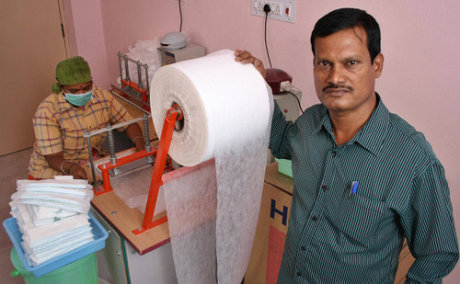
Sometimes those are good descriptors. I read a happy story for a change this morning: it’s about Arunachalam Muruganantham, an Indian man who embarked on a long crusade to make…sanitary napkins. Perhaps you laugh. Perhaps you get a little cranky at a guy who rushes in to meddle in women’s concerns. And there’s some good reason to feel that way: he starts out with embarrassing levels of ignorance.
He fashioned a sanitary pad out of cotton and gave it to Shanthi [his wife], demanding immediate feedback. She said he’d have to wait for some time – only then did he realise that periods were monthly. “I can’t wait a month for each feedback, it’ll take two decades!” He needed more volunteers.
And then a man who didn’t realize until then that menstrual periods were monthly dedicated himself to years of tinkering and testing to build a machine to manufacture sanitary napkins, which just sounds perversely fanatical and obsessive. But it turns out to be a serious problem for poor women.
Women who do use cloths are often too embarrassed to dry them in the sun, which means they don’t get disinfected. Approximately 70% of all reproductive diseases in India are caused by poor menstrual hygiene – it can also affect maternal mortality.
So Muruganantham set out to teach himself everything about making napkins, and examining and testing used menstrual pads. His wife left him. He was regarded as a sick pariah in his town — the disgusting guy who plays with menstrual blood. He was going up against traditional taboos and public squeamishness.
But he succeeded! He designed and built simple machines that take cotton and cellulose at one end and churn out disposable sanitary napkins — and it was relatively cheap, easy to maintain, and could be distributed to rural India where the women themselves could make the necessaries. And then we learn about his philosophy…
Muruganantham seemed set for fame and fortune, but he was not interested in profit. “Imagine, I got patent rights to the only machine in the world to make low-cost sanitary napkins – a hot-cake product,” he says. “Anyone with an MBA would immediately accumulate the maximum money. But I did not want to. Why? Because from childhood I know no human being died because of poverty – everything happens because of ignorance.”
He believes that big business is parasitic, like a mosquito, whereas he prefers the lighter touch, like that of a butterfly. “A butterfly can suck honey from the flower without damaging it,” he says.
Oh my god, an idealist. I thought they were all extinct! And such a fine beautiful specimen, too! I’m going to steal that metaphor, as well, just because it is so lovely.
Most of Muruganantham’s clients are NGOs and women’s self-help groups. A manual machine costs around 75,000 Indian rupees (£723) – a semi-automated machine costs more. Each machine converts 3,000 women to pads, and provides employment for 10 women. They can produce 200-250 pads a day which sell for an average of about 2.5 rupees (£0.025) each.
Women choose their own brand-name for their range of sanitary pads, so there is no over-arching brand – it is “by the women, for the women, and to the women”.
And my heart grew two sizes that day.


