Your state’s report card

The Fordham Institute has released their annual evaluation of state science standards. They are very tough graders — Minnesota got a “C”. Ack! Mom & Dad are going to be pissed, how will we ever get into a good college at this rate?

The Institute does a fairly thorough breakdown, so there are some bright spots: Minnesota is doing a good job in the life sciences, but where we got dinged hard was on the physical sciences, which are “illogically organized” and contain factual errors. Here’s the introduction to their evaluation of our life sciences standards:

Important life science content is presented quite minimally, but the flow and logic are such as to convey an understanding of the concepts rather than coming across as a list of topics to check off. The inclusion of examples from Kindergarten through eighth grade helps to further explain what students should know and be able to do.

Minimal is OK, as far as I’m concerned; it think it’s more important to get across a solid conceptual understanding. Of course, given that some teachers do a very poor job of getting those concepts across, more specific guidelines might be useful.

What’s really awful about our C, though, is that that’s the same grade Texas got. Oh, the ignominy!

I think we got robbed, though. The detailed breakdown says that a major problem is inconsistency: some bits of the Texas standards are stellar, others are terrible; different grade levels get variable quality of coverage. Texas gets slammed for life science standards that are “woefully imbalanced, with poorly developed material in the early grades and strong, sometimes excellent, content in the upper levels.” The major flaws are entirely predictable.

Perhaps the biggest problem with the middle school standards, however, is their coverage of evolution. For instance, the seventh-grade standards mention the Galapagos finches, giving the impression that the Darwinian paradigm is being presented. Unfortunately, it is not. Instead, the example of the finch Geospiza fortis apparently refers to studies by Peter and Rosemary Grant on beak size in this species, made widely known by Jonathan Weiner’s Pulitzer Prize-winning book, The Beak of the Finch. Creationists often distort these important findings to argue that Darwinian macroevolution does not occur—instead, microevolution does. In addition, the word “evolution” is never used in any of the middle school standards, and the term “natural selection” is never explained.

What’s really telling, though, is the reactions. I just told you I’m disappointed with Minnesota’s “C”; we can do better, and I hope the next round of standards will improve ours to an “A”. In Texas, creationist kook Don McLeroy was happy with his “C”.

McLeroy told the Texas Independent he is “very pleased” with the study and believes it only serves to validate the role he and the conservative bloc played in crafting the standards.

“The work of religious conservatives has been vindicated,” he said, pointing to the report’s positive review of high school evolution standards. When asked about the poor evaluation of middle school standards, McLeroy said blame could fall on the writing teams and review committees and/or the whole board who could have stepped up to improve them. “In the end, what we wrote was legitimate, sound science and the study proves it.”

That is so completely backwards. The weaknesses in the standards are the direct result of the meddling corruption of science pushed by the religious conservatives on the board; everything the Fordham Institute said was bad about their standards were the points the creationists pushed. The strengths are the product of the motivated, hard-working scientists and educators who fought against the religious conservatives. McLeroy can take credit for that “C” in the sense that it could have been an “A” if he and his fellow travellers in superstition had been kicked out of the process…and that’s nothing to be proud of.

(Also on Sb)

Why I am an atheist – SP

I’m an atheist for all the standard reasons of logic and evidence that others have already articulated, but I’m also an atheist because of a feeling that religious belief can blunt one’s sense of wonder. As a child, the things that struck me as most beautiful and awe inspiring appeared to be off religion’s radar screen. Where were the giant sequoias in the bible? The Grand Canyon and the other National Parks? Bears? I would have been a sucker for religion had my parents been Mormons or animists. My grandmother showed me a 3-D postcard of Christ wearing a bloody crown of thorns. My mom didn’t like this, so grandma revealed the postcard as if it was pornography, something hidden and very special. I didn’t get it. Jesus would blink his eyes open and shut as you tilted the postcard. This freaked me out a little; normal kids prefer live people to dying ones. Even as a five year old, I can remember being revolted at the cruelty of a doctrine that had no place in heaven for cats and even considered the question ridiculous. Richard Dawkins called religion a crime against childhood. That resonates with me, although I grew up without much distortion from religious education.

I married a lapsed but still religious Catholic. (We all have criteria, and I drew the line at Republicans or smokers.) Charles Darwin is a bit of a role model for me in terms of reconciling my total lack of faith with my dear wife’s residual attachment to her religion. He lost his faith, but loved his wife enough to support and accept that she retained hers. Anyway, like Darwin, one of the crosses I bear is occasional attendance at church. Last Easter, the priest was talking about the miracle of the resurrection. My usual Church-service meditation on the history and sociology of the Hellenistic world wasn’t doing it for me. I actually listened to the priest, and I was getting pissed off. Torture is not some abstraction. It is a grotesque crime with nothing redeeming about it, and real people suffer their entire lives from having been tortured. The Father tortured the Son to death and then resurrected Him to free us from sin? That’s obscene. What kind of manipulative organization would glorify it? And why would anyone pick an event like this as the foundation to build some elaborate theological structure and claim that it reflects something fundamental about the universe?

Just when I thought I could stand no more, a warbler appeared outside the window, gleaning insects off of the forsythia bush. Call it a miracle: A bird weighing less than the change in my pocket flew from Colombia en route to Canada. It makes this journey twice each year, and it can do this for a decade. Here was something of tremendous beauty, real and tangible and available to anyone with curiosity. The priest would probably offer some Hallmark sentiment about God’s love for all of His creations, at least until they fly into windows, or toss off a phrase about the beauty of God’s creation that has the effect of stifling inquiry more than encouraging it. To be fair, the Catholic Church accepts evolution and there are Jesuits who have a pretty solid understanding of biology. But even they would insist on Easter Sunday that the defining event in all time was the brutalization of a man during the expansion phase of the Roman Empire.

I don’t get it. I’ve never heard a believable rationale for separating religion and science, and the whole progression of science pretty much proves we’re not the center of the universe. This warbler seemed like a small but welcome messenger from the vast and impersonal universe outside the church. The mysteries of the resurrection and the volumes of theological speculation built upon it seem like weak tea, pale and downright unimaginative compared to the remarkable fact that this warbler and I share the same basic architecture and chemistry, that the warbler has even more in common with the tyrannosaurus down at the Field Museum, that a creature so small uses the stars to navigate, or any of the millions of other things that can be known or asked about both human and bird. The church has nothing emotionally or intellectually satisfying to say about the terrifying vastness of time and chance that created me, the world’s most easily-entertained mammal, or the warbler I was observing. I am an atheist because the universe is unexpected and beautiful in ways that bear little relationship to the myths or beliefs humans create to interpret it.

SP
United States

…and South Dakota follows suit

There was no opposition to a bill that encourages South Dakota public schools to study the bible. This one is as sectarian as they come.

Scripture study and science projects? That’s the prospect some students in South Dakota may face after a substantial majority in the state’s House of Representatives helped pass a resolution to encourage public school districts to incorporate Bible education into curricula. The House passed the resolution last week by a vote of 55-13 after a short floor debate during which no member from either party voiced opposition.

The sponsor of the bill, Steve Hickey, is a pastor, of course. This is clearly a law intended to promote Christianity and Christianity alone in the schools.

Hey, let’s not forget Pennsylvania in the roster of bad, lazy state legislatures. They passed a resolution declaring this the “year of the bible”. That one is just plain dumb: citing vague “great challenges” that the US is facing, it wants Pennsylvanians to turn to an ancient magic book to find strength. They won’t. Real problems need to be confronted with real solutions and hard work, not superstition and a retreat into fairy tales.

Indiana takes another step towards lunacy

Remember how Indiana managed to get a creationist bill through their Education committee? Crank up the dread, dismay, and disgust another notch: it has now passed the Indiana Senate, and is awaiting the approval of the house.

This is the bill that tries to avoid accusations of sectarian religious teaching by encouraging science classes to teach “Christianity, Judaism, Islam, Hinduism, Buddhism and Scientology”. They really don’t get it. None of them are science, and they shouldn’t be taught as if they were.

Yessss…come over to the Dark Side!

One of us! John Cole has seen the light…err, dark?

But from where I stand these days, the only thing I see religion doing in the public sector is gay bashing and telling women, mostly poor and desperate and in deplorable financial and personal situations, what to do with their bodies. I see busybodies deciding what drugs they can dispense to which customers, or deciding that they don’t have to issue a marriage license because of some petty deity that I don’t believe in told them to hate their fellow citizens and ignore the law. In a country in dire financial straits but still spending billions and billions of dollars on education, I see religious folks actively and openly working to make our schoolkids dumber. I see them shooting people who provided a medical procedure, and I see others rummaging through people’s personal lives to find out who hasn’t lived up the word of God. I see glassy-eyed fools running for President claiming that vaccines that save lives actually cause cancer, or that if you get raped and are pregnant, you should just lie back and think of Jeebus and make the best of a bad situation. In fact, everywhere you look these days, if Christianity or religion is getting a mention, it means something ugly is happening and someone somewhere is being victimized, marginalized, or otherwise abused. Go read some of the arguments against integration and you’ll see the same bible verses used today against homosexuals. Fifty years from now, they’ll be recycling them again to trash someone else they don’t like or who isn’t good enough for them.

Why I am an atheist – mandrellian

Why am I not an atheist …

… and why I am.

I am not an atheist because:

  • I hate God
  • I prayed to God and my prayers weren’t answered
  • Militant/fundamentalist atheists converted me away from God
  • I worship science and the works of man instead of God
  • I’m rebelling against God like I rebelled against my parents & teachers in high school
  • I think I’m better than God
  • I had a bad experience with a priest or church or religious person
  • I can’t decide which religion to subscribe to
  • atheism is my religion
  • I think religious people are idiots
  • I worship Batman
  • I worship Satan
  • I’m immoral/amoral and would rather do what I want
  • I want to destroy religion

I distrust and criticise certain organised religions because:

  • they are human inventions and many seem to be more preoccupied with obsessively controlling aspects of peoples’ private lives than improving them
  • many Christian churches are primarily concerned with attracting money and then keeping it rather than using it charitably
  • many holy books get descriptions of the world & nature completely wrong, which you would not expect had they been dictated by the omnipotent creator of the universe
  • many holy books contain descriptions of human events that cannot be historically verified and in all likelihood never happened (eg. Exodus)
  • many holy books contain numerous laws, acts & stories of a morality that modern, free societies find repugnant; these societies have passed many of their own laws contradicting them
  • there are so many separate & often violently opposed sects of each religion that it is more likely that none of them are correct than just one of them being so
  • many religious groups demand special treatment such as the right not to be offended by statements, artworks, songs or anything else that may criticise or disagree with their dogma
  • religious groups frequently try to have laws passed which unfairly impose their narrow standards of behaviour, based on interpretations of specific holy commands, onto the rest of society
  • religious people often tend to pick & choose from, or “interpret” their holy texts, discarding what does not conform to modern standards of morality, law & political freedom; they then imply that modern morality, law and political freedom rests on the foundations of their particular religion
  • there is such a wide spectrum of religious belief & adherence to dogma, ranging from light, barely-existent deism to the kind of rigid fundamentalism that oppresses and kills many, many people in its name, that it leads me to conclude that either God wasn’t clear enough with his message, didn’t spread it to enough people or that humans have basically made their religions and associated rules up as they went along and have been in conflict with each other about them ever since
  • many religious people & groups wilfully mis-characterise atheists as immoral, empty beings with no appreciation for beauty or mystery simply because we prefer natural explanations for the universe’s phenomena rather than defaulting to “God did it”; they believe that any explanation, even a wrong one or one which explains nothing, is better than “we just don’t know yet”
  • many religious groups continue to deny long-accepted scientific facts such as the divergence of species through evolution and the verified age of the Earth; some wish their particular mythology taught as fact in science classes and go to extraordinary lengths to accomplish it; some even insist there’s a huge, dark Scientist conspiracy quashing “academic freedom”
  • some religious people & groups attempt to cherry-pick science (as they do their scriptures) for those parts which conform to their belief system while actively denying others, e.g. agreeing with “microevolution” while denying “macroevolution” or attempting to use the Second Law of Thermodynamics to debunk evolution
  • some religious groups deny the efficacy of modern medicine in favour of treating an ill person with prayer, a practice which has led to many preventable deaths, often of children
  • they all make extraordinary claims based on their scriptures, provide no evidence beyond referring to their self-confirming scriptures and then insist that the onus is on atheists to disprove their claims
  • many religions have become inextricably intertwined with the laws of the patriarchal cultures which spawned or adopted them, leading to divine justifications for such horrors as female circumcision and “honour killings”, which more often than not punish women, already under the thumbs of domineering males, for seemingly minute transgressions of law
  • when it comes to the hot-button issue of sexual abuse by priests, many religions seem more concerned with good public relations, shielding themselves from culpability and keeping numbers in churches than with compensating victims and being active about preventing further abuse

I am an atheist because:

  • any & all claims of and explanations for the existence of God or any other gods have thus far fallen far short of my standards of evidence
  • my understanding of the natural universe is that it functions in such a way that doesn’t require (or indicate) the presence of any supernatural entity intervening in either the laws of nature or selected peoples’ lives
  • That’s it. They are the only two things that I can say I absolutely have in common with any other atheist. In matters of sex, politics, architecture, gaming, interior design, pets, music, clothing, hobbies, language, philosophy, education, sports, typing speed, preferred drugs, affinity with beagles & frogs and any number of other categories I may be diametrically opposite to any other atheist in the world. To label one atheist with the same attributes you label another atheist is ignorant at best, flat-out dishonest at worst. But all of us, if “atheist” is to mean anything at all, do not accept theistic claims.

But what could steer me in the opposite direction? Probably the same things that could steer any atheist…

I could be converted to theism if:

  • God, or a god, showed himself or performed an act that unambiguously proved both his existence and his attributes as an immortal, omnipotent being. As to what that proof would constitute: that god himself, if omnipotent, would be the perfect arbiter of what would conclusively prove to six billion people that he existed.

Such things as tortillas depicting blurred silhouettes of Mary (or any other second-tier deity) do not count. If you’re there, God, you’re on notice! Any time is fine. No tricks – and come alone (if indeed there’s only one of you, otherwise, bring the whole parthenon).

mandrellian
Australia

Why I am an atheist – mjr

I’m an atheist because I grew up in an environment free of the notion that religious teachings were true, in any sense. Whenever atheists who’ve recovered from religion talk about it, they seem to have had to sometimes struggle to reject the claims of faith – imagine how easy it was, for me, growing up with the opposite assumption: that it was a historical artifact and belonged with times gone by. When I was a kid I learned about the ancient Greeks and Zeus and Olympus, the Romans and Poseidon, the Vikings and Odin, the Jews and Yahweh, and the Egyptians and Bast – and it’s blindingly obvious that these myths are just stories to tell around the fire. For most of my life I largely ignored religion, until I started to study political philosophy and became uncomfortably aware of religion’s long role as a technique for political control. It was Seneca’s quip: “Religion is regarded by the common people as true, by the wise as false, and by the rulers as useful” that made me realize that if you’re going to engage in a political dialogue with another person, you will often need to address religious indoctrination just as you sometimes need to overcome national or tribal indoctrination. Since I realized that, I now am willing to engage in frank dialogue with another person regarding their religious beliefs in much the same way as I would with a person I encountered who held repugnant racist ideologies, xenophobic politics, or a counterproductive political philosophy. So, I’ve always been an atheist but now I am “strident” about it because I’ve realized that religion is one of the things that exacerbates ‘normal’ conflict and therefore needs to be argued against.

mjr
United States

Islamic science has come to this pitiful end

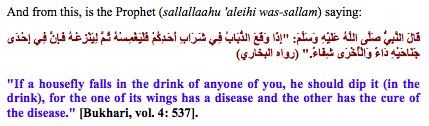
The words of the Prophet Muhammad (sallallahu ‘aleihi was-sallam) have been tested scientifically, and found hilarious. In work carried out under the direction of Dr. Jamaal Haamid, students at Qassim University examined a saying by the prophet, and have published it in a freely available pdf, The Hadeeth on the Fly, which you can download if you desire. Or you could just read this post, which summarizes entirely the complete content of the short paper, which is pretty much unpublishable and unbelievable anyway.

Here are the holy words.


(Notice that I include the original Arabic so there can be no confusion!)

If a housefly falls in the drink of anyone of you, he should dip it (in the drink), for the one of its wings has a disease and the other has the cure of the disease.

I do find that rather disturbing: so in Arabia, if a fly touches your water, you’re supposed to catch it, dunk it in deeper and slosh it around, to prevent disease? Arabian flies buzz around with pathogens segregated to just one wing, while the other one is healthy? How do they do that?

OK, setting aside the sanitary habits of Arabians and the mechanism by which this holy aphorism could be true, our intrepid students do carry out the obvious experiment: they drop a fly in a flask of sterile water, and then they pluck out the fly and immerse it completely in a second flask of sterile water. But then it all goes horribly wrong.

Here is the result of experiment #1.


Plate 2- Cultured water sample taken from a flask containing sterilized water and where a fly fell (without submersion). Growth of pathogenic (disease causing) bacterial colonies of the E. coli type were identified after taking samples from the water in the flask for culture.
Plate 1- Cultured water sample from the same flask following the complete dipping of the fly. An entire disappearance of the bacterial growth seen in Petri-dish 2 is clear. The new bacteria growing in plate 1 was identified as Actinomyces, the one from which useful antibiotics can be extracted. This explains the complete inhibition of growth in plate 2

Plate 2 on the right is the one from water merely touched by a fly. There is no explanation for how the plate was produced, or how the bacteria were identified; the strange brown sludge suggests poor technique, though, and I’ve cultured E. coli myself — and that hideous thick fecal-colored glop looks nothing like E. coli.

Plate 1 on the left, made from water in which the fly was fully immersed, looks nasty too. It’s a poor photograph, but that looks like a thick lawn of colonies everywhere. How do they know it’s Actinomyces? I have no idea, they don’t say. It’s also a mistake to simply declare it beneficial — Actinomyces are opportunistic pathogens.

Experiment #2 was a different fly, two flasks of water, same result.

Experiment #3 was a third fly, two flasks of water, same result.

Having done the experiment to death, our brave students retired at the third repetition, wrote it up with no methods, no discussion, no literature cited (except for their holy book, of course), and no reliable, believable data. They also didn’t do the other obvious experiment, of snipping off the wings and examining the bacterial flora living on the left vs. right, but then, maybe they’re leaving that for the advanced students.

Any 10 year olds looking for a quick and easy science fair project, there it is. I’m sure you can replicate this experiment trivially — but please, talk to a real microbiologist first and learn how to streak a plate. You might also learn something about a control plate, which our U of Qassim students didn’t bother to do.

Of course, this work wasn’t carried out by 10 year olds. It was done by university students in a “Med 497” (a medical course?) in a department of medical microbiology. I strongly urge anyone visiting Saudi Arabia to avoid getting sick. They might try to treat you by swishing a fly around in your coffee.

(Also on Sb)

Why I am an atheist – Frances

I can tell the story of my atheism in steps. It’s a bit of a revisionist history; now, when I look back, I can see that something had a huge impact on my life, that its repercussions influenced me in many ways. But at the time, I never thought of what happened as a step. Each day I felt like the same person as I was in the one before it. I never felt as though I had experienced any major change, or that I was a new person. The events I describe happened, and in this order, but as they were happening I didn’t think of them as significant.

In the third grade, I learned that there were other religions. This shocked me. As I had understood it, there was one god, and one word of god, and his word was the truth. The fact that there were other gods and other truths had eluded me until this point, and merely learning of their existence gave me some doubt. Why were there other religions? Why hadn’t god spoken to these other peoples like he spoke to Noah, or Moses? Why were their different Christianities? Suddenly, my childish notion of hell became far more upsetting. Before I had thought it a place for the people who did bad things; I assumed that they knew god’s commandments, and were thus knowingly defying their duty. To go to hell, one had to go about it intentionally, or so I thought. Suddenly, this wasn’t true. You could go to hell for believing in the wrong god, or for not even knowing that god existed. Intentions didn’t matter as much, only that you’d picked right. These ideas troubled me, but I couldn’t put them into words. In the end, I fell back on the idea that god loves everybody, so I must be missing something significant.

When I got to high school, I had been getting sexually harassed for two years already, and the boys in my year had also been touching me in ways I found uncomfortable, but during class. Their timing made my own studies more difficult, obviously, and it rendered me mute. I didn’t really know how to tell the teachers what was happening, and I didn’t know how to interrupt because frankly, I could hardly believe this was happening myself. So, the teacher would drone on, occasionally look at me, perhaps notice my discomfort, and proceed as if nothing was the matter. In the present I like to think that they also couldn’t understand what was happening, although I’m less sure of that.

In the first month of my freshman year, though, my best friend was raped. She later tried to kill herself. This was clearly more devastating for her than it was for me, and I only bring it up because it seemed very obvious to me as a result that rape was horrifying. There didn’t seem to be anything I could do to help her, and she was just fading away. I have never seen anyone as unhappy as she was. I realized that what was happening to me was probably also bad – it had always made me feel awful, to clarify, I’d just never known that anyone else would think it was bad. I still didn’t talk about it, though. It was much less bad than what my friend had been through, and I now knew that if no one took her experience seriously, they probably would laugh at mine.

I wondered where god was in all this. Not in an angry, he-should-have-my-back sort of way, but in a literal way. I went to church every Sunday for my entire life, and as near as I can tell, god has no opinions at all on rape, sexual harassment, sexual assault, or actually any of the issues women have to deal with. I knew the church was against abortion, premarital sex, and being gay (I was raised catholic in an area with lots of fundamentalists), but beyond that, there was literally no guidance. There were no ethics relating to this at all, or if there were, the priests were very tight-lipped about them. When my friend tried to go to the police, the school administration, anyone, she got no help. People thought she shouldn’t have been hanging around this guy, and she shouldn’t have had a beer beforehand. What did she think would happen, people demanded. And also he played sports and was a good student. Nobody seemed to consider her rape a problem, let alone an evil. At some point I concluded that if ‘thou shalt not rape’ hadn’t made god’s top ten list, god was wrong. Unfortunately, I didn’t yet become an atheist. I still believed in god, I just thought I’d been in the wrong religion. I left the catholic church, which may sound like a big change, but it didn’t actually feel like one at the time. I had simply compared what I believed to what the church believed, and found that we didn’t match up very well. I had never made the comparison before because I’d never been pushed to. Catholicism was part of my identity. I’d been confirmed, I’d confessed, and I truly believed in god. I had felt that my catholicism was something I’d earned and a part of who I was. I didn’t question it until then.

Thus began my mission to find a religion that didn’t hate women. Ideally, I hoped to find one in which women were equal to men. This, clearly, would be the one true religion, because it would address everyone’s needs, and it would have a god who loved everybody. I hoped it would have some answers for me, too. I do want to add that I considered science briefly as a possible recourse, but not too seriously. The popular image of science and scientists is pretty unfriendly to women, as is the history of science and women, and picking something that seemed to also dislike women would have gone against my goal. I wound up looking into neo-paganism and a bucketful of woo, these being the religions that were kindest to women. The trouble with this was that I couldn’t actually make myself believe that magick was real, or that ritual was important, or, well, much of any of it. Only a few months into this new religion I found myself unable to continue because I came to a really obvious conclusion. If I could just make religion up as I went along, if I could pick and choose as I saw fit, why did I think religion was real? By definition, making shit up is not the truth. This thought was immediately followed by a far more uncomfortable one: what if there is no god?

I couldn’t face that thought; it was completely devastating to me. It wasn’t just that that would mean I was essentially alone, or that there would never be any kind of justice in the next world, or even that there might not be any answers, then. These thoughts sucked, though. I was mostly horrified at the idea that this would be it. I’d never see my deceased grandparents again, I would only have access to what my body and mind could physically and mentally accomplish, and everything that I’d previously considered meaningful would simply vanish.

So, I didn’t face it. I went to college and I studied the humanities and social sciences. I hoped to learn more about what it meant to be human, and more specifically, how that related to what it meant to be a woman (I’d gotten the notion that people thought they were two different things, go figure). Somehow between learning statistics and learning about how anthropologists conduct field research, I started to realize that nothing had actually changed. If there wasn’t a god, there had never been a god. That would mean that my life had been deep and meaningful to me for other reasons. It was still deep and meaningful.

I started learning about how scientists looked for the truth, and how social scientists looked for the truth, and I became quite taken with the scientific method. I graduated, read The Demon-Haunted World, became aware of feminism, and just kept thinking and reading. Finally, when I was 26, I reapproached the question of god. It didn’t hurt anymore, and I found I could give it serious thought.

Truth is no longer something I have to believe in, it is something I can see and study. Doubt isn’t a character flaw anymore, and neither is not knowing the answer. I realized that there was no reason to believe in god, that everything I’d attributed to him in my wonder is explainable through evolution, the movement of glaciers long ago, the tilt of the Earth on its axis, and other natural phenomena. And, even more surprisingly, that these natural phenomena are even more wondrous than god was. The strange gaps in god’s commands regarding modern issues, his obliviousness about rape, and his really strange dislike of certain foods were more easily explainable when I realized that there probably wasn’t a god. The idea of a god doesn’t explain anything, actually, and in fact raises many uncomfortable questions. Especially if you are a woman. It also turns out that feminism and atheism go together really well.

So, as you can (hopefully) see, this is a story about how I didn’t actually change that much at all; I only changed how I thought.

Frances

In Indiana, it’s not just the lawmakers who are idiots — it’s the media, too!

The miseducation committee of the Indiana legislature recently approved a bill to allow the teaching of creationism in the schools, and now the Indianapolis newspaper approves, with the usual tepid and illegitimate arguments.

Much would depend on how teachers handle the origins of life in a biology or science class.

No, it doesn’t. A bill that inserts garbage into the curriculum is a bill that inserts garbage; it doesn’t matter if you think it could be used to make a lovely collage, or as an exercise in recycling, it’s still garbage. And if you trust teachers to do their job, let them do it without boneheaded cretins in the legislature telling them how.

And there is no provision in the bill that states creationism must be taught as a science subject.

Let me guess: it would be OK to teach it as “philosophy”. How much disrespect are you willing to give to that field? It’s bad philosophy, too. What disciplines is Indiana willing to poison with nonsense? Be specific. English? History? I know — how about relegating creationism to the football team.

Courts have ruled that using the Bible as an educational tool is permissible. We see nothing that would change that here, and note the bill stresses “theories” on the origins of life.

Uh-oh. I know what’s coming next. I cringe in anticipation.

The march down the slippery slope occurs when theories are presented as facts.

YEEEAAARGH. HULK SMASH!

Scientific theories are explanatory frameworks for integrating a body of facts. Evolutionary theory, cell theory, germ theory, quantum theory, electromagnetic theory, transition state theory, the theory of relativity — these are all theories, and they also represent accurate and useful descriptions of how the universe works. They should be and are taught as facts, provisional explanations that have been tested and evaluated and found successful. “Theory” means something very specific and powerful to a scientist — there is no creation theory to be taught or used, and especially, no creation story that has survived any scientific test.

This bill could act as a safeguard against an educator mentioning creationism, and then possibly getting sued for promoting religion in the classroom. The American Civil Liberties Union has jumped into the fray and says this bill is unconstitutional, and that courts have overturned similar bills from other states.

This makes no sense. Yes, if a teacher peddles creationism in the classroom, they are using a state-supported, public facility to promote a purely religious idea. If a legislator peddles creationism in a bill, they are using the resources of goverment to promote a sectarian religious idea. This is wrong whether it’s a teacher or a state rep doing it, it is unconstitutional, and most importantly, it is bad science being used to corrupt education.

Certainly, there is much empirical scientific evidence to support evolution, and some pretty good philosophical arguments to support creationism. It’s unfortunate, though, that the latter has to be tagged as a science.

“Pretty good philosophical arguments for creationism”? Name one. Most philosophers are cleverer than that.

We think a thorough education exposes students to different theories, and if schools have done a good job of developing a student’s critical thinking skills, there is no harm done.

Oh, great. This is going to be fun. So if they’ve learned how to fall safely in gym class, I can punch little kids in the nose, and no harm done. If they’ve learned basic logic in grade school, we can do a crappy job teaching them trigonometry and calculus — they’ll be able to derive them for themselves, and no harm will be done. If they’ve learned playground safety rules, we can turn them loose with random chemicals in the chemistry lab, and no harm done.

This moron is basically saying that if most of the kids’ education is decently done, then they can afford to throw a few state-mandated lies at them. Once upon a time, I thought the goal was to excel and provide the best education possible; in Indiana, the dream is a school system that is less than half shitty.

(Also on Sb)