Live by statistics, die by statistics

There is a magic and arbitrary line in ordinary statistical testing: the p level of 0.05. What that basically means is that if the p level of a comparison between two distributions is less than 0.05, there is a less than 5% chance that your results can be accounted for by accident. We’ll often say that having p<0.05 means your result is statistically significant. Note that there’s nothing really special about 0.05; it’s just a commonly chosen dividing line.

Now a paper has come out that ought to make some psychologists, who use that p value criterion a lot in their work, feel a little concerned. The researchers analyzed the distribution of reported p values in 3 well-regarded journals in experimental psychology, and described the pattern.

Here’s one figure from the paper.
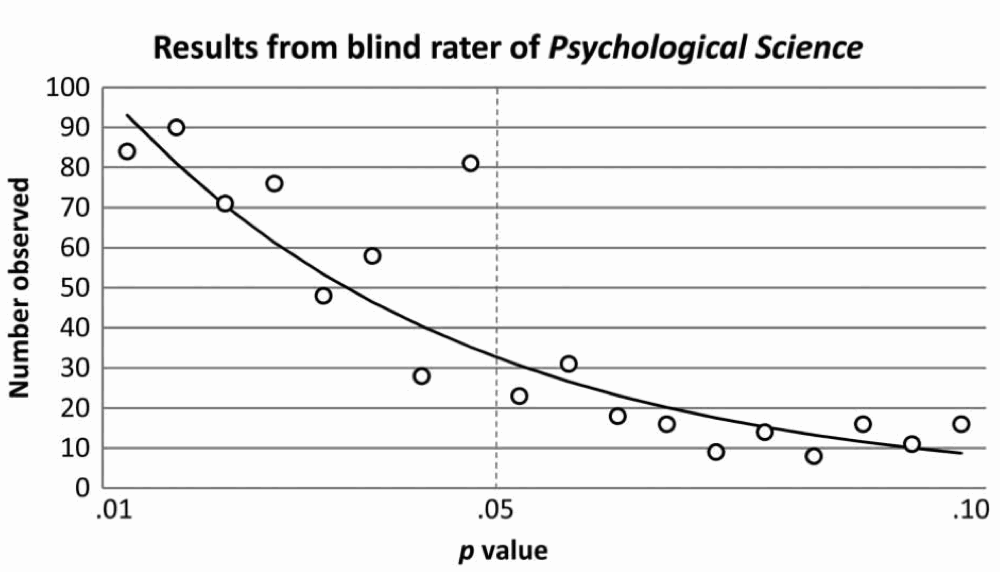
The solid line represents the expected distribution of p values. This was calculated from some theoretical statistical work.

…some theoretical papers offer insight into a likely distribution. Sellke, Bayarri, and Berger (2001) simulated p value distributions for various hypothetical effects and found that smaller p values were more likely than larger ones. Cumming (2008) likewise simulated large numbers of experiments so as to observe the various expected distributions of p.

The circles represent the actual distribution of p values in the published papers. Remember, 0.05 is the arbitrarily determined standard for significance; you don’t get accepted for publication if your observations don’t rise to that level.

Notice that unusual and gigantic hump in the distribution just below 0.05? Uh-oh.

I repeat, uh-oh. That looks like about half the papers that report p values just under 0.05 may have benefited from a little ‘adjustment’.

What that implies is that investigators whose work reaches only marginal statistical significance are scrambling to nudge their numbers below the 0.05 level. It’s not necessarily likely that they’re actually making up data, but there could be a sneakier bias: oh, we almost meet the criterion, let’s add a few more subjects and see if we can get it there. Oh, those data points are weird outliers, let’s throw them out. Oh, our initial parameter of interest didn’t meet the criterion, but this other incidental observation did, so let’s report one and not bother with the other.

But what it really means is that you should not trust published studies that only have marginal statistical significance. They may have been tweaked just a little bit to make them publishable. And that means that publication standards may be biasing the data.


Masicampo EJ, and Lalande DR (2012). A peculiar prevalence of p values just below .05. Quarterly journal of experimental psychology PMID: 22853650

Why I am an atheist – pedantik

It took me a long time to jettison the religious beliefs that had been instilled in me from my early youth.  While my father, an ordained deacon, was almost silent on religious matters while at home, my mother made certain that I knew of her beliefs every day.  She taught sunday school to teenage girls in our local Baptist church, and pressed my brother and me into attendance whether we liked it or not.

[Read more…]

Pity and pitilessness

Maggie Koerth-Baker, ex-fundamentalist, has a fine post up explaining why fundamentalists are against seemingly innocuous things like set theory. It’s because it’s symptomatic of a deeper conflict with the modern world.

Instead, they see modernism as the opposing worldview to their own. They are all about tradition (or, at least, what they have decided is traditional). Modernism is a knee-jerk rejection of tradition in favor of the new. Obviously, they think a very specific sort of Christian God should be the center of everything and all parts of society, public and private. Modernists prefer ideas like secular humanism and think God is something you should be doing in private, on your own time. They believe strongly in the importance of power hierarchies and rules. Modernism smashes all of that and says, “Hey, just do your own thing. Nobody’s ideas are any better or worse than anybody else’s. There’s no right and wrong. Go crazy, man!” [Insert obligatory bongo drumming session]

I am hamming this up a bit, but you get the picture. Modernism, to the publishers of A Beka math books, is sick and wrong. The idea is that if you reject their specific idea of God and their specific idea of The Rules, then you must be living in a crazy, dangerous world. You could kill people, and you would think it was okay, because you’re a modernist and you know there’s really no such thing as right and wrong. Basically, they’ve bumped into a need to separate themselves from the almost inhuman Other on a massive scale, and latched on to modernism as a shorthand for how to do that. It doesn’t matter what you or I actually believe, or even what we actually do. They know what we MUST believe and what we MUST be like because of the tenets of modernism.

I understand this. They’ve been brought up to think the godless world is a deeply dangerous threat to everything they hold precious, and it’s simpler to just shut down any thing that has to do with it. It’s like somebody has been told that some mushrooms are delicious, and others are deadly poisonous, and they’ve been told that they can, if they’re very careful, tell the difference between them…and they choose to never, ever eat mushrooms because they don’t want to go to the bother of learning how, and they also don’t want to put anyone they love at any risk at all. So they’re very, very cautious about new ideas, because their social structure is both important to them and sensitive to external perturbations.

I can even sympathize with this conclusion.

If this sounds crazy … you’re right. It’s pretty crazy. In fact, it’s this kind of thinking, and my realization that it was based fundamentally on lying about everybody who wasn’t a member of your religious tribe, that led me away from religion to begin with. Ironically. But there is a coherent thought process going on here, and I want you to understand that. If all you do is point and laugh at the fundies for calling set theory evil, then you are missing the point. This isn’t about them being stupid. It’s about who they think you are.

Yes, I can appreciate that. I could be toxic to their worldview. I’m (and you all, too) are dangerous in that we could damage their equilibrium and send their children — and maybe even themselves — off into new patterns of thought that would repudiate all that they hold dear right now.

I read Maggie Koerth-Baker’s piece and had no problem putting myself in their shoes: if someone were making a serious challenge to my social and intellectual framework, if I were concerned that some blundering clod could come along and with some thoughtless nudge, knock it all down, I’d be protective and suspicious, too. I would be building fences around my world to keep those evil insensitive assholes out.

And then I read stuff like this summary of what Bobby Jindal’s education plan is going to do to children in Louisiana: the stupidity of arguing that dinosaurs were fire-breathing dragons who lived into the middle ages, the callousness of teaching that the Trail of Tears was an opportunity for Christian proselytization, the evil of putting a happy shine on slavery and the KKK, the equation of gay people with child molesters and rapists, the contempt for the environment, and I think…

Tear it all down.

They’ve built cages for themselves and their children, and have beliefs that harm others. I can see that they’re quivering in fear at the modernists, the liberals, the gays, the atheists, all coming to expose their ‘worldview’ for the rickety tissue of lies and hate that it is, and I say…no mercy. No hesitation. No apologies. Break it apart, and set those people free.

Pointing and laughing is just one step in the process of liberating those Christians trapped in their prison of lies. I can feel pity for them, while I let reality crash into their delusions and send them scurrying. They fear change, but they must change.

Why I am an atheist – Meggan

As a child, Christianity never made sense and seemed unfair and rather limiting. After learning about mythology and how people believed the Gods to be real and the source of phenomena that can now be scientifically explained, I made the connection that the same could be said for Christianity. My parents weren’t non-believers, but they had no interest in religion. And when I felt the inevitable social pressure to go to church, my dad flat out said “No, church is for people who need it. They go in on Sundays and act holy, but the rest of the week they are assholes.” And after witnessing numerous examples of such behaviour over the years, I decided he had a point.

[Read more…]

Physiologically impossible, historically improbable

It’s official: Ken Ham’s Ark Park will include…fire breathing dragons. They’re quite definite. Because people have mentioned dragons in the past, and because the Bible specifically says that all air-breathing creatures were on Noah’s Ark, dragons must have been aboard. No other conclusion is possible.

Using this same reasoning, though, they’re also going to have to pack Bigfoot, chupacabras, chimeras, Greys, and unicorns on their big wooden boat. It just gets sillier and sillier.

Why I am an atheist – Rob McCallum

I am an atheist because I was born that way.

I grew up in a Catholic family. Not crazy fundamentalist Catholic or anything. We were a liberal family, but we went to church every Sunday, said grace at dinner, and all of the other calendar related business that I can barely remember. Outside of weddings and funerals I haven’t attended a church in over twenty-five years, so the rituals are fuzzy.

[Read more…]

Holy crap, the BBC’s racist apologetics

I have completely tuned out the Olympics because the jingoistic, shallow American commentary makes me want to puke…but I was just sent this clip from the BBC coverage. Watch how it goes from Darwin to eugenics to Hitler to slavery in order to explain how so many black athletes excel at sprinting events…because, obviously, being able to survive shackling in a slave ship and a lifetime of menial stoop labor in the cotton fields clearly selects for genes of benefit in short foot races.

Who authorized that kind of drivel to even be made? It’s bad science and bad history.

Why I am an atheist – Patrick Kelley

I was raised alternately in general Protestant and Lutheran churches, and my parents can’t be blamed for a lack of trying.  I can’t claim ignorance, so I’m among the worst of the damned in the eyes of some.  I started out believing, right up until I got a less than satisfactory answer to the doctrine of ignorance and original sin and salvation.  I came from an abusive home, and obsessed over fairness since punishment in my home was often disproportionate and arbitrary.  It was at that moment I recognised God as he’d been described as an abusive parent.  I could not believe that such a being as my stepfather ran the universe, or rather one so apparently powerless as my mother stood by and allowed suffering and death.  I was eight.  This was the beginning of my doubts.  I realized that the people claiming to know God’s will were like me claiming to know when I’d be yanked out of bed over a dirty dish, or yelled at for literally doing nothing. Whatever there was, they had no idea when it would act or why.   

[Read more…]

Don’t go into the light…until I’ve milked this story for another book

A while back, I wrote a couple of articles on near-death experiences: The NDE delusion and Near-death, rehashed. It’s a topic I’ve been following off and on for quite a few years.

So I was quite surprised to see this name popping up in the news lately: Melvin Morse. Morse is one of those gullible paranormalists who has a couple of sloppily breathless books out about NDEs — he gets mentioned a couple of times in this nice article debunking a couple of well-known cases. His specialty is describing NDEs in children.

Yeah, children. Which adds a little extra disgust to the news.

He has been arrested for waterboarding his own daughter, punishing her by holding her head under a running faucet so she couldn’t breathe.

The daughter told police she “could never understand what she did to be punished” and felt scared, court documents reported. Once, she said, her father told her he “was going to wrap her in a blanket and do it so that she could not move.” In another instance, she said Melvin Morse told her that “she could go five minutes without brain damage.”

After her father did these things, the girl said she would “go outside and cry,” prompting Melvin Morse to come outside and then “hold her nose and mouth with his hand,” police said in court records.

“He would tell her she was lucky he did not use duct tape,” police said in the documents. “He would not let go until she lost feeling and collapsed to the ground.”

It sounds like he was trying to do a little “research” on his own child. There’s good money in almost-dead children, you know.