Note to self: do not trust reviews in the NY Times

Tesla-Model-S

John Broder of the NY Times recently reviewed the Tesla Model S electric car, and panned it. Now I know nothing at all about this car; I’m not endorsing or criticizing it myself, and I’m not going to be able to tell you anything about the specs on this vehicle or how well or how poorly it delivers on its promises. But I can tell when someone is actively lying in a review, when evidence is provided.

The Tesla company had a device installed in the reviewed vehicle to automatically log just about everything the driver did. And the reviewer lied about what he did. It’s an appalling example of outright faking his observations — a scientific publication with that degree of fudging the data to achieve a desired conclusion would get you fired.

But now I’m wondering why — why would somebody cheat on his evaluation of a car? Personal bias? Or — uh-oh, conspiracy theory time — were there financial interests behind doing a bad review?


And now…the counterargument.

Need more Creation Science Fair?

Here’s another moderately detailed summary of the Twin Cities Creation Science Association’s Homeschool Science Fair. It’s about as I expected: some kids were enthusiastic about the science and actually thought about what they were doing, others were coasting by blankly, doing the work because they were required to. In other words, not any different from a secular science fair, except for the Bible verse nonsense and for some, the attitude that they were there to refute science…by using science.

Sasquatch is ill-served

zztop

Melba Ketchum issued a press release announcing that she had sequenced Sasquatch DNA. That was back in November.

It stalled out at that point. It turns out the paper couldn’t get past peer review, and no one was going to publish it. We’re all heartbroken, I know.

But now she has overcome all the obstacles, and it’s finally in print! You can read the abstract.

One hundred eleven samples of blood, tissue, hair, and other types of specimens were studied, characterized and hypothesized to be obtained from elusive hominins in North America commonly referred to as Sasquatch. DNA was extracted and purified from a subset of these samples that survived rigorous screening for wildlife species identification. Mitochondrial DNA (mtDNA) sequencing, specific genetic loci sequencing, forensic short tandem repeat (STR) testing, whole genome single nucleotide polymorphism (SNP) bead array analysis, and next generation whole genome sequencing were conducted on purported Sasquatch DNA samples gathered from various locations in North America. Additionally, histopathologic and electron microscopic examination were performed on a large tissue sample. vel non-human DNA.

Umm, yeah, I know, it kind of falls apart in the last sentence, but that’s what it says.

How did she get it published?

Well, she says she bought an existing journal and renamed it (the Journal of Cosmology was on the market, and I hoped most fervently that that was it…but no, JoC is still online). So she owns the journal. It’s now called De Novo.

Then she came out with a special edition. It’s Volume 1, Issue 1. It contains precisely one paper, hers.

You should be laughing by this point.

The online journal is a mess. The layout is funky-ugly, it’s difficult to figure out how to actually get to the paper, and when you navigate to it, it’s got a wretched little “Buy Now” button imbedded in a couple of intersecting blocks of color in a hideous table-like layout. It reminds be of the esthetics of JoC.

Anyway, it’s $30 to buy a paper so bad they had to build a custom journal around it to get it published. Not interested.

A Life Without Odin Barely Defines Robin Ince

I wish that could be true for me. Robin Ince lives in a rather more secular culture. I live a few blocks from a cemetery with an odious electronic chime that plays hymns every goddamned 15 minutes; I live in a town with approximately 15 churches; I’ve been condemned by the county council of churches; I share a state with Michele Bachmann, a state where every couple of years we get to have another battle to keep creationism out of the public school science standards. I’m in a country where a politician denying evolution because the Bible says the earth is less than ten thousand years old, or denying climate change because their god promised to never screw up the weather again, are perfectly practical positions that will endear them to their benighted segment of the electorate. I wish these people would just take their faith into the churches and leave the rest of us be.

But at least Robin is generally correct in this part.

For a while I have worried there is a rise in the superior atheist, though I hope that is not true of most I know. I believe there can be a lack of imagination and experience amongst some atheists. We can gloriously bathe in the reprehensible examples of faith inspired misogynists, homophobes, terrorists and other thugs, and ignore the religious people who amble around us, filled with doubt, questions, compassions and a non-dogmatic view of the world. There are cultures and countries, where the repugnant, muscular hand of organised religion manipulates the populace. There are people who embrace dogmas, religious or political, and will refuse to view them with a critical eye, whatever the evidence might seem to be; old Maoists or Catholic die-hards who, while eagerly criticising other persuasions, will remain energetically blind to “their own sides” shortfalls. I am sure I have and will fail to notice my own shortcomings, while criticising those I see as opponents for exactly the actions I have been guilty of. It seems that is part of the human survival mechanism, though I hope I am becoming more vivacious in my eye for personal hypocrisy.

These are concerns that sometimes leave me in despair. Yeah, I’m surrounded by the absurdly devout, but as we’ve all been discovering in the last few years, my chosen atheist community is pretty well cluttered with arrogant, petty assholes. Some days I feel even more isolated than before.

So, this Odin guy…are his followers enlightened and tolerant?

Kate Clancy tackles Evolutionary Psychology

It is a very good and measured response that highlights the flaws in bad evolutionary psychology.

Evolutionary psychology, the study of human psychological adaptations, does not have a popular or scientific reputation for being rigorous, even though there are rigorous, thoughtful scientists in the field. The field is trying to take on an incredibly challenging task: understand what of human behavior is adaptive and why. We can better circumvent the conditions that lead to violence, war, and hatred if we know as much as we can about why we are the way we are. What motivates us, excites us, angers us, and how can evolutionary theory help us understand it all?

Because of this, there are consequences to a bad evolutionary psychology interpretation of the world. The biggest problem, to my mind, is that so often the conclusions of the bad sort of evolutionary psychology match the stereotypes and cultural expectations we already hold about the world: more feminine women are more beautiful, more masculine men more handsome; appearance is important to men while wealth is important to women; women are prone to flighty changes in political and partner preference depending on the phase of their menstrual cycles. Rather than clue people in to problems with research design or interpretation, this alignment with stereotype further confirms the study. Variation gets erased: in bad evolutionary psychology, there are only straight people, and everyone wants the same things in life. Our brains are iPhones, each app designed for its own special adaptive purpose.

I’ve still got plans to post more on this subject, but an unfortunate event has blocked me. I was going to make my next post on evolutionary psychology one that focused on some of the papers, and in particular, I wanted to discuss a good paper or two, so that I could start off on the right tone. And people sent me links and papers.

Only problem: they were all awful. Every one. I couldn’t believe that even these papers that some people were telling me were the best of the bunch were so lacking in rigor and so rife with unjustified assumptions. I read through about a dozen before I gave up in disgust and decided that there were better things to do in my time.

I’d ask again, but I was burned so badly on that last go-round that I’d have a jaundiced view of any recommendation now.

Atheists are responsible for creationism!

Here’s something that really, really annoys me: clueless idiots who blame atheism for creationism.

I don’t have stats but I strongly suspect that the strenghtening of creationism with the simultaneous rise of public atheism is not a coincidence.

That isn’t just ahistorical ignorance: it requires such short-sightedness that they aren’t able to look back even a decade.

The major events in creationism that led to their expansion were the publications of the Scofield Reference Bible and The Fundamentals in the early years of the 20th century, and the publication of The Genesis Flood in 1961. Neither periods were associated with a rise in atheism. The first actually coincides with the third Great Awakening; I don’t want to diminish the importance of Robert Ingersoll and the Golden Age of Freethought, but lets not pretend that these were serious challenges to the ubiquitous association of the church with morality and political power. They were promises of secularism that didn’t threaten the status quo all that much, yet. If you wanted something that was scaring many conservatives of that time, look to the Suffrage Movement. I don’t see many people arguing that women’s rights were responsible for creationism, but I expect they are out there.

The second major event in creationism came after the entrenchment of Christianity in the 1950s as part of the Cold War. Our money was splattered with “in God we trust” and “under God” was added to the pledge of allegiance in the 1950s; where, pray tell, were the loud aggressive atheists who prompted those religious actions in that period? Is anyone seriously going to argue that the era of the gray flannel suit and Ward Cleaver and the Red Menace was a time of high atheist activity?

Madalyn Murray O’Hair’s lawsuit to end the reading of the Bible in public schools was settled by the Supreme Court in 1963. It was not a trigger for widespread public piety, but was a response to that association of patriotism and civil life and religiosity that had been brewing in this country since the end of World War II. American Atheists was founded after “in God we trust”. Finding a causal relationship that pins the blame on atheism has a few temporal difficulties.

The Institute for Creation Research was founded in 1972. Answers in Genesis was founded in 1980. The NCSE was established in 1983, in response to the rising influence of creationism in the schools (and it is explicitly NOT an atheist organization). No one was trying to insert atheism into the schools in the 1960s. No one is trying to do that even now, but we’ve been dealing with efforts to push Genesis crap and faith-based bullshit in the schools for at least 60 years.

The Moral Majority was big news in the early 1980s, and was founded in 1979. I was wide awake and politically aware in the 1980s; there were no big atheist role models making a noise in the public sphere, they were still little more than a despised minority at the time, and most people were surprised to learn that atheists even existed in America.

The recent rise of public atheism can be traced to a number of influential books. Freethinkers: A History of American Secularism, by Susan Jacoby, published in 2004. The End of Faith: Religion, Terror, and the Future of Reason in 2004 and Letter to a Christian Nation in 2006, by Sam Harris. The God Delusion by Richard Dawkins in 2006.

It’s been less than ten goddamned years.

And we’ve still got idiots claiming they see a correlation between creationism/public religiosity and outspoken atheists.

Listen, whenever you see someone making that claim, you know you’ve found an idiot talking out of their ass. Give them a look of contempt and walk away.

A paltry creationist effort

I missed it, but Angry by Choice, Tangled Up in Blue Guy, and Greg Laden visited the Creation Science Fair yesterday, and Greg Laden already has a write-up. It was as tawdry as expected, with every poster lauding Gawd with bible verses. It was also very small.

There is another reason we go: To keep the creationists honest(ish). A few years ago, a group of us went to the fair and noted 20-something posters, and in that year the organizers, unaware of our presence, reported a much later number, thus lying about the level of participation in this event. When I pointed out on my blog that among all the photographs they took and we took one could not count any number of even close to that suggested by them, the organizers of the creationist science fair deleted all their photos from their web site and accused me of being a child abuser.

Total poster count this year: 23, in all age groups. See? That’s why it’s hard to get up the enthusiasm to drive 3½ hours to see little kids dressing up science with Jesus.

You too can be a biolomagist

2013-02-09 12.26.08

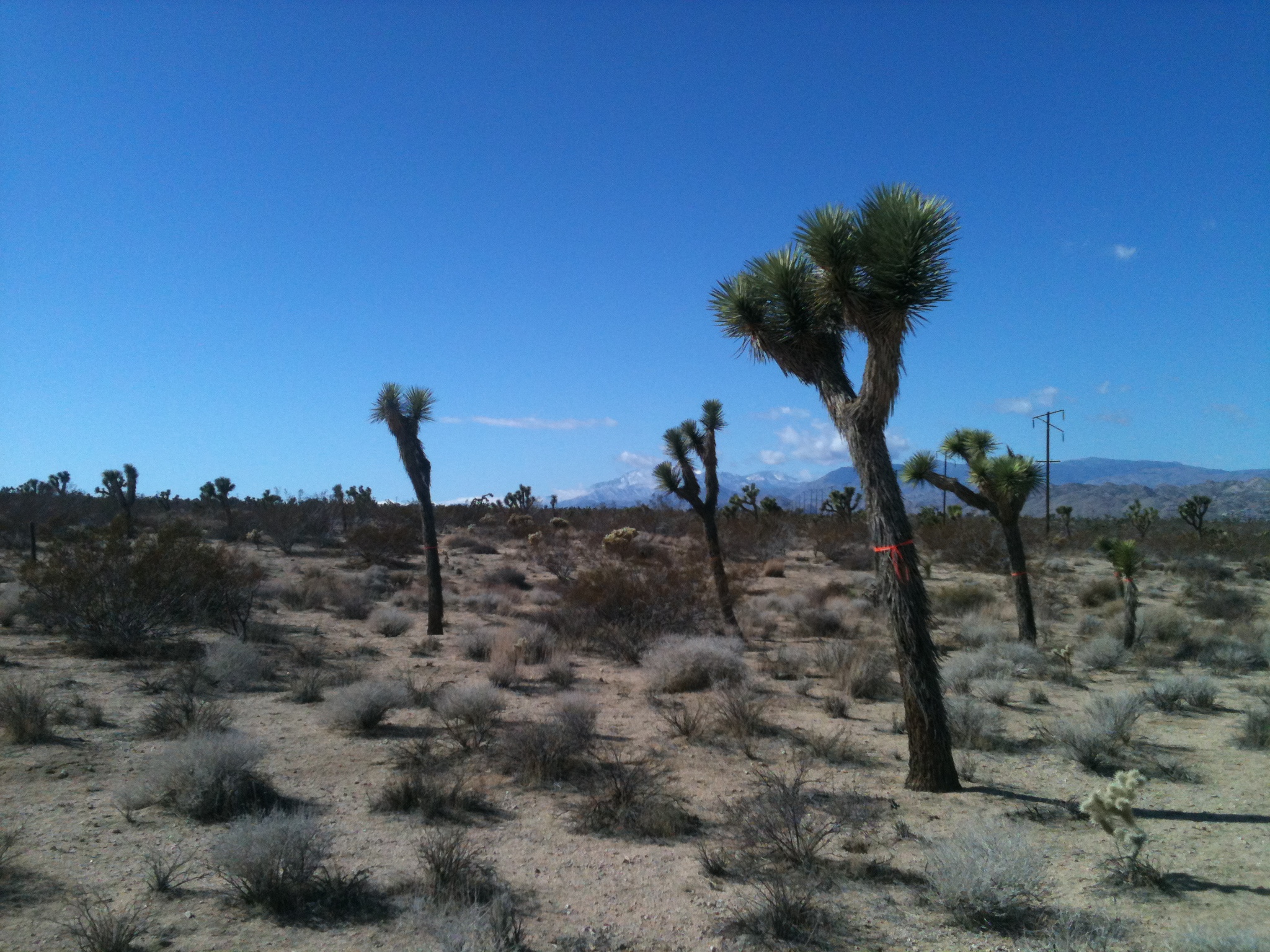
There’s a 30+-acre solar project proposed for a spot of Joshua tree woodland less that a mile from the house we’re renting here in Joshua Tree — significantly less than a mile — and I went for a walk on the site today.

My gut feeling when I heard about the project was that this isn’t the right place for it. I’m a big fan of smaller solar, and I have no problem living near a facility of that size. In fact, I’d love to live directly under a few kilowatts’ worth of photovoltaic panels. When people started calling me a NIMBY a few years back for publicly opposing some of the huge solar projects on publicly owned tortoise habitat in the Mojave, I thought “WTF are they talking about? I want this in my backyard!” Well, not a 750-foot  power tower surrounded by a hundred thousand heliostats the size of billboards, but you know. Solar. Fill the parking lots and the roofs and the bus shelters with solar panels. I want to see them everywhere I look, mostly.

But this site happens to be on a strip of land connecting our local National Park with a square mile of undeveloped land the local land trust just bought specifically due to that connection to the park, for wildlife linkage purposes. This project would cut that connectivity. It’s full of wildlife and mature vegetation. Very mature.  During my walk today I saw at least five shrubs likely more than 1,000 years old, and I wasn’t being anything like a thorough surveyor. There were tons of burrows and tons of scat, rabbit and coyote and possible bobcat. The plot is obviously well-used by wildlife. There are plenty of places in the area that would be more suitable for solar, I’m thinking.

2013-02-09 12.30.27

But because I do live here, and could reasonably be accused of NIMBYism — construction dust will likely blow into our yard, for instance — I wanted to scope out the site and become slightly better informed. I want to read the plans when they come out, talk to the proponents, make up my mind carefully.

So I walked around on the site for a bit.

As you can see from the photos so far, the Joshua trees on the site have been tagged. The proponent says that was done in order to inventory them, which seems reasonable. They are unlikely to be just cut down: villagers would show up with pitchforks and torches and such, as we love our Joshua trees here. They may be dug up and transplanted, an operation with a less than 50 percent survival rate. At any rate, for whatever end purpose, all the Joshua trees on the site have been tagged with pink ribbon.

Even the baby ones, like the 5-to-10-year-old tree at right. Just a wee cute little thing.

If it turns out that this patch of land won’t work for a solar array, then they picked the wrong place to try to push it through regardless. Aside from having an obscure but irritable desert blogger in the neighborhood, the site is right up against and upwind of a number of properties owned by relatively opinionated people, including two separate households of attorneys on the staff of a national environmental group known for its litigiousness. It may be that the developer decides to use this land as mitigation land for other nearby projects: preserving it to make up for the disturbance of less-valuable habitat elsewhere. Or maybe they’ll persuade us all that the project is right. We’ll see.

But what I found on the site this morning doesn’t bode well.

2013-02-09 12.46.42


These two yuccas, in right foreground and center mid-ground, were tagged by the crew during Joshua Tree Tagging Day. You can see the tags if you look closely. Can anyone tell me the problem with that?

Anyone besides Chas?

They’re not Joshua trees. They’re Mojave yuccas, Yucca schidigera rather than the Joshua tree’s Yucca brevifolia. They are roughly similar to a Joshua tree, enough so that tourists will call them by the wrong name. For anyone who’s worked with desert plants for even a little bit of time confusing the two is like mistaking an aardvark for a giraffe.

I found three Mojave yuccas tagged as Joshua trees. They weren’t tagging Mojave yuccas as well, because there were hundreds on the site, from babies to matriarchs, not tagged at all.

This doesn’t bode well for the solar developer’s knowledge of actual conditions on the ground. Protip: when hiring consulting field biologists, make sure they don’t claim to have graduated from the Larry The Cable Guy School of Biologism.

Come on, Ken, you can say it

After that silly exercise in which Ken Ham looked at a fossil and dismissed Eosinopteryx as only a bird — a bird with clawed forearms, teeth, and a bony tail — he got chewed out not just by me, but by one of his fans, who wrote in to call him on his “handwaving” and to say that it was plainly not just a bird. Ken Ham can ignore me, but when one of the faithful can see right through him, he has to repair the damage.

And it’s great! He has to say that ancient forms of birds looked different, and that it has some features consistent with modern birds and others more like ancient, extinct forms, and then he’s reduced to quoting Brian Switek in an attempt to gather support. (I don’t think Brian accepts that the earth is 6000 years old or that dinosaurs did not evolve into birds, though; I’ve restored the usual ellipses and truncations a creationist must resort to in order to use a scientists’ words.)

Even evolutionary science writer Brian Switek, when discussing Eosinopteryx, commented on the vagaries of whether to call a creature a bird or a dinosaur. Switek wrote:

Does this mean that we should stop calling Archaeopteryx the earliest known bird? Not necessarily.

‘[T]his phylogeny remains only weakly supported,’ Godefroit and coauthors caution…[and the paleontologists point out that convergent evolution among small, feathered dinosaurs might obscure the true pattern of relationships between the feathered forms. The identity of Archaeopteryx is being questioned, and rightly so, but paleontologists have yet to fully resolve which particular lineage of dinosaur spawned the first birds.]

Birds are a special lineage of coelurosaurian dinosaurs. That is a fact. But the details of when and how that transition occurred, not to mention exactly from whom, are still areas of active debate. [Eosinopteryx underscores the increasingly complex pattern of feathered dinosaur evolution and bird origins. The tiny dinosaur is another point of reference in an ongoing discussion about when dinosaurs took to the air, and which particular lineage left avian heirs to the Mesozoic legacy.]

OK, guy, you’re really reaching. This shouldn’t be so difficult. Complex lineages, ancient extinct forms, fossils with traits of an ancient form and a modern one, major changes in anatomy over time…just spit it out.

The “T” word. You know. Try it.

“Traaaaaans…”, that’s how it starts…

Transitional form! Good! You’re making progress!

Next week, we’ll work on the “E” word, that phenomenon which explains how we get transitional forms.