A charitable ethos

I very much enjoyed this TED talk by Amanda Palmer — she puts into practice a spirit of community that we would do well to foster, and which is actually at odds with many people’s attitudes. She’s talking about the music industry specifically but a way of life in general. Rather than trying to think of ways to make people pay for music, putting them in the cattle chute and compelling them to cough up the cash for the industry, she recommends asking and letting them pay, if they can and if they want.

I thought of Greta Christina when I saw that. Recall that when she went in for surgery, she asked for donations to help out…and people who valued her work and appreciated what she brought to the atheist community chipped in and freely gave. That was the work of community. That’s how it ought to work.

Palmer talks about the resentful people who would shout at her “get a job”…and they’re out there. Those are the people who didn’t give, who would bitterly denounce Greta for using money freely given as she saw fit. It’s a peculiar situation where true community is always going to be prone to parasites, but some people get so wrapped up in policing freeloaders that they end up destroying the community they intend to protect.

I think one of the hardest habits for people brought up in a society that dogmatically worships capitalism is to surrender a little bit and just give without expectation of compensation, and without demanding the right to retain control. They’ve rather lost sight of the meaning of the word “give”.


Quick! Let me correct one potential misapprehension in advance! I am not asking you to give to me, I’m not doing an Amanda Palmer move and offering you a flower and a moment of connection for a gift of compensation. I’m one of the lucky ones: I’ve got a secure job, live in an area with a low cost of living, have very good health insurance. I can do this blogging stuff, my own form of giving, without asking you to contribute directly to me. Some of you occasionally give me a small gift when we meet — a bit of squid art, a cupcake, a glass of beer — and that token is more than enough.

If you do feel a compulsion to give, I recommend you pass it on to one of the other bloggers here on FtB who do not have my good fortune of financial security, or alternatively, visit the Foundation Beyond Belief, where you can find plenty of outlets for your compassion.

Ha ha, Harvard!

This year, UMM will have Al Franken as our commencement speaker. Guess who Harvard gets?

nelson-ha-ha

A comment on the Crimson story got me poking around (I am not a big Oprah watcher) and now I wonder: Did anyone on the Harvard honorary degrees committee consider the fact that Oprah is a major purveyor of pseudoscience? Four years ago Newsweek did an extensive debunking of pseudo-medicine pandered on her show. She was #1 on Brian Dunning’s list of the top 10 purveyors of pseudoscience, citing her as follows: “she promotes the paranormal, psychic powers, new age spiritualism, conspiracy theories, quack celebrity diets, past life regression, angels, ghosts, alternative therapies like acupuncture and homeopathy, anti-vaccination, detoxification, vitamin megadosing, and virtually everything that will distract a human being from making useful progress and informed decisions in life.” Or read Martin Gardner’s take on Oprah — and her frequent guest, Harvard’s own Dr. Oz.

Score: UMM 1, Harvard -1,000,000.

As usual, it’s not the message, it’s the mere existence of atheists

American Atheists have put up a new set of billboards, with a “go godless” campaign theme.
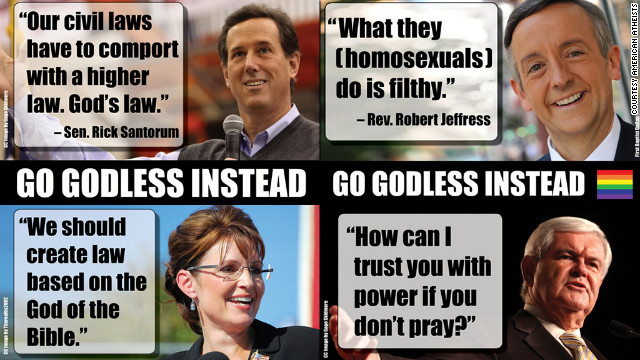
new-atheist-billboard-split-story-top

What’s interesting, though, is the media response:

Atheists ratchet up rhetoric, use billboards to attack Republican politicians

Hang on there…”Go godless instead” is ratcheting up the rhetoric? It seems like a rather mild suggestion to me — presenting an extremist religious position and then offering an alternative is an entirely reasonable approach.

As for attacking Republican politicians…has CNN noticed that the religious right has staked itself out in the Republican party? If Democrats were saying things as stupid as the Republicans, I’m sure Dave Silverman would be ripping on them just as aggressively. And if the Republicans were not basing bad policy on religious dogma, there wouldn’t be much concern about them and they wouldn’t be appearing on those billboards.

What is wrong with Republicans?

I really don’t get it. You’d think they’d learn after getting burned on the facts, but no, Republicans seem to have a need to engage their mouths to say something stupid about human biology all the time. The latest example: California Republican Celeste Greig declares that rape pregnancies are rare.

Granted, the percentage of pregnancies due to rape is small because it’s an act of violence, because the body is traumatized. I don’t know what percentage of pregnancies are due to the violence of rape. Because of the trauma the body goes through, I don’t know what percentage of pregnancy results from the act.

The weirdest thing about that comment is the context. She was talking about Todd Akin’s idiotic remarks about ‘legitimate rape’, and saying that he ought to have backed down and apologized. So she’s really saying, “He shouldn’t have said that, but hey, he was right anyway”?

The article goes on to explain what Greig didn’t know: that it’s biology, sperm meets egg, and that most studies show the frequency of pregnancy from sex acts consensual or non-consensual is roughly equal (with one outlier study showing the frequency of pregnancy after rape is greater than after consensual sex…probably because of reduced opportunities for contraception).

Taking the wonder back

Oh, how I hate this stupid question:

Many popular scientists are atheist, so why are they so happy to use the misty-eyed language of religion?

Check your assumptions, journalist. Why do you associate feelings of wonder and awe with fucking religion? Look at the stuff she quotes from prominent scientists: it has nothing to do with religion, except that religion has spent millennia appropriating these ideas.

It’s ironic that the public engagement with the science crowd is so pro-wonder, because they’re so anti-religion. "All the great religions have a place for awe, for ecstatic transport at the wonder and beauty of creation," writes Richard Dawkins. "And it’s exactly this feeling of spine-shivering, breath-catching awe – almost worship – this flooding of the chest with ecstatic wonder, that modern science can provide."

"I’m an atheist," said maths professor Marcus du Sautoy when he took up the Charles Simonyi chair in the public understanding of science at Oxford. "But for me the important thing is the wonder of science." Advocates for science can’t seem to give up on religion’s selling points: the awe, transcendence, and worship.

Notice what the godbots have managed to do: they have taken a child’s delight in the natural world, stolen it, and said, “Awe belongs to god; you aren’t thrilled with dandelion fluff, stars in the sky, or the leap of an antelope, you’re really feeling ecstasy at gods and the supernatural.”

That’s a lie. The scientists are taking back a stolen joy and placing it where it belongs: in our universe, in our natural world, in us. The journalists should be asking instead how we got so duped that we take it for granted that we’re worshipping an invisible man when we find happiness in a clear warm sky and the scent of grass on the wind and a calm sense of our place on Earth.

That isn’t the language of religion. The language of religion is dominion, tribalism, ignorance, and fear.


We are the WEIRD

Western, Educated, Industrialized, Rich, and Democratic, that is. One of the common complaints about evolutionary psychology is that it claims to be addressing evolved human universals, but when you look at the data sets, they are almost always drawn from the same tiny pool of outliers, Western undergraduate students enrolled in psychology programs, and excessively extrapolated to be representative of Homo sapiens — when we’re actually a very peculiar group.

How peculiar? A paper by Henrich, Heine, and Norenzayan, “The Weirdest People in the World”, tries to measure that…and by nearly every standard they looked at, the wealthy inhabitants of democratic western societies are not exactly normal (that is, they’re far from average in ways both good and bad and value neutral).

Who are the people studied in behavioral science research? A recent analysis of the top journals in six sub‐disciplines of Psychology from 2003‐2007 revealed that 68% of subjects came from the US, and a full 96% of subjects were from Western industrialized countries, specifically North America, Europe, Australia, and Israel (Arnett 2008). The make‐up of these samples appears to largely reflect the country of residence of the authors, as 73% of first authors were at American universities, and 99% were at universities in Western countries. This means that 96% of psychological samples come from countries with only 12% of the world’s population. Put another way, a randomly selected American is 300 times more likely to be a research participant in a study in one of these journals than is a randomly selected person from outside of the West.

It’s even worse: “67% of the American samples (and 80% of the samples from other countries) were composed solely of undergraduates in psychology courses”.

That wouldn’t be so bad if we were examining traits that were truly universal, or if we had a better understanding of exactly what properties were unusual and derived. Fruit flies are also real oddball organisms, but we can still learn a lot from taking them apart…as long as we don’t simply pretend that people and mice and beetles and clams are all just like flies. Lab rats have their place, but understanding the bigger picture needs more diversity.

So it is possible that maybe the results aren’t significantly biased by sampling error if there weren’t much variation anyway. Unfortunately for the psychological universalists, that doesn’t seem to be the case. The paper describes many differences between cultures, some of which one might be willing to argue are fairly superficial: some societies have homosexual activities as an important step in the rituals of becoming a man, for instance, and while many of us might find that uncomfortable, we can see a range of sexual preferences even within the WEIRD group. But others violate properties I’ve always taken for granted.

mueller-lyer

For instance, in neuroscience and psychology you’ll see this optical illusion all the time, the Mueller-Lyer illusion. The two lines are exactly the same length, but we perceive them as longer or shorter depending on the direction of the arrows.

Wait, “we”? Yeah, I do, most of you readers probably do too, and every time I’ve seen this illusion in the text books it’s presented as a fait accompli — but of course you will see this dramatic illustration of how the brain processes visual stimuli!

Only, they don’t. The magnitude of the effect is culture-dependent. In a series of tests in which the lines were adjusted until the viewer saw them as equal in length, different groups saw different things. The WEIRD group needed one line extended a great deal before they saw them as equal; the African San scarcely saw the illusion at all.

ml_cultures
Mueller‐Lyer Results for Segall et. al.’s cross‐cultural project. PSE is the percentage that segment ‘a’ must be longer than ‘b’ before individuals perceive them as equal.

The paper goes through multiple examples of this kind of variable phenomena: economic decision making (not everyone thinks like a trader), biological reasoning (Western people are marked by a deep ignorance of other organisms), spatial cognition (how do you see yourself and others relative to landmarks?), and the individual’s relationship to society. They also identify properties that do seem to be common across populations…and that’s the nub of the argument here.

No one is denying that there are almost certainly deep commonalities between all members of our species. But there are also phenomena that are much more fluid, and sometimes those phenomena are so deeply ingrained in contemporary culture that we assume that they must be human universals — we assume our personal differences and biases must be shared by all right-thinking, decent human beings. But you can’t know that until you look, and your personal prejudices do not count as data.

It takes hard work to identify the real common threads of our humanity, and it can be rewarding to see which bits of our identity are actually superficial, not an essential part of our generally human self. The authors advocate more care in interpretation and wider empirical research.

Many radical versions of cultural relativity deny any shared commonalities in human psychologies across populations. To the contrary, we expect humans from all societies to share, and probably share substantially, basic aspects of cognition, motivation, and behavior. As researchers who see much value in applying evolutionary thinking to psychology and behavior, we have little doubt that if a full accounting were taken across all domains among peoples past and present, that the number of similarities would indeed be large, as much ethnographic work suggests (e.g., Brown 1991)—ultimately, of course, this is an empirical question. Thus, our thesis is not that humans share few basic psychological properties or processes; rather we question our current ability to distinguish these reliably developing aspects of human psychology from more developmentally, culturally, or environmentally contingent aspects of our psychology given the disproportionate reliance on WEIRD subjects. Our aim here, then, is to inspire efforts to place knowledge of such universal features of psychology on a firmer footing by empirically addressing, rather than dismissing or ignoring, questions of population variability.

Perspective is needed. The ridiculous bias in most psychology studies might be unavoidable — not every undergraduate psychology can afford to fly to deepest Uganda or the Chinese hinterlands to broaden the cultural background of their research — but we could at least have greater caution in claiming breadth. I thought this suggestion was amusing:

Arnett (2008) notes that psychologists would surely bristle if journals were renamed to more accurately reflect the nature of their samples (e.g., Journal of Personality and Social Psychology of American Undergraduate Psychology Students). They would bristle, presumably, because they believe that their findings would broadly generalize. Of course, there are important exceptions to this general tendency as some researchers have assembled a broad database to provide evidence for universality (e.g., Buss 1989, Daly & Wilson 1988, Tracy & Matsumoto 2008).

I don’t think the specificity of that journal title would diminish its interest, and it would be a heck of a lot more accurate. We already have specialty science journals for Drosophila, zebrafish, nematodes, etc., so why not give the American Undergraduate Psychology Students the recognition they deserve as a standard model organism?

(via The Pacific Standard)

Me and my warlike ways

I’ve always wanted to trigger an international incident, and I guess I got my wish: I unleashed the Horde on Canada. Last week I brought to your attention a poll on abortion by a conservative Canadian MP. You all rushed in and surprised him by bringing in a strongly pro-choice position; he has since rallied the Canadian religious right (or more likely, tweaked a few numbers in the polling software) to produce a lead for the side wanting a complete ban on abortion.

You know the phrase “complete ban on abortion” is impractical, dishonest, and totalitarian, and can only be achieved over the bodies of dead women, right?

Anyway, it’s written up now by Windsor Star columnist Anne Jarvis. The Canadian government doesn’t want to debate abortion at all, and most Canadians are quite content with the current liberal legislation on reproductive rights. What this is is a game by conservatives to gin up the impression that there’s a serious argument being held among the electorate, rather than that there are a few authoritarian cranks lobbying for new laws to oppress women.

It’s what they all do. It’s exactly like the creationists saying we need to argue the strengths and weaknesses of evolution, when no, we do not: the matter has been settled, and only kooks are arguing against the right idea.

Please don’t use this argument

I got briefly drawn into a twitter argument with a fellow atheist who proudly flashed this image:

badarg
The next time you get bullied by religious people on facebook, remind them that they are using hardware and software invented and built by atheists, including facebook!

That is embarassingly bad. And when I pointed out a few of the flaws in that claim (briefly, ala twitter), he just repeated the claim and then accused me of trolling.

Look, it’s a terrible argument. It annoys me in multiple ways.

  • Have you ever heard Christians claim that all of science is built on a Judeo-Christian foundation? I sure have (WARNING: Creationist video on autoplay at link!). I’ve been told many times that Newton didn’t believe in evolution. It sounds stupid when they say it, it sounds stupid when atheists say it.

  • What, do you really think there are no religious scientists and engineers? Tim Berners-Lee is a Unitarian Universalist. Guglielmo Marconi was both a Catholic and an Anglican. James Clerk Maxwell was a Baptist. I mean, seriously, you’re going to claim our modern technological world is the product of atheists, and you’re going to ignore Maxwell? Jebus. Pretty strong selection bias you’ve got there.

  • I die a little bit inside when you tell me that your paragon of techno-atheist excellence is Mark Zuckerberg and Facebook. Who thinks that Facebook was something that couldn’t possibly have been invented by a devout Christian?

  • All anyone needs to do is cite one Christian who worked on the development of the internet, and your argument dies. Is it wise to stake your claim to something all it takes is one counterexample to shoot down?

  • I notice all the exemplars in the picture are white men. Keep using this logic; let’s start bragging to everyone on the internet that they are using hardware and software invented and built by white people. It’s the same argument. Do you see the flaws yet?

  • We are living in an interesting little bubble of time in which our best educated, most economically stable people are drifting into more secular ways of thinking. Odds are that if you’re sufficiently secure economically that you can go to Harvard in a tech field, even so secure that you can drop out of Harvard, you’re also likely to be secular or liberally religious, and you’re also more likely to be white. Do not confuse cause and effect. You are succeeding because being godless and pale-skinned gives you an edge — you’re looking at people who started out on third base. It’s not because being godless gives you special science powers.

You are not going to find many people who are more adamant than I am that religion and science are incompatible — they are fundamentally different ways of determining the validity of truth claims, and one works while the other perpetuates garbage — but I am not going to confuse that with an incompatibility between religious people and science. Scientists who are religious are quite capable of setting aside supernatural beliefs to work well and succeed in the lab. Being an atheist doesn’t turn you into a scientist or engineer. Avoiding church doesn’t make you a better scientist or engineer — practicing science, no matter how silly the hobbies you practice in your spare time, does that.

I didn’t know I was signing up for a psychology experiment!

Jadehawk has an interesting post up on what psychology considers harassment — that is, when the pros assess effective harassment campaigns, what do they do?

Conclusion: Even mild interruption, ridicule, and criticism elicits stress responses, and all these mild stress-response-elicitors count as harassment in psychology. That doesn’t mean we should stop criticizing people, and it doesn’t mean that people who want to be skeptics, scientists and/or activists don’t need to learn to deal with a certain degree of both criticism and “trolling”. However, as with microaggressions, a constant barrage of aggression (some low-grade some decidedly less so) is typically more wearying/damaging than the occasional blatant, massive outburst. Consequently, telling a person who’s subjected for months to non-stop criticism, “satire”, parody, “trolling”, and plain old “as defined by every college campus everywhere” harassment* on multiple fronts that they aren’t being harassed is pure, unadulterated bullshit. Even the thickest skin will eventually be worn down** my months, or even years, of this sort of thing.

Yeah, years. But here’s the surprise from my perspective: what creationists and Christians did to me would not be considered harassment. They were not camping on my virtual doorstep greeting me first thing every morning with a flood of stupid videos and photoshopped images. They were not using twitter to masquerade as my friends under pseydonyms. They were not setting up blogs and forums with no other purpose than to malign me and a few other atheists personally. Even when I pissed off the Catholics, what would happen is that many individuals would fire off an angry letter or two, and then move on with their lives. It meant I got a deluge of email, but it wasn’t one or a few nuts going on a prolonged tear. Mabus was an exception. He isn’t anymore.

It wasn’t until I annoyed a subset of atheists that the real harassment began. Serious harassment. People who have no lives and think the most important thing to do every day is to pour out their hatred for me, or Rebecca Watson, or Ophelia Benson, or anyone on the Atheism+ forum. I’m not talking principled disagreement or even stupid disagreement: I mean commitment to do any dumbass thing they can to lash out, and being driven by hatred for a few people.

I do want to address one bizarre comment from some guy named Hunt, though, who is commenting on Jadehawk’s article.

A lot of these people deserve each other though. The Slymepit seems to be a perfect counterpart to PZ, who has trolled and harassed creationists, for instance, for a decade. He’s finally come up against people who are as willing to put the same energy into trolling back, irreverently and in a very similar way to what he’s done to others for years, and it’s pissing him off. What goes around comes around.

Nope. He doesn’t get it. I disagree strongly with creationists, and they disagree with me, but I don’t troll or harass. When I visited the Creation “Museum”, I informed them of my plans, I even signed an agreement to not cause trouble while I was there, not that I planned to; when I encourage my students to attend creationist talks, I also tell them to be polite and non-disruptive, and that the goal is to get information, not interrupt them. I don’t criticize creationists by sneering at their sexuality, defacing photographs of them, and getting up every day with cheery enthusiasm at the prospect of calling them fat, or ugly, or thinking of ways to tweak their names to make them sound like terms for genitalia.

I have a blog that ridicules creationism by dismantling their idiotic arguments, and that isn’t even obsessive about that…and definitely isn’t focused exclusively on just a few individuals.

What those jerks are doing isn’t in any way similar to what I’ve ever done. And what’s worse, it isn’t similar to what creationists have done: Eric Hovind may not be very bright, but he’s never sunk to the depths that the denizens of the Slymepit have.

But then, the false equivalence is one of the most common tools in use by the trolls. “He has criticized creationists, therefore he is fair game for me to draw him having sexual congress with a dog. It’s ‘dissent’!”

You know what’s most annoying to me, though? For years we’ve been trying to make the case to the public that you can be a decent human being while not believing in god. And then these slack-jawed, 4chan-lovin’, youtube-chatterin’ privileged gits come along and instead demonstrate that atheists can be the biggest assholes of them all.