The gang that terrorizes the internet

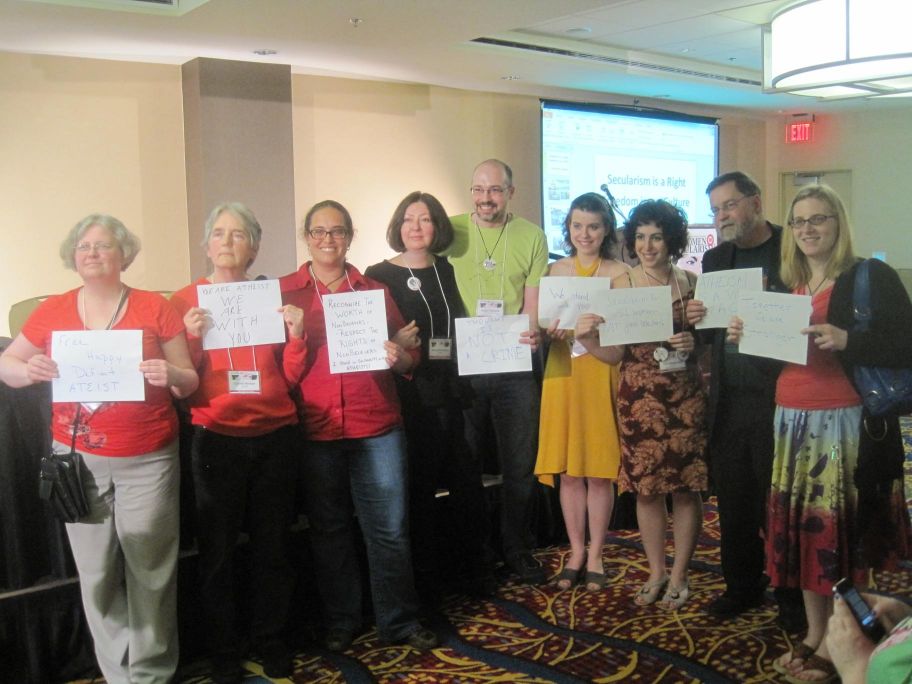
Adam Lee has a nice summary of the Women in Secularism conference. However, he does reveal that we Ftbullied him into talking the picture below, which is a no-no. You were told not to tattle, Adam Lee. The next time we meet, expect a pantsing, or even a swirlie. Also, put your lunch money in an envelope and mail it to me right now.

FTBullies

Oh, and look — even more ftbullying! We’re all holding signs abusing the theocratic governments that jail atheist bloggers.

A humanism relevant to humans

Sikivu Hutchinson has a new book, Godless Americana: Race and Religious Rebels, and she was recently interviewed about it.

What’s the most important take-home message for readers?

That humanism can be culturally relevant to communities of color. Traditional mainstream white-dominated freethought/atheist/humanist models don’t offer an adequate basis for social justice. They don’t address the intersection of women’s rights, civil rights, anti-racism, heterosexism, the racial wealth gap, and educational apartheid.

So while there are numerous grassroots atheist groups spearheading their own projects, the movement as a whole continues to be publicly defined by a handful of superstars and their limited vision. The absence of historical and sociological context for atheist politics, and its disconnection from social justice activism, will keep it in the lily-white one-percent column.

I have no patience for single-issue white male atheists who inveigh against the backwardness of organized religion as the fount of all evil and then have the luxury to retreat into their segregated ivory towers, insulated conferences, and highly-paid seminar bubbles. In Godless Americana I address the lived experiences of some of the most religious communities on the planet in one of the richest nations on the planet. I probe the sociological context for faith traditions and hyper-religiosity in American communities of color.

I have this grand, optimistic vision of humanity’s future, and escaping the dead-end lies of religion is part of it. But mostly what I see are people — all people — given the security and knowledge to live lives with true meaning, where they can grow and learn and engage in productive struggle, fighting to make the world a better place with every generation. I have my causes and my biases, but I don’t see how we can achieve that goal by having the causes and biases of a narrow subset imposed on the whole; rather, the few have to open themselves up to appreciate the experiences of the many. We must have the humility to change.

I am one of those white male atheists. I work in an ivory tower that is mostly white, I go to those conferences in beige, softly carpeted hotels, I sit contentedly in the seminar bubbles (but not highly paid — I have something better, a secure position that gives me the privilege to not have to ask for payment). But I am not a leader. I have no position in any hierarchy of any atheist/humanist organization. I just write and speak what I think, and that’s all I can do.

What I think is that for my vision to come true, no one can grasp at power, we have to surrender it. We have to sacrifice control by an elite for an expansion of opportunity for the base. We have to let go of the perspectives and interests of one gender, one race, one class and start thinking in terms of humanity.

You’d have a hard time finding someone more committed to the importance of freethought and science than myself — those are the ways to build a better world. It can’t be a better world if it only includes me and people like me — it has to be a better world for all. We have to include that in our equations and our principles.

Which path shall we take?

Amanda Marcotte has written an excellent open letter to the Center for Inquiry — it’s measured and reflects the consensus of the 30+ people who packed my hotel room on Saturday night.

Well, there are exceptions. This was Justin Vacula’s response on twitter:

Get out, Amanda, you not welcome here. Take your dogma elsewhere (you too, Ophelia)

This is the same guy who couldn’t get anyone to pay attention to him at the Women In Secularism conference — we had more interesting people to talk to — so he spent his Saturday doing an interview for that misogynist hate site, A Voice For Men.

Who’s supposed to get out again?

Mere atheism

Russell Blackford (@Metamagician) made a problematic assertion on twitter (the following paragraph is from four sequential tweets):

Just to be clear. My stance as a pro-feminist man does NOT follow from the fact that I am an atheist. Even if I became a philosophical deist overnight, I would maintain the same stance. Let’s not oversellMere atheism what mere atheism entails. None of which is to deny that actual religions can be used to provide false rationales for some abhorrent views.

That’s a bit of a mess, so let’s unpack it. I find interesting because my pro-feminist stance does follow from the fact that I am an atheist; perhaps we ought to recognize that there is more than one way to be an atheist, something I’ve been saying for a long time, and apparently Blackford and I are very different kinds of atheist.

There are some peculiarities in that statement. There is also more than one way to be a feminist, so announcing that one would still be feminist if they were a “philosophical deist” is both trivial and irrelevant: irrelevant because no one denies that there are religious positions that are compatible with feminism, and trivial because Blackford selected as an alternate a philosophy that’s about as close to atheism as you can get. I think we’d have a very different answer if he had speculated about an overnight conversion to Southern Baptist, or Amish, or conservative Muslim. As he notes at the end, there are religions that would impose abhorrent views that are incompatible with feminism. So about half of his comment is empty noise that contributes nothing to his thesis.

The interesting part is this: that “mere atheism” does not entail feminism. I both agree and disagree.

The agreeable side is that if we assume he means “mere atheism” the simple position that no gods or supernatural forces exist, then it’s true that that does not directly promote feminism. We could have a hypothetical atheism that postulated other, non-divine phenomena that contradicted feminism. For instance, a libertarian atheism that rationalized virtual enslavement of half the population to serve the other half, which just happened to recognize that it was easier to maintain the existing patriarchal framework, rather than going to all the trouble of inverting it. Or we could imagine a scientific atheism on a world with extreme sexual dimorphism, where the female sex was significantly smaller brained than the male sex. Or we could postulate a solipsistic or psychopathic atheism, in which an individual atheist considered members of the complementary sex to be resources to be exploited.

Blackford says he is pro-feminist (and he lives on this planet), so presumably none of the above scenarios apply. So why would an atheist be feminist?

In my case, the absence of a god invalidates all truth claims by revelation and all the traditional authority of holy books. It creates an epistemic gap, which I suppose someone could fill with just about anything: whim, utility, emotional needs, dice-rolling, whatever. I have no idea how Blackford explains cause and reason, but I know how I do: by an acceptance of natural causes which can be examined empirically and by experiment…by science. I also concede that where I can’t apply science in evaluating human motives, I use empathy and the principle of equating another’s condition with my own.

My atheism entails using those methods to resolve ethical decisions, for instance. That’s my toolkit. My atheism has stripped me of the tools of dogma and authoritarianism (and good riddance).

So now my atheism compels me to confront the question of the status of women by evidence and empathy. And what answer do both of those give? That women are my equals. That they share all the attributes of humanity that I have; there is no deficit in the quality of the experience of being a woman vs. being a man. That I cannot make assumptions about the capabilities or desires of a person on the basis of their sex.

This same reasoning applies whether I apply it to sex, to race, to class, or religious belief. My atheism requires me to be egalitarian because the evidence of our common humanity demands it. My reliance on that evidence is not independent of my atheism, but of course people who are not atheists can also share that same appreciation of others; the difference is simply that my form of “mere atheism” which is driven by naturalism means I have no other recourse, no other way of justifying my interpretation of the world.

But then, I don’t need any other mechanism — it seems to me that science and love of my fellow human beings is more than sufficient argument to guide the entirety of my life. And those are necessary axioms that I am compelled to accept by my atheism, even if there could exist alternate axioms that would also fill the gap left by the absence of gods.

It’s just that those alternate axioms, those other atheisms, also make one a jerk.

After they defeat Darwin, the creationists will be coming after psychiatry next

I think David Dobbs is going to be amused to learn that the Discovery Institute thinks he has just demolished Darwinism by way of psychiatry. But in an article that is delusional even by the standards of that bastion of lunacy, the DI argues that the collapse of evolution is just around the corner. Again. Like always.

Here’s how David Dobbs decided the demise of Darwinism: he wrote a positive review of a book critical of the impending release of DSM-5, The Book of Woe: The DSM and the Unmaking of Psychiatry. Such a small thing, the tiniest pebble that will lead to an avalanche of destruction and the total demolition of the edifice of modern science.

Or not. The book is critical of one component of the understanding of the mind, and it’s no surprise…hasn’t every edition of the DSM led to the gnashing of garments and the wailing of teeth, or something? As Dobbs points out, there really are fundamental flaws in how psychiatry handles mental illness.

The DSM, Greenberg concludes, “dresses up symptoms as diseases that are not real and then claims to have named and described the true varieties of our suffering”. Technically, the APA concurs, admitting sotto voce (for instance, in planning documents and public discussions for earlier versions of the DSM) that many psychiatric diagnoses are constructs of convenience rather than descriptions of biological ailments. This originates in an explicit decision the APA made, during the creation of DSM-III, to base diagnoses not on aetiology but on recognizable clusters of symptoms that seem problematic. The APA did so recognizing that this would mean stressing consistency among clinicians in recognizing symptom clusters rather than any other marker of a condition’s origins.

A slippery deal, but essential. For by formalizing this scheme, psychiatry can claim medical legitimacy and accompanying insurance coverage and pay rates so that it can help people. Unfortunately, writes Greenberg, this scheme has led everyone, psychiatrists included, to talk about and treat DSM’s conceptual constructs as if they are biological illnesses — a habit that has bred troubles ranging from overconfidence to incestuous liaisons with Big Pharma.

Yet neither Greenberg or Dobbs are predicting the annihilation of psychiatry. Rather, they seem to be discussing serious problems that need to be corrected so the discipline can advance.

As Greenberg writes, the DSM, and psychiatry with it, increasingly “casts its subjects into dry, data-driven stories, freed from the vagaries of hope and desire, of prejudice and ignorance and fear, and anchored instead in the laws of nature”. Yet when psychiatry works, it often works less at a biological than at a humanistic, narrative level, by helping the sufferer to reframe the story of his life and of his place in the world into one that includes a sense of agency, strength and social connection. This is doubtless why a combination of drugs and talk therapy generally works better than just drugs. It also helps to explain why schizophrenia, as described in Ethan Watters’ Crazy Like Us: The Globalization of the American Psyche (Free Press, 2010) and in work by Tanya Luhrmann, is much less disabling in cultures — or even treatment regimes — that cast its eccentricities more as variations in human nature than as biological dysfunction.

For more than 100 years, psychiatry has been getting by on pseudo-scientific explanations and confident nods while it waited for the day, always just around the corner, in which it could be a strictly biological undertaking. Part of the DSM-5’s long delay occurred because, a decade ago, APA leaders actually thought that advances in neuroscience would allow them write a brain-based DSM. Yet, as former APA front liner Michael First, a psychiatrist at Columbia University in New York, confirms on Greenberg’s last page, the discipline remains in its infancy.

So…it works, but our understanding of how it works is in its infancy. That’s not the act of carving its tombstone, but merely issuing its first grade report card (“little Psych is very creative, but needs focus and discipline.”)

That doesn’t fit into the creationist trope, though, so they had to…reinterpret what was said (“little Psych is about to die, deservedly!”) This is a really old line: the Discovery Institute has a hard-on for psychiatry that rivals Scientology’s. Some years ago they were fond of citing the troika of 19th century failed philosophers: Marx, Freud, and Darwin. They predicted that because Communism was already dead and Freud was an old discredited pervert, Darwin was next. It was highly irrational ‘logic’, and smacked more of superstition than reason, but it was a big deal for them. They’ve also been arguing for years for dualism — there is a supernatural soul or spirit in the brain — and anything that tries to find natural causes for the mind is anathema to them.

So Dobbs, published in Nature, and Greenberg, author of a very serious book, are dragooned into the service of intelligent design, their conclusions twisted to support the dogma of the day, and are now cited as not just pointing out the problems with past assertions or the politics that distort the publication of a major reference work, but as a science in crisis, on its deathbed, about to be pushing up daisies.

I agree with Greenberg, Dobbs, and the Discovery Institute (Erk! My heart!) that psychiatry is rife with conceptual problems and a serious absence of sound natural causes for the phenomena they describe. But I’m not about to write it off completely, and I certainly do not understand this massive bounding leap of illogic.

The things being said about psychiatry now, though, on the eve of publication of its latest upgrade, the DSM-5, are revealing it to be a science in crisis — if it ever was a science at all. As we list the problems, ponder whether many of the same criticisms could be leveled against Darwinism.

That makes no sense. The 18th century assertion by spermists that the spermatozoon contained a tiny homunculus has been disproven, therefore I’m pondering whether the same criticism could be leveled against stem cell therapies. The archaic economic structure of the Ottoman Empire contributed to its collapse, therefore I’m pondering whether the same criticism could be leveled against the apocalyptic popularity of Fifty Shades of Gray. The designated hitter rule ruined American league baseball, therefore I’m pondering whether the same criticism could be leveled against the use of polysiloxanes in McDonald’s Chicken McNuggets.

A = B, therefore X = Y is not sound reasoning.

But reason won’t get in the Discovery Institute’s way, now or ever! So they compile a list of psychiatry’s shortcomings, as they gleaned from a number of criticisms they found on the internet, calling it a “failed science”, even though that’s not the impression I got from the sources they cite.

  1. Long history of failure.

  2. No theoretical basis grounded in biological reality.

  3. Reliance on a book.

  4. Conflicts of interest.

  5. Lack of quality control.

  6. Ignoring critics.

  7. Focus on symptoms instead of causes.

  8. Category errors: confusing arbitrary classification with reality.

  9. Attempting to pigeonhole complex entities into simple categories.

  10. Concern for consistency and consensus over empiricism.

  11. Tortured attempts to fashion theories.

  12. Formalizing schemes to gain legitimacy.

  13. Promissory notes to do better in the future.

  14. Hopes that other sciences will legitimize it.

And now the fun begins. They have cobbled up 14 reasons why psychiatry is totally wrong, so let’s make up 14 complementary reasons why evolution is totally wrong!

  1. Failure to explain the Cambrian Explosion since Darwin.

  2. Extrapolating natural selection far beyond the evidence.

  3. Continuing to exalt Darwin and his Origin.

  4. Scheming to keep criticisms of Darwin out of journals and classrooms.

  5. Flimsy assertions that “it evolved,” with little rigor.

  6. Refusing to hear or publish scientific critiques of Darwinism.

  7. Use of homology as evidence and explanation for adaptation.

  8. Inventing terms like “kin selection” and “evo-devo.”

  9. Attributing the whole biosphere to undirected causes.

  10. Claiming the consensus accepts evolution in every meaning of the word.

  11. Applying natural selection recklessly to everything, even the universe.

  12. Scheming to prevent intelligent design from gaining a hearing.

  13. Always saying “more research is needed.”

  14. Misappropriating genetics, computer science, and development to support it.

Uh, wait. Despite having the same number of items, the lists don’t really line up at all well — there’s virtually no correspondence between the two. Furthermore, many of those items are just plain wrong or repetitive.

  1. We do have explanations for the Cambrian explosion, and good ones at that. That one is just a plug for Stephen Meyer’s hack book that’s supposed to come out next month (and I’ll write more about the reasons when it’s out.)

  2. That some people overuse a powerful explanation does not imply that the phenomenon does not exist. This is the same as #5 and #11.

  3. We do not exalt Darwin. We respect him as a great scientist who still got many things wrong. Also, you do not need to read the Origin to learn about evolution.

  4. “Scheming”? No. Demanding rigor. Half-assed assertions of a “designer” with no evidence are not adequate. This is the same as #6 and #12.

  5. This is the same as #2 and #11.

  6. This is the same as #4 and #12.

  7. No, I’ve never heard homology or common descent used as an explanation of adaption. Retention of non-adaptive features, sure.

  8. Both kin selection and evo-devo are terms for real phenomena, one for a gene-centric explanation for altruism (for instance) and the other for a discipline that relates evolution and development.

  9. This is not false. There is no evidence for teleology in evolutionary history.

  10. The scientific consensus accepts the scientific meaning of the word. What else would we do? Anything else, it wouldn’t be a consensus!

  11. This is the same as #2 and #5.

  12. This is the same as #4 and #6.

  13. But we always need more research! If we had all the answers, we’d be done with science.

  14. It’s not misappropriation. Genetics does support evolution; have you ever heard of the neo-Darwinian synthesis? Computer science provides an essential contribution to modern biology; have you ever heard of bioinformatics? Development and evolution work together beautifully; have you ever heard of evo-devo? Oh, right, you have, you just believe we made it all up.

The creationists are just getting more desperate and pathetic. They didn’t even try to come up with a reasonable set of correspondences — apparently they trust their readers to be so stupid that they won’t actually read or think about the comparisons, they’ll just see 14 reasons evolution is just as wrong as psychiatry — it’s about as reasonable as saying that the 14 stations of the cross mean Catholicism is as doomed as Freudian psychoanalysis.

But then, non sequiturs are what I’ve come to expect from those awful writers at the DI.


Dobbs D (2013) Psychiatry: A very sad story. Nature 497:36–37 doi:10.1038/497036a

The scarlet crayon of atheism

redcrayon

I’ve been trying to understand how people — not just people, but self-declared “leaders of the atheist movement” — can claim that atheism is only the lack of belief in any gods, and further, that absence of god-belief entails no other significant consequences. It’s been difficult, because that way of thinking is alien to me; atheism for me is all tangled up in naturalism and scientific thinking, and it’s not just a single, simple cause but has a whole cascade of meaning. But I’m trying, and I think I’m beginning to get it. There is a reasonable way to regard atheism as important while at the same time limiting its import.

Think of atheism as something like having a favorite color in a world with a set of cultural mores that dictate the value of colors. You’re five years old, and in kindergarten, and the teacher asks you to draw a picture of your mommy in your favorite color. You proudly go for the big red crayon in your box, and you start to draw, and everyone in the class turns to look at you strangely…and every single one of them is holding a blue crayon. “Everyone knows your favorite color is supposed to be blue,” they say, “You’re weird.” The teacher helpfully takes your red crayon away and gives you a blue one instead.

You might be a little resentful. You might think this is an infringement of your rights and an attempt to police your thoughts, and you’d be right. That would be a terrible thing to do to children. And then, what if you grew up and discovered that enshrined in your country’s constitution was a clause that specifically said the government did not have the right to dictate the citizenry’s favorite color? Why, you might become a crayon activist, fighting for the right of everyone to choose their own color, and you’d go to meetings where everyone would wave red crayons in the air and draw slogans on signs in red.

You might even be angry with other militant red crayon activists who tried to explain why red was the best color — that smacks too much of the blue crayonists who spent your childhood nagging at you why blue was the best. No, your cause is simply to let everyone have the right to choose their own color — it’s all about individual liberty and freedom of conscience. The crayon has no meaning beyond personal expression, and you don’t believe these stories that it has further implications, and you certainly don’t want to discuss why you liked red the best. It just is.

I sympathize with that perspective, and I think it’s entirely valid. There is a level at which you can fight for atheism in our culture purely on principle — that everyone should have a right to personal beliefs without meddling interference from outsiders, and certainly the government should not be in the business of supporting religion or its absence. There’s also a purely legal component to the argument, since America does have a constitution that plainly says “”Congress shall make no law respecting an establishment of religion, or prohibiting the free exercise thereof” — you can be a believer and still support the rights of atheists, just as someone in your kindergarten class could favor blue but still respect your choice of red.

But like all metaphors, this crayon story breaks down.

If religion were a purely personal matter, a case of individual preference (and for many people it is), the analogy would hold up. When we “militant” atheists speak about eradicating religion, that’s really what we mean — not that we’ll close all the churches and force everyone to publicly repudiate their faith, but that it will be reduced to a curious hobby or matter of choice, something that you might feel deeply (BLUE IS THE BESTEST COLOR!), but that you don’t get to impose that view on others, and that on matters of public policy, everyone will approach problems objectively and try to make decisions on the basis of evidence, rather than opinions about angels and ghosts and what’s best for your afterlife. So, yeah, someday I want your choice of religion to have about as much significance as your choice of a favorite color.

But that day is not now.

Religion is not merely a matter of taste. People attach great importance to an irrational explanation for how the universe works, to the degree that they use it to shape government and community decisions. You cannot get elected to high office in most districts in the US without professing a belief in a god — and in most places, it must be a belief in the specific Christian god. They use their irrational beliefs to justify actions that have real effects on thousands or millions of other people: we can pollute the atmosphere because god says we have dominion, and he promised to not ever kill us en masse again; black people and women are destined to servility because the holy book says so; you should punish or ostracize people who do not have sex in the traditional ways of your people.

Religion and atheism are not just different colors in the box of Crayolas.

Some of us are atheists for different reasons than just arbitrariness or thoughtless acceptance of a particular perspective. Among the New Atheists, we’re largely in this position because we reasoned our way to it, or adopted doubt and testing as our philosophical guidelines, or preferred science to faith. Atheism wasn’t a choice at all: we’re naturalists who accept observable reality and the universe around us as the metric for determining the truth of a claim, and every religion fails that test spectacularly, while science struggles honestly to accommodate understanding to the evidence.

I didn’t “choose” atheism. I can’t reject it without paying too high a price, the simultaneous rejection of a vast body of knowledge and a toolset that effectively discovers new knowledge.

Atheism also has implications. It actually makes significant claims about the nature of the universe…you know, that place we live in? The big box of rules and phenomena that determines whether we live or die, and how happy we’ll be during our existence? It’s important. As a science educator, that understanding of our world directly affects my occupation. As a human being, it directly determines how I will live my life.

When I say there is no god, it means that the foundation for a huge number of arguments that currently poison public policy evaporate. God created woman to be a helpmeet to man and to serve him as man serves God? Nope. We’re going to have to actually look at the evidence and determine from observations whether women are inferior (answer so far: no.) Black people were marked with that color as a curse from God and have servile natures? Nope. No god, no curse, no way to claim independent peoples are destined to be master or slave. Two men having sex together is an abomination unto the Lord, and the only fit response by a moral culture is to kill them, or at least abuse them? Nope. Your objective moral standard is a fiction, and perhaps a truly moral culture is one that gives all of its citizens equal respect.

Being an atheist means you can no longer learn your moral code by rote and tradition and obedience to authority*, but have to rely on reason and empathy and greater human goals, and you don’t get to justify actions simply because they “feel” right or good — you have to support them with evidence or recognition that they directly serve a secular purpose. Our atheism, our secularism, our rejection of divinity and ecclesiastical authority determines how we move through our life, and that movement matters. It’s not superficial, it’s not a fashion choice, and the absence of god has meaning.

Thank you to those who are willing to stand up for atheism simply as a matter of choice and principle, but you should know and be warned that we intend to change the world. We are more dangerous than you can even imagine. And apparently, more dangerous than even some atheists can imagine.

*I have to add that many theists also accept a secular morality — they may like their religion, but they also recognize that you must have a better excuse for community action than “god said so.”

Good times, good times. Wait, I meant bad times

Remember the good old days, when you could always trust a creationist to claim their theory was not religious, and then they’d turn around and neatly undermine their own claims for you? Think Bill Buckingham at the Dover trial, who completely won the case for the good guys by saying a lot of stupid stuff.

Wait, good old days? I think I meant now.

The Louisville Area Christian Educator Support (LACES) organization had a conference, where Bryce Hibbard, principal of Southern High School (a public school!) was one of the speakers. He first tries to claim that teaching creationism in the school was perfectly legitimate.

Hibbard and other speakers told the teachers present that it was perfectly acceptable under Kentucky law to teach biblical creationism in addition to evolution in science classes, and he suggested future meetings with biology teachers to craft curriculum.

“I taught biology for 20 years in this state and didn’t know that if evolution is part of the curriculum, that I could have been teaching creation,” Hibbard said. “I thought I was sneaky if I had the kids … present it. So it was presented in my classroom by the kids, but I could have been doing it and didn’t know that.”

So not only does he think it’s OK to teach creationism in science class, but confesses that he’s spent 20 years intentionally subverting the law.

But look what else this same guy said at the same conference:

Addressing a common theme of the night — the kids who aren’t taken to church, and therefore “have no hope” — Hibbard told the crowd they should be missionaries to students, planting the seed of Christ.

“We’re in the greatest mission field,” Hibbard said. “At one point I was told, ‘You should be a youth minister,’ and someone said, ‘No, you’re in the greatest mission field there is, stay in the public school.’”

Huh. Teachers and administrators in a public school who regard their students as targets for evangelical conversion. That sounds illegal, unconstitutional, and a violation of the public trust to me. Can we have him arrested, or fired at least? Anyone out there a victim of the shitty education provided by Southern High School want to bring a case against this goober?

There’s more.

When asked if such biblical lessons in science class — taking time away from learning actual science — would stunt the academic growth of students, Hibbard replied that it would not, as creationism is “just another theory.”

“Certainly, that’s what (creationism) is,” Hibbard said. “A theory is a scientific understanding of what we know today. So evolution is a theory. Creation is a theory. Intelligent design is a theory. The theory of relativity is a theory. Yeah.”

This incompetent was teaching biology? For shame.

The crucifixion is worse than nonsense

I was on another show with this odd New Covenant group — these are people very deeply steeped in Christianity, and it shows in their modes of thinking. Not all of them call themselves atheists, but they’re definitely freethinkers, and so I chattered with them for two hours. The topic for this one was on the crucifixion, and I argued that it was more than just false, this myth of sacrifice by proxy is abhorrent poison.

The other thing that makes them different from scientists and atheists is they’re just too nice — I’m really put on edge by compliments.

Fossil fish found on Mars!

Wait, not really. I should change that headline to “Pareidolia found on Mars!”, but then you’d all shrug your shoulders and say, “so what else is new?” I’ve got to do something to suck you in.

Anyway, there’s this whole weird subculture that’s been around since at least the 90s — I recall spending some time arguing with Mark Carlotto, an “expert in image processing”, at a lecture in Philadelphia some years ago, and these people were off-the-wall even then. The fudging and cheating he was doing to turn Mars Orbiter photos into vistas of ancient ruined Barsoomian cities was disgraceful. But even he showed some integrity with to the tools of image enhancement (not much, some) compared to the other bozos who spend hours staring at photos from Mars and imagining all kinds of weird and amazing things. For example, here’s one that’s supposed to be a “complete side view of a fossilized fish”. Look upon it, and believe!

martianfishFishLined

Oh, I better explain. The photo in the middle is an actual fossilized fish, from Earth. The picture at the top is a Martian mesa which someone thought looks like a fish, kinda like how this cloud outside my window right now looks like a woman’s breasts. In case you are unconvinced by the resemblance, the bottom picture is the same as the top one, with the fish drawn in by hand. That should persuade you, right?

Conveniently, they tell you what photo it’s taken from: it’s Mars Global Surveyor M0807345. Here’s a higher resolution photo of the same feature. The fishiness is even less apparent.

m0807345

NASA also provides the scale for the image. That mesa is about 750 meters long! Somehow I don’t think it’s a fossil fish, unless they grew really big on Mars.

But there’s more! Here’s a feature that looks like a sculpted Olmec head, if you squint so hard your eyes are closed.

OlmecFishOlmecHead

Those of you who didn’t quite close your eyes might have noticed something else: this is the very same feature that was called a fossil fish above. One orientation, fish; rotate it 90°, it becomes a stylized human head.

Shouldn’t someone have stopped at this point and realized that the similarities are entirely in the viewer’s head? But no, that’s no fun, not when you imagine you’re on the track of Martians. So let’s get weirder.

Here’s a picture of the Martian landscape; you can see the “fish” near the top. The rest looks like a jumble, so we’ve got to fix that with some sophistimacated image processing techniques. See the red line? They’re going to take everything on the right side of that line, and duplicate its mirror image to the left side, because apparently that’s how Martian brains work.

Demarcation2

And when you add a plane of mirror symmetry, MAGIC!

tiger

It’s a tiger! Don’t you see it? It’s obvious!

You know, this is what our brain does all the time. Add a hint of bilateral symmetry (or cheat blatantly and artificially create the bilateral symmetry), and our brains fill in the details and impose an interpretation on it.

I’m sorry, Martian fan-guy, but all your photos show are rough-hewn mesas and barren fields strewn with rubble.