Don’t read the comments!

I mean, do read the comments! In an article titled Why Atheists Have a Serious Problem With Women, the commentariat perfectly exemplify why women have a serious problem with atheists.

I would just point to those comments and say, “That. There. That’s exactly why the movement is having this dispute: because so many of our members are in denial of reality.”

Your four minutes of zen

I know how to convert creationists back to reason: I’ll just show them this video. It’s Harun Yahya and his harem of dolled-up acolytes letting loose by “dancing” Gangnam style. Well, they don’t actually get out of their chairs. And they all look very uncomfortable with it.

I’m no dancer myself, but that was a remarkably joyless spectacle.

The economics of menstruation and the short-sighted reductionism of capitalism

In science, there’s data, and there’s interpretation. It’s really easy to collect data (usually), but interpretation is the hard part — it requires an understanding of context and theory, and an appreciation of the real complexity of the problem. It’s tempting to simplify all your models — the spherical cow problem — but you also have to justify the reduction in complexity to show that it is reasonable. And that’s where some papers blow a hole in their foot. This is particularly a problem when the interpretation of the science is used to argue for policy changes.

Here’s a paper that’s a beautiful example of the split. The data is pretty and clever, the interpretation is shit…and that it goes on to question how to deal with the issue is the toxic icing on top. It’s about women’s menstruation, and how it effects their performance on the job.

This is the first part of the abstract. I don’t disagree with this at all.

In most Western countries illness-related absenteeism is higher among female workers than among male workers. Using the personnel dataset of a large Italian bank, we show that the probability of an absence due to illness increases for females, relative to males, approximately 28 days after a previous illness. This difference disappears for workers age 45 or older. We interpret this as evidence that the menstrual cycle raises female absenteeism. Absences with a 28-day cycle explain a significant fraction of the male-female absenteeism gap.

The interesting exercise in the paper was to see if they could mathematically identify a pattern in the absences. They had a very large data set — the payroll data for 2,965 women and 11,892 men who worked at an Italian bank — and they carried out some simple statistical operations that are familiar to me. I’ve done something similar before; I collected data on the positions of neurons in the spinal cord, and asked whether there was a repeating pattern in their distribution, and whether it was the same distance seen in the pattern of segmental muscle boundaries (it was). This is the same problem! Cool!

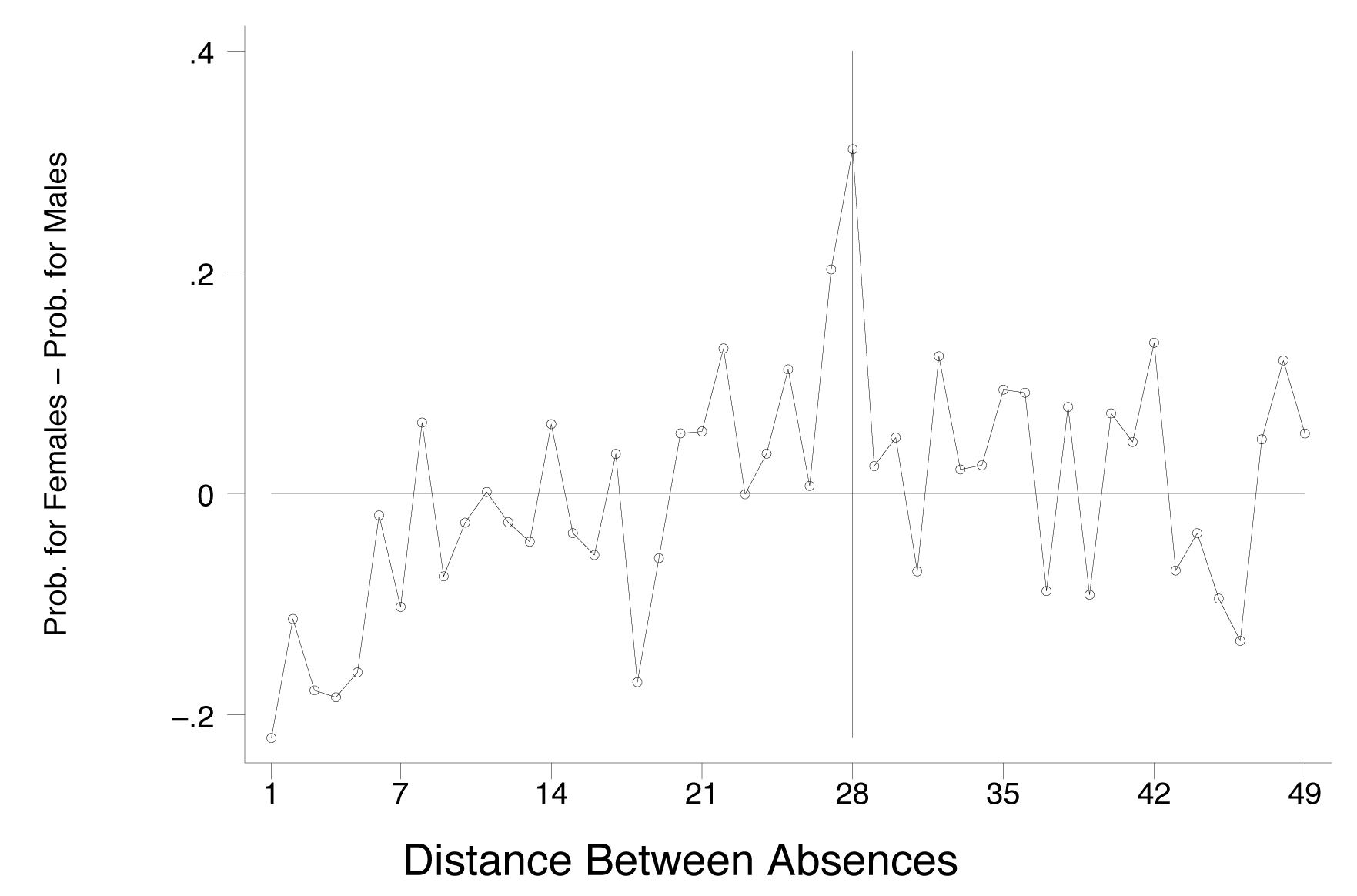
So they just asked if there were any periodic regularities in the aggregate absences all of the women working at the bank — not whether there was any synchrony in the absences, but whether if, for example, person A had an absence on her record on one date, what was the likelihood that she’d have another absence at some interval later? When you plot out the data, the signal jumps out at you: women are more likely to have repeating absences at 28 day intervals.

menstrualpeak

Note that this plot is of women’s absences relative to men’s — this is necessary because I’m sure there were other periodicities in the data that weren’t shown. For instance, the likelihood of someone taking a day off on Friday is higher than taking a day off on Wednesday, because we all like our 3-day weekends, so there ought to be a 7-day periodicity in the chart. But those absences are going to be roughly equally frequent for men or women, so by subtracting the two you get just the differential signal.

The results are totally unsurprising. Many women experience debilitating migraines or nausea at the onset of menstruation, so of course you’re going to see that biological regularity expressed in behavior. The work also found that there was a disappearance of the regularity in post-menopausal women, exactly as expected — it does not address the fact that many women regulate their menstrual cycle with birth control, but then, that information wasn’t in the data set. The authors should be emphasizing that their procedure detected a statistically consistent variation that does not apply to all women; you cannot assess one woman’s performance by pointing to the aggregate data for 3,000 women.

But they do fall for a fallacy. The authors seem to be sucked down into a whirlpool of narrow-mindedness by the prettiness of their numbers. Here’s the rest of their abstract, where they try to interpret their findings, and that’s where I have problems with the paper.

To investigate the effect of absenteeism on earnings, we use a simple signaling model in which employers cannot directly observe workers’ productivity, and therefore use observable characteristics – including absenteeism – to set wages. Since men are absent from work because of health and shirking reasons, while women face an additional exogenous source of health shocks due to menstruation, the signal extraction based on absenteeism is more informative about shirking for males than for females. Consistent with the predictions of the model, we find that the relationship between earnings and absenteeism is more negative for males than for females. Furthermore, this difference declines with seniority, as employers learn more about their workers’ true productivity. Finally, we calculate the earnings cost for women associated with menstruation. We find that higher absenteeism induced by the 28-day cycle explains 11.8 percent of the earnings gender differential.

You should have been put on high alert by the phrase “simple signaling model”. They’re going to argue that wages and promotions are set rationally, by impartial observers looking at just a few simply quantifiable characteristics, like absenteeism. Has anyone in the history of humankind ever worked at a job like that? Punch in, punch out, zoom, you’re climbing the ladder of success and no one ever looks at your work…or the color of your skin or the kind of genitals you keep in your pants…and all decisions might as well be made by a computer.

It’s an excellent example of being blinkered by an over-simplified theory. I don’t trust their “simple signaling model” at all — it’s only virtue is that they can plug numbers into pages of mathematical formulae in their paper. But if it doesn’t accurately describe how wages are set, what good is it?

Their own data has massive differences that they cannot account for with their equations either. Notice that they have 4 times as many men as women in their data sample; why is that? Does banking have a demand for greater upper body strength? Is the ability to grow a beard, which most of them will shave off, some kind of qualification for accounting?

And there’s more. The authors say this about their data set:

Females are younger and slightly more educated, but have significantly more sick-days [In the US, men take on average 3 sick days/year; women take 5.2 –pzm]. They are also paid on average 20 percent less and are heavily under-represented in the managerial ranks.

This bank employs a quarter as many women, pays them 20% less, and doesn’t promote them to management…are we seriously going to look at the fact that they menstruate as a significant factor in those differences? Yeah, they are: they’re going to punch some numbers into their spreadsheets and announce that menstruation causes 11.8% of the discrimination…that it’s a rational decision based purely on numbers in their account books.

This is bullshit. It’s bullshit used to prop up odious arguments.

Our findings may have policy implications. Forcing employers, rather than women, to bear the monetary burden associated with menstruation may be counterproductive. Whether society should address this biological difference with a gender-based wage subsidy depends on voters’ tastes for redistribution. Clearly, this is not a case of market failure, and the rationale for the subsidy would be redistribution rather than efficiency. A gender-specific public subsidy financed out of general taxation would shift part of the costs of menstrual- related absenteeism from women to men.

That’s beancounting thinking. Of course society and employers should subsidize biology: their employees are all biological organisms! Are we going to argue that perhaps companies should not be required to pay to maintain restrooms in the workplace because every minute spent pooping is one minute not spent assembling widgets? How dare workers demand 40 hour work weeks, simply because their bodies demand nightly periods of sleep, and their brains require other activities to maintain their mental health? And don’t get me started on handicap access ramps and the need to maintain two kinds of restrooms or the whole ridiculous demand for lunch hours.

What this is is an argument that the standard for all employees is that they be an able-bodied man, and any difference from that represents a short-coming that should be penalized…and anyone who argues otherwise is promoting wealth “redistribution rather than efficiency”. And as we all know, jobs are not for people, but for the company, and our sole criterion for efficiency is what works best for the corporate management. Not the worker.

I think that’s the fundamental problem of this paper and many others like it. It looks at human beings as numbers in a spreadsheet, and assesses them statistically by their contribution to corporate “success”, as measured entirely by short-term profit to the shareholders and management. The perspective used to interpret the data skews the meaning. And when your perspective is entirely based on over-simplified models and a purpose that ignores values other than profit, you get demeaning garbage.

This paper was published by the US’s very own National Bureau of Economic Research. It is not some reactionary right-wing think tank — it has been summarized by Paul Krugman as:

The NBER is best described, I’d say, as the old-boy network of economics made flesh. There are a couple of NBER offices, but they’re small; what the organization mainly consists of is its associates and what they do. In many sub-fields of economics, just about anyone well-known in the profession is an NBER research associate (yes, me too); it’s normal for these associates to release new research as NBER working papers.

You can criticize the role the NBER plays, mainly because it privileges insiders. If you’re associated with the Bureau, you can get research out quickly in a place everyone will see, whereas if you aren’t in the magic circle, getting noticed can be much harder. I would say that economics blogs are starting to remedy this disparity, but there will never be a truly level playing field.

This is a problem, too. We aren’t talking about far right-wing tea party crazies here — this is a smug economic establishment trapped in a rigid capitalistic worldview that can’t see anything but tables of numbers. It’s a nice way to plod along, getting incremental improvements in “efficiency”, but it’s all going to hell when the people rise up and scramble all their equations with a more human reality.

This is not an update

I can’t explain how things are going except to say…it’s complicated. Do try to keep up with others — I can’t. I worry that this is the end of a lot of good things, or rather, things that had to be the potential to be good, and that without many changes, we’re going to lose too many great people, and that conditions have become intolerable. Let me tell you that when I pressed “publish” on a certain post the other day, I knew that no matter how it turns out, the one thing I could be certain of is that I would be persona non grata in a large segment of the movement, and that I’d be spending many more quiet weekends at home in Morris in the future (which is OK, this is a nice place, and my day job is ramping up the responsibilities, and I’ll always have the blog).

But even if I’m squeezed out, it’s time to pick a side and build a better secular movement. You can’t do it by simply accepting what is and looking the other way. The standard you walk past is the standard you accept. It’s especially important that you don’t walk past the standard set by the powerful men in the movement.

The right-wing corruption of the process of science continues apace

The thoroughly discredited Regnerus study has met another ethical challenge. The Regnerus study was a bit of hackwork that tried to demonstrate, using Science, that gay parents were bad parents. It was an ideologically loaded mess endorsed by right wing think tanks that had massive procedural problems, but the conclusions aligned with what the think tanks wanted, so they pushed it.

Here’s an example of the procedural problems. One man, Brad Wilcox, seemed to do everything.

It’s also been alleged that W. Bradford Wilcox, associate professor of sociology at the University of Virginia with former ties to the conservative Witherspoon Institute that funded the study, served as a reviewer. He also consulted on the study, according to documents made public by the University of Texas. Wilcox, who also serves on the journal’s editorial board, did not immediately respond to a request for comment.

That’s only the tip of the problem. It turns out that Wilcox initiated the study, arranged the grant from the Witherspoon Institute, was planning to run the study (but had to beg off because he was too busy screwing science in other ways), was paid as a consultant to the study, and then was one of the reviewers of the paper. I presume he also signed the standard statement on the review that he had no conflict of interest.

You know, in science we make a very big deal about faking data — it can easily cost you your career, and definitely devastates your reputation. Shouldn’t subverting the entire process of peer review and independent evaluation count as something even worse?

Y’all can stop patting yourselves on the back now

There’s a study going around by Zuckerman, Silberman, and Hall that purports to show an inverse relationship between intelligence and religiosity. Here’s the abstract.

A meta-analysis of 63 studies showed a significant negative association between intelligence and religiosity. The association was stronger for college students and the general population than for participants younger than college age; it was also stronger for religious beliefs than religious behavior. For college students and the general population, means of weighted and unweighted correlations between intelligence and the strength of religious beliefs ranged from −.20 to −.25 (mean r = −.24). Three possible interpretations were discussed. First, intelligent people are less likely to conform and, thus, are more likely to resist religious dogma. Second, intelligent people tend to adopt an analytic (as opposed to intuitive) thinking style, which has been shown to undermine religious beliefs. Third, several functions of religiosity, including compensatory control, self-regulation, self-enhancement, and secure attachment, are also conferred by intelligence. Intelligent people may therefore have less need for religious beliefs and practices.

After reading the paper, I’m reasonably confident that they processed the data competently. However, I’d add a fourth interpretation that they don’t take seriously enough: that there was systematic bias in the intelligence studies they analyzed. I’m actually personally put off (bias alert!) by any study that attempts to reduce something as complex as intelligence to a simple number amenable to statistical analysis. The various studies measure intelligence by GPA (grade point average), UEE (university entrance exams), Mensa membership, and Intelligence Quotient (IQ) tests. Can you say apples and oranges? Yeah, I thought so. And anyone who has spent any time with Mensa people knows they aren’t particularly shining examples of crystal clear analytical intelligence, for instance.

But I would agree with the conclusion that studies have found an inverse correlation between religiosity and something they’re calling intelligence. But that doesn’t mean much.

This was a meta-analysis of 63 studies done on the corelation of intelligence and religiosity. Meta-analysis is a legitimate statistical approach, but it’s just as likely that what they’re detecting is a consistent pattern of abuse of the data, rather than that they’re actually observing a true psychological property of religious people. They’re using a grab-bag of studies; the first warning should be that work by Satoshi Kanazawa, Richard Lynn, and Arthur Jensen are tossed into the statistical stewpot. It cites Herrnstein & Murray’s The Bell Curve.

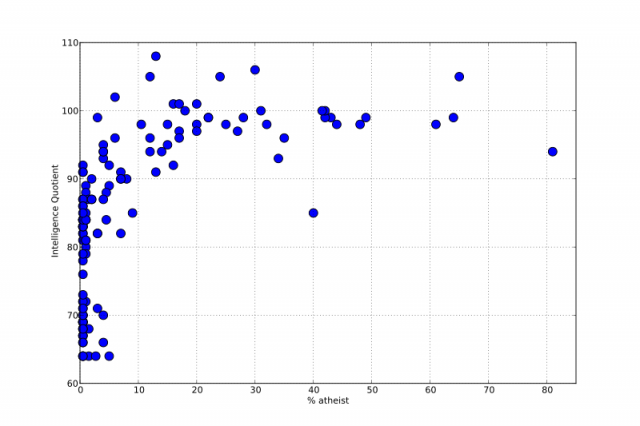
That’s right, they used Richard Lynn’s work — the guy who produced this gem of a graph.

LynnHarveyNyborg-Atheism-IQ

That’s a plot of average IQ of a country on the vertical axis against the percentage of atheists living in that country; each data point represents a whole nation. Apparently, there are entire countries on this planet where the average citizen has an IQ between 50 and 70 — that is, they are mildly mentally impaired, or capable of education at the elementary school level at best, and sometimes able to live independently. I think we can reject that nonsense out of hand.

Again, the statistics in the paper seem fine to my casual eye, but it really looks like a case of garbage in, garbage out. I’m not at all impressed that we can discern a trend when the floor is defined by people willing to embrace racist bullshit.

I thought the attempts to explain the pattern were quite nice, addressing a number of different hypotheses, and some of them were reasonable in trying to find a broader cause than simply “hicks is dumb”. But I had a hard time getting past the implicit bias in the study that they were looking at “intelligence”. I don’t think they were. I think you could find that ignorance is associated with religiosity — a lot of religions oppose education and insist on keeping certain segments of the population (i.e., women) as uninformed and uneducated as possible, and just that fact is going to skew the results to fit their conclusion. They also note studies that show the higher echelons of academia and educated individuals are less likely to be religious, and I can honestly believe that analytical examination of the claims of religion leads to a loss of faith. But we typically associate “intelligence” with something intrinsic to the individual, a biological property of their brains, and nothing in this study allows that conclusion to be made. The word is heavily loaded and entirely inappropriate.

Also, look at that graph again. If you throw out the obvious bias of classifying whole nations as mentally impaired, if you recognize that IQ is an artificial construct that measures a very narrow range of intellectual potential, it looks to me like the variation reduces to noise — that the supposed debilitating effects of religion are going to be very weak, if there at all. And what does that do to all the cunning rationalizations, no matter how plausible, for why atheists would do better on IQ tests?

I’m more inclined to accept Gregory Paul’s thesis that religiosity is coupled to socioeconomic status — that if you’re poor, you’re less likely to get the education that would help you see beyond the delusions of faith, and that also you’re going to be more reliant on the social safety net of your church. But it’s not lack of intelligence that is at the heart of religion, it’s class and emotional/cultural/historical concerns. Poor performance on IQ tests is simply a side-effect of discrimination and deprivation.

And, I must add, even if the correlation does hold up in studies that aren’t from racist jerks, it’s no consolation for you: your intelligence is a property of the individual, and being a member of statistically slightly superior group doesn’t confer any special abilities on you, other than the ability to hide behind Richard Feynman and pretend his brilliance somehow rubbed off on you. It didn’t, sorry.

I also think that Paul is closer to the solution: reduce socio-economic disparities, increase access to education, provide a secular social safety net, and you’ll get two effects: it’ll increase the knowledge of the population, and it will reduce religiosity. It won’t work by making poor people more “intelligent”, but it will increase their understanding and give them less reliance on religion — it will give already intelligent people opportunities to use their minds.

But it won’t make religion go away completely — smart people will still believe. And it won’t make all atheists uniformly non-stupid.


There has been a complaint that this paper didn’t actually use the data from the Lynn paper in their meta-analysis. This seems to be true. Although they do use data from Lynn’s coauthor, Nyborg, and certainly do cite the offending work without noting any caveats about its premises.

The last decade also saw studies on the relation between intelligence and religiosity at the group level. Using data from 137 nations, Lynn, Harvey, and Nyborg (2009) found a negative relation between mean intelligence scores (computed for each nation) and mean religiosity scores.

Why is anyone continuing to cite that sloppy work?

Certified 100% Non-Despairing Free-Range Atheists™

Remember those dumbass billboards outside St Joseph, MN — the ones that claim “With atheism, there is no hope, only despair” and “Jesus provides the only worldview that offers forgiveness”? It turns out that they have a defender writing op-eds. Cuttlefish has dealt with his nonsense more than adequately, but I just had to mention a few things (hey, it’s in MY backyard, I get to have fun with it).

The first thing that caught my eye was the opening sentence.

Like many of you who have driven by the religious-themed billboard on Stearns Country Road 75 recently, I’ve been encouraged by the Scripture.

That implies (but doesn’t outright say) that the messages are scriptural. They aren’t. They’re in quotes, but no attribution is given — the quote marks are there to give the impression that they come from an authority, and the suggestive implication that they’re somehow further authenticated by association with the Bible is a further attempt to mislead. So right off the mark, he’s being dishonest.

But the thrust of his message is that gosh, atheists shouldn’t be offended, it’s not an insult, but is simply the “logical consequences” of our ideas…and that, of course, a life of devotion to the myths of religion is a good thing.

The logical consequences of atheism elicit emotion because to live consistently as an atheist is untenable. Grasping these truths put me on the narrow path that is brightly lit, not by me, but by the sacrifice, love and grace of Jesus Christ.

Hmmm. How would he feel if the logical consequences of Christianity were that you’d shoot abortion doctors, enslave women to a life of pregnancy and household chores, and cheerfully torture and murder infidels? Does simply asserting that that is what Christianity teaches make it any less insulting, especially since that is not what most Christians believe?

Similarly, atheists are not typically in despair and find living without gods not only tenable, but liberating and uplifting. And you’ll have to try to understand that most rational people in the 21st century do not find blood sacrifice to be particularly redeeming — it’s primitive, barbaric, and revolting.

A warning

Here’s another challenge for the growing atheist movement: can we avoid the trap of charismatic leadership and the cult of personality? As church attendance declines (a good thing), as pastors wake up and realize their faith was a lie (a very good thing), and as we try to embrace even church leaders who want to join the secular movement, we have to beware of the temptation to just put them to work doing the same old thing they’re familiar with, in atheist “churches”. Donald Wright does a fine job expressing reservations I’ve also had about adopting the trappings of religion.

One of the joys I celebrate in escaping from religion and church is no longer participating in this unbridled authority and reverence given to the pastor; the position of entitlements. Their needs and desires are always met or a concerted effort is attempted by the membership with much toil and sacrifice. The pastor is doused with honor and respect, given a god-like public image, and proclaimed a truth teller. A celebrity is added to the culture.

After receiving these former religionists with open arms and nurturing their non-belief, how will the secular community respond when they seek leadership positions? Will the secularists, humanists, freethinkers, atheists, agnostics, and skeptics embrace these individuals with greater enthusiasm just because they are ex-pastors? Will they seek to find the true character and uncover those holy skeletons? Will they put forth adequate vetting to determine that their integrity matches their charisma? These are my concerns, because a secular church in the hands of a cult personality is a religion disguised as a humanist community. Will there be a secular church on every corner filled with sheeples?

What we need to construct are egalitarian institutions that do not simply co-opt the corrupt schema of existing religious institutions. We should be modeling democratic political forms rather than buying into destructive ecclesiastical patterns of organization.

Sometimes, malice is likelier than natural causes

Rahul, a child in India, is covered with horrible burns (caution: large color picture of scarred baby at the top of the article.)

The infant was admitted to the hospital on Thur­sday with burn injuries. The baby had had four such episodes with the first one barely nine days after his birth and another more re­cent one three weeks ago.

“An episode may or may not recur. It’s like any other burn injury, with the likelihood of scars and secondary infections. Plastic surgery is also expected to be done. The relatives or parents have to always keep an eye on the baby. Matchsticks, crackers or anything that can catch fire should not be kept near him,” Dr Babu added.

A bucket of water and fire extinguisher have always to be kept ready near the baby’s bed.

Huh? He’s in the hospital. Why are they worried about more burns rather than treating the ones he’s got?

Because they are blaming the child’s injuries on Spontaneous Human Combustion. Recurring spontaneous human combustion, no less — the kid is claimed to just burst into flames with no discernible cause.

The paediatric intensive care unit at Kilpauk Medi­cal College and Hospital on Friday received a number of curious visitors wanting a glimpse of three-month-old baby Rahul who suffers from Spontaneous Human Combustion (SHC).

Only 200 cases have been seen such in the world over the past 300 years, the last reported case being in the United States in 2010.

“The body burns spontaneously due to combustible gases emitting from the patient’s body, without any external source of ignition,” said Dr R. Narayana Babu, head of the paediatrics department, Kilpauk Medi­cal College. “Clothes and other things nearby that are inflammable may also catch fire.”

I have a suggestion. The bucket of water and fire extinguisher are silly. Instead, I recommend a hidden video camera…especially one that is carefully monitored whenever the parents come to visit.