Hug an Atheist — but ask first!

Some movie makers are trying to raise money to distribute their film, and it looks good and sends the right message. It’s titled Hug an Atheist.

I don’t mind an occasional hug, but remember, though: some people are very uncomfortable with personal contact, and being an atheist is not a label that says you have permission to cross boundaries.

Except at the mandatory Satan-worshipping orgies. Oh, wait, did I let that slip?

(via Lousy Canuck.)

Stop kicking yourselves, Australians

On the eve of the Bill Nye/Ken Ham debate, it’s nice of the Secular Coalition of Australia to apologize for sending Ken Ham to us. But, to be honest, I cannot accept the apology. Ken Ham’s ideas were forged in the crucible of raging American fundagelicalism — he has explicitly credited The Genesis Flood: The Biblical Record and Its Scientific Implications by Whitcomb and Morris as his inspiration for the idiocy he promotes, and it really is the bog-standard Young Earth Creationism formulated in the 1960s by frustrated American creationists who were trying to appropriate scientific respectability for their religious cause. So we are ultimately responsible for poisoning the entire planet with this nonsense (you aren’t alone, either; Turkish creationism is really just regurgitated bilge from The Genesis Flood, too).

I do think the Australian suggestions for what Bill Nye ought to do to Ken Ham to be possibly acceptable, however — if only someone could translate them into English.

So on Tuesday, when you’re roasting the Ham and his patently ridiculous ideas on the rotisserie of logic, tell him you’ve got a message from Australia. Tell him from us that we used his state-issued Akubra hat to cover a hole in the national chookhouse shed, that he is no longer entitled to use his formal Australian name (Kenno) and that he is now forbidden any Tim Tams – ever again. Also, that whenever his name comes up at Christmas, while we sit around drinking white wine in the sun, there will be a formal awkward silence of twenty to forty seconds, until someone brightly offers everyone pudding. And if you could manage to kick him in the shins and tell him and his ilk to leave our kids alone, Bill – we’d owe you one.

Biblical slavery was such a lovely and tolerant experience

The clueless goons at AiG are confident about the outcome of Ken Ham’s debate with Bill Nye, claiming that the scientific facts of the Bible will win the day. Of course, you have to understand that what creationists call “fact” and what rational people call fact are rather different things. For example, when confronted with the Biblical support for slavery, here’s what they have to say:

What do you mean by slavery? Biblical slavery (servitude) was much different from what most people today think of as slavery (e.g., what some Europeans and Americans shamefully did with some African peoples, which is a recent example of forced slavery in the Western world).

Slavery (servitude) in the Bible was when someone was overextended in debt and could not pay it off. They would sell themselves into slavery for a seven-year term to pay off that debt to a wealthier person. During that time, they were given room and board, were paid a small wage that they could put into savings, and were taught a vocation. Then when they came out of this seven-year servitude, they could enter the culture with means and a profession.

Oh, really? That was only sometimes true, and then, only for the men, and only if they are Hebrews. Read Exodus 21.

2 “If you buy a Hebrew servant, he is to serve you for six years. But in the seventh year, he shall go free, without paying anything. 3 If he comes alone, he is to go free alone; but if he has a wife when he comes, she is to go with him. 4 If his master gives him a wife and she bears him sons or daughters, the woman and her children shall belong to her master, and only the man shall go free.

5 “But if the servant declares, ‘I love my master and my wife and children and do not want to go free,’ 6 then his master must take him before the judges.[a] He shall take him to the door or the doorpost and pierce his ear with an awl. Then he will be his servant for life.

7 “If a man sells his daughter as a servant, she is not to go free as male servants do. 8 If she does not please the master who has selected her for himself,[b] he must let her be redeemed. He has no right to sell her to foreigners, because he has broken faith with her. 9 If he selects her for his son, he must grant her the rights of a daughter. 10 If he marries another woman, he must not deprive the first one of her food, clothing and marital rights. 11 If he does not provide her with these three things, she is to go free, without any payment of money.

This idea that slaves were all happy Hebrews who were going through the ancient equivalent of bankruptcy court is amusing, but atypical. Where did many slaves come from? It’s just a real shame if you happen to be a woman, or for instance, a Midianite, because you were spoils of war. Read your bible, Numbers 31.

7 They fought against Midian, as the Lord commanded Moses, and killed every man. 8 Among their victims were Evi, Rekem, Zur, Hur and Reba—the five kings of Midian. They also killed Balaam son of Beor with the sword. 9 The Israelites captured the Midianite women and children and took all the Midianite herds, flocks and goods as plunder. 10 They burned all the towns where the Midianites had settled, as well as all their camps. 11 They took all the plunder and spoils, including the people and animals, 12 and brought the captives, spoils and plunder to Moses and Eleazar the priest and the Israelite assembly at their camp on the plains of Moab, by the Jordan across from Jericho.

13 Moses, Eleazar the priest and all the leaders of the community went to meet them outside the camp. 14 Moses was angry with the officers of the army—the commanders of thousands and commanders of hundreds—who returned from the battle.

15 “Have you allowed all the women to live?” he asked them. 16 “They were the ones who followed Balaam’s advice and enticed the Israelites to be unfaithful to the Lord in the Peor incident, so that a plague struck the Lord’s people. 17 Now kill all the boys. And kill every woman who has slept with a man, 18 but save for yourselves every girl who has never slept with a man.

I am not so confident of the outcome of this debate. You can see what the liars at Answers in Genesis will do; not even the words of their Holy Bible are safe, but will be twisted and misrepresented to produce a false picture of their claims. I do wish these loons who so enthusiastically endorse the “literal interpretation” of their Bible would actually acknowledge what it says. If you’re going to claim that the Earth is less than ten thousand years old because you are forced by logic and consistency to accept every word of the Bible, then you must also accept that your daughters are your possessions to be bought and sold into slavery, and that the rape and genocide of foreigners is God’s will.

Funny Looking Rock found on Mars!

When last we heard from Rhawn Joseph, he was playing with photoshop and trying to sell off his online journal, the Journal of Cosmology. The Journal of Cosmology has been plugging away, claiming to have found bacteria in meteorites and then diatoms in meteorites — give them a blurry, vague photo of some shapeless blob, and they’ll claim it looks just like something biological on Earth. Either that, or they’ll photoshop my head on to it.

Rhawn Joseph’s latest struggle: he’s suing NASA for suppressing evidence of life on Mars. His evidence is this pair of photos taken by the Mars Opportunity rover, 12 days apart, and released by NASA.

sol3540

Look! There’s a rock in the later picture that wasn’t there earlier! How did it get there? NASA’s explanations were first, speculation that it could be a meteorite, but now they seem to think that it was most likely flicked by the rover itself, as it was making a turn. That sounds reasonable to me.

But not to Rhawn Joseph! We’re missing the most obvious “fact” of all, that what appeared in the later photo was no rock at all, but a mushroom. He demands that NASA investigate thoroughly, using the power of a legal writ.

In Re RHAWN JOSEPH’S PETITION FOR A WRIT OF MANDAMUS COMPELLING NASA TO PERFORM A DUTY TO THOROUGHLY SCIENTIFICALLY EXAMINE AND INVESTIGATE A PUTATIVE BIOLOGICAL ORGANISM ON MARS IDENTIFIED/DISCOVERED BY PETITIONER AND REFERRED TO BY NASA AS: “UNLIKE ANYTHING WE HAVE SEEN BEFORE.”

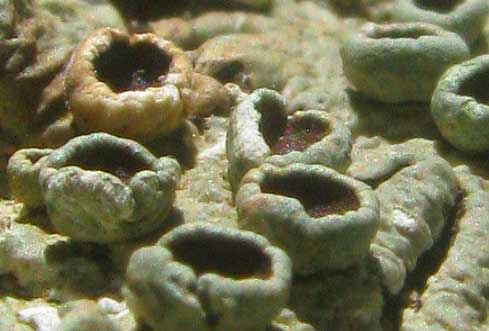
How can you doubt it? He has since published his results in a “scientific journal” — his own online website — complete with side-by-side photos of the Martian Funny-Looking-Rock and earthly apothecia.

Apothecia

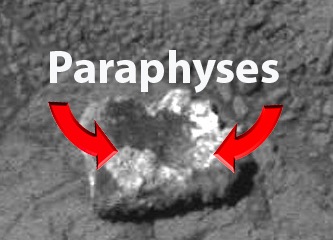
The “mysterious” bowl-like structure which appeared on Mars does not resemble a rock or a meteor, but a lichen fungus which on Earth is known as “Apothecia.” A magnification of the structure Sol 3540 reveals the presence of numerous “paraphyses” which are spore producing organs of Apothecium. On Earth Apothecia are commonly observed on rocks, tree limbs, or growing on the ground next to open road. Related species are known by a variety of names, such as Eastern Speckled Shield Lichen (Punctellia Bolliana). The term “shield lichen” is applied to a variety of foliose lichens. An important characteristic is their bowl-shaped growth with brown inner surfaces. These bowl shaped structures are “apothecia” and appear basically identical to the “mystery” structure depicted in Sol 3540 but which NASA wishes the public to believe is a rock or meteor which suddenly sprouted on this slab of Martian real estate.

In case you missed the similarity, here’s a photo of the Mars FLR with big red arrows and bold text pointing to the “paraphyses” — you know, just in case the visual similarity might not be as strong as Joseph claims.

paraphyses

Joseph says that if you “magnify” the image the similarities to the paraphyses of apothecia are even more apparent, which is kind of amusing: you can’t magnify the raw pixel data. All the information you get is right there. You can make it larger, but that’s not at all the same as increasing resolution.

I have used all the powers bestowed upon me with my Ph.D. to squint even harder than Rhawn Joseph at that rock, and I’m sorry, it’s a rock. It’s not a fungus or a lichen or a Happy Meal toy or Rhawn Joseph’s lost marbles, and if you look at the raw image rather than one that Joseph has pseudocolored to tint it green, it doesn’t look particularly biological.

Also, NASA already seems quite happy to investigate further.

Mr Squyres said scientists believe the rock, named "Pinnacle Island," got there when the aging rover did a pirouette turn in the dusty Martian soil and knocked loose a chunk of bedrock that rolled a short distance downhill.

"We think that in the process of that wheel moving across the ground, we kind of flicked it, kind of tiddly winked it out of the ground and it moved to the location where we see it," Mr Squyres said.

Still, scientists have not found the divet the rock would have left behind. They think it is hidden beneath one of the rover’s solar arrays.

The Opportunity team plans to manuever the robotic vehicle around a bit more to see if they can find the spot from which the rock emerged.

As to why it is such an unusual color [it’s a darker red than the surface], Mr Squyres said it may be that humans are witnessing a surface that has not been exposed in a very, very long time.

"It appears that it may have flipped itself upside down," he said.

"If that is the case, what we are seeing is we are seeing the surface, the underside of a rock, that hasn’t seen the Martian atmosphere for perhaps billions of years."

Already, an analysis of the rock with the Opportunity’s spectrometer has shown a "strange composition, different from anything we have seen before," he told reporters.

The rock has a lot of sulphur, along with very high concentrations of manganese and magnesium.

"We are still working this out. We are making measurements right now. This is an ongoing story of discovery," he said.

Ah, but I think you see the real problem: NASA has used data from other instruments on the rover to come to a conclusion that differs from Rhawn Joseph’s far-fetched speculation of Martian mushrooms.

“The New Atheists as Secular Fundamentalists”

My delightful evening of fun and intellectual stimulation continues shortly, with a guest lecture on my campus from Chris Hedges, who threatens to berate atheists with his typical ignorance. I’m hoping for full-bore hand-waving purple-faced screaming, but otherwise, it’s going to be a failure of a night.

I’ll try to live-blog it, if he says anything interesting.

His introduction is all about his Harvard Divinity School professor’s experiences in Nazi Germany, and how Christianity was coopted by fascists, which led to his book, Christian Fascists, and his concern with the origins of totalitarianism. He also talks about how megachurches absorb people into the fold, and the nonsense at the Creation Museum.

Then he debated Harris and Hitchens. He was upset and angry at how Dawkins and Dennett and Harris and Hitchens replicated the authority structures of the Christian Right. What?


7:45. Suddenly we’re talking about genocide in Serbia. Where’s the connection to the atheists?

Now he says that like like the Christian Right, atheists can only argue against a caricature of religion: they haven’t studied theology! They have gods of reason and science. And this meme stuff is an example of the misuse of science, reflecting the desire of atheists to engineer ideas, and control the way people think.

He really doesn’t like Sam Harris, quoting him on torture and nuking Islamists. I know this would surprise Hedges, but there are an awful lot of atheists who dislike Harris’s ideas, too.

But no: both atheists and the Christian Right embrace the dehumanization of Muslims. We do? I keep hearing things that I reject, being told that this is what I believe to be a New Atheist.


Weird. Now we’re being told of the bizarre practices of Christian Right anti-abortion activists. What drives people into these movements is despair. Relevance? I don’t know. It seems he doesn’t have enough horrible stories about totalitarian atheists so he has to drag in tales of the religious to tar us with their sins.

The New Atheists misuse Charles Darwin and the theory of evolution. It’s not a theory about politics or culture, and Dawkins and EO Wilson abuse it to make false claims about society. What? The Dawkins who has said that selection is an inappropriate ideal for human behavior? Freakish. And now he has brought up Social Darwinism. He’s sounding a bit like the loons at the Discovery Institute.

The New Atheists believe that evolution is linear and directed towards a goal and that we believe in using it to justify genocide.

Religion is not irrational, but it is non-rational. Jebus, Hedges, focus. Make an argument and back it up. This is rambling nonsense.


8:05. My brain hurts. This is stupid. Now he’s chewing out science for fracking and global warming and pollution, and blames it on the corporate state. Fine. Do atheists align with the corporate state? Does any of this have anything to do with his thesis?

New Atheists see evil as something outside themselves that must be eradicated and that evil is largely Muslim.

Fundamentalists readily embrace violence, just like Sam Harris, therefore atheists are fundamentalists. How can I possibly defeat such lucid logic?


8:15. I don’t much like Sam Harris. Harris rather detests me. It’s getting a bit old hearing some horrible thing Harris said being pinned on atheists, including me, as a class…by a guy who’s berating atheists for demonizing groups of people.

We seem to be closing with some babble about transcendance and the struggle with the irrational and the need for the sacred, whatever the hell that is. And we get to the heart of his problem: atheists are knocking down his cherished presumptions, and replacing then with squalid monuments to ourselves…which is a form of idolatry.


8:20. He’s blathering incoherently through the Q&anp;A now. This talk has been such a mess of misconceptions and rambling nonsense that I can’t even think of a question. It’s the same feeling I get when I’m at a creationist talk: it’s wrong from word one, so where do you start?


There were two places where Hedges totally lost me with his bullshit false equivalencies. Well, more than two — but these were the big ones.

  • Just as the Christian fascists abuse the bible, the atheists abuse evolution. Dawkins argues for a linear, progressive, utopian version of evolution. Total crap. Dawkins has been quite clear that natural selection is a “clumsy, wasteful, blundering low and horridly cruel” process, and not at all desirable as a model for human relations. Hedges argument relied entirely on misrepresenting what atheist evolutionists have said.

  • Christian fascists have totalitarian authority structures, just like the New Atheists. I just wanted to ask, what authority structures in atheism? He spent a lot of time railing against Dawkins and Hitchens and Harris; one of those three is dead, and the other two are single individuals who’ve written books. I remember attending a Hitchens lecture in which he presented his odious anti-Muslim views, and the audience booed him. These guys are not our rulers. Hedges has simply inflated his animus against a few individuals into a broad brush characterization of every atheist.

It was infuriating.

I love to watch my enemies flail at each other

Two creationist camps, both alike in dignity, in fair America, where we lay our scene, from ancient grudge break to new mutiny, where civil blood makes civil hands unclean. Not that they were ever very civil to begin with.

The Discovery Institute snipes at Answers in Genesis, suggesting that the Nye-Ham debate is going to humiliate the science side and also clarify the difference between Intelligent Design creationism and Overtly Religious creationism; Ken Ham fires back at the Discovery Institute, arguing that ID fails to lead people to the One True God.

This can only end in blood, we hope. Or poison.

An understated map of the problem

This is a map of all the American schools that are officially teaching creationism with the full permission of the state educational system, either through voucher programs or state laws that allow nonsense to be taught (Louisiana and Tennessee stand out as gangrenous spots, don’t they?).

It minimizes the problem. Minnesota looks pure and clean, but that’s because our laws expressly forbid teaching creationism here…but that doesn’t mean that it isn’t snuck under the table. About a quarter of our teachers give instruction in creationism without state endorsement.

Nice example of the fallacy of the excluded middle

The Huffington Post has published A Conversation Between Two Atheists From Muslim Backgrounds. It would be more interesting if it weren’t full of logical fallacies — in places, it’s more of an exercise in beating up liberal straw-people.

I think 21st century westerners generally don’t appreciate what they take for granted, because somebody else fought for these rights before they were born. I have given so many speeches around the country and I have heard many statements like, "The United States is the worst country on Earth," and, "We are no better if not worse than the Middle East when it comes to women’s rights and gay rights." These laughable statements generally come from people who have not been outside the United States, let alone even left their zip code. So I think most of the lack of appreciation of the freedoms in this nation or other Western nations have come from ignorance and lack of experience.

It’s quite possible that they have heard a few comments like those quoted — both the left and right contain stupid people. But I do think those are grossly misrepresentative, as well as simply wrong.

I don’t know anyone who thinks the United States is the worst country on earth — we can point to ‘witches’ being burnt alive in Africa, to gays being oppressed and murdered just about everywhere, to women being denied even the most basic freedoms in many Islamic countries. But we can also point to the satanic ritual abuse mania, the epidemic of violence against trans people, endemic racism, and inequity here, too. That the US is not quite as bloody-minded domestically (we’re pretty bloody-minded when it comes to foreign policy, unfortunately) as, say, Afghanistan does not mean we need to shut up and not worry about cleaning our own house. It does not mean we must live in denial about the diminished career opportunities for women in America because women in Saudi Arabia are being stoned to death for adultery.

We must remain focused on injustice everywhere. We cannot excuse a lesser crime here because a greater crime occurs somewhere else.

Even if you’re focused entirely on the greatest offenses against humanity, there are good practical reasons to address them everywhere. For example: Ireland is a western democracy; I’d rather live there than in the Sudan, or Uganda, or Iran. It’s a very nice place, for the most part, with some ugly history and unfortunate relics of theocracy lurking about, like their blasphemy law and their acknowledgment of a deity in their constitution. Minor problems compared to countries that are actively and oppressively theocratic, right? But some Islamic nations love to point to the blasphemy laws in Ireland as legitimizing their own tyrannical laws.

Further, the Irish people can work to change their laws to a more enlightened state; Irish or Americans or French people can’t do much to change Iranian law, other than by setting a good example, or more unfortunately, throwing threats and bombs at them until they change (and the record shows that those tactics aren’t particularly effective).

And may I say that I find it particularly irritating for someone to say that westerners are just sitting back and coasting on the labors of their ancestors, as if Grandpa solved all of America’s problems, and there are no battles left to fight. Tell that to women, to minorities, to gays — go ahead, tell them that Stonewall was just a little party, that the Selma-to-Montgomery march was just a meaningless stroll, that the people who have been campaigning against our aggressive military or corporate abuse aren’t putting their livelihoods on the line.

How would Muslims feel if we declared that they have to shut up and stop with the pity party until North Korea is cleaned up? Because of course there is only room for one Hell on earth, and all the rest of the planet is a paradise.

Do you see that that is as much of a false dilemma as accusing the West of wasting time on their own failings?

Engaging silly beliefs in multiple ways

John Wilkins discusses the utility of believing in nonsense. He knows some members of a branch of the Plymouth Brethren down there in Australia; they’re a pretty distinctive sect here where I live, too. The interesting thing about them is their intentional isolation. They don’t proselytize, they don’t even talk much to us outsiders, and as John says, these are probably survival tactics for the sect — silly beliefs can flourish if you only talk to other people who share the same silly beliefs.

So what do you do when your opponent avoids engagement?

What does this mean for practical purposes? How do we counter these false beliefs? There is no simple answer. In the short term we can insist that our functional bureaucracies and social institutions do not give credence, but that will only harden those who deny the facts in their beliefs. At best it will slough off the fence sitters, and reduce the core denialists to a rump. That is one good thing, but we want people to face reality when it really matters. A better, but longer term solution is to insist that education teaches not the facts, but the methods by which we understand those facts, in order that people can develop their cognitive stances appropriately. This denies the next generation of denialists their replacements, until they become at best an extremely small minority. Education is the solution, which the denialists well understand. This is why we have objections to even discussing these “controversial” matters in schools, and why the denialists (whether of evolution, global warming, or whatever) continuously try to insert their agenda into public education. An uneducated community is more easily controlled and manipulated.

This is a good general approach, not just for dealing with creationists, but for teaching the general population. Teaching to the test just generates competing authorities, and we can’t win that battle; parents, peers, and coercive religion hold all the trump cards. But teaching kids to think for themselves…now that’s where we totally rule.

But I think there are a couple of issues that John didn’t engage in that blog post. Yes, please, better teaching. But what about these problems?

The Brethren or the Amish or any other sect that withdraws from the larger society really isn’t a long-term problem. They’re going to fade away or evolve eventually. The reality is that, at least in America, we have to deal with evangelical religions: Answers in Genesis or the Southern Baptist Convention aren’t simply retreating into their own navels, they are actively proselytizing bad beliefs. Simply trying to erode their base away with good teaching hasn’t worked here, at least (or possibly, we just don’t have good teaching), and direct and aggressive opposition is necessary.

Even religions that have insulated themselves and just want to be left alone do harm. Consider just the problem of faith healing; we have laws in the US that shelter ideas that lead to dead children. Unless we’re willing to say that society as a whole has no interest in kids, and parents are free to abuse them intellectually and medically, intervention is often called for. Our local Brethren aren’t proselytizing directly, but apparently they have quiet clout: they’ve compelled the school board and local businesses to avoid ‘controversial’ issues by threatening to withhold their custom or withdraw their kids from school. They’re smart and are using passive techniques to prevent kids from getting good educations.

Finally, if we’re going to concede that creationists are following a rational social strategy (and I do!), then we also have to recognize the godless complement: while many scientists and naturalists certainly follow the similar tactic of cloistering themselves with their like-minded colleagues, many of us are rationally pursuing a strategy of active, public opposition to believing in silly things. While teaching children how to think and learn is part of our goal of taking over the world, another important aspect is consolidating and reinforcing a non-believing community.

The inward-looking community is one approach to sustaining and strengthening a group: look to those Brethren or most academic departments, for instance, and you’ll see that in action. But the flip side is forming outward-looking communities — Answers in Genesis has a little bit of that, poorly done because they can’t really afford to engage the evidence, but it’s a fairly natural direction for science-based communities to take … we’re supposed to be evaluating new ideas all the time.

Also, we do it for the lurkers. Exclusive sects aren’t very good at gaining new recruits.

Philosophism

I have seen scientism, and it’s usually not us. The most blatant example recently was Pinker’s appalling essay in which he suggested that Hume could have used some instruction in molecular biology; I’ve seen people like Hawking and Krauss claim that philosophy is dead, killed by science. But usually the prominent atheists manage to step back from the brink and acknowledge that there is virtue to the humanities that is not dependent on science (but make no mistake, poetry is not a tool for generating new knowledge, but for communicating insights into human nature, which is fine and valuable — science is the tool we have for testing and verifying, and for acquiring new information about the universe).

Massimo Pigliucci has written a paper chastising the New Atheists for taking a turn towards scientism. But take note of my first paragraph: I’ve already given more specific examples of scientism than Pigliucci does in his entire paper. I’d also consider them illuminating: Krauss has retracted his sentiments, both Krauss and Hawking took a lot of flak for their weird ideas about philosophy (science is a branch of philosophy, so I found both rather discombobulating), and Pinker…well, I’d consider that the most damning evidence for a plague of scientism within atheism, that so many praised that blatant example of ahistorical and aphilosophical BS. Pinker isn’t even mentioned anywhere in the paper.

Pigliucci has picked his scientistic enemies: Dawkins, of course, and Harris and Stenger, adding just for the sake of completeness a couple of other scientists, me and Jerry Coyne, who also strongly criticizes the paper. Hitchens is dismissed as a mere polemicist, while Dennett, as a philosopher, causes some discomfort to his thesis, Pigliucci simply acknowledges that he can’t accuse him of scientism and moves on to his other targets.

But he can’t really defend his accusation against any of the others, either, and he doesn’t seem to care that there is a range of perspectives on philosophy even within his hand-picked sample. I consider myself to have a strong appreciation of philosophy and the humanities, and have even proposed to colleagues that a real liberal arts education ought to require learning some philosophy. Stenger’s work is full of history and philosophy; read God and the Atom, for instance, to see what I mean. I think Harris’s The Moral Landscape was all kinds of awful, but that he exercised some bad philosophy does not support his claim that the New Atheists reject it.

And look who he leaves off: Susan Jacoby, David Silverman, Hemant Mehta, Greta Christina, Ibn Warriq, Ophelia Benson. And worse, he has to explicitly deny that AC Grayling is a New Atheist! The impression I get is that what he has done is not find prominent New Atheists who endorse scientism, but prominent New Atheists who also happen to be trained as scientists, and then clumsily elided “is a scientist” into “is practicing scientism,” while also glossing over the existence of philosophers in our clan. We have a word for this: cherry-picking. It’s not a compliment.

Then he tries to define New Atheism, mentioning that nothing in it is actually “new” (a point that I think all of the New Atheists have made repeatedly! It’s a stupid name we got stuck with by a journalist writing in Wired). Here’s his definition.

Rather, it seems to me that two characteristics stand out as defining New Atheism apart from what I refer to as classical Atheism, one extrinsic, the other intrinsic. The extrinsic character of the New Atheism is to be found in the indisputably popular character of the movement. All books produced by the chief New Atheists mentioned above have been worldwide best sellers, in the case of Dawkins’s God Delusion, for instance, remaining for a whopping 51 weeks on the New York Times best-seller list. While previous volumes criticizing religion had received wide popular reception (especially the classic critique of Christianity by Bertrand Russell), nothing like that had happened before in the annals of Western literature. The search for the reasons explaining such an unprecedented level of popularity is best left to sociologists, and at any rate is not really relevant to my aims here. It is likely, though, that the New Atheism qua popular movement is a direct result of the complex effects of the 9/11 terrorist attacks. We have seen that the first book in the series, by Sam Harris, was written explicitly in reaction to those events, and I suspect that careful sociological analysis will reveal that that is also what accounts for Harris et al.’s success.

The second reason is intrinsic, and close to the core of my argument in this paper: the New Atheism approach to criticizing religion relies much more forcefully on science than on philosophy. Indeed, a good number of New Atheists (the notable exception being, of course, Daniel Dennett) is on record explicitly belittling philosophy as a source of knowledge or insight. Dawkins says that the “God hypothesis” should be treated as a falsifiable scientific hypothesis; Stenger explicitly—in the very subtitle of his book—states that “Science shows that God does not exist” (my emphasis); and Harris later on writes a whole book in which he pointedly ignores two and a half millennia of moral philosophy in an attempt to convince his readers that moral questions are best answered by science (more on this below). All of these are, to my way of seeing things, standard examples of scientism. Scientism here is defined as a totalizing attitude that regards science as the ultimate standard and arbiter of all interesting questions; or alternatively that seeks to expand the very definition and scope of science to encompass all aspects of human knowledge and understanding.

So he’s got two criteria: 1) We’re popular. That’s an accusation that has me stumped; would we be more respectable if nobody liked us at all? 2) We’re scientists and take a scientific approach. Well, we’re not all scientists, and what’s wrong with looking at an issue using evidence and reason? Why shouldn’t we reject ideas that might be pretty to some people, but contradict reality? It’s not as if we can’t appreciate beauty or justice, entirely non-scientific ideas, unless they’re also counter-factual. Beauty and justice are best when they aren’t wrapped around lies and nonsense!

I’m going to start replying to these broad-brush accusations of scientism with my own accusations of philosophism. It seems to me we’ve got a plague of people who resent the success of atheism and respond by belittling it with trite claims of it being “bad theology” or “naive philosophy”. I’m about to be served with a big plumbing bill for a frozen pipe — I wonder if I can get a discount if I argue that those two guys with the big toolboxes were insufficiently appreciative of the philosophy of flowing water, and are unwarrantedly popular with homeowners this time of year. Damn plumbists.