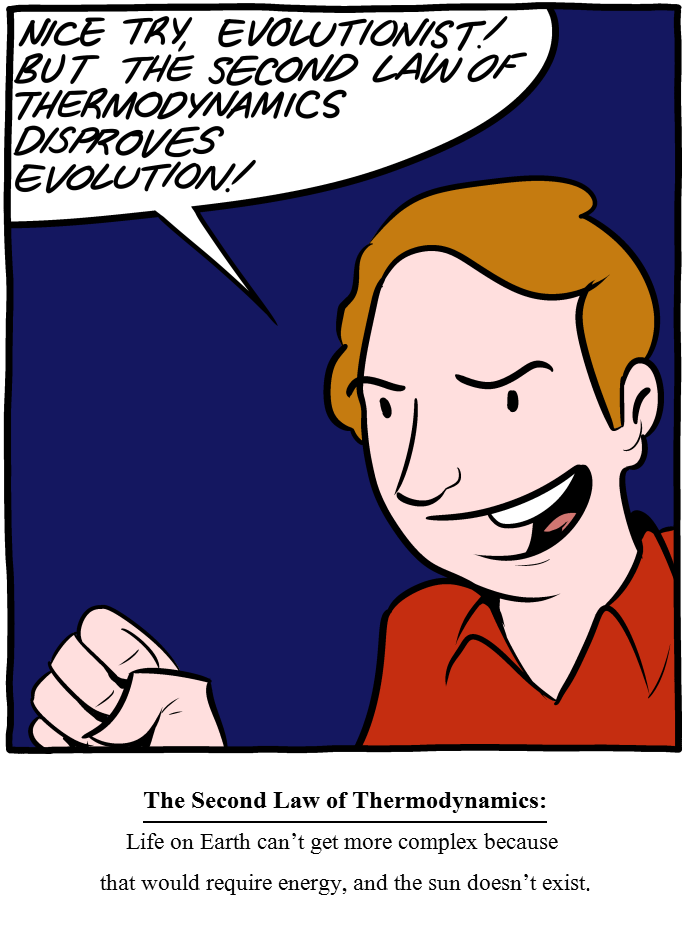
Checkmate, evolutionists!

Those creationists…their arguments get ever more sophisticamated, and are being increasingly difficult to refute. Look at Senator Mike Fair, putting all them scientists in their place:


eyeball = creation

If only Darwin had considered the evolution of the eye, or if modern scientists had studied the evolution of the molecules of vision, maybe we’d be able to respond.

And he’s a senator. Isn’t “senator” synonymous with “smart”?

What happens to creationists who dare to step into this den of evil?

If you ever want to see the typical course of a creationist’s visit to Pharyngula, we’ve got a good example in medic0506, who showed up to argue and then didn’t. I mostly ignored him, but his announcement that he was disappointed caught my eye.

I was told on DDO that there were actual scientists here who would engage in informal argumentation, so since I’ve had my fun with the whineylibs, I’ll scroll through an see if there is any valid posts by someone who wishes to have a discussion rather than just try to scratch my eyeballs out.

This is standard noise from creationists: get thrown lots of evidence, then claim that there was no evidence and they’re all so very tired of it. So I thought I would take a look at his posting history here to see what kind of substantial, thought-provoking, evidence-based arguments he had made.

Surprise. There weren’t any.

He’s very proud to have coined the term “National Coven for the Solicitation of Evolutionism” for the NCSE. He thinks it fits because Eugenie Scott reminds him of the wicked witch. Why? Because she lied and said Meyer’s awful paper, The origin of biological information and the higher taxonomic categories, didn’t mention ID (what? It was an ID paper; the whole issue with that is that it was smuggled in by a creationist editor friendly to the idea, making a farce of peer review). As evidence, he provided this video:

I really would not want to cite that as favorable to intelligent design creationism. Meyer was disgraceful, Eugenie was patient and calm, and she didn’t say what medic0506 claimed she said.

Then he declares that he is a young earth creationist. In reply to a comment that he’s flat-out denying the overwhelming scientific consensus, he waves away that little problem of contradicting physics, chemistry, and geology by saying it only takes 1 to be right.

Next we learn That “old book” [the Bible], on the other hand, paints an accurate picture of what nature should, and does look like, so I see no need to disregard it in favor of what others believe. He then ignores all the comments that point to verses in the Bible that paint a very inaccurate picture of the world. Sometimes the absence of a reply is as damning as the content of a reply.

When confronted with standard evidence for an ancient universe, like the existence of galaxies farther away than 6000 light years, he simply denies it: your belief in deep time is heavy on theory but light on actual evidence.

The rest is just repetitive noise, and then he starts talking about retreat because there is a dearth of scientists here. He can’t make a single positive argument for his goofy beliefs, and his entire visit was simply an exercise in evasion.

Unimpressed. Bored. That’s why I didn’t bother to engage with yet another asinine fool stopping by — he had nothing to discuss, and he knew that if he brought up any actual arguments for a young earth or creation by divine poofery, he’d have his head handed to him.


Yay! We have a major eruption of kookery from medic0506!

I’m willing to be proven wrong on this, but I don’t believe that starlight is something that actually physically travels to earth, in order for us to see it. I think that light is emitted from an energy source, and if the amount of energy released as light is enough, the object will be bright enough for our eyes to see it from earth. I don’t buy when someone argues that starlight has been traveling for billions of years to get here. Feel free to prove me wrong by proving the current understanding of light travel, but no one else so far has been able to address this without just throwing more theoretical BS at it.

So light doesn’t actually travel at some limited speed, but if it’s really, really bright, it is instantly transported to our eyes. All that empirical evidence, all those measurements of the speed of light…that’s all just theoretical BS. Why should we throw out all of physics? Because a creationist thinks brightness can substitute for velocity.

#CDCVax is the Twitter place to be today

The CDC is going to have a twitter party, sharing information about National Infant Immunization Week, 140 characters at a time, at 1pm EDT today. Just for fun, the anti-vaxxer crazies are planning to crash the hashtag, so getting more rational people to join the conversation would be a good idea — let’s swamp out the nonsense with reality.

Unfortunately, they picked a time when I’m going to be in class, so I’m going to be no help at all.

The guy’s an evolutionist, and there’s nothing in the whole course description about biblical creation as even a plausible alternative!

Oh, joy. We’re getting another cheesy Christian movie in which the college professor is the evil bad guy. We just had Kevin Sorbo pretending to be an angry atheist philosophy professor in God’s Not Dead, and now we get Harry Anderson playing an angry atheist biology professor in A Matter of Faith.

Rachel Whitaker, a Christian girl, heads off to college for her much-anticipated freshman year. New friends create situations that require important, quick decisions—some about her social life, some about her core beliefs! Rachel begins to embrace the ideas of the university’s immensely popular biology professor (Harry Anderson) who boldly teaches that Darwinian evolution is the only logical explanation for the origin of life, and the Bible therefore cannot be true. When Rachel’s father (Jay Pickett) senses something changing in his daughter while she is home on a weekend visit; he begins to look into the situation and what he discovers catches him completely off guard. Now very concerned about Rachel drifting away from her Christian faith and the clear teachings of the Bible, he accepts an impossible challenge and tries to do something about it!

Can you guess what the impossible challenge is? He’s going to debate the biology professor on evolution.

Gosh, I wonder who will win?

It’s rather clear that people who believe in the Bible don’t have much connection to reality in their entertainment.

Furious at a breach of ethical behavior…by an evolutionist

I thought it was simple plagiarism, but it turned out to be so much worse. Commenter A. Noyd discovered that anti-creationist arguments posted here were being regularly parroted elsewhere, on a site called debate.org, without attribution. Jon Milne was in a debate with a creationist named Iredia, and he was getting handy rebuttals straight from me and various other regular commenters here, including Nerd of Redhead, Amphiox, a_ray_in_dilbert_space, and David Marjanović, which he’d simply copy and paste straight from here into comments there, under his name.

That’s disgraceful. I was shocked to hear of it: we often accuse creationists of this game, of simply pasting together quotes without understanding them, and here was someone acting as a debater for evolution doing the same thing. It was patent plagiarism, and ethically wrong.

But then it turned into something else altogether, something even more contemptible. From his confession, it turns out that he’d been doing something truly dishonest. He had a second account here. When a creationist gave him an argument on another site, he would copy it, word for word, come over to Pharyngula, pose as a creationist (“biasevolution”), and paste it into a comment, to trigger a response from us.

He was plagiarizing creationists.

He then used a sockpuppet account to parrot their words.

He would then plagiarize us in his replies on this other site.

He was simply shuttling arguments from one site to another, providing no creative input of his own other than to carefully remove any evidence of the origin of arguments. Why? I don’t know. Maybe he wanted to look really clever. But all I know is that his every argument on debate.org is now tainted, and he’s managed to discredit a lot of people with seriously damaging behavior that reflects poorly on the science side of these arguments.

He has been banned, along with his “biasevolution” creationist sockpuppet. And I’m really pissed off.


Aaargh. Stephanie tells me he’s been doing this for a good long while.

He’s been plagiarizing for a couple of years, too. His email address brings up a short-lived LJ account where he bragged about bringing the “epic smackdown” on a creationist.

His material? Lifted from Rational Wiki.

And the Iron Chariots Wiki.

And Rational Wiki again.

Yeah? This is my angry Viking face.

angryviking

Just when I thought I was out, @BlakeStacey pulls me back in

I’ve been Salon-free for a whole week, and then Blake Stacey has to link to the newest tactic in Salon’s courting of the woo demographic. I’m used to the idiot apologists; I can mock the gooey soft religion of the liberal theists; but what they’d done this time is flaunt an incompetent atheist. Yes, it’s an article by an atheist, but it’s so badly written and so waffly and so reliant on stereotypes that I want to just back away slowly and pretend he’s not there.

The author is W.R. Klemm, a neuroscientist who, every time I’ve heard of him previously, has been terribly incoherent. What does this mean?

“Many polls show that most scientists are atheists,” said Dr. W.R. Klemm, a senior professor of neuroscience at the university’s College of Veterinary Medicine & Biomedical Sciences, in explaining why he created the course. “I think that is unfortunate to say the least.”

I think it just means he’s a full-of-himself contrarian.

His article in Salon is far worse — for one thing, it meanders along forever, saying next to nothing. His premise seems to be that biologists and physicists are “two cultures” (and he cites C.P. Snow!) that don’t get along and don’t understand each other, because physicists are too mathy.

It’s hard for biologists to argue with physicists. Often physicists listen with detached bemusement because biologists can’t explain life with mathematics. Physics could not exist without math. Sometimes I think physicists get too enamored with math. I get the impression that they think that describing and predicting phenomena with equations is the same as explaining why and how such phenomena occur. Take the most famous equation of all, E = mc2. Just what does that equal sign mean? It implies that the variables on each side are the same. But is mass really identical to energy? True, mass can be converted to energy, as atom bombs prove, and energy can even be turned into mass. Still, they are not the same things. Not only are the units of measurement different, but the equation is only descriptive and predictive. It does not explain how mass converts to energy or vice versa.

I am embarrassed. Physicists, I swear, not all biologists are this stupid. Really, we aren’t.

Then, after telling us that he hates it when physicists write about biology, and muddily explaining that the mind has a material, biological basis, and sorta rejecting the silliness of The Spiritual Brain, he proceeds to explain to us that ‘spirit’ might be lurking in physics.

To me, other possibilities for discovering material attributes of “spirit” seem more likely. Modern physics, especially quantum mechanics and the theories of relativity, dark matter, and dark energy, has already shown that not even physicists understand what “material” is. I will now summarize the more likely possibilities for hidden realities of mind.

And then the neuroscientist writes about physics: quantum mechanics, relativity, dark matter, dark energy, string theory, parallel universes, etc., each with a little potted summary to explain how maybe there is a source for spirits within them. For example, bugger thermodynamics:

Also, what about the energy generated as electrons whip through protein chains in mitochondria? Only some of the energy is trapped in phosphate bonds of adenosine triphosphate. We assume that all the other energy is lost as heat. How can we be sure relativity is irrelevant to energy capture? Energy is well established as crucial for consciousness.

Oh, jebus. I am so eagerly anticipating the first creationist to come along and tell me that God is fueled by energy losses in biochemical pathways…because relativity. Or that dark energy is diddling our thoughts.

So what about dark energy? To push galaxies apart, it must impart some of its energy to the cluster of stars and planets to give them a push. What must dark energy be doing to us? Obviously, its push is not greater than the gravity that keeps us fixed to earth. But if that energy is absorbed by the galaxy, surely some of it must be absorbed in us. But what could such absorption do? Would such dark energy interact with the regular energy that we know about—like the energy in our brain? Could it act on consciousness?

Hey, and maybe the gravitational perturbations caused by the motion of the planets affects our brains, too, and astrology is true! Could it act on consciousness? is such a cheap and meaningless question — replace “it” with anything (frying pans, neutrinos, water, fluttering butterflies in the Amazon rain forest, the color orange, cosmic clouds of sentient formaldehyde, whatever) and it’s just as empty and just as thought-provoking as that noise.

I feel like I have to apologize to all the physicists in the world right now. Please, please, please don’t think all neuroscientists are like that. Neuroscience is a field that actually does use a lot of math and biochemistry and physical chemistry and physics, and it doesn’t usually lead to crania full of drivel.

Irreducible complexity, again?

We’ve had a creationist named “biasevolution” babbling away in the comments. He’s not very bright and he’s longwinded, always a disastrous combination, and he tends to echo tedious creationist tropes that have been demolished many times before. But hey, I’m indefatigable, I can hammer at these things all day long.

He brings up irreducible complexity (IC), Behe’s ever-popular contribution to the creationism debate. Behe’s version of the idea was published in 1996, so we’ve had almost 20 years to refute it — successfully! — so it gets a little old seeing it brought up again and again.

If you really, really understood IC you WOULD NOT argue with it. You would find that it would be as silly as say arguing against variation or heredity, or the principle of flotation. The reason is this: if you must design a system towards some given function or set of function you would need critical parts. For one, you must have a source of energy for that system. Two, it must have a set of interacting parts that work towards the function you want, you can even add parts to fine-tune it to better perform that function (eg adding capacitors to fans to smoothen out voltage reduced). To then argue that an eye ain’t IC is laughable. All the accounts supposedly falsifying IC or showing how it evolved routinely assume simple IC precursors or point to other IC systems lacking a part and say IC is refuted for a system as Miller did in the blood clotting cascade (akin to arguing because some cars don’t use clutches cars ain’t IC).

I do understand IC quite well. I’ve read Behe’s books. I’ve had it thrown in my face many times, often by creationists who don’t understand it (Jerry Bergman’s claim that carbon all by itself is irreducibly complex was particularly memorable). Biasevolution’s version isn’t quite that bad, but it’s still awful.

And it’s wrong.

First, there’s the problem of begging the question: if you must design a system towards some given function. You’re trying to argue that something is designed, and the first thing you do is demand that we accept the premise that it is designed?

The whole point of the IC concept is that if you examine a final ‘design’, and there’s no way to remove a piece of the structure without destroying its function, then it could not have evolved in a stepwise fashion, as evolution would predict. That’s really all it says: that evolution is falsified if you identify a pathway, for instance, that would not be functional if you removed a piece. It’s naively appealing — but only if you think evolutionary change must be symmetrical and reversible. But we actually evolve irreducibly complex systems all the time.

Let’s work through a simple example. Here’s a pathway, or circuit: a battery, a switch, and a light bulb (I’ve left out the one wire to complete the circuit, just to simplify it all; don’t take it too literally.) You close the switch, the bulb lights up. Simple.

circuit1

Here’s a simple expansion of that circuit. I’ve merely duplicated the switch, so now there’s two of them: close either one, the bulb lights up. This might not be a trivial change to an electrician, but it is to a geneticist — genes get duplicated all the time, and typically all it would do is add a redundant element. So this is a routine variation of a kind that is frequently observed in biological systems.

circuit2

Now we change one wire, shifting the output of the first switch from directly activating the effector (the bulb) to feeding into the second switch. Now to light up the bulb, you must close the second switch, but the first switch is redundant.

circuit3

The biological analog to this would be if, for instance, a protein in a biochemical pathway lost its ability to bind a terminal substrate, but could still activate an intermediate protein. Again, this happens.

Now you could imagine a mutation that destroyed the first switch, and the whole system would simply revert to the initial condition, in which a single switch controls the bulb. That happens, too — we find dead genes (called pseudogenes) all over the genome.

Or, just as possible, what if you kept the first switch but lost another wire?

circuit4

This is an interesting change. Now, to light up the bulb, you have to close both the first and second switch. It also fits Behe’s description of an irreducibly complex system, because removing any part, the battery, the first switch, or the second switch, produces a pathway that cannot light up the bulb. It’s a dead system. It is most definitely irreducibly complex by any reading of Behe’s hypothesis.

But does that mean it could not have evolved by the incremental addition or subtraction of parts, with every step retaining the full capability of lighting up the bulb? Of course not. I just led you through each step, and in all four of the cartoons above, you can turn the lightbulb on. The fact of ICness does not vitiate the idea of incremental evolution.

So naive creationists will look at the fact of the organization of the eye, that you cannot remove the optic nerve or the retina and still have a functional eye, and fallaciously argue that that means it could not have evolved. This is logically false. I can point to lots of biological systems that can be called irreducibly complex: I am personally irreducibly complex, for instance, because I would stop functioning if you cut out my heart or gave me a brainectomy or deleted a big chunk of my immune system — but that fact is not sufficient to demonstrate that evolution couldn’t have done it.

I’ve been pointing this out to creationists for well over a decade, and all I ever get from them is stupefied stares and the occasional splutter. I don’t expect it will sink in this time, either. But I do derive a certain rude satisfaction from the fact that creationists repeatedly exhibit that same dumb incomprehension every time, so I’ll keep puncturing them with it.

The Deepening Rift

When I visited Iceland a while back, one of the sights I got to see was the dividing line between Europe and North America — one spot on the actual, physical dividing line between the tectonic plates. It was a literal rift.

rift

Another fascinating thing about it is that it’s growing. These plates are slowly drifting apart, and we expect the Atlantic Ocean to grow larger in the coming millions of years. This is not a bad thing or a good thing, it’s just what is.

You can see a growing rift right now: just look at the atheist movement. In particular, one really good marker right now is to look at Melody Hensley. Melody has been a vigorous activist for CFI, organizing many meetings in the Washington DC area, and in particular acting as the driving force behind the impressive Women in Secularism meetings. If there are real Brave Heroes in this movement, she’s one of them. I’m on Melody’s side of the rift.

On the other side…well, a mob of shrill nobodies, who don’t seem to do anything for the movement at all, but are really good at non-stop whining and lying. They are entitled shits who get furious if you block them on twitter or ban them from your personal blogs, but mainly seem to be involved in pursuing vicious vendettas against feminism, social justice, or anyone who dares to suggest that atheists ought to be doing more than just chanting that god is dead.

I am not on their side. I’m actually wishing we had a nearby subduction zone so they’d get sucked down into a more appropriate region.

Their latest cause célèbre is to howl in rage because Melody has been diagnosed (by a professional, not some ignoramus on Twitter) with post-traumatic stress disorder, PTSD, as a consequence of years of harassment and bullying. This is a legitimate diagnosis: years of watching crime dramas on TV may have given you the impression that PTSD only affects soldiers in war zones, but real psychologists and real doctors will tell you otherwise: all kinds of prolonged stressors can produce PTSD symptoms. So if you’re one of the idiots ranting that you can’t get PTSD from bullying/stalking/harassment, you’re on the other side of the rift from me, and you’re also factually wrong. Which is amazing, considering that atheists should be putting a very high premium on following the evidence.

Then the other response is that if Melody can get PTSD from ‘mere’ online bullying, then she is demeaning the experience of soldiers who get PTSD from bombs going off near them— you know, ‘legitimate’ PTSD. This is absurd. They’re trying to rank degrees of trauma? That doesn’t discredit the fact that they’re all trauma. Someone saying they’ve got PTSD from source X is not an attack on someone getting PTSD from source Y. It’s painful to watch: it’s as if someone said they had prostate cancer, and instead of sympathy and help, they got accused of belittling breast cancer patients, because that’s a real cancer…and then someone starts tearing into those people because saying that breast cancer is a serious disease is equivalent to shitting all over pancreatic cancer patients. No, it’s not. They’re all bad. It’s a group of outsiders trying to establish a hierarchy of suffering solely so they can disparage one group. It’s dishonest and despicable.

I’m on the side of the people citing the scientific and medical evidence. I’m not on the side of people abusing the facts to further bully others.

And now, of course, their real agenda is becoming apparent: the Melody-haters who also reject the medical facts are finding common cause with misogynists and the usual incoherent ranters of the inappropriately named Men’s Rights Movement are are upset that mere rape and death threats against a woman might be wrong. It’s clear that the reason for all the bullying isn’t that Melody is weak, or lying, or oppressing people, because she isn’t — it’s because she’s a prominent, strong activist fighting for better representation of women in atheism and skepticism. That is her crime. And so those people on the other side of the rift will hound her to oppress and silence her.

Here I stand, on my side. Not only will I take pride in my choice, but if you try to tell me that I somehow have to heal this rift, I’ll ask you…”WHY?”

What is it about the word "choice" that you don’t understand?

I don’t follow the British popular press very closely, but Josie Cunningham must have done something truly evil.

To read Cunningham’s mentions on Twitter is to explore a world of medieval morality I didn’t think still existed in the UK. The "murdering cow" needs "locking up", you see. "It’s a mental institute you need," explains one man. One woman tells her to throw herself off a cliff, while a man named Warren patiently explains that, "someone needs to throw acid on you." "I sincerely hope this woman is flattened by a lorry," prays another. Women who’ve never met her call her an "ugly no good cunt," a "rank slut," who "doesn’t deserve the ability to conceive" and needs "a good hard kick in your piss flaps." Many talk erroneously about murdering babies or children, one woman asking if she can feel the 18-week-old foetus kicking inside her.

What did she do? She chose to state on television that she was pregnant and was going to get an abortion. She had a mix of good reasons — not wanting to be tied to the father, wanting to focus on her career — and bad reasons — her chosen career is to be a TV celebrity — but that doesn’t matter. The whole point of being pro-choice is that women get to make their own decisions about their own bodies. You can also have bad reasons for wanting to have a baby, but we shouldn’t also vilify women for making that choice (it’s a double-whammy: a single career woman who chooses to have a baby can also be vilified for selfishness and not fitting the maternal stereotype sufficiently well).

I don’t know much of anything about this woman, but if she wants to have an abortion, that’s her decision, not mine. And it doesn’t really matter why she wants it.