How can an Allosaurus be racist?

It can’t, but its owner can be. Ken Ham has been mugging for the media quite a bit lately: he’s got a little coup, in that he’s acquired a fossil allosaur — a real, and valuable, scientific specimen — for his crappy little Creation “Museum”. He claims it’s evidence for a young earth, because it is supposedly only 4500 years old, if you ignore the actual evidence for its age.

But here’s something I didn’t know. Daniel Phelps did a little digging, and excavated the history of the donor. He’s not a nice guy. He’s one of those racist traitors who worships the Confederacy.

FOR IMMEDIATE RELEASE: 

May 22, 2014

CREATION MUSEUM TO UNVEIL DINOSAUR FOSSIL FROM ORGANIZATION WHOSE LEADER IS AFFILIATED WITH HATE GROUP

The Creation Museum in Petersburg, Kentucky is about to unveil a dinosaur fossil donated by an organization whose leader is affiliated with a hate group.

In October 2013 the Creation Museum, operated by Answers in Genesis, announced the receipt of a partial Allosaurus skeleton and skull from the Elizabeth Streb Peroutka Foundation. The foundation’s leader Michael Peroutka until recently was also a board member of the League of the South, a white supremacist, Neo-Confederate and pro-secessionist organization that has been named a hate group by the Southern Poverty Law Center. (See the web links at the end of this press release for documentation.)

The Creation Museum will be unveiling the specimen this upcoming Memorial Day weekend. The Creation Museum expresses thanks to Michael Peroutka and the Peroutka Foundation on their website (http://creationmuseum.org/whats-here/exhibits/allosaur/):

"One blessing in getting the allosaur was that the Creation Museum did not seek it out. Michael Peroutka, one of the board members of the Foundation, says that this fossil is a testimony to the creative power of God and also lends evidence to the truth of a worldwide catastrophic flooding of the earth about 4,500 years ago as described in the Bible. In order to ensure that the display of the fossil represented this teaching, the Peroutka Foundation donated the fossil to the Creation Museum."

Kentucky geologist and President of the Kentucky Paleontological Society Daniel Phelps is calling for Answers in Genesis and the Creation Museum to disavow the hate group, and to donate the fossil to a real natural history museum so that scientific research can be performed on the specimen. 

Phelps said, "The Creation Museum could use this opportunity to take a stand against a racist, Neo-Confederate, hate group by refusing to take possession of the Allosaurus fossil or by donating it to a real natural history museum so the specimen could be placed in the public trust, especially in the light of AIG’s anti-racist position."

Possible museums that could properly curate and research the specimen, according to Phelps, include the Smithsonian (Washington, DC), the American Museum of Natural History (New York), the Field Museum (Chicago), Cincinnati Museum Center, and the Museum of Western Colorado.

Phelps also points out that the Creation Museum will be incapable of doing scientific research on the specimen.  All employees of Answers in Genesis and the Creation Museum are obligated to sign an oath of Biblical literalism before employment.  This oath (found here: http://www.answersingenesis.org/about/faith)

includes statements that make scientific research on the specimen impossible since all conclusions are known before any possible research is undertaken. The Creation Museum’s Statement of Faith even includes this dogmatic statement: 

"By definition, no apparent, perceived or claimed evidence in any field, including history and chronology, can be valid if it contradicts the scriptural record."

Answers in Genesis has an in house publication that mimics a scientific journal named Answers Research Journal, but that publication requires author’s conclusions to match AIG’s statement of faith. The following quote from the publication’s instructions to authors illustrates this point:

"The editor-in-chief will not be afraid to reject a paper if it does not properly satisfy the above criteria or it conflicts with the best interests of AiG as judged by its biblical stand and goals outlined in its statement of faith."

(Page 9) http://legacy-cdn-assets.answersingenesis.org/assets/pdf/arj/instructions-to-authors.pdf

Phelps stated, "Oaths based on religious doctrine are not how modern science is accomplished. The Creation Museum has decided, without doing research, that the dinosaur fossil is evidence of Noah’s Flood which they believe occurred in approximately 2350 BC." 

Phelps continues, "Since the Creation Museum doesn’t do scientific research, all the Creation Museum really has done is obtain a nice display trophy. Real museums do research.  The Creation Museum has asserted the specimen to be evidence of Noah’s Flood without any actual research and will not consider other explanations for theological reasons."


Here is more information on Michael Peroutka and his connections to The League of the South:

http://www.dailykos.com/story/2014/03/23/1286860/-RINO-Says-His-Dino-Proves-Noah-s-Flood-Wha-Wha-What

http://www.independentpoliticalreport.com/2013/06/michael-peroutka-appointed-to-the-league-of-the-south-board-of-directors/

YouTube video of Peroutka joining League of the South board:

http://www.youtube.com/watch?v=vze4fPPkgxY&feature=youtube_gdata_player

Michael Peroutka “proud to be a member” of The League of the South:

http://archive.theamericanview.com/index.php?id=80#__utma=149406063.1866893309.1398790110.1398790110.1398790110.1&__utmb=149406063.1.10.1398790110&__utmc=149406063&__utmx=-&__utmz=149406063.1398790110.1.1.utmcsr=google|utmccn=(organic)|utmcmd=organic|utmctr=%22michael%20peroutka%22&__utmv=-&__utmk=192255274

The Southern Poverty Law Center names The League of the South a Neo-Confederate hate group here:

http://www.splcenter.org/get-informed/intelligence-files/groups/league-of-the-south

The Southern Poverty Law Center writes of connections between Peroutka and The League of the South here:
http://www.splcenter.org/blog/2013/09/18/american-heritage-group-pushes-radical-theocratic-class-on-constitution/

People For the American Way articles on Peroutka’s activities:

http://www.rightwingwatch.org/category/people/michael-peroutka?page=1

Michael Peroutka decries Union victory in the 1863 Battle of Gettysburg:

http://archive.theamericanview.com/index.php?id=270

Michael Peroutka’s listing in the Encyclopedia of American Loons can be found here:
http://americanloons.blogspot.com/2014/05/1022-michael-peroutka.html

I think Dan is a bit optimistic if he thinks Ham will be swayed at all by the association with racist traitors. I suspect he’s sympathetic, actually, since they tend to be fanatical Christians, too.

Would you learn the philosophy of science from a creationist?

Yesterday, I attended a discussion led by a philosophy professor after a matinee showing of God’s Not Dead. It was a strangely skewed group: about half the attendees were local pastors or wives of pastors. Also, not to my surprise, most of them didn’t care for the movie. It was too over the top, it paid short shrift to serious theology, some of the scenes (especially the death scene) made them uncomfortable and wasn’t true to how Christians actually respond to death. So that was good. Of course, I had to point out that the caricatures of atheists were also unrepresentative.

One guy wandered in with a bunch of tracts and books and announced that he wanted to talk about creation and how the earth was young and recited a bunch of creationist cliches — he got booed out of the room, and looked dismayed that ministers weren’t accepting his conclusions.

Now I’m wondering how Christians respond to this collection of nonsense from Ken Ham and Answers in Genesis.

Does science trump the Word of God? No way!
This fun, animated video demonstrates how science couldn’t even be possible without God and how we need to be careful how we “interpret” evidence.

Always be wary when they have to tell you their own video is “fun”. It wasn’t very. It’s another of those videos that is just words in varying fonts and locations flashing on the screen, while a narrator speaks a bunch of drivel.

Once again, it’s the Hamites reciting this magical distinction, that there are two kinds of science, historical and observational, and that the only one that really counts as true science is the observation of things in the here and now, and that the only historical science you can trust and that is important is stuff that has documents and eyewitness accounts to back it up (You can see where this is going.) As an example, they use the Eiffel Tower, pointing out that you can use observational science to measure its height and location, but in order to figure out when it was built and who constructed it, you’d need to look at old papers.

This is total bullshit, and a terrible example.

If every document describing the Eiffel Tower were destroyed, we’d still be able to make estimates of its age. We’d look at rates of oxidation of the iron in the structure; we’d compare construction techniques with other buildings around the world and identify its contemporaries; and I’m sure engineers and architects would have many other tools they could use to analyze it.

Furthermore, if the two hypothesis they were testing were that a) it was constructed of earthly materials by natural mechanical means vs. b) it was conjured instantaneously into existence last Thursday by a god, who cast a discarded toothpick down into Paris, we could evaluate those ideas and come very quickly to the conclusion that (b) was stark raving nonsense. And that’s analogous to what these bozos are trying to do with their bogus philosophy of science.

What they really try desperately to claim is that you can only examine the past through the first person accounts by people who were there, and presto, they have one for the creation of the world, the Bible, which is totally trustworthy in its every word, and therefore you are supposed to believe it in every detail, because you can’t do observational science of the past.

Bullshit, through and through. The Bible is not trustworthy; it’s a hodge podge of historical accidents assembled in a biased and political process 1500 years ago, it’s full of contradictions, and even if you accept the crappy distinction of science as AiG presents it, it is not a document that is at all contemporary with the creation of the world. (I wonder…maybe they are so delusional that they think the Bible is 6000 years old.)

You can’t simply accept an account of the past because it is a “document”. People lie all the time. More charitably, people make up stories for entertainment. With their kind of uncritical swallowing of myth because it is simply written down, we’d have to conclude that Ilúvatar was the creator, and Tolkien was his prophet. Hey, were you there? Then how do you know it was wrong? I have a book right here that explains how the Ainur sung the world into existence. A real book, with words even.

Then they go on to claim that Observational Science confirms that every word in the Bible is accurate. So why does nearly every scientist in the world disagree?

Finally, they trot out Plantinga-style baloney: we must have been created by an intelligent being, because if our brains are byproducts of chance…we couldn’t trust their conclusions to ever be accurate. To which I have to say…EXACTLY. We can’t trust our brains — the whole elaborate edifice of science is a collection of protocols we follow to avoid trusting our brains. They have to know this; by their own ideas, they think that the majority of the world’s scientists, who all use their brains rather than the Bible, have come up with a set of explanations for the world that the creationists consider wrong.

Evolution does not claim that our brains are solely the product of chance, either. These guys don’t understand science, they don’t understand history, and they don’t understand brains. They do know how to put together a slick, superficial stream of lies into a very low information density video, though.

Secularism has a tunnel-vision problem

elitegroup

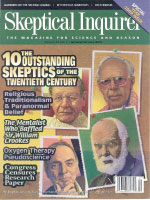
There was a time, back when I was a paying subscriber to the Skeptical Inquirer, that I received this issue in the mail: the January/February 2000 issue, which proudly announced the Ten Outstanding Skeptics of the Twentieth Century. It stopped me cold, and I decided to not bother to renew my subscription.

Why? It starts this way:

We put that question to an elite group of scholars who should know—the Fellows and Scientific Consultants of CSICOP.

Sound familiar? A small group of really smart people appoint themselves to pick who the really smart people are. Unsurprisingly, a whole lot of the winners of this self-selected poll turned out to be…the Fellows and Scientific Consultants of CSICOP, leavened with a few big name additions, like Albert Einstein and Harry Houdini. It was so painfully incestuous, and it was terribly undefined: what does “outstanding” mean? Just the most famous? So it was some kind of popularity contest within CSICOP? And it was made the cover story?

And then, the list…the so oblivious and self-congratulatory list. It consists of ten white men. They also include a list of 14 runners-up who received multiple votes or at least one first-place vote: every one of them a white man. Where was Rachel Carson, Ellen Swallow Richards, Theo Colborn, or any of the women activists in the environmental movement? Not only were women invisible on this list, but you could tell that there was a bias against some significant areas of human endeavor. Where were the black civil rights leaders, like A. Philip Randolph, who questioned the social and political assumptions of the country, and was a humanist/atheist? Where was Emma Goldman? Where was the labor movement? There wasn’t even the slightest effort to reach out beyond the narrow bounds of their rarefied academic skepticism, no interest in expanding the scope of skepticism to stuff that mattered.

That still seems to be the problem. I really want to say to any organization that tries to represent atheists: get out more. Broaden your circle of friends. Circle jerks tend to be self-perpetuating and pointless.

Almost there!

Chris Johnson, who made that lovely coffee table book about atheists called A Better Life: Joy & Meaning in a World Without God, is now planning to turn it into a documentary. He’s running a kickstarter fundraiser forA Better Life: The Film.

I’ve read the book. It won’t have any atheists threatening to convert anyone, harassing people on their deathbeds, or demanding anything but their own personal autonomy. It should be good.

That’s not how you do it

Ophelia has been ripping on this bizarre self-appointed Global Secular Council. I’m just kind of flabbergasted. When they make these kinds of comparisons — “Republicans have The Heritage Foundation, New Democrats have the Progressive Policy Institute, Libertarians have The Cato Institute, and Secularists have the Global Secular Council” — I wonder if they really think that reflects well on them. Would you want to be part of an organization that says “we’re sort of similar to the Heritage Foundation?” And I look at their team, and I see a lot of smart people, but are any of them policy experts?

Will they be effective? I looked at their Issues page, and it’s rather high-mindedly vague. For instance, one issue is International Human Rights. I’m glad they’re for ’em, but after a scant 3 paragraphs that consist of platitudes, they present their summary:

POLICY RECOMMENDATION: The U.S. government should apply political pressure whenever possible to countries violating their international human rights obligations.

So, the Global Secular Council’s advice is that the US should do something about it? How? Do they have lobbyists on their staff? It looks like they have a lot of high-profile figureheads, but where’s the equivalent of Michael DeDora of CFI’s Office of Policy, or American Atheists’ Amanda Knief, or the whole dang team at Americans United for Separation of Church and State? They’re not going to accomplish much if they’re just going to announce a set of goals on a website and then pose wisely to convince other people to go do the actual work, somehow.

I’m always going to be suspicious of an ad hoc group that assembles itself, declares itself the leader, and then tells everyone to follow on the strength of the prestige of their team. That’s not how real, functional organizations work. “BE IN CHARGE” is not a mission statement.

As a counter-example, look at Freethought Blogs. It’s an organization. When Ed Brayton and I were discussing setting it up, we did not begin by saying we’re really, really smart, and we should take charge and lead the whole atheist movement — we had a more reasonable and limited and specific goal. We wanted to set up a platform where we could write freely, and where we could create a shared space for people who wanted to promote equality and diversity within the movement…and thereby amplify the voices of all those people with broader social concerns than simply not believing in gods. The mission came first, then we built the framework to do it, and then we brought in people who fit our ideals (and also threw out one who didn’t).

This new organization seems to have gotten it all backwards, assembling high profile “thought leaders” (yeesh, but I hate that term) first, and then deciding to fix everything in the world. Because they think they can, I guess.

I would not want to be Nicholas Wade right now

Two more meaty reviews of his li’l book of racism: One by Agustin Fuentes, an anthropologist who debated Wade, and the other by Jennifer Raff, yet another anthropologist with expertise in genetics.

I’ve focused a lot of this review on numerous technical details because I think that it’s very important that non-geneticists understand the degree to which Wade is distorting the results of recent research on genome-wide human variation. I won’t speculate whether this distortion is deliberate or a result of simple ignorance about genetics, but it is serious. There is a great deal more in this book that also needs to be critiqued, such as Wade’s assertion that the genetic differences between human groups determine behavioral differences, resurrecting the specter of “national character” and “racial temperaments”. But as I’ve shown here, Wade’s book is all pseudoscientific rubbish because he can’t justify his first and primary point: his claim that the human racial groups we recognize today culturally are scientifically meaningful, discrete biological divisions of humans. This claim provides a direct basis for the whole second half of the book where he makes those “speculative” arguments about national character. In other words, the entire book is a house of cards.

Although the scientists are all laughing at him, at least he’ll have the praise of David Duke and John Derbyshire as consolation.

He’s not a racist!

It’s another review of Nicholas Wade’s A Troublesome Inheritance.

Nicholas Wade is not a racist. In his new book, A Troublesome Inheritance, the former science writer for the New York Times states this explicitly. “It is not automatically racist to consider racial categories as a possible explanatory factor.” He then explains why white people are better because of their genes. In fairness, Wade does not say Caucasians are better per se, merely better adapted (because of their genes) to the modern economic institutions that Western society has created, and which now dominate the world’s economy and culture. In contrast, Africans are better adapted to hot-headed tribalism while East Asians are better adapted to authoritarian political structures. “Looking at the three principal races, one can see that each has followed a different evolutionary path as it adapted to its local circumstances.” It’s not prejudice; it’s science.

In addition to going over some of the sloppy science and devious distortions, the review links to other negative reviews of the book, too, but I appreciate its even handedness — it also cites at some length the positive reviews.

“Wade says in this book many of the things I’ve been saying for the last 40 years of my life,” said David Duke, the white nationalist politician and former Grand Wizard of the Knights of the Ku Klux Klan, on his radio program on May 12, 2014. “The ideas for which I’ve been relentlessly villified are now becoming part of the mainstream because of the irrepressible movement of science and genetics.” Duke devoted his “blockbuster” show to a discussion of A Troublesome Inheritance and celebrated how Wade bravely took on the “Jewish Supremacists” and their “blatant hypocrisy over race and DNA.” There have also been multiple lively discussions about the book at Stormfront.org, the online forum Duke created and one of the most visited white supremacist websites on the net with about 40,000 unique users each day.

Over at The American Renaissance, which the Anti-Defamation League identifies as a white supremacist online journal, dozens of articles have been published about the book over the past two months. “People who understand race are clearly rooting for this book,” wrote Jared Taylor, founder and editor of the publication. Other white power advocates see the book’s arrival as a call to battle. John Derbyshire, a self-described white supremacist and former columnist for the National Review, wrote triumphantly, “Wade’s calm, brave assault on the enemy’s lines will likely be repulsed, but not without enemy losses, making the next assault more likely to break through.”

See? Glowing reviews! Doesn’t that just compel you to rush out and buy the book?

How to argue for evolution

Jerry Coyne reviews Genie Scott’s talk at the Imagine No Religion conference. It’s mostly positive — Genie always gives a thoughtful talk — but there are obvious points of disagreement.

In the talk, Genie said several times that if you want to change people’s minds—about either climate-change denialism or evolution—the most effective way to reach them is through someone who has a similar “ideology,” be that religious or political. In other words, to make a creationist Christian accept evolution, the best way is for an evolution-accepting Christian of the same denomination to convince them that evolution isn’t inimical to their religious beliefs. (That’s what the “Faith Project” of the NCSE is about.) I suppose this wouldn’t work very well for fundamentalist believers, since no other fundamentalists accept evolution!

I vaguely recall some psychological research showing that people are more convinced in the “lab” under such circumstances, and certainly Dan Barker, in his talk, began his road to apostasy by pondering statements by fellow Christians. But I’m still not sure Genie was right.

I’m not so sure either. I don’t think it’s true that the person doing the convincing has to share the same ideology — it’s messier than that. And what do you know, I had just read a very good article on why people persist in believing things that just aren't true. I suspect that the psychological research Coyne vaguely recalls is the work of Nyhan and Lewandowsky.

False beliefs, it turns out, have little to do with one’s stated political affiliations and far more to do with self-identity: What kind of person am I, and what kind of person do I want to be? All ideologies are similarly affected.

It’s the realization that persistently false beliefs stem from issues closely tied to our conception of self that prompted Nyhan and his colleagues to look at less traditional methods of rectifying misinformation. Rather than correcting or augmenting facts, they decided to target people’s beliefs about themselves. In a series of studies that they’ve just submitted for publication, the Dartmouth team approached false-belief correction from a self-affirmation angle, an approach that had previously been used for fighting prejudice and low self-esteem. The theory, pioneered by Claude Steele, suggests that, when people feel their sense of self threatened by the outside world, they are strongly motivated to correct the misperception, be it by reasoning away the inconsistency or by modifying their behavior. For example, when women are asked to state their gender before taking a math or science test, they end up performing worse than if no such statement appears, conforming their behavior to societal beliefs about female math-and-science ability. To address this so-called stereotype threat, Steele proposes an exercise in self-affirmation: either write down or say aloud positive moments from your past that reaffirm your sense of self and are related to the threat in question. Steele’s research suggests that affirmation makes people far more resilient and high performing, be it on an S.A.T., an I.Q. test, or at a book-club meeting.

Normally, self-affirmation is reserved for instances in which identity is threatened in direct ways: race, gender, age, weight, and the like. Here, Nyhan decided to apply it in an unrelated context: Could recalling a time when you felt good about yourself make you more broad-minded about highly politicized issues, like the Iraq surge or global warming? As it turns out, it would. On all issues, attitudes became more accurate with self-affirmation, and remained just as inaccurate without. That effect held even when no additional information was presented—that is, when people were simply asked the same questions twice, before and after the self-affirmation.

Still, as Nyhan is the first to admit, it’s hardly a solution that can be applied easily outside the lab. “People don’t just go around writing essays about a time they felt good about themselves,” he said. And who knows how long the effect lasts—it’s not as though we often think good thoughts and then go on to debate climate change.

I think the simpler version of that is that if you’re trying to persuade a religious person to accept the truth, you can’t come at it with the approach, “Religious people are stupid. You must accept evolution, or you are stupid.” They resist. They don’t think of themselves as stupid, so they immediately know you are wrong. Or alternatively, they immediately identify with religion, and what they hear you saying is confirmation that religious people do not accept evolution, therefore you have just told them what position a good religious person must accept in this argument.

To address this concern does not require that the evolutionist also be a Christian. I don’t usually go all barking attack dog on creationists, one on one, either — the art of persuasion involves finding common ground, and then showing that to be consistent with their own values, they should recognize that one position is wrong. (Note that the sole value some Christians hold is that the Bible is authoritative and literally true — I can’t really find common ground with them, they’re too far gone. But the majority just have vaguely sympathetic feelings for God and church — they can be reached.)

Coyne also has some ire for the theistic evolutionist perspective, as well. So do I. I think it distorts the science in an ugly way. It’s effective with some soft creationists in the same way the approach I mentioned in the last paragraph works. You find common ground: “I believe in God, too!” Then, unfortunately, to bring them around to your side, what you then do is produce a mangled, false version of evolution — “It’s guided by a higher power!” — in order to get them to accept “evolution”. A gutless, mechanistically compromised version of evolution.

No thanks. Darwin’s great insight was that you don’t need an overseer guiding evolution — that local responses to the environment will produce efficient responses that will yield a pattern of descent and diversity and complexity. To replace “intent was unnecessary” with “God provided intent” does deep violence to the whole theory, and completely misses the point.