I’ll just plop this on the ground in front of you

Someone sent me this. They must hate me.


Evolution CAN’T B verified Jesus as creator&savior can&has been w/billions of experiments

I’m afraid to ask what the billions of experiments that verified Jesus as creator&savior were, because I’ve reached my limit of stupid today. I have this suspicion that @NormanDeArmond wouldn’t recognize an experiment if it knocked him out, dragged him into my subterranean lair, injected him with mutagens, and started surgically replacing his limbs with tentacles.

Connect the dots, and look at ourselves

I’ve been reading Scott Atran’s work for years; I initially thought he was too soft on religion, but that he was still carrying out compelling, insightful research on what makes people turn to terrorism. His key message was that you can’t simply blame religion. There’s something about young men in particular that makes them susceptible to radicalization, and it’s a cop-out to blame it on Islam, or mental illness, or economic hardship. I first heard him talking about soccer clubs — how young men isolated from other communities would room together, and begin to drift, thanks to Islamic propaganda, into increasingly radical attempts to find purpose in their lives.

Atran’s war zone research over the last few years, and interviews during the last decade with members of various groups engaged in militant jihad (or holy war in the name of Islamic law), give him a gritty perspective on this issue. He rejects popular assumptions that people frequently join up, fight and die for terrorist groups due to mental problems, poverty, brainwashing or savvy recruitment efforts by jihadist organizations.

Instead, he argues, young people adrift in a globalized world find their own way to ISIS, looking to don a social identity that gives their lives significance. Groups of dissatisfied young adult friends around the world — often with little knowledge of Islam but yearning for lives of profound meaning and glory — typically choose to become volunteers in the Islamic State army in Syria and Iraq, Atran contends. Many of these individuals connect via the internet and social media to form a global community of alienated youth seeking heroic sacrifice, he proposes.

This does not fit the media narrative. I’m sure you’ve noticed: the message they try to send is always that the terrorist, the mass murderer, is an alien outsider, someone wildly different from us — a lone wolf with a broken brain. His origin is incomprehensible, and we don’t try to understand it, but only to separate him from us, the normal people, and reassure ourselves that our social group is nothing like that.

Sarah Lyons-Padilla shares a similar view.

Researchers have long studied the motivations of terrorists, with psychologist Arie Kruglanski proposing a particularly compelling theory: people become terrorists to restore a sense of significance in their lives, a feeling that they matter. Extremist organizations like Isis are experts at giving their recruits that sense of purpose, through status, recognition, and the promise of eternal rewards in the afterlife.

My own survey work supports Kruglanski’s theory. I find that American Muslims who feel a lack of significance in their lives are more likely to support fundamentalist groups and extreme ideologies.

She also sees what sets people on the path to supporting terrorism: the isolation of smaller communities from the larger, the fastening of blame on innocent groups. It’s a self-fulfilling prophecy.

What we really need to know now is, what sets people on this path? How do people lose their sense of purpose?

My research reveals one answer: the more my survey respondents felt they or other Muslims had been discriminated against, the more they reported feeling a lack of meaning in their lives. Respondents who felt culturally homeless – not really American, but also not really a part of their own cultural community – were particularly jarred by messages that they don’t belong. Yet Muslim Americans who felt well integrated in both their American and Muslim communities were more resilient in the face of discrimination.

My results are not surprising to many social scientists, who know that we humans derive a great deal of self-worth from the groups we belong to. Our groups tell us who we are and make us feel good about ourselves. But feeling like we don’t belong to any group can really rattle our sense of self.

Take a look at America. We fear Islamic terrorism, so the first thing we do is condemn all Muslims, displacing them from our selves, isolating them, divorcing from the True American community, and reinforcing the very sociological conditions that foster radicalization.

This isn’t just about Islam, though. This seems to be a property of young men in all sorts of conditions. Abi Wilkinson writes about the online radicalisation of young, white men. She’s been reading the Internet.

No, not the bit you’re thinking of. Somewhere far worse. That loose network of blogs, forums, subreddits and alternative media publications colloquially known as the “manosphere”. An online subculture centred around hatred, anger and resentment of feminism specifically, and women more broadly. It’s grimly fascinating and now troubling relevant.

In modern parlance, this is part of the phenomenon known as the “alt-right”. More sympathetic commentators portray it as “a backlash to PC culture” and critics call it out as neofascism. Over the past year, it has been strange to see the disturbing internet subculture I’ve followed for so long enter the mainstream. The executive chairman of one of its most popular media outlets, Breitbart, has just been appointed Donald Trump’s chief of strategy, and their UK bureau chief was among the first Brits to have a meeting with the president-elect. Their figurehead – Milo Yiannopoulos – toured the country stumping for him during the campaign on his “Dangerous Faggot” tour. These people are now part of the political landscape.

It turns out that Algerian soccer clubs, the Red Pill subreddit, and Breitbart have a lot in common: they’re all gathering places for frustrated men, who then proceed to reinforce each other’s views, starting with vaguely unpleasant dissatisfaction with, for instance, women, to increasingly vicious and dangerous forms of propaganda. I think you might recognize this tendency many men have to top each other’s stories, to exaggerate their dominance. It leads to increasingly awful stories…and the men in these groups, rather than condemning or rejecting their claims, instead strive to repeat even more outrageous claims.

Reading through the posting history of individual aliases, it’s possible to chart their progress from vague dissatisfaction, and desire for social status and sexual success, to full-blown adherence to a cohesive ideology of white supremacy and misogyny. Neofascists treat these websites as recruitment grounds. They find angry, frustrated young men and groom them in their own image. Yet there’s no Prevent equivalent to try to stamp this out.

Much has been written about financial hardship turning afflicted white communities into breeding grounds for white supremacist politics, but what about when dissatisfaction has little to do with economic circumstance? It’s hard to know what can be done to combat this phenomenon, but surely we have to start by taking the link between online hatred and resentment of women and the rise of neofascism seriously.

These communities create a kind of tension within themselves that seeks an outlet. In radical Islam, it might be to strap on a dynamite vest and kill yourself for glory. In the alt-right, it might be to raise a middle finger to the establishment and vote for Donald Trump. It’s arguable which is more disastrous for world stability.

We need to pay attention to how these radical movements develop. Avoid the cheap out of dismissing it as a consequence of the wicked other — it is us. White people are people, just like Muslims, and just as susceptible to being led down a dark path.

Speaking of introspection and examining ourselves, here’s someone else who was radicalized by a social movement — in this case, the dark side of atheism. Sam Harris, Dave Rubin, Thunderf00t, Christopher Hitchens…these guys are gateways to the normalization of hatred.

I was curious as to the motives of leave voters. Surely they were not all racist, bigoted or hateful? I watched some debates on YouTube. Obvious points of concern about terrorism were brought up. A leaver cited Sam Harris as a source. I looked him up: this “intellectual, free-thinker” was very critical of Islam. Naturally my liberal kneejerk reaction was to be shocked, but I listened to his concerns and some of his debates.

This, I think, is where YouTube’s “suggested videos” can lead you down a rabbit hole. Moving on from Harris, I unlocked the Pandora’s box of “It’s not racist to criticise Islam!” content. Eventually I was introduced, by YouTube algorithms, to Milo Yiannopoulos and various “anti-SJW” videos (SJW, or social justice warrior, is a pejorative directed at progressives). They were shocking at first, but always presented as innocuous criticism from people claiming to be liberals themselves, or centrists, sometimes “just a regular conservative” – but never, ever identifying as the dreaded “alt-right”.

For three months I watched this stuff grow steadily more fearful of Islam. “Not Muslims,” they would usually say, “individual Muslims are fine.” But Islam was presented as a “threat to western civilisation”. Fear-mongering content was presented in a compelling way by charismatic people who would distance themselves from the very movement of which they were a part.

Oh, man, that sounds so familiar. I felt the pull of this attitude myself, but at least was able to look ahead and see where it would lead me in the long run, to a belief in Western male exceptionalism that I find grossly repellent.

This morning, I got an email from someone who was in the same situation and got out. They warn of things to watch out for, that almost seduced them.

Here is a tactic to watch out for. They always justify given talking with these people as credible, by say “I disagree with what they say, but they’re nice people, not racist, bigots, sexist etc.”

Sam Harris thinks Black Lives Matter are awful and playing Identity politics. I wonder if Martin Luther king would have been dismissed as playing Identity politics. Anyways just thought I would add to the tactics these people use to lure impressionable white guys like me to the alt-right movement.

Take a look at the NY Times. Combative, Populist Steve Bannon in an article that tries to claim that he’s not a racist. Yet at the same time, it reports that…

One of his three former wives claimed in court papers that he had said he did not want their twin daughters to go to school with Jews who raise their children to be “whiny brats,” a claim Mr. Bannon denies. In a 2011 radio interview, he dismissed liberal women as “a bunch of dykes that came from the Seven Sisters schools.”

In a radio interview last year with Mr. Trump, Mr. Bannon complained, inaccurately, that “two-thirds or three-quarters of the C.E.O.s in Silicon Valley are from South Asia or from Asia.” He has sometimes portrayed a grave threat to civilization not just from violent jihadists but from “Islam.” He once suggested to a colleague that perhaps only property owners should be allowed to vote. In an email to a Breitbart colleague in 2014, he dismissed Republican congressional leaders with an epithet and added, “Let the grass roots turn on the hate.”

Not racist! Not misogynist! Just a “combative populist”.

The seeds were sown early on, and we dismissed them, and now they’re bearing fruit, while the media tries to pretend that there’s no problem at all.

Let’s not do that. Let’s look at that work on the origins of radical Islamic terrorism and appreciate that it’s not solely about those brown people over there, it’s about human beings like the ones right here.

How to lie about a science paper

J. Andrew Armour is a Canadian physiologist who has published quite a few papers on the regulation of the heart — a very complex subject. There are hormonal and external neuronal controls, and a specific tracery of internal neurons and neuron-like fibers that generate patterned muscle contractions. And muscle, of course, is itself called an excitable tissue because it has electrical properties that are essential for its function. There is a lot of cool stuff going on in cardiac research.

So, in 1991, Armour published on Intrinsic Cardiac Neurons in the Journal of Cardiac Electrophysiology. It’s solid work that summarizes these complex interactions, and explains how the heart has its own independent and relatively sophisticated independent electrical properties.

Physiological evidence indicates that afferent neurons, local circuit neurons, as well as efferent sympathetic and efferent parasympathetic neurons, are located in the mammalian intrinsic cardiac nervous system. Complex interneuronal interactions can occur between these neurons, as well as between such neurons and other intrathoracic and central nervous system neurons. A variety of neurochemicals have been proposed to be involved in such interneuronal interactions. Thus the electrophysiologic properties and synaptology of intrinsic cardiac neurons may be more varied than has been appreciated accounting, at least in part, for the variety of neuronal responses that in situ intrinsic cardiac neurons are capable of displaying. The various interactions that occur between intrinsic cardiac neurons and other intrathoracic neurons, as well as between neurons in all intrathoracic ganglia and the central nervous system, will have to be characterized in order to clarify the role of the autonomic nervous system regulating the heart throughout each cardiac cycle.

This is not revolutionary. It had all been pretty well known for decades, although Armour did a fine job of synthesizing all the pieces of the story.

In 2007, he also published a review of the importance of understanding cardiac circuitry, Potential clinical relevance of the ‘little brain’ on the mammalian heart, in Experimental Physiology. Again, this is good, useful, substantive stuff.

It is hypothetized that the heart possesses a nervous system intrinsic to it that represents the final relay station for the co-ordination of regional cardiac indices. This ‘little brain’ on the heart is comprised of spatially distributed sensory (afferent), interconnecting (local circuit) and motor (adrenergic and cholinergic efferent) neurones that communicate with others in intrathoracic extracardiac ganglia, all under the tonic influence of central neuronal command and circulating catecholamines. Neurones residing from the level of the heart to the insular cortex form temporally dependent reflexes that control overlapping, spatially determined cardiac indices. The emergent properties that most of its components display depend primarily on sensory transduction of the cardiovascular milieu. It is further hypothesized that the stochastic nature of such neuronal interactions represents a stabilizing feature that matches cardiac output to normal corporal blood flow demands. Thus, with regard to cardiac disease states, one must consider not only cardiac myocyte dysfunction but also the fact that components within this neuroaxis may interact abnormally to alter myocyte function. This review emphasizes the stochastic behaviour displayed by most peripheral cardiac neurones, which appears to be a consequence of their predominant cardiac chemosensory inputs, as well as their complex functional interconnectivity. Despite our limited understanding of the whole, current data indicate that the emergent properties displayed by most neurones comprising the cardiac neuroaxis will have to be taken into consideration when contemplating the targeting of its individual components if predictable, long-term therapeutic benefits are to accrue.

Here’s a diagram from that paper that might give you a visual depiction of what he’s talking about. It will look familiar to everyone who has taken a college level physiology course.

heartcircuitry

Now just take a moment and think about this. Here’s a piece of credible, robust science. How would an ignorant wackaloon interpret the story? Just close your eyes and let your imagination run riot for a while. Maybe you’ll come up with a wacky enough story that will make you rich. Or maybe you’ll come up with what you think is a crazy idea, but someone has already beaten you to it and published it.

After you’ve thought about a minute, you can go on and read the story of Gregg Braden. If you’ve got a loonier interpretation than he does, maybe you too can make good money on the New Age circuit!

[Read more…]

We may have to expand the War on Christmas

Shocking news:

Parents, though, are being urged to re-consider the ethics of the great Santa Claus lie. In an article published in the journal Lancet Psychiatry, two psychologists have raised the spectre of children’s moral compass being permanently thrown off-kilter by what is normally considered a magical part of the Christmas tradition.

The darker reality, the authors suggest, is that lying to children, even about something fun and frivolous, could undermine their trust in their parents and leave them open to “abject disappointment” when they eventually discover that magic is not real.

My first thought: does this also apply to parents who lie to their children about gods and prayers? They make it sound so dire.

Kathy McKay, a clinical psychologist at the University of New England, Australia and co-author, said: “The Santa myth is such an involved lie, such a long-lasting one, between parents and children, that if a relationship is vulnerable, this may be the final straw. If parents can lie so convincingly and over such a long time, what else can they lie about?”

Levelling with your children so close to the big event may put a bit of a dampener on festivities, but parents must sometimes take the long view, according to McKay. “There is potential for children to be harmed in these lies,” she said.

Exactly what atheists have been saying all along. Jesus. Heaven. Hell. Blood redemption. Resurrections. All harmful lies. Stop lying to your kids now!

This means war

Last night, I had to make a run to the grocery store. On the way, I encountered traffic from the Festival of Lights, the annual Morris holiday parade. Then, in the grocery store, they were piping in Christmas carols already.

This is intolerable.

The 2016 War On Christmas begins today. Gird up your loins, atheists!

I have already made my assault plans, and am assembling my army. Next week, all three of my kids, and one daughter-in-law, are gathering at my house, and I’m going to propose an all-out attack to them. We’re going to travel north a few miles to the local tree farm to savagely cut down a pine tree, which we’ll erect in our house and festoon with fearsome glittering objects. We will drink hot apple cider. There will be reindeer-drawn wagon rides downtown the day after Thanksgiving — we will ride the hell out of them. We may even put up decorations in our windows, and I’m even tempted to get lawn ornaments, or maybe put up colorful lights around the door. We shall be blatant.

And when the believers feebly protest, But you’re atheists…, I shall tell them, “Yes, and this is my celebration of family and relaxation and a secular federal holiday, and it is a godless, humanist occasion. Why don’t you go mewl at ghosts in church, or more likely, trundle soullessly through a noisy shopping mall?” Because I’m taking over.

Bad news sites

One of the things that has made me angry are fake news sites that try to make people angry. I’ve been blocking lots of these places, but still, people circumvent my blocks by independently sending me links to the lie of the day, and it’s more than a little annoying. Melissa Zimdars has been doing something about it, though: she has begun compiling a long list of all the fake news/”satire” sites out there. Do check that list before you get annoyed at some fresh horror in the world — it’s entirely possible that it’s completely imaginary.

It has a long way to go to even approximate completeness, unfortunately, because new ones keep cropping up. It’s got some well known and infamous sites on the list, like Breitbart and everything Alex Jones has cobbled up, but it’s missing some, like the Drudge Report, and it can’t possibly cover all the dishonest wackaloons on the web — I’m currently getting flooded with crap from constitution.com, for instance, which seems to be trying to make a name for itself with histrionic conservativism.

But there has also been Snopes, which, for example, takes apart a lying claim that liberals are beating up innocent people from a site called christiantimesnewspaper.com. That’s not on the Zimdars list.

The bottom line is that you can’t rely on lists of baddies. You have to use critical thinking. Zimdars provides some good general rules to follow.

  • Avoid websites that end in “lo” ex: Newslo (above). These sites take pieces of accurate information and then packaging that information with other false or misleading “facts” (sometimes for the purposes of satire or comedy).
  • Watch out for websites that end in “.com.co” as they are often fake versions of real news sources.
  • Watch out if known/reputable news sites are not also reporting on the story. Sometimes lack of coverage is the result of corporate media bias and other factors, but there should typically be more than one source reporting on a topic or event.
  • Odd domain names generally equal odd and rarely truthful news.
  • Lack of author attribution may, but not always, signify that the news story is suspect and requires verification.
  • Some news organizations are also letting bloggers post under the banner of particular news brands; however, many of these posts do not go through the same editing process (ex: BuzzFeed Community Posts, Kinja blogs, Forbes blogs).
  • Check the “About Us” tab on websites or look up the website on Snopes or Wikipedia for more information about the source.
  • Bad web design and use of ALL CAPS can also be a sign that the source you’re looking at should be verified and/or read in conjunction with other sources.
  • If the story makes you REALLY ANGRY it’s probably a good idea to keep reading about the topic via other sources to make sure the story you read wasn’t purposefully trying to make you angry (with potentially misleading or false information) in order to generate shares and ad revenue.
  • It’s always best to read multiple sources of information to get a variety of viewpoints and media frames. Some sources not yet included in this list (although their practices at times may qualify them for addition), such as The Daily Kos, The Huffington Post, and Fox News, vacillate between providing important, legitimate, problematic, and/or hyperbolic news coverage, requiring readers and viewers to verify and contextualize information with other sources.

It’s always good to think when reading!

I almost forgot! I had a workshop at Skepticon

Oh, yeah, I did a workshop last Friday titled “Bad Evolution”. It was fun! Not quite as I anticipated, though.

It was a workshop. As I understand it, a workshop should involve audience participation, not just lecturing at them, and that’s what I prepared for. I had an exercise prepared, and I came with 50 handouts, just in case a lot of people showed up.

About 120 people showed up. Whoops. I might suggest that, in the future, Skepticon have some kind of workshop registration that allows us to set limits on the audience size, because that was too many, and it was kind of chaotic. Chaotic fun, rather than chaotic evil, so I guess it was OK, but it was still a little overwhelming.

Also, it was in a room with rows of chairs lined up, all facing straight ahead, which is also not conducive to workshopping. At least that was easily disrupted, and I had everyone destroying the tidy arrangement of the room.

Anyway, what we did is fairly simple. I talked for a bit, giving an overview of good strategies for handling discussions with creationists. I gave them this list of suggestions:

  1. Don’t be afraid to say “I don’t know.” Honesty is always a good idea.
  2. Go meta if you’re asked a difficult question. Do they know the answer? Why are they asking you? Is it a sincere question?
  3. If you have an answer, don’t let them dodge it. Follow up. Pursue a line of argument.
  4. Focus. It’s better to skip an opportunity for a good jab in order to build a strong story.
  5. Ask questions of them. You are not a passive oracle at their bidding.
  6. Question their assumptions. Be prepared to have your assumptions questioned.
  7. Demand sources. Science is built on the shoulders of giants, they must be acknowledged.
  8. Patience pays off. You’re not engaged to go in for a kill, you’re having a conversation.
  9. You will not convince the creationist, or “win”. Resign yourself to that.
  10. Keep your perspective and a sense of humor. These people are ridiculous.

I walked them through a couple of simple examples (“If evolution is true, why are there still monkeys?”), and then handed out a long list of much more difficult, more subtle creationist claims, and had one person in the group pretend to be a creationist, present one claim, and then let the others try to rebut them. The main point was to both cultivate a little empathy for the creationist argument, stupid as it might be, and to show that even someone on the side of science might be stymied fairly easily.

For example, here’s one question from my list (which was taken from a collection of bad arguments from the mindless pen of David Buckna):

Microsoft programmers utilized complex codes to create the Windows 95 software. The genetic code, which is more sophisticated, controls the physical processes of life and is accompanied by elaborate transmission and duplication systems. How does evolution, using natural processes and chance, solve the problem of complex information sequencing without intelligence?

The average person would have difficulty responding to that. I think it’s important for us to not take for granted that the answers are always obvious…even when I might find anyone question easy to answer.

Go ahead, try to answer it in the comments, but note that “You’re stupid” and “Citations to the peer-reviewed literature or GTFO” are not on my list of recommended strategies.

Creationists are outliers in another way

Popehat is looking for someone to defend yet another science blogger from a lawsuit.

Pepijn van Erp blogs about science and pseudoscience from the Netherlands. He praises good science and skewers and critiques the bad. Wait a minute. Is that the Jaws theme playing? Yes. Yes it is — because blogging about junk science is a great way to get threatened or sued. In my experience, purveyors of “non-mainstream” science are unusually litigious and sensitive to criticism. You’ve seen it here at Popehat with “atavistic” cancer theorists and vaccine truthers and naturopaths and fans of questionable cancer remedies and AIDS deniers. I blame the crystals.

He’s being sued by Ruggero Santilli, a physics crank. However, I realized something as I was reading about it. I’ve become something of an unwilling expert in this area — I’ve been threatened with lawsuits so many times that I’ve completely lost count. I now regard cease-and-desist letters as ho-hum, and getting told I’m going to be sued for over 2 million dollars just triggers an eye-roll. But you know what’s weird?

I’ve never been threatened with a lawsuit by a creationist.

Notice that they aren’t present in Popehat’s list, either. The people who get most indignant about criticism seem to be people who are trying hardest to gain undeserved credibility from mainstream science, and that includes certain skeptics and atheists. Creationists love to steal scientific cred whenever they can, but it’s for the purpose of suckering Christians and Muslims, not for winning the respect of the scientific community.

I’ve also pissed off Catholics, but even they didn’t threaten to sue me. They threatened to kill me and my family and destroy my life, and repeatedly told me I was going to burn in hell, but not a whisper of dragging me into court over maltreatment of a cracker.

I’m going to have to file this datum away in my head as a reference to use in determining which are the “safe” targets of criticism. Religious nuts may talk a loud game about bashing your skull in, but they don’t hire lawyers to harass you.

Skepticon highlights

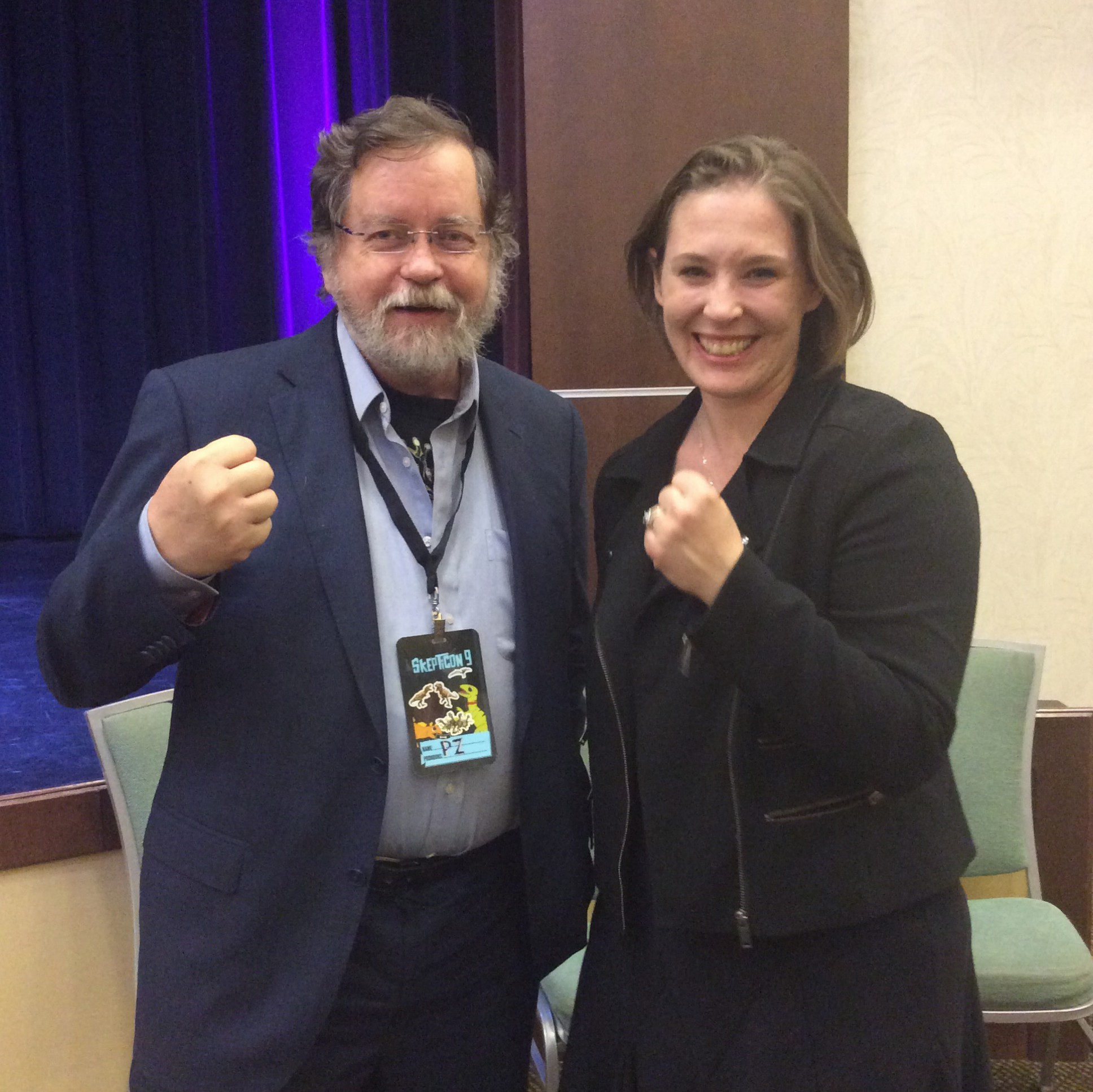
#inappropriatefistpose

#inappropriatefistpose

I’m back from Skepticon, and I’m feeling good. This is the most relaxing conference around for me — it’s a gathering of non-believers, but of non-abrasive, open-minded non-believers who also think there’s a heck of a lot more to being an atheist than expunging “god” from our coinage. It was all good, but here are my favorite events:

  • Margee Kerr talked about the physiology and psychology of fear. She’s been checking spooky places, like Eastern State Penitentiary, to try and figure out what it is about these supposedly “haunted” places that triggers fearful reactions in people. It turns out that the fear is real, but ghosts are not.

  • Jennifer Raff analyzed some outlandish claims about genetics: that Peruvians are descended from Nephilim and white Europeans, and genetic astrology. There were some particularly effective bits in their where she contrasted the lengths she goes to to extract and isolate DNA without contamination, with the rather sloppy stuff people like LA Marzulli do.

  • Alix Jules discussed the reality of racism. It’s not just loud people with southern accents, pickup trucks, and confederate flags: casual racism is everywhere, and it just won some big elections.

There was lots of other good stuff: Rebecca Watson made a triumphant return to the stage, there were lots of conversations about the state of secular activism, there was a taco truck parked outside, and of course lots of happy socializing. I also had to miss the entire last day — I had to fly back and get ready to teach this morning — so I didn’t get to see Jerry DeWitt or Debbie Goddard or the other people who finished up the conference with a bang.

Skepticon 10 will be held on 10-12 November 2017, so clear your calendars now.