
I study spiders in the family Theridiidae, which you’ve probably seen many times. Sometimes they’re called cupboard spiders, or cobweb spiders, or combfooted spiders after specialized limb structures they use to tease the silk they spin. They are also somewhat specialized to capture ground insects, making something called a gumfoot web, which is a sticky line under tension that is attached to the ground. Prey that contact the gumfoot line get snared, break the tension, and then get yanked up into the air. It’s a brilliant innovation.
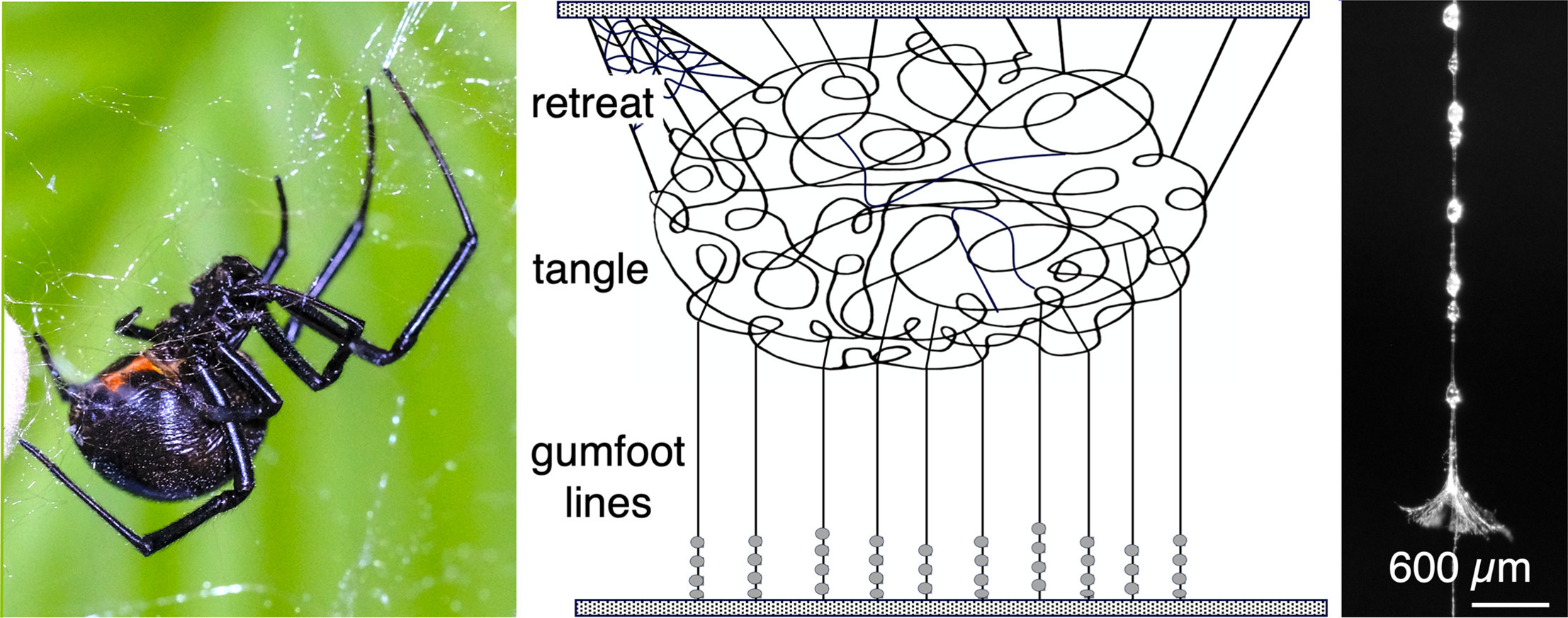
Some theridiidae have taken this to an extreme: Propostira, the ballista spider, has reinforced the gumfoot line to such a degree that it snaps prey up into it’s tangle web.
Propostira sp. (Theridiidae) was found on trees close to the foraging trails of O. smaragdina, a locally abundant, arboreal, highly aggressive and territorial species5. On trees occupied by these ants, the ballista spider took refuge during the day on the underside of leaves and ventured out from their refuge 30 minutes after sunset. Upon leaving its refuge, the spider began an exploratory phase during which it descended on a silk line to substrates up to 50 cm away. When it landed on a suitable substrate, it laid down an anchor point and returned to the core web by laying a tension line. Repetition of this process resulted in a fan shaped array of 15–60 tension lines that were bundled close to the substrate (Figure 1B and Video 1 at https://bit.ly/4cKtVGT) where the lines were laid out in a scaffold in the shape of a small cone. In the final phase, the cone scaffold was densely wrapped with a thinner type of silk . The spider then retreated to a position several centimeters above the cone. Very soon after the cone was wrapped (5–55 seconds; n = 12), O. smaragdina ants were attracted to it. Within milliseconds after probing the cone with its antennae, the ant displayed aggressive behavior, elevated its gaster, and bit the silk cone. The ant’s aggressive behavior is similar to that exhibited towards non-nestmates. The biting destabilized the cone and detached it from the substrate within 42.12 ± 16.09 ms (n = 5), leading to a rapid contraction of the tension lines. While still holding the cone with its mandibles, the ant was pulled off the substrate and propelled into the core web, reaching distances of up to 28.19 cm from the substrate (mean ± s.d. = 13.37 ± 8.57 cm, n = 5), with peak accelerations of 1367 m/s2 (mean ± s.d. = 1108.96 ± 166.14 m/s2; n = 5) and maximum velocities of 4.36 m/s (mean ± s.d. = 3.83 ± 0.68 m/s, n = 5, Video 3 at https://bit.ly/4cKtVGT). The spider moved only after the ant had been hauled up and was no longer in contact with the substrate. The spider then moved upwards on the web and waited until the ant was fully entangled before approaching to wrap it in silk. In one of 12 instances, the ant triggered the snare but was not hauled up; without the added mass of the ant, the snare accelerated at 4732.89 m/s2 and reached a maximal velocity of 13.47 m/s.
That’s amazing.
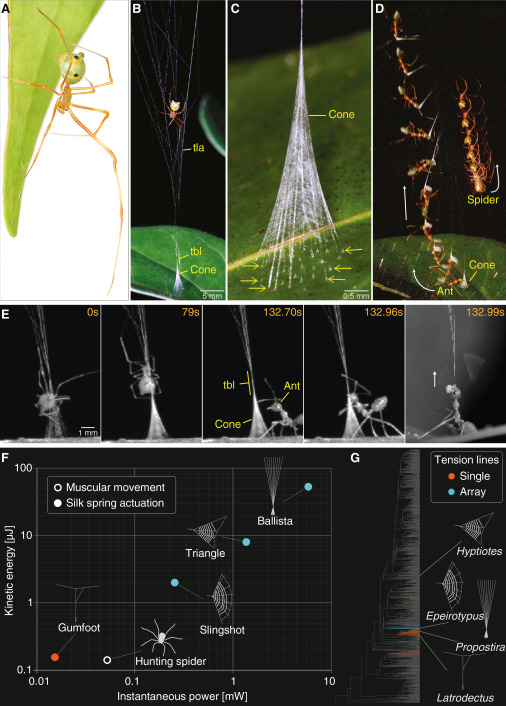
But you know what else is amazing? This is plainly an evolutionary adaptation, an extension of known, familiar behavior of related species that you don’t have to live in Sri Lanka or the Cape York peninsula to witness; black widows and false widows do the same thing, with less extraordinary power. But that power is a product of combining more strands to amplify the force. It’s analogous to an actual ballista, where multiple strands of fiber are twisted to make great tension that can propel boulders, rather than ants, great distances with great force.
It’s a real evolutionary success story, in that we can see a continuum of small variations that accumulate to produce this one remarkable innovation. The ballista spider is a product of its evolutionary history.
So why is Ken Ham trumpeting this story?
But spiders spinning intricate webs to snag other insects for dinner and ants blasting formic acid at their enemies brings up a question, “Why is God’s creation filled with creatures who look designed to kill or avoid being killed?” Genesis gives us the answer!
God graciously provided for his creation, giving them what they would need to survive and thrive in a world broken because of sin.
God’s original creation was “very good” (Genesis 1:31), and humans and animals were created to be vegetarian (Genesis 1:30), though it’s unclear if insects fall into the animal category. (See this article on nephesh life and whether insects were on the menu prior to the fall. Interestingly, there’s even a vegetarian spider in today’s fallen world!) But when Adam and Eve sinned, creation fell, and now all of creation groans from the effects of sin. Some animals now eat other animals, and everything tries to avoid being eaten, and even insects are now a source of pain, difficulty, and even death for humans. It’s not the way it was designed to be—slingshot spiders and aggressive ants remind us that it’s a fallen world. God graciously provided for his creation, giving animals and even insects what they would need to survive and thrive in a world broken because of sin.
Genesis gives us no answer. He claims his god arbitrarily conjured this spider ability in response to an ape eating fruit in his garden, which is no explanation at all, while biologists see this as a consequence of natural evolutionary processes that don’t require extraordinary magical events. Ham is simply stealing scientific explanations to paper over the superstitious nonsense he peddles.

That’s stupid even by Ham’s dismally low standards. He’s admitting his perfect god isn’t perfect. His god was blindsided by a mythological archetype whom the supposedly omniscient deity either didn’t realise was there or whose nature it didn’t properly understand.
If there is one thing that will blatantly lead to selection pressure it’s an adaptation that makes it easier for a predator to catch prey or for prey to avoid being caught!