
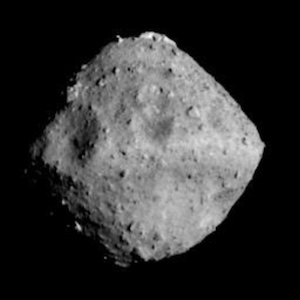
Samples have been analyzed from two carbonaceous chondrites in space, Ryugu and Bennu, and they’ve been found to contain common organic molecules, specifically, the building blocks of DNA. That’s cool, not particularly surprising, and it’s good stuff to know…but then we get all these pop science articles speculating that life came from space. No, no, no — it tells us that these organic molecules are universal, that they can be assembled by all kinds of physical/chemical processes, and that nucleotides (for instance) do not require synthesis by living organisms. Chemistry is everywhere, but biology isn’t. Unfortunately, these kinds of observations always provoke people to babble about life, or at least the ingredients for life, falling from space. I don’t buy it.
Scientists have discovered all five nucleobases—the fundamental components of DNA and RNA—in pristine samples from the asteroid Ryugu, according to a study published on Monday in Nature Astronomy. The finding strengthens the case that the ingredients for life are abundant in the solar system and may have found their way to Earth from space, according to a study published on Monday in Nature Astronomy.
OK, yes, it’s quite likely that some organic molecules fell to Earth from outer space. But please, think a little bit quantitatively. There are clouds of organic molecules in space, but they are incredibly diffuse and poorly concentrated. There are asteroids that are made of condensed lumps of carbon with richer concentrations of these molecules, but they are drifting in the vast empty volumes of space, and only occasionally falling to Earth, adding droplets of nucleotides to the Earth’s oceans.
Meanwhile, the Earth itself is a gigantic crucible containing 1,386,000,000 cubic kilometers of water, with a complex pattern of heating and cooling, and immeasurable interactions with minerals and other organic molecules. It is a far weightier contributor to biochemistry than a thin, almost undetectable, vapor of scattered molecules in space. But these stories always get excited about the thin vapor rather than the fact that Earth itself is a rich churning cauldron of geochemistry that is going to be far more responsible for the wealth of biologically relevant chemistry we find ourselves swimming in.
This is not to discount how interesting these asteroid analyses are. They’re telling us that natural, unguided mechanisms can produce the biomolecules that make up life. The asteroids, though, are not likely to be where they originated here, on planet Earth, which is already a great place for building them.
The article says something else that irritated me.
Now, following the discovery of all five nucleobases in the Bennu pebbles, Koga and his colleagues have found the complete set in Ryugu. The findings lend weight to the so-called “RNA world” model of abiogenesis. In this hypothesis, early life on Earth depended solely on RNA as a self-replicating molecule, laying the biological groundwork for later, more complicated systems that involved DNA and protein-based organisms. The extraterrestrial samples from Ryugu and Bennu provide evidence that at least some of the nucleobases that made up these early lifeforms came from outer space.
No, this observation says nothing relevant to the RNA World hypothesis. It neither confirms nor refutes it. Nucleobases exist, we’ve known that for a long, long time, but I don’t believe that the earliest life on Earth depended solely on RNA, and finding nucleobases in a lifeless rock is not evidence that life was solely spawned from those few components. Were there no other molecules in them? No sugars, no amino acids, no polycyclic aromatic hydrocarbons, no carboxylic acids? There are a great many complex organic molecules found bubbling in the soup of our oceans, aren’t they a more likely source of life than a dead lump that’s been floating in space for billions of years?
Sorry. It’s a good bit of science, but I get cranky when I read these ill-informed unwarranted speculations that ignore more substantial science.

‘five nucleobases’ – I thought there were only four. I didn’t know about uracil. I must have skipped that day in organic chemistry class …. and biology glass … and probably a few others.
DNA has 4. RNA has 4, but replaces thymine with uracil. So, 5.
Now what is possible is that perhaps the giant celestial body that smacked into the earth to create the moon (which is commonly called “Theia”) was the sole harbour of the biochemical components that make life possible. Now you might argue that the elements in all celestial bodies should be approximately equal if they formed at about the same place in the protoplanetary disk. But it is quite possible for a celestial body to travel outward or inward in that disk, at least before an equilibrium is found. Therefore Theia might have brought some components, and might have simultaneously been responsible for some of the debree that makes up the asteroid belt.
Similarly, the idea that life originated somewhere, then got kicked off the planet it was on by a huge impact, spent millions of years in space, and then impacted a planet and proceeded to prosper greatly, is so ridiculous that it is always surprising to see it trotted out again and again.
So space-seeded abiogenesis was homeopathic. /s
But, PZ their conclusions sound so sciency! The moon is made of green cheese and fragments fell to earth. so, of course, life came to earth from outer space,
Seriously, I do appreciate your imparting of biological knowledge to enlighten us (especially those of us who are not biologists).
“The Andromeda Strain” was not a documentary?
Well, I never.
Perhaps Theia was also the source of the hydrocarbons/carbohydrates (same thing) that rained down upon the ancient Israelites as manna? It could have picked them up as it swung by Venus and Jupiter.
Honestly, one of the few things you could get from this sort of thing is, well…
A lot of organic molecules are explicitly left-handed or right-handed, and can exist in either form. Biological processes will generally only produce one of those forms because all the biological processes are already of a given handedness; non-biological processes can produce either or both forms. (Look up ‘racemic acid’, essentially a non-biological form of tartaric acid; study of this stuff dates back to Pasteur.)
It’s an open question as to whether or not life on other worlds has an even chance of being in either handedness. There are some quantum physics reasons to suggest that one particular handedness might actually be preferred, but it’s far from certain. What is certain is that once any sort of self-replication takes off, whichever handedness is used by those biological molecules will take over rapidly.
Where this ties into ‘life from space’ is that the presence of asymmetric biological molecules arriving from space could influence which handedness life takes up wherever they land. So if this is a significant thing, you’d expect life to at least tend to form clusters of handedness, where all worlds with ‘life’ in a region would be using the same subset of isomers, and ‘mirror life’ wouldn’t be found within that region, but might form competing clusters.
Dibwys @4, quite right. I don’t see “life” surviving after floating around in the vicious bath of high-energy radiation that is space for a million years.
jenorafeuer @9, there may be some quantum physics tending to show that one handedness is preferred. But it is overwhelmingly more likely that some process of assymetric catalysis got going on earth, over-producing one enantiomer at random, which then became the standard. In other words, just chance.
Almost anything can become part of catalytic systems and affect catalytic processes: salts, metal ions, clay, the surface of rocks, the surface of ice, the presence of other organic molecules, anything that might be on primordial earth. They don’t have to be very selective or very fast or very effective catalysts, just ones that produce even slight excesses of one enantiomer faster than they do the other enantiomer.
Humans, of course, can do assymetric catalysis very well.
@pzmyers I so saw that coming. As far as I know, it may though sometimes even be good to have an open mind regarding new theories…
If you have a non-polemical argument why my theory should be absurd, please do share it.
By the way, if your posting is construed to mean that you claim that the hydrocarbons specific to life exist throughout the solar system (which is so far unproven), then let me respond that hydrocarbons are very diverse, with different physical properties (in particular density) that could lead to different locations where these materials would have been in the proto-planetary disk.
I believe that a possible way of sorting this out could be to look for the abundance of hydrocarbons on different planets. Heavy hydrocarbons ought to be insufficiently unstable in order to be evaporated by solar winds, so that an unusually high concentration of hydrocarbons on earth (as opposed to other planets) would lend a certain amount of credence to my theory, whereas an even distribution would perhaps support your claim.
Of course, the earth could as well have been right in the center where the hydrocarbons are, but the point is that I wanted to argue that the “life from space” theory is NOT absurd in all its variations.
[drdrdrdrdralhazeneuler — PZ is mockingly alluding to Velikovsky, who famously conflated hydrocarbons with carbohydrates (Worlds in Collision)]
By the way, due to the late hour I’ve made a mistake: In post #13, when I wrote “hydrocarbons”, I meant “hydrocarbons essential to life”.
And not even that is true, because it appears as though in your language, hydrocarbons can’t have any functional groups. I should really have written “organic molecules essential to life”.