
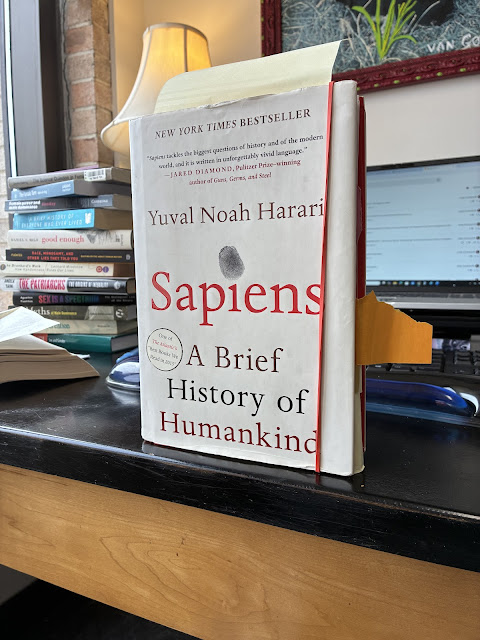
Holly Dunsworth is doing a page-by-page reading of Sapiens by Yuval Noah Harari. She has more stamina than I do.
When that book came out, it got a lot of praise, so I picked a copy off the shelf at the bookstore and started browsing through it. I did not buy it, because I could see, just from skimming the first chapter that it was shallow trash written by someone with only a superficial knowledge of the subject. How did people fall for this? It was just another example of the enshittification of everything, in this case of evolutionary science.
She doesn’t hate the book, though. She’s just correcting all the petty and annoying mistakes in a book that, so far, is sort of generally true. That’s a useful service.
Personally, I couldn’t bear reading the book, but it’s worth reading the Dunsworth commentaries.

In October 2024 Harai’s book “Nexus” came out. I was mildly interested and then I read an interview with Harai where he was asked about his views on AI. In his answers he claimed that AlphaGo’s victory over the Go champion Lee Sedol by using unusual moves was a sign of creative intelligence. To me, that was an indication tha Harari doesn’t know much about AI and had no idea how it works. Money saved.
Imagine if he had bothered to have a professional read it before he sent it to the publisher. I mean, I have a professional check my taxes first, how hard can it be?
@1 — Harari makes it clear that he does not equate creative intelligence with consciousness. What he says about AlphaGo is correct within his definition of the term. He’s generally on firmer ground in that book because it’s essentially about history, which is his field, and not evolution or biology.
(https://ecodevoevo.blogspot.com/2026/04/sapiens-page-5-crummy-one.html)
She kinda tears into that one.
John @4: Yeah, that sounds much more like an ancient religion’s origin story than anything else.
@5–
Yep. Certainly doesn’t sound like a knowledgeable description of speciation, even allowing for pop-science simplification.
It could be considered an accurate but poorly phrased description of the human-chimp mitochondrial coalescent.
akela51@1–
Without getting into an argument about what “generative intelligence” means, there is no doubt that the AlphaGo victory was a huge moment in computational problem-solving. It wasn’t that it beat a top professional player in a game more computationally complex than chess. The big shock was that it came up with a powerful new strategy that human players could understand once they had seen it (i.e., a good strategy even if you’re not a computer with vast number-crunching capacity, although it certainly helps if you are).
The game of Go is 2500 years old and has millions of players around the world, and yet no human had come up with the strategy. This is the true promise of machine learning: to find strategies, theorems, and processes that have escaped human attention but are highly learnable once revealed, and to empirically test those processes that are not easily understood by humans. Unfortunately the current major driving forces in AI are stake-claiming for future IP litigation, impossibly optimistic venture capital baiting, and overvalued tech companies sacking workers under cover of AI efficiency rather than admitting to poor corporate performance.
My grandpa, who turned 95 last month, had it on his bookshelf, so I asked his opinion: “It doesn’t contain anything you or I don’t know”. So I never bothered, thanks grandpa.
@#7 John Harshman
“It could be considered an accurate but poorly phrased description of the human-chimp mitochondrial coalescent.”
Well, no, because the reality is that it was not at all analogous to, say, an Irish family where one daughter, Colleen, emigrates to America and the other, Shannon, stays in Ireland. It was a population of apes that gradually split into two populations. Because of that fact the mitochondrial “Eve” of both branches would have lived several thousand generations before the splitting, and her daughters wouldn’t have been cleanly split between the two branches. In other words, if Eve’s daughter “Alice” was the mitochondrial ancestor of 100% of the “human” apes, she also was the mitochondrial ancestor of perhaps 99% of the “chimpanzee” apes, and Eve’s other daughter “Betty” would be the mitochondrial ancestor of all the chimpanzees and at the same time the mitochondrial ancestor of perhaps 99% of humans. So, a whole lot messier than Harari’s fairy tale.