
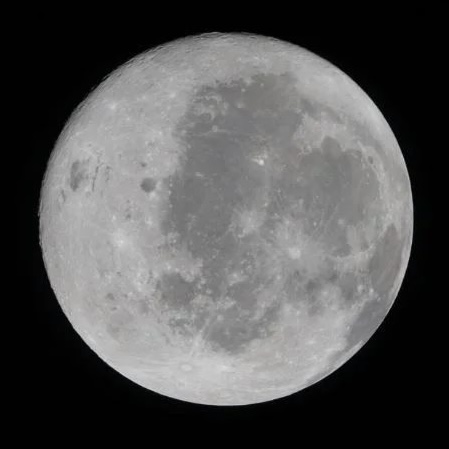
Farther away than anyone has gone before.
The Orion spacecraft is now in the lunar sphere of influence, meaning the moon’s gravity has more pull on the vehicle than the Earth. At 1:57 p.m. ET, the crew surpassed the record for the farthest distance traveled from Earth by humans, which was set by the Apollo 13 mission at 248,655 statute miles from Earth. At 2:45 p.m., the crew will begin making observations of the surface of the moon during the flyby.
Pretty good. Fly on!

So cool.
Oh, yes. It is all over the news.
Reuters: https://www.reuters.com/science/artemis-crew-reaches-moon-approaches-record-breaking-distance-earth-2026-04-06/
1.656% further, after 56 years. Whoo!
H. sapiens can do that! I guess I was born to the right species. 8-)
@ ^ John Morales :
Yet we are finally retruning to dointhe most impressiveand remarkable thing our species have ever done and going further. Even if by just a bit. Which is awesome and superluminous (beyond merely brilliant) in my view. Am loving seeing this misison and rocket & spacecraft fly and it is giving some hope and showing what Humanity can do at our best.
Live coverage on Aussie ABC here : .
https://www.abc.net.au/news/2026-04-07/artemis-ii-on-track-break-all-time-distance-record/106534158
Plus watching Ellie inspace live follow along of this here
This is a fantastic commentary:
https://bsky.app/profile/the-astro-stud.bsky.social/post/3miugrmtwwc2b
Clarity fix :
Yet we are finally returning to doing the most impressive and remarkable thing our species have ever done
.***
Er, actually make that please come back and splash down safely here on Earth! ;-)
But hopefully many more missions will fly onwards and land on our Moon and Mars and travel to asteroids and far more.
In some circumstances, advancing by 1.7% is a monumental achievement.
Well, computing power is up a tad more these days. As are telecommunications. As is automation.
As are almost all the sciences such as materials technology or medicine or sensors.
Space toilets aside, obs.
(And by a few to many orders of magnitude, not under 2%; e.g. https://en.wikipedia.org/wiki/Apollo_Guidance_Computer )
—
But sure, almost waking up from many decades of stagnation and loss of competence is monumental, for some.
In some circumstances. ;)
Doing in the 1960s was more impressive.
I am all for sending out probes and putting freaking good telescopes (etc.) in orbit and elsewhere. But the more we learn about how the human body responds to microgravity, the radiation damage, and the intrinsic costs of keeping canned apes alive, the more I think that for the rest of my life – and for several decades afterwards – we should keep crewed launches to visiting the ISS and its successors. Landing on the Moon (particularly with 1960s/1870s technologies) was pretty cool, and eventually humans visiting Mars will be pretty cool….but we should wait to try to go to Mars until we know a lot more about space medicine and have better propulsion and life support technologies. Also, that our robots will have constructed a large and comfortable base for the arriving humans to work out of. Maybe late next century.