Coverage of cops needs to change.

I am not a journalist. I write about news, but I’m pretty much always a secondary or tertiary source. All of that is to say that I’m not an expert in this field, so maybe I’m missing something obvious when I ask:  Why would so-called “news” organizations ever report police statements as fact?

The recent ubiquity of cameras has revealed something that was always there – police do not make our communities safer. They do not serve us. They serve themselves, and they serve the ruling class. In fact, through civil asset forfeiture, they play an increasingly large role in preventing class mobility – stealing from those who have little enough to begin with, apparently just because they can. If the United States was actually a free and just society, governed by and for the people, civil asset forfeiture would never have been made legal in the first place. If we had the kind of democratic power our leaders pretend we do, then I have to believe these laws would have been changed after John Oliver shined a big spotlight on them in 2014. Apparently the only state that’s actually made a meaningful change is apparently New Mexico.

Between 2000 and 2020, police stole at least $68 BILLION dollars from innocent people in the United States. Again, under the law, you do not have to be convicted of anything for the police to just take your property, and you have to hire an attorney on your own dime if you want to get it back. Might be hard to do if they’ve just stolen all your money, or your car, or your home.

More than that, cops lie constantly, and at this point it’s been so widely reported that I cannot believe anyone in the news industry is unaware. By the time we saw the cavalcade of lies from the Uvalde PD, nobody who had been paying even a little attention was surprised by their craven dishonesty.

When the subject of police violence comes up, I sometimes hear people say that even though cops do kill around three people per day. that’s not that many out of the hundreds of thousands of interactions every day. Even ignoring the less direct harm done by police theft and police dishonesty, the focus on killings often leads to us overlooking the non-lethal violence that police inflict on the communities that pay them:

>Data from the Centers for Disease Control and Prevention show that since 2015, more than 400,000 people have been treated in emergency rooms because of a violent interaction with police or security guards. But there’s almost no nationwide data on the nature or circumstances of their injuries. Many of the country’s roughly 18,000 law enforcement agencies don’t tally or make public the number of people who need medical care after officers break their arms, bruise their faces, or shock them with Tasers.
Researchers point out that only a tiny portion of arrests involve force. But when police do use force, more than half of the incidents ended with a suspect or civilian getting hurt, according to a 2020 analysis. It’s unclear how serious the harm is. “We need better data on injury severity,” said Matthew Hickman, a professor at Seattle University and one of the study’s authors.
Most experts agree that injuries at the hands of cops remain underreported.

And, of course, that doesn’t even start talking about the prevalence of white supremacy in law enforcement.

I don’t think any of this is new to my readers at this point, or if it is maybe you’re new around here? Maybe I need to write about this more often. Obviously, I don’t think that the corporations who own most “news” coverage in the United States serve the public interest any more than the cops do. If you want more of a breakdown of the problems of crime reporting in the US, you can go here. The point of this post was to say that I think the tendency towards passive reporting, and police-friendly reporting continues to help cops get away with a level of abuse and criminality so extreme that I’ve had people deny its reality to my face “because they would have heard about it”.

They should have heard about it, but for all our media love sensationalism, they love protecting the rich and powerful far, far more. If they actually saw themselves as serving the interests of the public, this is what their reporting would look like (content warning for extreme grief):

How warm air stirs Greenland’s waters and accelerates even submarine melting!

I seem to be on some sort of COVID plateau. My temperature hasn’t gone above 37.5,  and my throat and lungs have been mostly fine, but my ability to regulate my temperature is still wonky, and my snot production is still far too high. My eyeballs also aren’t thrilled about all of this.

That said, I’m starting to feel bad about just posting videos, so instead you get a somewhat gloomy climate science report! How excited you must be! I should say, however, that thus far the ocean is not hot enough to melt submarine vessels, in case the headline had you confused. We’ve got at least another couple years before the oceans get hotter than burning jet fuel.

Well, since you’re so excited, I won’t keep you waiting any longer. According to new research, the Greenland ice sheet may be more vulnerable to climate change than previously thought:

Rising air temperatures amplify the effects of melting caused by ocean warming, leading to greater ice loss from the world’s second largest ice sheet, a study reveals.

While previous studies have shown that rising air and ocean temperatures both cause the Greenland ice sheet to melt, the new study reveals how one intensifies the effects of the other.

Experts liken the effect to how ice cubes melt more quickly if they are in a drink that is being stirred – the combination of warmer liquid and movement accelerates their demise.

In Greenland, amplification occurs when warm air temperatures melt the surface of the ice sheet, generating meltwater.

Meltwater flowing into the ocean creates turbulence that results in more heat melting the edges of the ice sheet submerged in the ocean – so-called submarine melting.

The team found that air temperature has had almost as much impact as ocean temperature on submarine melting, with some regional variations.

For example, ocean temperature is the main factor that controls submarine melting in south and central-west Greenland, while atmospheric warming is equally damaging in the island’s northwest.

The findings suggest that if the atmosphere had not warmed since 1979, the retreat of Greenland’s glaciers, driven by submarine melting, could have been reduced by a half in the northwest region, and by a third across Greenland as a whole.

At this point I think it’s important to note that this is new understanding, not a new phenomenon. That means that even if this “stirring” effect is not accounted for in estimates and predictions for ice melt and sea level rise, it is accounted for in the actual data we have about sea level. This process has been ongoing for as long as ice melt has been increasing. Knowing about it will allow for more accurate estimates and predictions, which can only be a good thing. The bad news, of course, is that ice melt and sea level rise are likely to progress faster than currently predicted.

The effect we investigated is a bit like ice cubes melting in a drink – ice cubes will obviously melt faster in a warm drink than in a cold drink, hence the edges of the Greenland ice sheet melt faster if the ocean is warmer. But ice cubes in a drink will also melt faster if you stir the drink, and rising air temperatures in Greenland effectively result in a stirring of the ocean close to the ice sheet, causing faster melting of the ice sheet by the ocean. This unfortunately adds to the overwhelming body of evidence showing the sensitivity of the Greenland ice sheet to climate change, hence the need for urgent action to reduce greenhouse gas emissions.
-Dr Donald Slater, School of GeoSciences

Whenever we get bad news like this about the climate, it’s important to remember that for us, this changes very little. Those in power continue to demonstrate their inability to deal with climate change in a responsible manner, which means that we need to build the collective power to change who’s in power, or ideally end this antiquated insistence on having a ruling class. That means questioning “common sense” about the hierarchies and rules set over us, and it means encouraging people to think about direct action. It means organizing, and it means preparing for bad times so we can help our communities if the need arises. As ever, humanity’s greatest strength is our ability to cooperate, and we’ll need that going forward.


If you like the content of this blog, please share it around. If you like the blog and you have the means, please consider joining my lovely patrons in paying for the work that goes into it. Due to my immigration status, I’m currently prohibited from conventional wage labor, so for the next couple years at least this is going to be my only source of income. You can sign up for as little as $1 per month (though more is obviously welcome), to help us make ends meet – every little bit counts!
Tegan Tuesday: Backstage Beauty

The joy of doing gig work in the performing arts means that sometimes you are in non-public facing areas of interesting places. Now, I am someone who likes both history and architecture, so it’s not always hard to find something I’d consider interesting, but the specific quality of hidden or forgotten parts of a place that only exist once you’re past the ‘Employee Only’ door are always unexpected and sometimes truly bizarre. I know when I worked in the box office of a theatre in Boston I’d find abandoned safes, decades-old and abandoned merch, and we had a collection of several hundred CDs collected over the years. If I looked hard enough, I’d also find tape cassettes and inside jokes from dead actors scrawled on the walls.

This week I am in and out of Ireland’s National Concert Hall in Dublin. I had actually attended concerts here prior to my ever going ‘backstage.’ But this building has only loosely abandoned its earlier uses. Let’s take a brief photo journey through some NCH history.

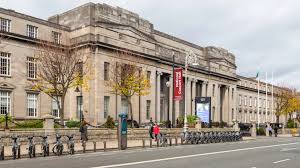
The first image is a modern picture of the National Concert Hall from the street.

An image of a stone building, taken at a slight angle. It has columns and wings extending beyond a central point, and there are three visible floors.

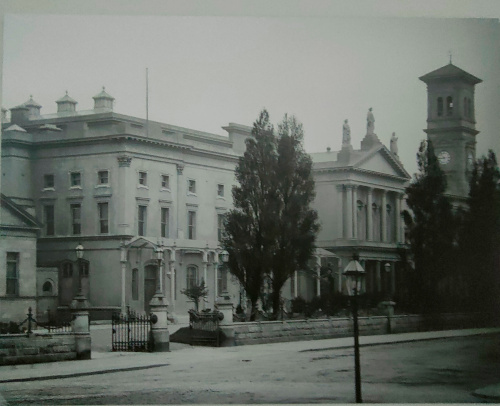
This next image is one that’s posted in the upstairs hallway of an earlier life of the building. The accompanying caption reads: The Royal University Dublin pre-1908. During major University College Dublin reconstruction work, the campanile was dismantled and removed to the Royal College of Science in Dublin’s Merrion Street around 1915.

A photo of the previous building, clearly an older version. There is a front section with a cornice and pillars that is missing from the modern image.

That’s right! The NCH used to be one of the buildings for University College Dublin (one of the Irish state schools, along with others like UC Cork and UC Limerick) back when all of the Dublin universities were downtown. It makes sense that a state-owned building would remain a state building when UCD moved to their Belfield-area campus in the 1970s. According to wikipedia, the building was originally an exhibition hall until it was repurposed into a university in the late 19th century, so going from university to concert hall is hardly its first rebranding.

Just being an old school building or exhibition hall isn’t particularly fancy, as any number of buildings are abandoned schools, or churches, or supermarkets. It’s probably more common for a building to have had multiple uses throughout its life than to remain one single entity forever. The Boston theatre mentioned previously had been a church in its past, for example. But like so many areas of downtown Dublin, there were important connections to the Irish civil war too.

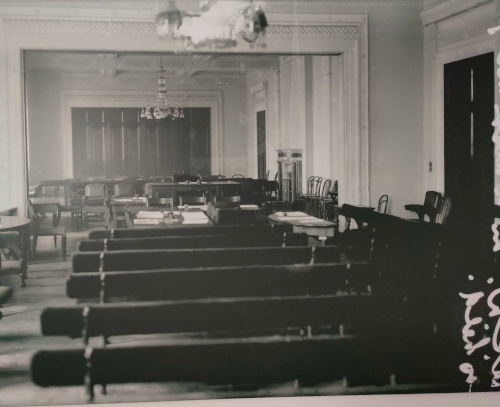
A black and white photo of a large room with molding on the walls and in archways. The room is full of benches and chairs, mostly visible from the back.

The caption accompanying this picture states: Council Chamber of UCD, now the Kevin Barry Room, where the Treaty debates took place between 14th December 1921 and 10th January 1922. On the reverse of this photograph, it was noted at the time ‘would not be allowed take photo during sitting.’ There are actually quite a few photos on the walls of civil war and independence relevant images and details, and so even wandering the halls can be an interesting experience. But notice the benches in that photo of the Council Chamber?

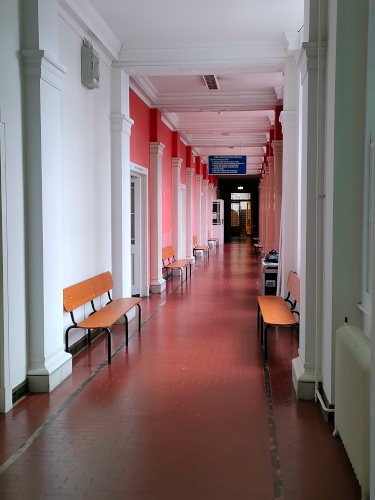
A photo of a hallway painted pink and white. Distinctive benches made of oblong planks are visible running the length of the hallway.

Those benches are still here! This is one end of the first floor hallway, each of these rooms are currently small rehearsal spaces and lesson rooms. They could of course be repro, but they are such an unusual shape I feel like it would be easier to just re-use old benches rather than source a modern recreation. It does look like some of the hardware has been changed, but the overall appearance is the same.

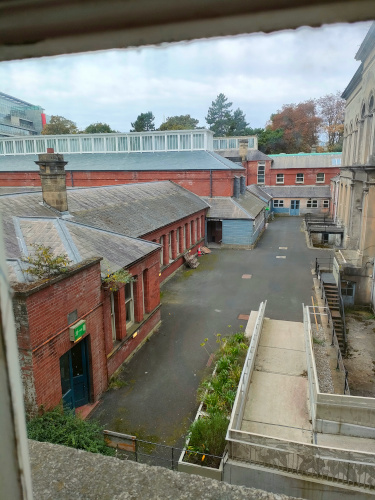
I have, however, saved the best secret for last. Any building can have a past. Any building can reuse furnishings from said past. But let’s take a peek out the windows of that hallway with all of the benches.

A photo of an outdoor area with low brick buildings and a driveway.

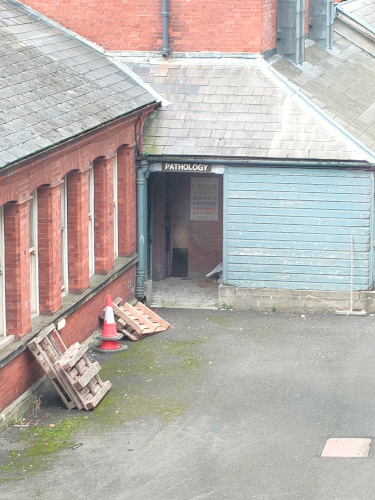
See it yet?

A zoomed-in photo of the previous driveway are, however the doorway in the back is visible and labled 'Pathology.'

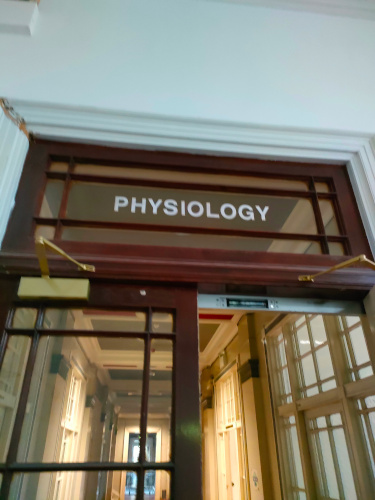
A pathology lab! This UCD building had been where medicine and engineering studied and these traces are absolutely everywhere that concert patrons are not. Many of the rehearsal rooms and offices are labeled as the offices of former professors or different departments or specific classes. As many of these doors are starting to lose some of their letters, and I was technically working, I only snapped one quick photo of a particularly nice example of this.

A photo of a set of double doors. The focus is on the label 'Physiology' written on the glass above the doors.

Isn’t that just so charming? I love how the professors and students stepped out of this building one day and the building has waited for their return. As the main concert hall only opened in 1981, a friend of mine said his father had attended UCD when it was here, and that the concert hall was the exam room. It had apparently made for a nervewracking first concert experience, trying to overcome the training of four years worth of fear and stress that lurked behind the doors to that room.

What history is hidden in the buildings you frequent? Even the simplest thing gains shine when viewed from decades away, and it is often a fun game to try and find the evidence of the past.


If you like the content of this blog, please share it around. If you like the blog and you have the means, please consider joining my lovely patrons in paying for the work that goes into it. Due to my immigration status, I’m currently prohibited from conventional wage labor, so for the next couple years at least this is going to be my only source of income. You can sign up for as little as $1 per month (though more is obviously welcome), to help us make ends meet – every little bit counts!
Video: What the new “Climate Declaration” doesn’t tell us

Well, I’m still sick. It feels different from yesterday – my sinuses feel too hot and dry rather than full of gunk – but I’m still out of it enough to want another day “off”.

Thankfully, a blast from the past is here to save me!

Longtime skeptic/atheist types are probably familiar with Peter Hadfield, known on Youtube as Potholer54 for his work debunking creationists, and overseeing the Golden Crocoduck award, for lying in defense of creationism. He’s also done some good work debunking climate deniers, and exposing their bullshit. I hadn’t thought of him in a little while, but recently I saw a new letter/petition “signed by hundreds of scientists” saying that there’s no climate emergency, and it made me think of him.

Sure enough, he was good enough to pop up and demonstrate how this letter is as much empty propaganda as its predecessors. This is an old tactic, and as you’ll see if you watch, a predictable one.

It’s not warming, but if it is, it’s not humans doing it, but if it is, there’s nothing to worry about, and – get ready for this one – there might be something to worry about, but there’s nothing we can do, so we shouldn’t try.

I also like the fact that we can see that our climate action – woefully inadequate as it has been – has had some effect.

Video: How Corruption Leads to Conspiracy Theories

Well, today may have been better than yesterday, but if so it was not by much. I’m glad it wasn’t worse, and I have my fingers crossed for tomorrow. It’s still basically just congestion, and just a hint of an impending sore throat that has yet to arrive. Oh, and some difficulty with temperature regulation. I think my head feels a little clearer today, but the fact that I’m so uncertain seems to imply otherwise.

Anyway, here’s a video that I think is useful. The ruling class of the US has spent the last century or so making corruption so much a part of daily operations that a lot of people can’t even tell it’s there. Growing up, I remember hearing about corruption in other countries – through media of various sorts – and it was always presented as a pyramid of officials shaking people down, and shaking each other down, all the way to the top, all outside the actual laws. I’ve grown up a bit since then, but even so it’s hard to really pick apart just how much the United States has been designed over the years to have a scared and obedient workforce that willingly gives almost all of everything they create or earn to corporations.

In that setting, is it any wonder that people believe in conspiracies? Add in the various conspiracies that we know have happened, and I think it would be more surprising if people didn’t start seeing patterns where none actually exist. This video is an interesting dig into some research into why people believe conspiracy theories, and how government corruption can lead to them. As always with Rebecca Watson’s videos, you can find a full transcript on Skepchick.org.


Video: Use of tactical nukes is unlikely in Ukraine

Some days it feels as though the elderly people who’re driving humanity towards extinction are nostalgic for the existential terror of their youth, so they decided to bring back the constant fear of imminent nuclear annihilation. While none of us can predict exactly where this is going to go from here, I think this breakdown is useful and somewhat comforting.

The TL:DW is that Putin knows that if he were to use tactical nukes in Ukraine, Russia’s remaining allies would turn against them, and the US would destroy all of their assets outside of their geographical borders. The US would also probably give Ukraine better weapons – ones that can reach inside Russia. More than that, because of how this war has gone, there’s no longer any question at all whether Russia has the military capacity to stop any of that. Basically, nukes are all they have, and they’re not something that can “win” this war for Putin in any meaningful sense.

Again, that does not mean that we’re safe. I’m comfortable with helping Ukraine defend itself, but not supporting an invasion of Russia. I think it’s unlikely that Putin would use nukes unless he felt it was the only way to hold on to power, and I think it’s good to avoid reaching that point. Triggering nuclear war would be a far greater injustice than allowing an asshole like Putin to die of old age, still holding on to what little power he has. As the saying goes, it ain’t over till it’s over.

Until then, we keep doing what we can to make the world better.

Some More News: Mental Health and Mass Shootings

I always find it odd how resonant my head seems to be when it’s loaded up with snot. I’m grateful that this continues to manifest as a head cold, and I hope it stays that way. I don’t know if I have brain fog, but I’m certainly glad I decided not to try to do any real writing today.

Here’s Cody’s Showdy talking about mental health and mass shootings (and how the “mental health” line is a bigoted dodge that hurts everyone, especially those of us struggling with mental health problems. I also do not believe for a second that any of these powerful people – as ignorant and incurious as I think they are – actually think that “mental health” is the driver of mass shootings. They’re lying for the same reason they always lie – to prevent any kind of systemic change.


I finally caught COVID (plus True Facts about parasitic birds)

I made it almost three years without getting it. I avoided it when Tegan had her first case, but I guess I got too careless this time. At the moment, it feels like a head cold with a slight fever, and trouble with temperature regulation. It’s my goal to keep posting through it, but I can’t make any promises about post “quality”.

For today, here’s Ze Frank with a cool and slightly horrific video about brood parasites:


Why don’t we have “good” cops? Ask the ones we do have…

I remember seeing an article going around, back in June, about the funeral of a police officer who’d been “accidentally killed during a training exercise”. I had other things on my mind at the time so I didn’t look into it much, but I remember assuming that he was deliberately killed by other officers for either investigating a crime one of them committed, or for reporting misconduct. I honestly didn’t expect to hear about it again any time soon, but just today I saw the same funeral picture, this time with a Jezebel headline supporting my initial suspicion:

LAPD Officer Killed in Training ‘Accident’ Was Investigating Gang Rape by 4 Other Officers

The lawyer of a Los Angeles police officer killed in what the LAPD called a training accident back in May said the officer, Houston Tipping, had been investigating an alleged gang rape perpetrated by four LAPD officers in 2021 when he was killed. Tipping’s lawyer, Bradley Gage, claimed on Monday that one of the four officers who allegedly participated in the gang rape was present when Tipping was killed.

There was a time in my life, long ago, when some of this would have surprised me. Hell, there was a time not too long ago that I still believed that some, or even most cops were “good”. I’ve learned a bit more since then – enough to realize that I had been taken by the propaganda that fills the culture of the United States like some kind of cursed fog. According to the cops, Tipping died when he was trying to demonstrate a grappling move by some sort of ledge, and both officers fell off. The attorney representing Tipping’s interests here has a different perspective:

At a July news conference, Gage showed reporters MRI scans revealing that Tipping had staples in his head due to the injuries he sustained leading up to his death. Gage also cited sworn declarations from a nurse and a paramedic and alleged that Tipping had suffered spinal cord injuries, a collapsed lung, broken ribs, and liver damage consistent with being fatally beaten. “When you look at all these horrific injuries, the truth is something went seriously wrong here,” Gage said. “I cannot fathom anything other than a severe beating.”

In June, Gage first filed a damages claim against the LAPD on behalf of Tipping’s mother, Shirley Huffman, alleging that he had been beaten to death as part of a training exercise to “simulate a mob.” According to the claim filed by Gage, Tipping died after being repeatedly hit in the head, causing bleeding and multiple fatal neck fractures.

At this point, it’s more reasonable to assume any police statement is more likely to be a lie than the truth. They lie far more often than they attack people, and they attack people all the time. I don’t know what sort of person Tipping was, but given that he was a cop, he probably wasn’t great. That said, it was good that he was investigating the crime committed by his colleagues. People with power over others have a tendency to use that power to get away with sexual harassment, assault, and rape. Few people have more unaccountable power in the United States than the police, so it should not surprise you that they commit sex crimes all the time.

And Tipping’s fate shows what can happen to anyone who tries to hold them accountable. As with all the other police atrocities we’ve been seeing, it’s worth remembering that this stuff is not new. Non-white communities in particular have been sounding the alarm on the horrors of policing for decades, and have been largely ignored. All that has changed is that now they’re being caught on camera more often, so now we can see them lying.

I don’t know what will come of this story. Ideally, the people responsible would be put on trial for murder or manslaughter, and would be blacklisted from police or guard work in the future. It may be that because they got caught killing a fellow cop – you know, an actual person – they’ll actually face prison time. It seems more likely to me that they’ll either get a slap on the wrist for getting caught, or maybe they’ll just be fired. As ever, I’d love to be proven wrong, but LA is notorious for the viciousness and corruption of its law enforcement:

The allegations against the LAPD suggesting officers may have killed Tipping because of his investigation come amid years of whistleblowing and reports about “shadow-gangs” within the Los Angeles County Sheriff’s Department. These gangs allegedly comprise a sort of shadow government within local law enforcement to cover up officers’ crimes. As of July, at roughly the same time Gage and the LAPD were disputing the circumstances that led to Tipping’s death, LA County Sheriff Alex Villanueva’s former chief of staff publicly admitted he’d once belonged to the alleged “Grim Reaper” deputy gang within the county sheriff’s department.
In August 2020, the Los Angeles County Board of Supervisors paid a $5.5 million settlement to a young woman who said a LA County Sheriff’s Department had raped her in 2017 when she was 15. The detective in question had faced two prior allegations of sexual misconduct that included committing a lewd act with a child and unlawful sexual intercourse. The Los Angeles Times recently reported on the LAPD’s history of systematically declining to discipline officers for sex crimes and then concealing these crimes from the public.

This is why I no longer believe reform can work. Better training is a waste of everyone’s time, because new cops are told to ignore that training the second they tart actually working, and because old cops will just ignore any training that doesn’t rank their ego above the life of every other human they interact with. Abolition isn’t something that will happen overnight, or in isolation from the rest of society, but until it does happen, this will continue. From what I can tell, we cannot expect other outcomes from creating a class of unaccountable people with power over life and death. Hell, even giving them far less power to kill doesn’t remove this dynamic, as the UK has shown. Replacing our current police with “better people” will not change the fundamental purpose served by the institution. We need first responders, but we do not need cops. Trying to reform them is useless, and continuing to have them destroys countless lives on an ongoing basis.


If you like the content of this blog, please share it around. If you like the blog and you have the means, please consider joining my lovely patrons in paying for the work that goes into it. Due to my immigration status, I’m currently prohibited from conventional wage labor, so for the next couple years at least this is going to be my only source of income. You can sign up for as little as $1 per month (though more is obviously welcome), to help us make ends meet – every little bit counts!
Tegan Tuesday: The Banality of Bigotry

This is a tale of heartbreak. A tale of death. A tale of perpetual life. A tale of political outreach and artistic expression. This is a mystery, as well. A famous work – a minimalist political artistic representation of grief – was briefly denied the chance to be either political or grief-inducing. While the situation has been corrected, the mystery has not been solved, and may never be. Even so, let us explore this saga.

For those who follow queer art and art news, this will probably not be your first introduction to minimalist Félix González-Torres, and his many “Untitled” works. His “Untitled (Portrait of Ross in L.A.)” (1991) is among his most famous and rightfully so. As I do not have the digital image rights to this work, please have a quick glance at this youtube video from the National Portrait Gallery.

As described in the video, it is an extremely simple installation of 175lbs of candy. This weight represents the ideal, healthy body weight of González-Torres’s partner, Ross, prior to his illness and death due to AIDS in 1991. As visitors are encouraged to pick a candy from the pile, the slow diminishing of ‘Ross’ represents both the disease devouring his body and the societal dismissal and diminishing of those afflicted. It’s an incredibly moving piece, made all the more so by the participation and complicity of the gallery patron. It’s far from the artist’s only AIDS related art, but it is probably his most famous. In 1996, González-Torres himself passed from AIDS at age 38.

I also cannot emphasize enough: this piece is incredibly well-known and so is the context. I’ve discussed it in classes, I’ve read articles and gushing accounts of its impact on personal lives for at least a decade, and I’ve certainly seen pictures of it all over the web.

Imagine my surprise when I came across this bombshell of a tweet yesterday:

Published on September 28th of this year, the tweet came out the same day as an equally inflammatory letter published in The Windy City Times (The Voice of Chicago’s Gay, Lesbian, Bi, Trans and Queer Community Since 1985).  Both the tweeter, Will Scullin, and the letter-writer, Zac Thriffiley, noticed that the signage for the Art Institute of Chicago’s installation of “Untitled (Portrait of Ross in L.A.)” had removed any and all mention of Ross, AIDS, death, memorial, or anything personal at all. There were many pointed comments on Twitter about the concept of the 175lbs referring to “the average body weight of an adult male,” and a few mentioning “ideal weight.”

I tromped all over the internet, trying to source reasons or explanations, only to discover that, hallelujah! The text had been changed yet again and now included Ross and his death as well as opening the door to more abstract interpretations.

Felix Gonzalez-Torres produced meaningful and restrained sculptural forms out of common materials. “Untitled” (Portrait of Ross in L.A.) consists of an ideal weight of 175 pounds of shiny, commercially distributed candy. The work’s physical form and scale change with each display, affected by its placement in the gallery as well as audience interactions. Regardless of its physical shape, the label lists its ideal weight, likely corresponding to the average body weight of an adult male, or perhaps the ideal weight of the subject referred to in the title, Ross Laycock, the artist’s partner who died of complications from AIDS in 1991, as did Gonzalez-Torres in 1996. As visitors take candy, the configuration changes, linking the participatory action with loss—even though the work holds the potential for endless replenishment.

Problem solved, yes? Well, yes and no. The first change as well as the second were implemented with no fanfare, and according to some sources, this has been on-going since 2018. (Also, for all the wall text changed, the museum’s audio description remains unchanged from 2015)

Then the work was de-installed [in 2017], and when it was put back on display in the summer of 2018, it was accompanied by a wall label that made no mention of AIDS and focused solely on the work’s aesthetic value. (The accompanying audio focuses heavily on Laycock and the AIDS crisis and has gone unchanged since 2015, according to a museum spokesperson.)
“Felix Gonzalez-Torres’s work is characterized by a sense of quiet elegy,” read the new label. “He possessed an uncanny ability to produce elegant and restrained sculptural forms out of common materials.” The text acknowledged that 175 pounds “corresponds to the average body weight of an adult male” but excluded any biographical information.

“Untitled (Portrait of Ross in L.A.)” was taken down again in the summer of 2018 and reinstalled this July [2022], once more accompanied by the newer text that avoided any mention of AIDS. This time, visitors voiced their concern.

This, emphatically, does not make sense to me. Why would an incredibly famous AIDS-activism artwork be stripped of all of its context? One theory, put forth in both the article quote above and on twitter, lays the blame for this situation at the representative for the artist’s estate, David Zwirner of the Zwirner Gallery.

Well, sure, I’m always happy to think ill of the ‘men in suits’ who move the money in the art world, but I still couldn’t prove anything one way or the other, and I realized that I also had no real understanding of what could potentially be the motives from the institution side of the equation. Thankfully for me and my mystery, being in a performing arts department of a university means that I could find someone who knew.

A lovely hour-long discussion with the head of Art History at my school brought forth several revelations, if no clear answers. Firstly, the Zwirner Gallery is incredibly well-known in the art world, and there is absolutely no financial incentive or advantage to their demonstrating homophobia in 2022. Aside from museum directors, who are almost exclusively white, cis-het men, the art world is generally pretty queer. Whether it’s artists, collectors, buyers, curators, interns, patrons- many of the people in the art world just aren’t straight. The Zwirner Gallery would lose the representation of many of its artists as well as many lucrative sales or museum loans if this omission was known to come from them, so while this is possible that David Zwirner could have the influence on the wall plaque, it’s unlikely that he would have removed any mention of AIDS or of Ross.

It is also unlikely to have come from the board, or any donors of the Art Institute of Chicago. According to the professor I spoke with, the three areas of art that have censorship issues are: sex, body parts that are normally clothed, body fluids and scat. A pile of candies that is representative of the impact of AIDS hardly qualifies. It’s also unlikely to have censorship coming from the city government of Chicago in 2022. This isn’t Texas in the 1980s. Perhaps there are US galleries in communities that have such strict control over messaging that this work would be censored, but that isn’t the case here.

The likely reason for the signage change comes from one of two places, according to my source. If it’s a top-down decision, it likely comes from the family of the artist. González-Torres was Cuban-born and had strong family connections to the Cuban community in Florida. This community is often extremely conservative, extremely Catholic, and perhaps that someone in the family who is associated with the González-Torres Foundation is attempted to straight-wash the history of the artist. It is unusual that the gallery would bow to the whims of an estate on the verbiage of a wall plaque, but perhaps the visual rights could be held out of reach until such changes were made. It’s possible.

The other possibility? The poorly-received text was written by an intern, with very little oversight from a curator. Apparently writing the text for things like wall plaques is the museum version of grunt work that often gets fobbed off onto interns or Art History undergrads. This potential anonymous intern could equally have had an axe to grind about González-Torres’s representation as a gay artist who created art about AIDS (it seems unlikely that such an important thing would be changed “by accident”). And with the amount of work that is needed to put together exhibits and keep museums running, much of this grunt work is checked off as ‘done’ without much attention paid to the details by someone further up the food chain.

I guess the only way to discover the actual solution to this mystery is will be to watch González-Torres’s works in future exhibits. If the artist’s personal details continue to get lost from museum catalogs, then perhaps an outside influence like a family member is pulling some strings. If this remains a freak accident, it might very easily have been an intern’s barely-approved text getting printed. Either way, I am pleased that this story at least has a happy ending: the artist’s life details have been reunited with his art for future visitors to learn about this powerful and wonderful work. Who needs to solve mysteries anyway?


If you like the content of this blog, please share it around. If you like the blog and you have the means, please consider joining my lovely patrons in paying for the work that goes into it. Due to my immigration status, I’m currently prohibited from conventional wage labor, so for the next couple years at least this is going to be my only source of income. You can sign up for as little as $1 per month (though more is obviously welcome), to help us make ends meet – every little bit counts!