Caturday come on Wednesday this week.

I find Irish winters to be an interesting and novel experience. I’m further north here than pretty much the entire United States, but thanks to oceanic currents, it never gets as cold as the winters of my homeland. That said, the cold is still very much a problem. To begin with, the housing is designed for the average climate. That means that there’s basically no insulation. Worse, because these apartments were built with gas boilers, there are vents to the outside in every room. Add in the apparently lazy installation of the windows, and the result is a very drafty apartment that does not hold heat for long. Its natural resting temperature seems to be around 50°F/10°C, when the outdoor temperature is around freezing, and it gets there quite quickly. More than that, it’s always very humid here, and that really makes a difference. Recently, we got about half an inch of snow, and it’s been just cold enough to keep most of it around. At the same time, the humidity has been hovering around 100%. That means that it’s been feeling about ten degrees colder than it actually is.

I took the cat out into the snow when it was falling, to see his reaction. Initially, he just hid in the bushes, but when I actually carried him to a salad station, he was willing to eat some grass. He was, however, not happy about the snowflakes falling on his delicate fur.

His holiness was not thrilled about the cold, wet stuff on his toebeans. He also did not appreciate things falling on his back. The salad was good, though. The image, for those who can’t see, is of a chubby British shorthair cat, partially hidden by a tree trunk. His fur is mostly dark, but he’s got white on his face, neck, and paws that’s as pure as the falling snow. He’s sitting on snowy grass, watching flakes fall.

After that, he actually was willing to play a little. I tried, and failed to get a video of him chasing snowballs, but it was extremely cute. Then, he chased one into a more brightly lit area, and his tiny brain was short-circuited by the combination of big flakes falling, and big shadows falling with them. He started randomly chasing everything at once until he reached a car, and retreated into the blessed darkness underneath it.

In this somewhat blurry photo, you can see His Holiness huddled under my neighbor’s car. His dark fur blends in with the background, but you can see the white on his muzzle, forehead, cheeks, and neck, and you can see his stubby white paws poking out. He’s looking to the side, and his eye is glowing a little from the camera flash. A couple cat pawprints are visible in the snowy foreground.

Eventually, I managed to coax him out from under the car, and we went back inside.

I’ve been maintaining a livable temperature by running a space heater in my little workroom, where I already spend most of my time. It’s cheaper than running the boiler to heat the whole flat, and thankfully the Irish government has been handing out electricity credits to help people get through the winter.

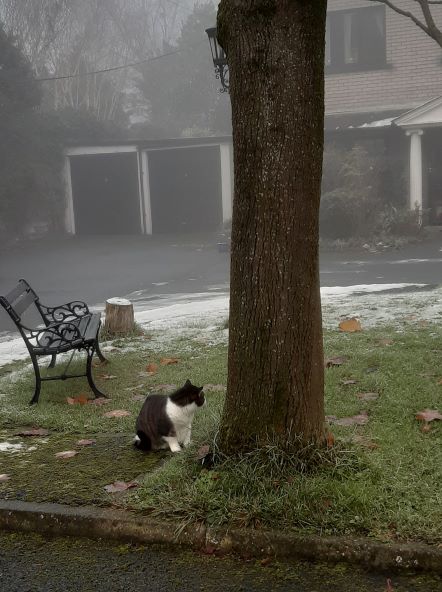
A couple days later, we awoke to find ourselves shrouded in fog, so I decided to see if I could get some evocative pictures during the cat’s salad run. I still need to get a new charger for my camera, and I find it hard capture the feel of a foggy day anyway, but I tried my best. It felt cold enough that the mist should have been freezing out of the air, but instead it hung around to make everything feel colder.

His Holiness made his usual first stop, giving me a chance to grab this picture. Fog seems to hold on to smells, so the air was full of slightly stale wood smoke, that seemed to be diffusing through the water droplets more than blowing from any definable source The bare branches of the maple trees stand out against the white fog that seems to have consumed the world outside our little oasis of reality.

This weather was much more acceptable to His sensibilities, but he still wasn’t thrilled about the cold, wet, white stuff on the ground, so when it came time to move on from the first grass patch, he was careful to walk where it was safe.


His Holiness has dark fur – brown-gray on the sides, with black stripes that thicken into the black that runs along his spine. His tail is similarly striped with a black tip. He’s a chunky cat, with thick fur that makes him look chunkier. His white legs seem stubbier than they are poking out from other the imposing bulk of his torso. In the picture, you can see that he’s walking along a curb where the snow has melted, forming a clear path through the treacherous white landscape. There was too much snow by that stump for him to graze there.


He followed that trail around to an area that had gotten a little more solar radiation, and stopped for a blessedly snow-free bit of roughage.

His Holiness is sitting on the corner of the paved walkway, looking back towards the mist-shrouded house. You can see the green grass fading smoothly into white snow behind him, contrasted with the tree trunk that fills the center of the picture.

Shortly after taking this picture, I decided it was time for both of us to go back inside to where it was warm.

For those of you who’re wondering about the title, it’s a reference to a very old newspaper comic called Pogo, about the lives of various anthropomorphic swamp critters somewhere in Georgia. I don’t need to go into too much detail, but Churchill “Churchy” LaFemme is a turtle with an interesting perspective on the transitive property of days:

The image is a four panel comic strip. In panel one, Pogo Possum is scooping a bucket of water, while angrily saying,


If you want to help me feed His Holiness, that we might be spared his divine wrath, or you just want me to be able to do things like eat and have shelter, consider tossing me a little money at patreon.com/oceanoxia. It can be as little as a few cents a day, and for immigration reasons it’s my only form of income right now. See this as me passing around the hat at the end of a bit.

Video: History alla PragerU

All my energy today has gone into prying a couple lines of fiction out of some crevasse in my brain, so here’s a video. It’s not new, but I find it interesting and a little entertaining, and hopefully you will as well. It’s about how conservative propagandists use history in their work.

Edit: Managed to get the crowbar down in between a couple brain wrinkles, and actually found a couple thousand words of the novel hiding in there, so that’s nice.

Charges over Flint Water Crisis dismissed on procedural grounds

The Flint water crisis of 2014 happened as a result of a Michigan democracy crisis that had started years earlier. Flint was one of the primary victims of the way the auto industry abandoned Detroit, and had been struggling financially for years. Rather than actually working to alleviate poverty and build up the community, Flint’s Republican governor decided to go with the too-popular lie that authoritarianism is more efficient and effective than democracy or other forms of self-governance. In an act of open defiance of democracy, the Michigan legislature passed a law, which the governor signed, re-instating the emergency management powers that the people of Michigan had resoundingly and directly voted to remove:

Following his election in 2010, Snyder and the Republican-controlled state Legislature expanded the powers of emergency managers. Michigan voters, through a November 2012 ballot proposal, repealed the controversial law.

But less than two months later, Snyder signed replacement legislation that he said improved upon the former law. It offered four pathways for struggling schools and municipalities: A consent agreement, Chapter 9 bankruptcy, mediation or emergency manager.

Michigan’s emergency manager law is facing scrutiny in federal court, where plaintiffs argue that the law is unconstitutional because it disproportionately targets black communities and continues a “narrative of structural and strategic racism.”

Emergency managers were given near-total power over their jurisdictions, and could outright ignore local elected officials. This was the setting in which the decision was made to switch Flint’s water supply from Lake Huron to the Flint River, to save money, resulting in the poisoning of thousands of people, and potentially permanent brain damage for an entire generation of Flint’s children:


While it’s still difficult to know for sure, it seems like the decision to ignore warnings about the need for treatment to prevent corrosion was also apparently made to save money.

“As we all know, the water plant itself is operating fine, but without corrosion control chemicals, it had a detrimental impact on the lead pipes,” Adler said.

The city “made the decision” not to use corrosion controls “because they didn’t think they needed it,” Adler said. The state Department of Environmental Quality failed to ensure the chemicals were added, and the federal Environmental Protection Agency didn’t alert the public when an employee first raised a red flag.

“It was a failure at every level, all along the way. This was a perfect storm of bureaucratic mismanagement of a public health issue,” Adler said.

A previously released email showed that Flint water plant supervisor Mike Glasgow was also concerned about the conversion to Flint River water just days before the city would formally close a valve that had delivered Detroit water for nearly 50 years.

“If water is distributed from this plant in the next couple weeks, it will be against my direction,” Glasgow wrote in an April 17, 2014, email to officials at the state Department of Environmental Quality, suggesting management above him had its own “agenda.”

When we hear this person talking about “a perfect storm of bureaucratic mismanagement”, I think it’s worth noting that this was a spokesperson for Republican governor Rick Snyder. The GOP has a long-standing hostility towards the general concept of “government”, and they lean heavily on the notion that bureaucracy is both always bad, and only a government problem. Pretty much any time I get into an internet fight about healthcare systems, I have to explain to fellow USians that all the paperwork they have to deal with from health insurance corporations is also bureaucracy. With the USPS, the deliberately unpleasant tax system, under-funded schools, and many other areas of government, conservatives have a record of using sabotage not just to allow their corporate overlords to get away with harming people, but also to support their antigovernmental rhetoric by making the government worse on purpose. They like when there’s a huge government catastrophe like this, because it’s tailor-made for their perennial antigovernmental talking points.

And as always, the only parts of the government they actually dislike, are the ones that make life better for the general population. What’s more, their constant efforts to spread corruption and dysfunction also provide a degree of protection for themselves. There’s a quote that I’ve shared before:

Conservatism consists of exactly one proposition, to wit:

There must be in-groups whom the law protectes but does not bind, alongside out-groups whom the law binds but does not protect.

It’s from a comment by a composer named Frank Wilhoit, and while I don’t know how I feel about the broader argument he was making, this definition is useful all by itself. The conservative project of dismantling government, and then using the dysfunction they have caused to advocate for further dismantling, serves to both remove protection from the out-groups, and remove bindings from the in-groups. This was a crime of conservative, authoritarian governance, for which thousands of people will be paying for the rest of their lives. All of it happened under the authority and supervision of Rick Snyder, the Republican governor who signed the law bringing back the emergency management system his constituents had just rejected.

And a judge has thrown out charges against Snyder on procedural grounds:

A district judge in Genesee County tossed a pair of misdemeanor charges levied against former Gov. Rick Snyder for his involvement in the Flint water crisis, citing previous court rulings that state prosecutors incorrectly used a “one-person grand jury” to indict Snyder.

Snyder, who was governor in Michigan from 2011 to 2019, was charged with two counts of willful neglect of duty by a public official. Genesee County Judge F. Kay Behm signed an order remanding the charges Wednesday.

Behm’s order technically does not dismiss the charges, but sends them back to a lower court for dismissal.

Behm cited a Michigan Supreme Court ruling from June which stated government prosecutors erred in 2021 when they had a circuit judge serve as a “one-man grand jury” to indict Snyder and the other officials. She also noted circuit court rulings to dismiss charges against other former state officials which cited the Supreme Court ruling.

Snyder is the latest former official to have charges tossed related to the Flint water crisis, although state prosecutors, led by Attorney General Dana Nessel, have vowed to continue seeking charges related to the case. In October, charges for seven other former state and Flint officials were dismissed, although the state’s prosecution team has indicated it will appeal the decision to dismiss the charges.

In a statement, the prosecuting team said it plans to appeal Behm’s order.

“As we have reiterated time and again, rulings up to this point have been on process alone — not on the merits of the case,” the unattributed statement says. “We are confident that the evidence clearly supports the criminal charges against Rick Snyder, and we will not stop until we have exhausted all possible legal options to secure justice for the people of Flint.”

Snyder’s lawyer, Brian Lennon, said in a statement the prosecution efforts have been “amateurish and unethical.”

“The state has already wasted millions of taxpayer dollars pursuing meritless misdemeanor charges and this case should now be considered closed,” Lennon said. “The prosecution team’s statement saying it will appeal this ruling is further proof that they intend to continue their efforts to weaponize the court system against their political enemies.”

They always claim persecution, but I can’t help but note that the United States will hold people for weeks, months or even years without trial, often over petty shit like suspected shoplifting, but poisoning thousands of people? Well, that is generally done by members of the in-group, whom the law protects, but does not bind, and years later, the “criminal prosecutions” section of Wikipedia’s water crisis article shows an awful lot of dismissals.

More and more, I’ve been realizing that the United States is a conservative country, in that it is set up, at every level, to maintain racial and economic disparities. It’s not just the legacy of redlining, or environmental racism, or civil asset forfeiture, or white supremacy in law enforcement, or racism in the courts, or racism in legislation – it’s also a parallel infrastructure designed to smooth the way for those at the top (who are almost all white men). When you’re at the bottom, when the system screws up, you pay the price. At the bottom, you can spend years in prison even when everyone in the legal system agrees on your innocence. At the top, you can steal millions, and get a finger wag as you’re gently told to give it back.

And race is absolutely a part of this. Flint, MI is a predominantly Black city, and that fact is a big part of how this whole situation came to be in the first place. The system does actively harm poor white people as well, of course, but they are much more likely to be treated as part of the in-group that gets protection and exemption from the law, if their crimes and conduct merit honorary membership. That option is generally not available to people who aren’t white (though exceptions are sometimes made for wealth, power, or allegiance/usefulness to wealth and power). I think George Zimmerman – the man who murdered Trayvon Martin – is a good example of that. He had no authority, and not much in the way of political and economic power, but he adopted the role of being a member and defender of the in-group, and is therefor in the clear. Kyle Rittenhouse also comes to mind. There’s always some reason. Zimmerman was probably over-charged, given the available evidence. Was that an honest mistake by the prosecutors? Who can say? But the overall pattern is suggestive, to me, of more than just coincidence. They say justice delayed is justice denied, and it seems like we’ve seen nothing but delay on this case.

I’m glad to hear that prosecutors will keep trying, but the fact that this is where they’re at, so many years later, demonstrates the degree to which our “justice” system exists to serve and maintain hierarchical order, not any meaningful notion of justice.


If you like the content of this blog, please share it around. If you like the blog and you have the means, please consider joining my lovely patrons in paying for the work that goes into it. Due to my immigration status, I’m currently prohibited from conventional wage labor, so for the next couple years at least this is going to be my only source of income. You can sign up for as little as $1 per month (though more is obviously welcome), to help us make ends meet – every little bit counts!

Defunctland does a deep dive into Disney Channel’s theme

Usually, if I talk about Disney, I’m not going to be saying anything good. While I did like some Disney movies growing up, Disney as a thing didn’t really factor into my understanding of the world. Most of my related brain cells deal with labor violations, litigious and sometimes malicious overuse of intellectual property laws – you know, evil capitalist empire stuff. Still, I think it’s worth remembering that even if the cultural dominance of a corporation like Disney is a sign of deep systemic problems, it’s also just a big part of people’s lives, and that’s perfectly valid.

This documentary is an incredible work of investigative reporting about four musical notes, and how they came to be. It’s a mystery that turns up a lot of what’s best about Disney – the passion of the artists who work there, and the respect they had for each other. It’s a pleasant watch, and an interesting story.

Irish study confirms: A four-day work week is better for everyone.

I don’t often take days off. Some days I’ll do the bare minimum, but I’m still doing at least a little work. Part of that is because I’m afraid that if I take time off, I won’t be able to start back up with daily posting. A lot of it is that if I hope to ever get to the point where I’m making even minimum wage, I need to post often, and have content that people might consider paying for (patreon.com/oceanoxia). Basically, I’m an internet busker, and if I’m not putting in the time, I can’t expect to make a living. Honestly, I don’t expect that even if I do put in the time, which is part of why I’m working on the novel I’ve mentioned before. All of this is to say that I basically have a 7 day work week, which pulls in very little money (though you could help change that!), which makes it just a little amusing to write about a resoundingly successful trial of a four-day work week that took place right here in Ireland!

The project, backed by Fórsa and carried out in partnership by Four-Day Week Ireland, University College Dublin (UCD), and Boston College, examined the financial, social, and environmental impact that a four-day working week would have on businesses and employees in Ireland.

Following the trial, 100 per cent of employees indicated they would like to continue a reduced work schedule. Nine of the 12 companies involved are committed to continuing with the four-day week, while the remaining three are planning to continue but have not made a long-term commitment.

Lead researcher Dr Orla Kelly said: “All participating organisations plan to continue the reduced work schedule. Productivity levels are up. We found significant improvements across a wide range of well-being metrics, including positive affect, work-family and work-life balance, and several domains of life satisfaction.

“Conversely, stress, burnout, fatigue, and work-family conflict significantly declined. Levels of sleep deprivation have also fallen dramatically. We observed an increase across three forms of pro-environmental behaviour.

“The trial was particularly successful for women. They reported a significantly greater improvement in life satisfaction, had larger gains in sleep time and reported feeling more secure in their employment. Our findings hold important lessons for the future of work in this country.”

I’m not surprised. I’m a huge advocate of people having as much control over their own time as possible, and every time I see research on it, the result seems to be the same – moving to fewer days on the job is better for everyone, even the bosses. The one way it’s not better, which the articles I read don’t mention, is that it means that bosses have less control over their workers’ lives. Personally, I don’t think that’s a “downside” worth considering, but I think it’s something that does need to be considered when thinking about the motivations of business owners. A disproportionate number of them seem to be some form of petty tyrant.

It’s somewhat irritating to me that “improves productivity for employers” always has to be a part of it, though:

“In today’s working world there’s a mismatch between the amount of time we spend working and the time we spend with our families and friends. The four-day week can be at the forefront of a new age of work, providing transformative social benefits without losing pay or productivity.”

In a just world, the fact that the companies can afford it, and that it makes the workers’ lives better, would be enough. Still, in this case it seems that the drive for “more productivity” lines up with the goal of more freedom for workers, since happy, healthy workers tend to be more competent as well.

Despite this research, I suspect that it will be a long, hard struggle to make a shorter work week the norm. Powerful people seem to have a deep horror of any movement away from the arrangement that gave them their power, so we have to make the world better despite them.

But the case can be made, and studies like this show how important it is to fight for this stuff. Another day off is a huge boon in a world where so much of our time is dictated by work, getting to and from work, and trying to find moments to live in between it all. Further, with overproduction driving this climate crisis, a lot of the work that’s being done now needs to stop being done, and it would be good, in my view, if that didn’t result in anyone losing their home or going hungry. Some of that work can be replaced with environmental cleanup and restoration work – there’s a lot to do – but this is a golden opportunity to start to undo some of the social damage that has been done over the last couple centuries, and start moving towards a world where the point of life isn’t working, but living.


If you like the content of this blog, please share it around. If you like the blog and you have the means, please consider joining my lovely patrons in paying for the work that goes into it. Due to my immigration status, I’m currently prohibited from conventional wage labor, so for the next couple years at least this is going to be my only source of income. You can sign up for as little as $1 per month (though more is obviously welcome), to help us make ends meet – every little bit counts!

The Lancet: Racism is a global public health hazard.

If you start to dig into the history of white supremacy, you start to realize that it’s still very much a part of the global political and economic system. It’s not the only force at work, of course, but it has left scars on both land and people, and it’s built into a great many aspects of how the world works. It’s not always something you can see, if you don’t have enough context for what’s in front of your eyes, but it’s there, and it continues to do real harm. There are, of course, people who are racist, and who cause harm deliberately for that reason, but it goes far beyond that.

White supremacy is a global public health problem. To some degree, we already knew that, right? Redlining – the racist housing policies that we’re told are in the past – continues to disproportionately expose communities of color to things like lead poisoning. Environmental racism is a known, global phenomenon, but I’m starting to think that we ought to view white supremacy as a sort of pollutant in its own right, or maybe a dangerous building material, like asbestos. The problem is that while the asbestos industry has definitely fought to keep making money (and keep exposing people to the stuff), the social infrastructure of white supremacy was designed to cause harm to people from the very beginning.

And for all many powerful people like to pretend racism isn’t a big problem, it turns out that it is a global public health crisis.

First, racism, xenophobia, and discrimination are fundamental determinants of health globally. The misclassification of race as a biological (rather than social) construct continues to compound health disparities. Four research papers show how discrimination leads to poorer health outcomes and quality of care. In a study of over 2 million pregnancies across 20 high-income and middle-income countries, neonatal death, stillbirth, and preterm delivery were more likely among babies born to Black, Hispanic, and south Asian women. Another shows how theft of land and destruction of traditional practices of Indigenous Brazilians are associated with adverse cardiometabolic outcomes. Among people diagnosed with brain tumours in the USA, Black patients were more likely to have recommendations against surgical resection, regardless of clinical, demographic, and socioeconomic factors, suggesting bias in clinical decision making. In Australia, everyday discrimination contributes to half the burden of psychological distress experienced by Aboriginal and Torres Strait Islander peoples. The logical conclusion is that racism and discrimination must be central concerns—for practitioners, researchers, and institutions—to advance health equity.

This issue also shows how systems intersect to perpetuate inequities. Racism converges with systems of oppression, including those based on age, gender, and socioeconomic status, to exacerbate or mitigate experiences of discrimination. The core problem is an inequality in power, historically rooted but still operating today. It shapes environments and opportunities. Specific recommendations for health include increasing cultural safety and diversity in the health-care workforce; co-designing with affected communities health-care systems that are more flexible, accessible, and welcoming; and strengthening Indigenous self-determination and land rights. A four-paper Series shows that social equity can be promoted best through interventions that target structures and systems, particularly through radical rights-based legal and political measures, led by affected communities. These are important lessons for health care, education, research, funding bodies, and government.

This report tries to quantify the material harm done by racism, and crucially draws attention to the fact that race is a social construct, and that pretending otherwise is itself harmful. It’s good to see research like this being done, and it’s good to see it being published in The Lancet. For all its mistakes, the journal is still well-respected, and I find it encouraging to see such a publication talking about the importance of self-determination, radical measures, and efforts led by affected communities.

As ever, this knowledge means little by itself. We already knew, beyond any shadow of a doubt, that racism, prejudice, and the infrastructure of white supremacy do ongoing harm, and that knowledge has not helped us stop it. What does make a difference is when people band together and use their collective power to demand change, or better yet to start making that change themselves. This is yet another example of justice delayed being justice denied. The way the British royal family clings to its stolen jewels may be the most glaring example of this, but the reality is that while the rich and powerful may be pay lip service to notions like justice and equality, they will do everything they can to obstruct both. Whether it was the broken promises to former slaves, the broken treaties with Native tribes, or the punitive debt imposed on newly “independent” colonies, justice has never been served, and that has compounded the harm, and re-inflicted the wounds on generation after generation. Do not trust to fairy tales about history having a moral arc – this will not stop unless we make it stop.


If you like the content of this blog, please share it around. If you like the blog and you have the means, please consider joining my lovely patrons in paying for the work that goes into it. Due to my immigration status, I’m currently prohibited from conventional wage labor, so for the next couple years at least this is going to be my only source of income. You can sign up for as little as $1 per month (though more is obviously welcome), to help us make ends meet – every little bit counts!

Video: Positive Leftist News from November, 2022

Recently, I’ve been made aware that some people avoid watching the videos I post, because the content tends to be depressing, infuriating, or both. I know that the format just isn’t “for” some people, and that’s fine, but for those who do like videos, but are tired of bad news, well, at least we have PLN. There’s a particular frustration that comes with being a leftist in a world dominated by neoliberal capitalism. All of the major news outlets are owned by for-profit corporations, and they have a very definite pro-capitalist bias, while pretending to be “just reporting the news”. This pattern reaches peaks of enraging absurdity when it comes to moments like MSNBC’s panicked attacks on Bernie Sanders, a moderate social democrat whose values and policies seem to be in line with what most of even a right-wing nation like the United States wants.

Positive Leftist News features a wide variety of commentators from different backgrounds and different leftist schools of thought. It focuses on victories in the effort to empower the working people of the world, end oppression, and remove the artificial and/or unnecessary barriers that are maintained by the current capitalist order. This is news from all over the planet about real fights for systemic change, and I hope that it uplifts and inspires you.

Nowhere to run, nowhere to hide, you’ll burn in the fire, if you don’t get fried.

Many years ago, in this blog’s toddler years, I wrote a little about the advantages of being motivated not just by fear of the future we want to avoid, but also by hope for the future that we want to build. While that fear is valid, if it’s our sole motivator, we’ll be too busy looking over our shoulder to pay attention to where we’re going. Most of the time, when I’ve talked about this, the focus has been on the kind of society we want to build, and how being proactive could head off disaster. At that point, I wasn’t thinking much about politics, economics, and power, but I I think the overall idea holds true there as well. What I hadn’t really considered was how literal the metaphor of running away could end up being.

I suppose it’s obvious, in hindsight, and it’s not like the subject of climate refugees hasn’t been discussed. I had assumed that if people were leaving an area because of climate change, if they had a choice in where to go, they’d factor climate change into their decision. After all, if you’re moving away from hurricanes and killer heat waves, you might not want to move to somewhere that’s having a problem with drought, heat waves, and an ever-worsening fire season, right? Right?

Oh dear.

Americans are leaving many of the U.S. counties hit hardest by hurricanes and heatwaves — and moving towards dangerous wildfires and warmer temperatures, finds one of the largest studies of U.S. migration and natural disasters.

The ten-year national study reveals troubling public health patterns, with Americans flocking to regions with the greatest risk of wildfires and significant summer heat. These environmental hazards are already causing significant damage to people and property each year — and projected to worsen with climate change.

“These findings are concerning, because people are moving into harm’s way—into regions with wildfires and rising temperatures, which are expected to become more extreme due to climate change,” said the University of Vermont (UVM) study lead author Mahalia Clark, noting that the study was inspired by the increasing number of headlines of record-breaking natural disasters.

Published by the journal Frontiers in Human Dynamics, the study—titled “Flocking to Fire”—is the largest investigation yet of how natural disasters, climate change and other factors impacted U.S. migration over the last decade (2010-2020). “Our goal was to understand how extreme weather is influencing migration as it becomes more severe with climate change,” Clark said.

‘Red-hot’ real estate

The top U.S. migration destinations over the last decade were cities and suburbs in the Pacific Northwest, parts of the Southwest (in Arizona, Colorado, Nevada, Utah), Texas, Florida, and a large swath of the Southeast (from Nashville to Atlanta to Washington, D.C.)—locations that face significant wildfire risks and relatively warm annual temperatures. In contrast, people tended to move away from places in the Midwest, the Great Plains, and along the Mississippi River, including many counties hit hardest by hurricanes or frequent heatwaves, the researchers say.

“These findings suggest that, for many Americans, the risks and dangers of living in hurricane zones may be starting to outweigh the benefits of life in those areas,” said UVM co-author Gillian Galford, who led the recent Vermont Climate Assessment. “That same tipping point has yet to happen for wildfires and rising summer heat, which have emerged as national issues more recently.”

One implication of the study—given how development can exacerbate risks in fire-prone areas—is that city planners may need to consider discouraging new development where fires are most likely or difficult to fight, researchers say. At a minimum, policymakers must consider fire prevention in areas of high risk with large growth in human populations, and work to increase public awareness and preparedness.

I want to say that I’m not blaming these people, as such. There are a lot of factors that go into deciding where to move, and very often the “choice” is no choice at all. You have a job in California? You move to California. We live where we can, not always where we’d like to.

am blaming the federal government, and the largely corrupt crowd that comprises it. This is the result of inaction. This is what neoliberal, laissez-faire policies, gets us. Why are there no programs to help people resettle somewhere with more water? Why haven’t we already been moving people out of the Colorado River Valley? Because it would threaten fossil fuel profits, of course, but also because most politicians in both major parties view government action as essentially evil. Some Democrats view it as a necessary evil, and a handful are mostly focused on the good it can do, but as a party, they mostly seem to serve the same agenda as the GOP.

We will be seeing more climate refugees as the temperature continues to rise. Literally the only way to prevent that would be to find a way to get them to move to a safer place before disaster drives them. Instead, we have a borderline useless federal government, and a disorienting fog of misinformation about the issue. People are left to figure things out while navigating a ruthless housing market that’s increasingly controlled by big corporations, with a government whose advisors are advocating an increase in unemployment. This kind of crisis is exactly what society is supposed to be for, but our world is run by people who want to convince everyone that society shouldn’t provide us with any real benefits.

Beyond the aversion to hurricanes and heatwaves, the study identified several other clear preferences—a mix of environmental, social, and economic factors—that also contributed to U.S. migration decisions over the last decade.

The team’s analysis revealed a set of common qualities shared among the top migration destinations: warmer winters, proximity to water, moderate tree cover, moderate population density, better human development index (HDI) scores—plus wildfire risks. In contrast, for the counties people left, common traits included low employment, higher income inequality, and more summer humidity, heatwaves, and hurricanes.

Researchers note that Florida remained a top migration destination, despite a history of hurricanes—and increasing wildfire. While nationally, people were less attracted to counties hit by hurricanes, many people—particularly retirees—still moved to Florida, attracted by the warm climate, beaches, and other qualities shared by top migration destinations. Although hurricanes likely factor into people’s choices, the study suggests that, overall, the benefits of Florida’s desirable amenities still outweigh the perceived risks of life there, researchers say.

“The decision to move is a complicated and personal decision that involves weighing dozens of factors,” said Clark. “Weighing all these factors, we see a general aversion to hurricane risk, but ultimately—as we see in Florida—it’s one factor in a person’s list of pros and cons, which can be outweighed by other preferences.”

For the study, researchers combined census data with data on natural disasters, weather, temperature, land cover, and demographic and socioeconomic factors. While the study includes data from the first year of the COVID pandemic, the researchers plan to delve deeper into the impacts of remote work, house prices, and the cost of living.

For most of my life, climate change has been talked about as some kind of future issue. It has also been talked about as something that will hit poorer countries first, and hardest. While there’s some truth to that latter point, I hope it’s obvious to all of you by now that it’s happening now, and it’s hitting everywhere. It will get worse, of course, but we have entered the Age of Endless Recovery, and part of that is the endless, weary movement of people trying to find that one place where maybe they can live in peace.

This doesn’t have to be our future.

We could, if we can build the collective power to do so, stop prioritizing endless war and the indulgence of bottomless greed. We could build quality public housing in places that are likely to have plenty of water going forward. We could pay people to do ecosystem support and management work, or to clean up pollution, or to work on indoor food production, or any number of a hundred other things that society needs people to do.

We could, in short, respond to this crisis by proactively building a better world, with the changing climate in mind. We have the resources and knowledge to do this, and we’ve had them for a long time. What we lack is political and economic power among those who actually want the world to get better, because the people who currently hold that power? They would rather see the world burn around their bunkers than allow for systemic change.


If you like the content of this blog, please share it around. If you like the blog and you have the means, please consider joining my lovely patrons in paying for the work that goes into it. Due to my immigration status, I’m currently prohibited from conventional wage labor, so for the next couple years at least this is going to be my only source of income. You can sign up for as little as $1 per month (though more is obviously welcome), to help us make ends meet – every little bit counts!

O’ahu, Red Hill, and the environmental disaster that is the U.S. armed forces.

The U.S. military is an ongoing environmental disaster and violation of human rights. The United States of America has been engaged in war, officially and unofficially, for 92% of its history, and as time has gone on, that war has become increasingly destructive not just to humans and our surroundings, but to the environment. Those who’ve been paying attention will know that pollution and the effects of environmental degredation do far more harm to those at the bottom of the political, economic, and racial hierarchies of the world.  This is why justice has become a key part of the modern environmental movement, and why dismantling white supremacy, capitalism, and other hierarchical systems is a crucial part of our fight for a better world.

Part of that effort includes understanding that the United States is still very much a colonial empire that exerts power on a global scale, and that works to maintain the injustices created in the establishment of that empire. The native people of the various bits of land the U.S. has claimed – those that survive – are still very much under the thumb of an occupying power, and it shows. The Water Protectors who have been opposing the Keystone XL pipeline probably got the most attention over the last decade, but similar fights have been ongoing not just across the United States, but around the world. Many of the fights are against corporations, which often have government support, but some are also directly against the U.S. government. One of these that has gone under-reported is the ongoing poisoning of O’ahu’s drinking water by the U.S. Navy.

For nearly 80 years, the U.S. Navy has stored well over 100 million gallons of fuel in 20, 20-story massive underground storage tanks in Kapūkakī, also known as Red Hill, a ridge between Hālawa and Moanalua.

Located a mere 100 feet above Oʻahu’s primary drinking water source these deteriorating tanks have leaked more than 180,000 gallons of fuel over their lifetime. Their walls have corroded to less than the thickness of a dime and are under high pressure from the large volume of jet fuel. While the Board of Water Supply maintains that Oʻahu’s drinking water is currently safe to consume, the recent pattern of leaks suggests that the tanks and their connected distribution system are failing and have a high probability of catastrophic failure that would make our water supply undrinkable:

– In 2014, 27,000 gallons of jet fuel leaked from Tank 5.
– In March 2020, a pipeline connected to Red Hill leaked an unknown quantity of fuel into Pearl Harbor Hotel Pier. The leak, which had stopped, started again in June 2020.  Approximately 7,100 gallons of fuel was collected from the surrounding environment.
– In January 2021, a pipeline that leads to the Hotel Pier area failed two leak detection tests. In February, a Navy contractor determined that there is an active leak at Hotel Pier. The Department of Health only found out in May.
– In May 2021, over 1,600 gallons of fuel leaked from the facility due to human error after a control room operator failed to follow correct procedures.
– In July 2021, 100 gallons of fuel was released into Pearl Harbor, possibly from a source connected to the Red Hill facility.
– In November 2021, residents from the neighborhoods of Foster Village and Aliamanu called 911 to report the smell of fuel, later found likely to have come from a leak from a fire suppression drain line connected to Red Hill. -The Navy reported that about 14,000 gallons of a fuel-water mixture had leaked.
– The Navy’s own risk assessment  reports that there is a 96% chance that up to 30,000 gallons of fuel will leak into the aquifer over the next 10 years.

The Red Hill fuel tanks are an environmental time bomb threatening the drinking water for 400,000 Oʻahu residents.

In general, the default position of the U.S. government is that if it did anything bad, no it didn’t. My first encounter with this was in high school, when I was briefly involved in the movement to close the School of the Americas/WHINSEC, and to bring justice to its victims. In addition to attending a protest in Georgia, signing petitions, and doing all that sort of stuff, the group I was with also met with a US army PR officer, who simply denied that anything bad had ever happened in association with the institution or its graduates. Skim through the list of notable graduates on the Wikipedia link above, you’ll note one or two things that don’t seem to align with that story.

The same is true here. This news report on the crisis has some pretty good reporting, including the fact that the Navy was warned about this almost a decade before it happened, and they were denying it past the point where their own people, living on-base, were getting sick. It seems that the main civilian water supply is still clean, but there’s no way to be sure that the contamination just hasn’t reached that far yet, or that another spill won’t happen at any time.

I think it’s also important to note, here, that the callous disregard that the U.S. government holds for powerless people extends to those people tied to its military. There are a lot of veterans and military families who’ve had to spend their lives in and out of hospitals and trying to get coverage for ailments caused by exposure to burn pits, agent orange, and a host of other stuff, and it looks like these folks are joining their ranks.

More than two dozen families have joined a lawsuit accusing the U.S. Navy of making them sick from jet fuel that leaked into the tap water in their Hawaii homes.

There are now more than 100 people in an amended lawsuit filed Thursday that also accuses the Navy of destroying more than 1,000 water samples collected from affected homes.

The families say in the lawsuit the samples could have revealed chemicals in the water.

Navy spokesperson Lt. Cmdr. James Adams said the Navy doesn’t comment on current litigation.

A fuel storage facility in the hills above Pearl Harbor leaked petroleum into the Navy’s tap water system last year and sickened nearly 6,000 people, mostly those living in military housing.

The lawsuit was initially filed in August with four families alleging the Navy hasn’t fully disclosed the scope of the contamination and hasn’t provided appropriate medical care to those who are sick.

The lawsuit said the Navy continues to claim families are not sick from the jet fuel exposure.

It’s honestly very reminiscent of the way fossil fuel companies have denied contamination from fracking activities, denied the risk of earthquakes from wastewater injection, denied climate change… Why, it’s almost like the U.S. military and the fossil fuel industry are sharing notes! As always, I am with these families in their fight for justice, and I’m with everyone fighting to defuel Red Hill and end that threat to the aquifer.

But, of course, the problems don’t end there. While the fuel tanks will supposedly be empty by 2024, the process has been delayed by a different toxic spill.

The Navy says there is no evidence of any drinking water contamination after a spill of about 1,100 gallons of fire suppressant at a fuel facility in Hawaii.

A cleanup is underway at the Red Hill fuel facility after the spill Tuesday of Aqueous Film Forming Foam, which is used to suppress fires caused by flammable liquids such as fuel and contain PFAS, a class of chemicals that are slow to degrade in the environment.

“This is egregious,” Kathleen Ho, a Hawaii environmental official, said in a news release. “AFFF contains PFAS forever chemicals — groundwater contamination could be devastating to our aquifer.”

At least we have them to protect us from the bad guys, right? I suppose one small ray of light is that if the water supply does end up being contaminated, we’re closer to being able to remove PFAS from it. What’s interesting is that there seems to be some kind of cover-up underway relating to this spill. I suppose it could be serial incompetence, but at the risk of sounding conspiratorial, I’ll just say that this seems odd to me:

The state Health Department is demanding that the military release video of the latest spill at the Red Hill fuel facility.

Last week, military leaders said there was no video of the toxic spill of firefighting foam concentrate.

But officials later corrected that, saying there was actually video.

But the military says it won’t release the closed circuit video because it “may impact the integrity of the investigation.” Instead, military officials say they’ll allow the state Health Department regulators to see the video without sharing a copy.

The Health Department, in response, said it’s imperative that the Joint Task Force on Red Hill makes the video available to the public as soon as possible in the “interest of honesty and transparency.”

Wayne Tanaka, director of the Sierra Club of Hawaii, called the military’s decision “ludicrous.”

“This just isn’t a matter of transparency or even after the fact investigation, this is a matter of saving lives,” he said.

Kat McClanahan, former Pearl Harbor resident, worries about the impact of the toxic concentrate on the environment ― and says the military should release the video to clear up doubt.

“I’m scared that they are hiding something, that something else is going on,” she said.

Gary Gill was deputy director of environmental health for nine years at the state Health Department under two governors. The Navy’s 27,000-gallon fuel spill from Red Hill happened in 2014 during his tenure.

“With a facility as complex as Red Hill and as old as Red Hill you can just assume there’s going to be a continual number of these events,” said Gill.

In 2013, Gill saw naphthalene ― a chemical in gasoline ― detected in the Navy’s monitoring well just 20 feet from the Red Hill drinking water shaft. The military dismissed it, he said.

“I think the Navy’s chain of command and their mission, they are there to be ready for war,” said Gill.

“They don’t really have the resources or the imperative to manage these environmental issues,”

I often talk about how we need to ensure that fascists no longer have the power to hurt people, or that billionaires no longer have the power to mess with other people’s lives the way they do not. The U.S. armed forces have demonstrated over, and over, and over again that they cannot be trusted to handle toxic materials in a responsible manner, even if one was so lost to humanity as to approve of everything else they do. Empires come and go, borders change, and priorities change. At some point in time, the U.S. government will no longer control Hawaii, but they’re playing with poison over a water supply that could, if managed carefully, support human life on that island for centuries to come.

The way we’re going, it’ll end up being yet another place that has to rely on imported water, because someone couldn’t be bothered to invest enough to protect such a vital resource. At some point, we’re going to run out of places to import clean water from.

I started this post by mentioning the colonial aspect of the U.S. presence in Hawaii, and while the Native Hawaiian community isn’t the group “primarily” affected by this particular leak, it’s worth remembering that all of this is happening in a broader context. The main interest the U.S. government has in Hawaii is its usefulness as a military base. That usefulness does not require the people of those islands to have good lives, or even lives at all, so there’s little incentive to invest in protecting natural resources. This is demonstrated with murderous negligence like the saga of Red Hill, but it’s also demonstrated in what being part of the U.S.A. has meant for the people of Hawaii. A combination of tourism and rich people buying property is making life increasingly difficult for Native Hawaiians, to the point where they’ve been actively asking people to stay away. As with so many other aspects of our society, the way we do things right now just isn’t working, and the longer it takes us to accept that, the more damage will be done, and the harder it will be to clean up, repair, or recover from it.


If you like the content of this blog, please share it around. If you like the blog and you have the means, please consider joining my lovely patrons in paying for the work that goes into it. Due to my immigration status, I’m currently prohibited from conventional wage labor, so for the next couple years at least this is going to be my only source of income. You can sign up for as little as $1 per month (though more is obviously welcome), to help us make ends meet – every little bit counts!