Tetrapod Tuesday (Yes, I have a problem with alliteration, and no, I’m not going to stop)

Today is a Tegan-less Tuesday. This may shock you, but earning a PhD takes a lot of work, so instead you get to hear from a couple members of the household who haven’t made an appearance in a while.

When it’s nice out, we let His Holiness Saint Ray the Cat join Raksha on some of her daily outings. He has long since gotten over his childhood trauma, and actually enjoys going outside, sneaking through bushes, and eating grass. The problem is, while he has yet to try to leave our yard, he does like investigating bushes, which means that to let him out, we have to be willing to rummage around in bushes to get him if he’s not ready to go inside when the time comes. In other words, he’s been shut inside for most of the winter, and was thrilled to get the sun and wind on his fur, and grass in his teeth.

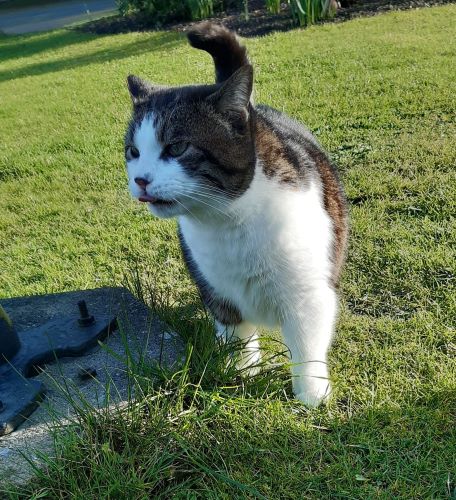
The image shows a stocky male cat with a hint of "tomcat jowls". He's got thick, medium-short fur that stands out like deep velvet. He's facing the camera, with his head looking off to his right. His left leg, chest, throat, muzzle, and center forehead are snowy white. The rest of his head and ears, and his back and tail are a brindled golden-tan and gray-black. He's sniffing the breeze after eating some of the green grass he's standing on, and licking his lips. Next to his right leg, which is the same brindle as his back and tail, is the base of a small street lamp

Having sampled the grass by the lamppost, His Holiness sniffs the air and licks his lips.

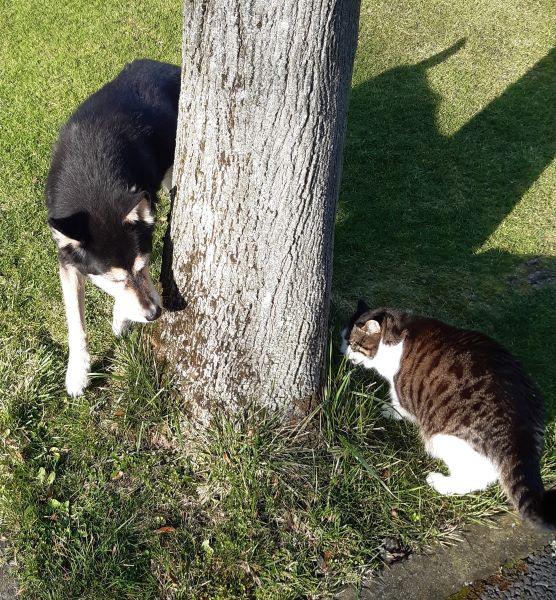
Just after taking this picture, I went to pick up after the dog, and he scampered into a row of cedar trees where the food waste bins are kept out of sight. I took the dog back to the trash bin behind the house, and went over to root around in the bushes and trees for His Holiness. Apparently it wasn’t necessary, because when I glanced back out at the green, I realized the good saint had scampered back into the open as I started my search, so I followed him over to his next patch of grass, by a maple tree. Raksha also took an interest.

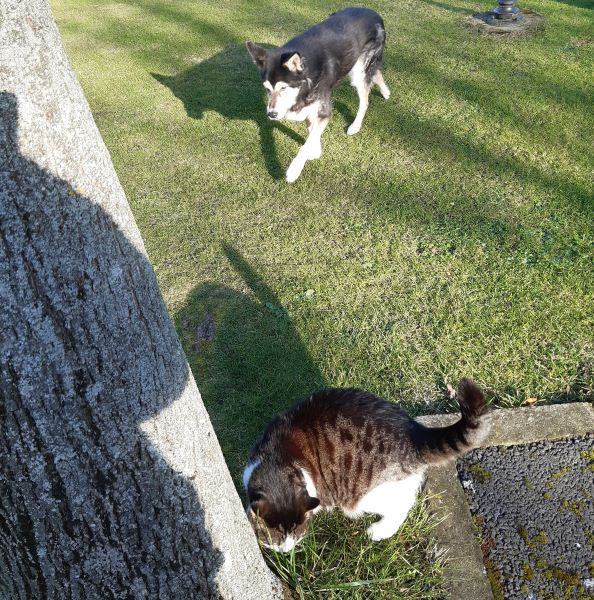
The image shows a brindled black, gold, and gray cat with white legs eating grass at the base of a tree, in the foreground of the photograph. Further back, on sun-lit grass, is a medium-sized dog, approaching the tree. She's black with creamy fur on her legs, eyebrows, and cheeks. Her large, pointed ears are aiming in two different directions. Both animals have their fur glowing with sunlight.

Raksha wandered over to join us

For those who don’t know, Raksha’s about 15 years old now. I got her from a shelter in Indiana in the summer of 2007, and they said she’d been born that March. Since then she’s been with me in Indiana, Wisconsin, New Hampshire, Massachusetts, Scotland, and now Ireland, and I’m pretty sure this is going to be her last stop. She’s needed arthritis meds to be able to walk at all for the last couple years, and she’s almost completely blind in the dark now. I’m pretty sure she mostly just sees general shapes, because this past winter, she thought the wreath the neighbors had hung on the door might be a person a number of times. She also has some trouble with her throat, and I’m getting her checked for kidney problems tomorrow.

All that said, she’s still enjoying life, and interprets most sudden movements when we’re outside as an invitation to play, which is endearing.

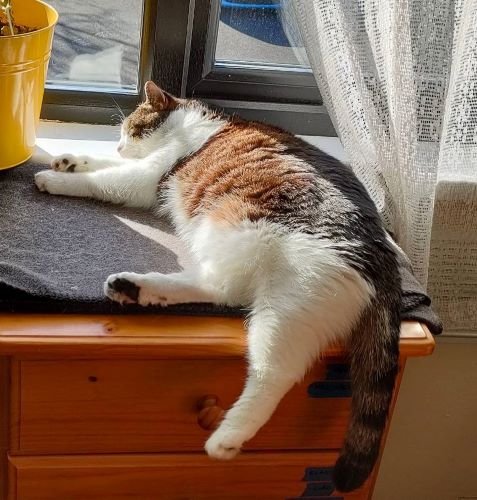
The cat is… as he always is. Forever wanting more food, and otherwise generally acting like a stuffed animal.

The image shows a cat and a dog by a tree. The cat, with brindled black and gold-gray fur, and white legs and throat, is eating grass. if you look closely, you can see sunlight turning his eye golden as he munches. The dog is mid-sized, and black with cream legs, face (except for a black stripe on her snout), cream-colored fur on the inside of her pointed ears. She's sniffing the tree. Both of them have their fur glowing in the sun.

This is the Best Tree, at least for today. Good grass, interesting smells – it’s got everything a tree needs!

I think everybody’s glad for spring. Soon it’ll be warm enough to have the windows open all day, and to spend at least some of my time working outside (It’s a pity I don’t have a laptop, or it’d be more). When that starts, you’ll get to see His Holiness sulking in his leash and harness, because I don’t trust him not to get into trouble while I work, and I definitely don’t trust in his ability to survive as a street cat. I’ve also been training him to come for treats when I play a flute my grandmother left to me, so maybe you’ll get a video of him watching me play as though he actually cares about the music!


As always, if you enjoy the contents of this blog, please consider helping support my work at patreon.com/oceanoxia. My immigration status in Ireland prohibits me from getting a normal job, so for the foreseeable future, this is my only source of income. I am eternally grateful to my current and past patrons, and I’m sure the knowledge of that fills their every waking moment with delight. For just pennies a day, that could be your life!

Let’s try not to curse the land: Climate, war, and nuclear power

I recently started re-reading The Wheel of Time, because I enjoyed the first season of the new TV adaptation. I read some of it when I was a kid. My friend John had the series, and loaned me the books (I think I damaged one and had to replace it). At the time, the main problem I noticed with the books is Robert Jordan’s bizarre views on gender and on relationships between men and women. In researching for this post, another thing occurred to me.

The basic premise of the series is that there’s a Supreme Good and a Supreme Evil, and there’s an eternal war being waged as Mr. Evil tries to take over and do Evil things. The eternal nature of the war is complicated by the fact that reincarnation is a definite, confirmed reality in this universe, and so specific people involved in that war keep being reborn and fighting each other in successive lives. Combine this with the fact that powerfully magical or powerfully good or evil events can leave lasting magical effects, and you get a landscape littered with old ruins and buried temples and whatnot, half of which could destroy the world if some person happens to knock over a particular pile of rocks, or insult the wrong ghost. More that that, it’s clear that another one of these “magical exclusion zones” could pop up pretty much anywhere, any time. I think this is a pretty good metaphor for nuclear power, because I’m not particularly worried about Chernobyl or Fukushima-style meltdowns, but I still think there’s reason to be afraid of nuclear power.

I also, as I’ve said, think that there’s reason to continue the development and use of nuclear power, that’s just not what I’m getting into today.

Right now, Russia is in the process of invading Ukraine, which has highlighted the “security” angle of my fear:

Ukraine is home to 15 nuclear power reactors across four plants that supply about half of its energy needs—if struck, they could release radioactive waste that would contaminate the area for thousands of years. Among these facilities is the largest nuclear plant in Europe, the Zaporizhzhia power plant, which sits around 125 miles west of the Donbas combat zone and could soon find itself directly on the front line of conflict. This would cause unknowable environmental damage, and would also threaten the country’s energy security (the plant provides around a quarter of the country’s overall electricity supply.)

I’ll start by saying that the world has suffered a great deal of harm from military activity around fossil fuel infrastructure, and while the exact nature of that damage is different, the death toll, through climate change and air pollution, is much higher than the death toll of nuclear power. That said, there are two complicating factors that dramatically increase the danger I see from nuclear power. The first is that if we do replace a large portion of coal, oil, and gas power plants with nuclear reactors, that will mean multiplying the number of active reactors around the world that could become targets for terrorist or military action (to whatever degree those two are separate). It will also mean an increase both in waste storage sites, and in the volume of waste being stored. Use of nuclear weapons is not required for a war to create radioactive fallout, and the more nuclear power we have around the world, the more true that will be.

The second part of this is that climate change has long been considered a “threat multiplier”, because it will create refugees, resource shortages, and other material problems that historically drive an increase in conflict, as we saw recently in the Syrian civil war. That means more political violence of all kinds. If Putin’s invasion of Ukraine doesn’t result in any radioactive contamination, that will probably be because there’s not much benefit in having control over a fallout zone. That will not be a concern for every group involved in political violence. It’s not hard to imagine either governments or non-government forces deciding that deliberately causing fallout would either “send a message”, or would be a convenient way to keep people out of a particular region.

And again, the risk of that happening goes up as global temperatures increase, and as the number of reactors and waste disposal sites increase.

The other big risk factor is the climate itself. In 2020, a wildfire broke out near Chernobyl, which got a lot of people worried– wildfire smoke is bad enough, without adding radiation to it. Rising sea levels, strengthening storms, and droughts all also pose potential risks, as they do with the other forms of pollution that litter the landscape.

We’re entering an era in which conditions in ten years will almost certain be different from what we’re dealing with now, not just because politics are volatile, but because the planet itself is now going through a major transition to a new, much hotter, stable state. One might assume that it would be possible to avoid at least some of these problems by burying the waste in a geologically stable area, but unfortunately the rising temperature is likely to also cause changes in seismic and volcanic activity.

I don’t think that means nuclear power needs to be erased from human society, but it does mean that we have to be proactive in both plant design, and in disposal of waste. The reality is that we need to begin actively cleaning the planet as soon as we’ve stopped actively making the problem worse.

I think the proposal I’ve heard most often for dealing with spent fuel is to recycle and re-use it, since the high level of radioactivity demonstrates there’s still power to be used, if we can figure out how. Unfortunately, spent fuel “contains about half the periodic table“, meaning we have to either invest a huge amount of energy removing contaminants, or we have to develop a way to safely use un-refined radioactive material. There is at least one working theory for how to go about doing this that I find appealing:

In the early 1990s, Carlo Rubbia, Nobel prize winner in physics (1984) and then CERN’s director general, launched a small experiment applying cutting-edge accelerator technologies toward energy production. The First Energy Amplifier Test (FEAT), funded by the European Commission, successfully demonstrated the principles of a clean and inherently safe process of energy production, based on widely available thorium. Since then, numerous experiments have demonstrated the feasibility of a large scale-up for industrial use. They also demonstrated that existing long-term (240,000 years or more) nuclear waste can be “burned up” in the thorium reactor to become a much more manageable short-term (less than 500 years) nuclear waste.

An Accelerator-Driven System (ADS), as the process is called, comprises an assembly of key technologies developed at CERN: an accelerated proton beam focuses on a metal target, usually lead, in a process called spallation. This spawns neutrons that in turn convert thorium into fissile uranium233, producing heat by way of nuclear fission. The heavy uranium233 nuclei divides into smaller nucleus such as zirconium (think Shopping Channel jewellery) or xenon (used in camera flash bulbs), with only minimal radioactive waste produced.

The advantages of an ADS over other energy production process are many:

Clean: No emissions are produced (CO2, nitrogen or sulphur oxides particles, among others), unlike with fossil fuel. Heat is generated from the transmutation of thorium into the highly radioactive uranium233 and its subsequent fission into smaller particles.

Feasible: ADS technology development has been proven to be a bounded problem with a realistic development timeline. In comparison, fusion is an unbounded problem that does not have a constrained development timeline.

Transmutation of nuclear waste: the ADS process has been proven to transmute long-term nuclear waste, harmful for 240,000 years or more, into short-term radioactivity waste of less than 500 years toxicity. The technology would solve the intractable problem of very long-term radioactive waste storage.

No military usage: The International Atomic Energy Agency has repeatedly stated that the technology is “intrinsically proliferation resistant.”

Large thorium reserves: enough for 20 centuries at 2018 level of global electricity consumption. Thorium is well distributed around the globe, with no nation having a monopoly.

High energy density: 1 tonne of thorium would provide the energy equivalent of 3 million tonnes of coal, or 200 tonnes of natural uranium enriched for use in a nuclear reactor.

Inherent safety: the process operates at atmospheric pressure therefore the plant can’t explode (unlike Chernobyl). The reaction is also stops immediately when the proton beam is interrupted, providing inherent safety.

Smart grid friendly: Immediate ON/OFF capability would make ADS power plants ideal for base load energy production for smart grids.

Small footprint: A 500MW ADS plant would only be as large as a medium size factory, compared to 26 km2 (10 mi2) for the 550MW Topaz solar farm in the sunny California desert. In the wintery north-west, an equivalent solar farm would be almost three times larger, approximately 62 km2. Wind turbines require even more space.

Proximity: inherent safety and small size make ADS ideally suited for any use, industrial or urban, and able to be located in remote regions, including high latitudes with little sunshine.

Decarbonized hydrogen production: reactors could be set close to abundant freshwater at high latitudes for clean hydrogen production, allowing the conversion of electrons into a green gas used for transport, heating and industrial processes.

We’ve known for some time that it’s possible to literally transmute matter in the alchemical sense, as long as you have enough energy, and you don’t mind the finished product being radioactive. In this case, the point is to start with something radioactive, and burn off that energy to run a generator, while generating waste that’s both smaller in volume, and less dangerous. That said, 500 years is still far longer than we’ve even had nuclear technology, and it’s the kind of timespan that has seen entire civilizations collapse. What we also need is a way to take that less-radioactive waste and render it inert. There’s promising research into using bacteria to do this, but it seems like we’re farther behind on that than we are on the ADS thing, as the bacteria involved are good at eating the sorts of things that might be used to contain them for industrial use.

So. Where does that leave us?

Well, I still think that we’re likely to need the “energy density” of nuclear power to survive climate change, and I’m still very concerned about the dangers posed by a dramatic increase in the amount of radioactive material out in the world. I’m under no illusions about how much influence I have. My actual readership is absolutely dwarfed by the number of people who accidentally clicked on one of my recent low-effort posts because it had the words “sexy video” in the title. That said, just as I think we should going beyond a “WW2-scale” response to climate change with renewable energy and agricultural changes, I also think we should be investing heavily in things like ADS technology and radiation-munching bacteria, as part of our broader effort to figure out how to clean up the mess we’ve made.

Ideally, I’d like to see those new disposal methods in place and functioning before any massive increase in reactors. It won’t eliminate problems. Nothing will, and that’s true for everything we do. To get back to my opening reference, we’ve learned enough to avoid “cursing” random bits of the planet, we just need to put that knowledge into action. As with so many things these days, I think a lot of the reason that we’re not doing that is that our political and economic systems (to whatever degree those are separate things) aren’t set up to encourage responsible behavior by those in power. Basically, there are so many ways in which we could drive ourselves to extinction in the next couple centuries that revolutionary change seems like our only hope of survival. It all comes back to politics.


Thank you for reading. If you find my work interesting, useful, or entertaining, please share it with others, and please consider joining the group of lovely people who support me at patreon.com/oceanoxia. Life costs money, alas, and owing to my immigration status in Ireland, this is likely to be my only form of income for the foreseeable future, so if you are able to help out, I’d greatly appreciate it. The beauty of crowdfunding is that even as little as $1 per month (that’s like three pennies a day!) ends up helping a great deal if enough people do it. You’d be supporting both my nonfiction and my science fiction writing, and you’d get early access to some of the fiction and some other content.

Did you know that Earth has a pyroscape? Well, it does, and that’s changing too.

There are a lot of terms used to describe aspects of our planet. “Ecosystem” is a generally familiar one, and any minecraft players will be familiar with the concept of biomes. “Pyroscape” was one that I hadn’t encountered, but if you think about it for a second, it makes perfect sense. Fires have always been a part of life on Earth, so it stands to reason that there would be a “natural” pattern for fires over time – one that can be traced and analyzed, as Daniel Immerwahr writes:

Fire flourishes where life does, and the two depend on each other. There are pyrophilous (“fire-loving”) plants and animals that organise their lives around fire, such as the beetles that lay eggs in burned trees or pine cones that need flames to release their seeds. More than individual species, whole ecosystems depend on fire to clear space. In many habitats, fire is “as fundamental to sustaining plants and animals” as sun and rain are, a 2005 scientific survey found.

The most successful pyrophilous species is Homo sapiens. Early humans used fire for light, warmth, social gatherings and protection from predators. Fire lets us absorb nutrients quickly through cooking, rather than spending hours chewing every day as our primate cousins do. Chimpanzees, orangutans and gorillas all eat raw food, and they all have much smaller brains. The caloric boost of cooking underwrites our large, resource-heavy brains. Simply put: no fire, no us.

No us in an evolutionary sense, and no us in a historical one, too. Every known human society has used fire. Our ancestors didn’t just dispel darkness and prepare food with it, they shaped their environments: repelling pests, flushing out game and making clearings. With spears, they could hunt individual animals; with firesticks, they could alter whole landscapes.

The article is a deep dive into the history of fire on Earth, and as in integral part of who we are as humans. I think it’s a useful perspective to have, given all the news about massive wildfires, and the less sensational discussions about the importance of things like deliberately setting seasonal fires as part of ecosystem management. I also think the historical perspective is important, because climate change has once again given us a rather counterintuitive scenario: Between 1998 and 2015, the total amount of land on fire in any given year decreased by a quarter, and this is not a good thing.

 The main reason fires are dwindling is that humanity is expanding. Sprawling settlements and industrial farms act as firebreaks in the savannas of South America and Africa and the grasslands of the Asian steppe. Livestock consume vegetation that otherwise might feed big burns. “A shift toward more capital-intensive agriculture has led to fewer and smaller fires,” the authors of the 2017 Science study concluded. And that decrease – especially in flame-reliant landscapes in sub-Saharan Africa and northern Australia – outweighs the uptick in headline-grabbing megafires.

It might seem that extinguishing wildfires has made the world safer. But what it has really done is made the fires stranger. Where flame grows rare, biomass that would normally have regularly burned instead piles up as kindling. Decades of fire suppression is enough to build timebombs, and the supercharged blazes that do break out are more severe and harder to control. This is what the US now experiences every year: overall, the number of its fires is shrinking, while their size and the cost of fighting them are growing.

I’ve talked before about the need to engage in active ecosystem management, and I think it’s fair to say that there’s a degree to which all of our current environmental problems come from us abandoning ecosystem management, in favor of a more adversarial relationship with the ecosystems that support us. Since there’s apparently been some confusion among my readers, let me be clear – I think that our only way out of the current crisis is forward, not back. I think we need to embrace technology as a part of who we are, rather than a way to make money or exert power. I also think that we need to pick up some “pre-industrial” practices like deliberate ecosystem management, and integrate those into how we live. We’re not separate from the rest of life on this planet, so we need to stop acting like it before we destroy ourselves.

That said, as terrifying as the “mega-fires” of recent years have been, relatively few people are actually killed by the flames. Far, far more die due to fire’s contribution to the ever-present companion to climate change: air pollution. Immerwahr continues:

It’s not that fires are harmless. It’s rather that the ways they harm people aren’t the ways that come most readily to mind. Unless you’re a firefighter, you’re extremely unlikely to die in a big blaze. But you might shave years off your life by inhaling the particulates and chemicals that fires release.

The death toll from wildfire smoke is enormous: 339,000 die a year from such smoke-related maladies as strokes, heart failure and asthma, according to the Australian public health scientist Fay Johnston and her fellow researchers. A few die in the affluent places known for their telegenic fires, such as North America and southern Australia (more than 400 from Australia’s 2019–20 Black Summer, Johnston and her colleagues have estimated). But the vast majority die in poorer places, where fires are smaller, yet chronic: sub-Saharan Africa and south-east Asia.

What’s more, fires are burning in new places, thanks to both climate change, and more direct human intervention. In both Southeast Asia, and in the Arctic circle, fires are now burning massive reservoirs of plant matter like peat, releasing more CO2 into the atmosphere, driving up the temperature, and hey look it’s another feedback loop!

Immerwahr is right to point out that for all a towering inferno captures our attention, the danger of climate change is not death by fire. The reality will be far more drawn out. I think we have a grim few decades ahead of us, but the fact that this is a slow process, by human terms, means that there’s a lot we can do to change course and improve our future, if we can build the political power to do so.


Thank you for reading. If you find my work interesting, useful, or entertaining, please share it with others, and please consider joining the group of lovely people who support me at patreon.com/oceanoxia. Life costs money, alas, and owing to my immigration status in Ireland, this is likely to be my only form of income for the foreseeable future, so if you are able to help out, I’d greatly appreciate it. The beauty of crowdfunding is that even as little as $1 per month (that’s like three pennies a day!) ends up helping a great deal if enough people do it. You’d be supporting both my nonfiction and my science fiction writing, and you’d get early access to some of the fiction and some other content.

Scrying for Turtles: eDNA is a powerful new tool for ecosystem monitoring.

As I’ve mentioned before, I have a small amount of experience doing reptile population surveys. The basic method is the same whether you’re dealing with lizards, snakes, or turtles – you try to catch and measure as large a proportion of that population as you can. If your method of capture is some kind of trap, then you’re probably also going to be recording other species that get caught. This can be a problem because it takes a fair amount of effort. If you’re looking for one species in particular, you might not want to waste your limited resources catching every turtle in a pond, only to find that your species was never there. How can we just… check and see if it’s present?

Obviously, we cast a scrying spell.

Specifically, we can look at what’s being called eDNA – environmental DNA. See, we animals are rather messy organisms. We’re always shedding bits of ourselves everywhere we go. For us land-dwellers, this ends up as the mix of particles, microbes, and shed skin cells we call dust. In water, in theory, we should be able to detect that “dust”, at least from those creatures that live there. A team from the University of Illinois tested theory to help them find alligator snapping turtles:

The research team knew alligator snapping turtles were in Clear Creek, a southern Illinois stream feeding into the Mississippi River, because they put them there. A reintroduction program has put 400 to 500 young turtles into the system since 2014 and work is ongoing to determine the introduced population’s viability.

Each turtle is outfitted with a tracking device. To find them, researchers have to walk or kayak around the site with a less-than-waterproof radio receiver, set up and check traps, and interact with potentially dangerous snapping turtles.

Image shows the head of an alligator snapping turtle. Its scales are a light tan color, its eye is murky brown with a hint of lighter color outlining a black cross over the pupil. Its mouth is open, shoeing a red, worm-like tongue lure, and the sharp edges of it beak.

Prehistoric monster, Photo by Seth LaGrange who apparently went back in time to get the picture.

“It’s time consuming and a lot of effort. And we’re limited by the number of traps that we can check in a day,” Kessler says. “With eDNA, we can just show up at a location and pull a quick water sample. You can cover a wide geographic area relatively rapidly. That saves money, too, considering the cost of traveling to these remote locations.”

To prove eDNA is capable of detecting alligator snapping turtles, the research team first identified genetic markers that matched all of the subpopulations across the species’ range, but differed from any other turtle species. After radio-tracking each turtle, they took water samples near the turtles as well as in dozens of random sites to determine how eDNA travels in a riverine setting.

The eDNA method was able to detect alligator snapping turtles up to a kilometer, or two-thirds of a mile, downstream. Remarkable, considering less than a gallon of water was taken from each sampling location.

“This was a great place to test the performance of eDNA, because there are only so many alligator snapping turtles in Clear Creek, and we know where many of them are. That gave us something like the control of a laboratory experiment, but under very natural conditions in a real ecosystem,” Larson says.

The study also identified shortcomings of the method. For example, the researchers found that stretches of the river that were exposed to more sunlight represented gauntlets of DNA degradation.

“We know ultraviolet light destroys DNA, but we didn’t know how much the sun would affect our ability to detect alligator snapping turtles,” Kessler says. “We ended up finding that UV exposure does have a slight effect on our ability to detect. It’s reducing the copy number, or the amount of DNA, in our samples.”

Even with reduced copy number in some samples, the researchers were able to detect the elusive species with fairly high fidelity. The results suggest eDNA detection could be used as a first step to find turtles in locations where their status is unknown.

This technique wouldn’t have helped with any of the research projects in which I was involved, but it’s not hard to see the myriad of potential uses for it. As we continue to try to monitor everything happening to this planet’s biosphere, I’m willing to bet we’ll be hearing more about eDNA as a non-invasive way to get an idea of a species presence in a given body of water. I don’t know to what degree it would work on dry land, but I’m sure someone’s looking into it.

Thanks to @cosmixstardust for sharing the article around! It’s always neat to see developments like this.

Pollution, bio-indicators, and our crumbling foundations (also a big bug photo)

If you ever get a chance to hike a  stretch of the Appalachian Trail, you’ll find that the shelters all have “trail registers”. These are cheap notebooks where people mark down when they were at the shelter, and leave relevant notes. Sometimes you’ll see warnings of a bear that’s been showing up, or a Kevin Bacon sighting. Sometimes thru-hikers will leave notes for friends or acquaintances who’re behind them on the trail, and sometimes people get creative. I met one woman who would perform a rap at most shelters, and write the whole thing in the trail register.

Sometimes you come across something that seems a little… worrying.

Picture the scene, if you will. It’s early evening, and you’ve been hiking for several hours. The sun’s starting to get a bit lower in the sky, and the golden light is shimmering on the Housatonic to your right. Ahead to the left, you see a sign for the Stewart Hollow Brook lean-to, and you take the turn, glad you reached your day’s destination with plenty of daylight left.

You heave your pack into the lean-to, and sit on the edge, eating a mint-chocolate food bar, and listening to the wind and the birds. You wash your snack down with a swig of water, and lean over to grab the trail register.

Someone who passed you a week ago is now just a day ahead. There’s a liquor store that’ll give through hikers a free beer not too far away. And there’s –

-WARNING – DO NOT SLEEP ON THE GROUND HERE! Seriously don’t. There are these huge bugs that come out at night! Check your shoes!

-Holy shit I thought the other entries were joking but they’re not! They’re like some kind of alien bugs or something? They’ve got spikes and stuff all over them and pincers!

-Ridgerunner here – yes there are scary bugs, but they won’t hurt you. They’re just hellgramites

“Hellgramites”?

Like that doesn’t sound like some kind of alien parasite? Well, it’s just a name, so let’s see what they actually look like.

Image shows a hand carefully holding a large insect larva by its head. Its pincers can't reach the fingers, and its legs are flailing helplessly. Its abdomen is about as long as the hand is wide, with large, soft

“It’s just a Hellgramite”

Oh.

Well.

And not just one or two – in the evening and through the night, there’s a never-ending march of these things up from the river.

So, dear readers – what’s going on here?

Well, lots of things, but when I saw this phenomenon as a ridgerunner back in my college days, it put me in mind of a high school environmental science class I took. It was a well-designed course, looking back. We learned about stuff like water quality, industrial runoff, and so on, and we learned it by going out and testing the water, and visiting sewage treatment plants and papermills.

And we learned how to use benthic macroinvertebrates as pollution bioindicators. In plain speech, we learned how to learn about water quality by looking at the bugs that lived in the riverbed. There are many kinds of bugs and worms that live under the rocks and in the sand at the bottom of any river, and as with any community, they have different specializations, preferences, and chemical tolerances.

Hellgramites – also known as dobsonfly larvae – were one of the species we studied, and I have them lodged in my head as being “pollution tolerant”. I believe that assessment is an exaggeration – it’s probably better to say that compared to some other fly larvae that live on riverbeds, they’re more tolerant of moderate levels of pollution. We’re talking the kind of water rivers that have people fishing for food, but also have signs warning everyone not to eat more than one fish per month from that water.

The Housatonic, as I remember it, is a shallow and somewhat murky river that can smell a bit off on a hot day, and has a lot of brown algal growth over its stones. It was pretty, but I think I only swam in it on a couple occasions when the heat got to be too much. Like most rivers in the U.S., it suffered from various forms of runoff, and while I never actually studied its invertebrate community, I’m willing to bet it would have been possible to gauge where the river was at even without the ability to measure for specific chemicals.

A couple years later, I had graduated, and was working as property manager for the Earlham College biology department. The job involved a number of tasks, but one of them was helping with a turtle population survey for a nearby pond. The pond was located between a couple industrial parks, and had had a major fish kill in recent years. The biology and chemistry departments had a grant to investigate, and my end involved catching, measuring, and marking as close to every turtle in that pond as I could get. I never saw the final reports, but there was one finding that jumped out at us right away – we caught dozens of turtles, of three or four different species, but not a single one of them was younger than six years old.

Sure, you can guesstimate pollution levels by what bugs are or aren’t thriving, but in this case reproduction had just ended in that pond. That’s another level.

During my work as a curriculum writer, the team I was on spent a good amount of time on the idea of bioindicators, because we had students studying how climate change is affecting things like leaf-out and flowering times in plants.

All of these things – the bugs, the turtles, the plants – they’re like looking at a person’s skin to assess their health. How does the color compare to their normal complexion? Do they have wounds? Blisters? A rash? Are they clammy, or is their skin too dry? None of the symptoms are the underlying problem, but they’re all useful ways to get an idea for what’s going on.

What I haven’t fully connected, until recently, is that the solidity of our knowledge about bioindicators and the sheer number of examples that exist both indicate that humanity’s traces can be found everywhere.

It’s easy to talk about indicators and trends, but even though one can spend an entire career teaching the same lessons over and over again, things don’t just start over. They continue happening. Chemicals continue building up, because they continue being released. Ecosystems take one hit after another, and bit by bit, cracks form in the foundations.

The study concludes that chemical pollution has crossed a “planetary boundary”, the point at which human-made changes to the Earth push it outside the stable environment of the last 10,000 years.

Chemical pollution threatens Earth’s systems by damaging the biological and physical processes that underpin all life. For example, pesticides wipe out many non-target insects, which are fundamental to all ecosystems and, therefore, to the provision of clean air, water and food.

“There has been a fiftyfold increase in the production of chemicals since 1950 and this is projected to triple again by 2050,” said Patricia Villarrubia-Gómez, a PhD candidate and research assistant at the Stockholm Resilience Centre (SRC) who was part of the study team. “The pace that societies are producing and releasing new chemicals into the environment is not consistent with staying within a safe operating space for humanity.”

Dr Sarah Cornell, an associate professor and principal researcher at SRC, said: “For a long time, people have known that chemical pollution is a bad thing. But they haven’t been thinking about it at the global level. This work brings chemical pollution, especially plastics, into the story of how people are changing the planet.”

Some threats have been tackled to a larger extent, the scientists said, such as the CFC chemicals that destroy the ozone layer and its protection from damaging ultraviolet rays.

Determining whether chemical pollution has crossed a planetary boundary is complex because there is no pre-human baseline, unlike with the climate crisis and the pre-industrial level of CO2 in the atmosphere. There are also a huge number of chemical compounds registered for use – about 350,000 – and only a tiny fraction of these have been assessed for safety.

So the research used a combination of measurements to assess the situation. These included the rate of production of chemicals, which is rising rapidly, and their release into the environment, which is happening much faster than the ability of authorities to track or investigate the impacts.

The well-known negative effects of some chemicals, from the extraction of fossil fuels to produce them to their leaking into the environment, were also part of the assessment. The scientists acknowledged the data was limited in many areas, but said the weight of evidence pointed to a breach of the planetary boundary.

“There’s evidence that things are pointing in the wrong direction every step of the way,” said Prof Bethanie Carney Almroth at the University of Gothenburg who was part of the team. “For example, the total mass of plastics now exceeds the total mass of all living mammals. That to me is a pretty clear indication that we’ve crossed a boundary. We’re in trouble, but there are things we can do to reverse some of this.”

Villarrubia-Gómez said: “Shifting to a circular economy is really important. That means changing materials and products so they can be reused, not wasted.”

The researchers said stronger regulation was needed and in the future a fixed cap on chemical production and release, in the same way carbon targets aim to end greenhouse gas emissions. Their study was published in the journal Environmental Science & Technology

There are growing calls for international action on chemicals and plastics, including the establishment of a global scientific body for chemical pollution akin to the Intergovernmental Panel on Climate Change.

Prof Sir Ian Boyd at the University of St Andrews, who was not part of the study, said: “The rise of the chemical burden in the environment is diffuse and insidious. Even if the toxic effects of individual chemicals can be hard to detect, this does not mean that the aggregate effect is likely to be insignificant.

“Diffuse and insidious” seems to apply to a lot of the problems we’re facing right now. In particular – and this will shock you – this makes me think of greenhouse gas pollution. The entire problem of global warming is diffuse and insidious. Instead of the attention-grabbing stuff, like causing cancer, greenhouse gases just… raise the temperature a little. So very little that it’s hard to measure, and then they do it again. And again. And again. Every hour, of every day, of every month, year round, for as long as they exist. We’ve known about it for well over a century now. We’ve been studying it for longer than that, and we’ve been watching as the numbers have gotten higher.

As the article says, we’ve crossed a number of thresholds recently, and there’s no real way to go back – we just have to find a different way forward.  As I will never stop repeating, we need systemic change. It’s not just the climate. It’s not just the chemical pollution. It’s not just the bigotry, and the greed, and the cruelty.

It’s everything. Plenty of parts of our society are good, and wonderful, and worth holding on to, but all parts of our society are sick. Because we are a self-aware collective organism, as a species, we have the ability to re-arrange the workings of our “body” to suit different wants and needs. That’s our greatest power, and it’s past time we did the learning and organizing required to put it to use for the good of all.


Thank you for reading. If you find my work interesting, useful, or entertaining, please share it with others, and please consider joining the group of lovely people who support me at patreon.com/oceanoxia. Life costs money, alas, and owing to my immigration status in Ireland, this is likely to be my only form of income for the foreseeable future, so if you are able to help out, I’d greatly appreciate it. The beauty of crowdfunding is that even as little as $1 per month ends up helping a great deal if enough people do it. You’d be supporting both my nonfiction and my science fiction writing, and you’d get early access to the fiction.

When research and development starts to feel like a delaying tactic

I am endlessly frustrated by the fact that there are so many things that we could be doing about climate change, and we just…

Don’t.

Even without the obvious large-scale stuff like replacing fossil fuels with renewable and nuclear power, we could be rebuilding or relocating cities to deal with sea level rise, and building greenhouses, and making sure everyone who wants one can have a solar water heater, and the list goes on.

But I think the one that annoys me the most is carbon capture and sequestration. It’s not that I think it’s a bad idea to pull CO2 out of the air and sequester it; quite the opposite. It’s that of all the challenges created by this climate crisis, this is perhaps the easiest one to tackle, and something we could start doing at a massive scale today if we wanted to. Instead of doing that (and eliminating fossil fuel use), we seem to be investing money in ever-more elaborate ways to capture carbon using “cutting-edge” technology.

“Our new method still harnesses the power of liquid metals but the design has been modified for smoother integration into standard industrial processes,” Daeneke said.

“As well as being simpler to scale up, the new tech is radically more efficient and can break down CO2 to carbon in an instant.

“We hope this could be a significant new tool in the push towards decarbonisation, to help industries and governments deliver on their climate commitments and bring us radically closer to net zero.”

A provisional patent application has been filed for the technology and researchers have recently signed a $AUD2.6 million agreement with Australian environmental technology company ABR, who are commercialising technologies to decarbonise the cement and steel manufacturing industries.

Co-lead researcher Dr Ken Chiang said the team was keen to hear from other companies to understand the challenges in difficult-to-decarbonise industries and identify other potential applications of the technology.

“To accelerate the sustainable industrial revolution and the zero carbon economy, we need smart technical solutions and effective research-industry collaborations,” Chiang said.

The steel and cement industries are each responsible for about 7% of total global CO2 emissions (International Energy Agency), with both sectors expected to continue growing over coming decades as demand is fuelled by population growth and urbanisation.

Technologies for carbon capture and storage (CCS) have largely focused on compressing the gas into a liquid and injecting it underground, but this comes with significant engineering challenges and environmental concerns. CCS has also drawn criticism for being too expensive and energy-intensive for widespread use.

Daeneke, an Australian Research Council DECRA Fellow, said the new approach offered a sustainable alternative, with the aim of both preventing CO2 emissions and delivering value-added reutilisation of carbon.

“Turning CO2 into a solid avoids potential issues of leakage and locks it away securely and indefinitely,” he said.

“And because our process does not use very high temperatures, it would be feasible to power the reaction with renewable energy.”

The Australian Government has highlighted CCS as a priority technology for investment in its net zero plan, announcing a $1 billion fund for the development of new low emissions technologies.

How the tech works

The RMIT team, with lead author and PhD researcher Karma Zuraiqi, employed thermal chemistry methods widely used by industry in their development of the new CCS tech.

The “bubble column” method starts with liquid metal being heated to about 100-120C.

Carbon dioxide is injected into the liquid metal, with the gas bubbles rising up just like bubbles in a champagne glass.

As the bubbles move through the liquid metal, the gas molecule splits up to form flakes of solid carbon, with the reaction taking just a split second.

That is genuinely neat. I think it’s amazing that we can do that, and I have no doubt that there are going to be good uses for that technology in the future.

But, as I said earlier, we have everything we need to start large-scale carbon sequestration right away, without using any fancy new technology. As was mentioned in the interview I embedded in yesterday’s agriculture post, we could take existing farmland that’s not currently in use, plant cover crops, bale them up, and store them where they can’t rot. We could pull vast amounts of carbon out of the air by doing that, and it would almost certainly require fewer resources than elaborate processes like these liquid metal bubblers. This obsession a lot of people seem to have with finding some technological “quick fix” seems like a desperate ploy to avoid having to change, and to justify continued inaction.

The problem is not technical, it’s political.


Thank you for reading. If you find my work interesting, useful, or entertaining, please share it with others, and please consider joining the group of lovely people who support me at patreon.com/oceanoxia. Life costs money, alas, and owing to my immigration status in Ireland, this is likely to be my only form of income for the foreseeable future, so if you are able to help out, I’d greatly appreciate it. The beauty of crowdfunding is that even as little as $1 per month ends up helping a great deal if enough people do it. You’d be supporting both my nonfiction and my science fiction writing, and you’d get early access to the fiction.

Happy M.L.K. Jr. Day!

Apparently the agriculture post is going to take me another day – sorry about that!

For any readers outside the United States, today is the celebration of Reverend Dr. Martin Luther King Jr., a leader from the Civil Rights Movement, and a man whose legacy has been misused and abused since well before his death. Of the famous leaders of that movement, King is often viewed as the “correct” one because of his focus on nonviolence, but the reality is that he was treated as an extremist while he was alive, and many of those who love to praise him today are explicitly opposed to most or all of what he fought for. Fortunately, it seems that more and more people are speaking out against that kind of hypocritical crap, and telling the truth about King and his place in history.

Stinkhorn Saturday

It’s been a long day and I’m tired, so I’ll leave you in the capable hands of Ze Frank. Enjoy these funky fungal facts! (content warning for “blue” humor? Do I need to do content warnings for that? I honestly don’t know.)

Possible progress on identifying the causes of “Long Covid”

A scientist in South Africa, Resia Pretorius, believes that she and her colleagues may have found at least one causal factor for “Long Covid.” The term is used to describe those with effects that extend beyond four weeks time, according to the most current information by the Mayo Clinic. Symptoms of long Covid may vary from person to person, but the primary symptoms include fatigue, brain fog, muscle or joint pain, shortness of breath, sleep difficulties, and depression or anxiety. It’s been cause for real concern as the pandemic has unfolded, and until now, it’s seemed like we had no leads on what mechanism was actually causing it.

“A recent study in my lab revealed that there is significant microclot formation in the blood of both acute COVID-19 and long COVID patients,” Resia Pretorius, head of the science department at Stellenbosch University in South Africa, wrote Wednesday in an op-ed.

Pretorius writes that healthy bodies are typically able to efficiently break down blood clots through a process called fibrinolysis. But, when looking at blood from long COVID-19 patients, “persistent microclots are resistant to the body’s own fibrinolytic processes.”

Pretorius’ team in an analysis over the summer found high levels of inflammatory molecules “trapped” in the persistent microclots observed in long COVID-19 patients, which may be preventing the breakdown of clots. Because of that, cells in the body’s tissues may not be getting enough oxygen to sustain regular bodily functions, a condition known as cellular hypoxia.

“Widespread hypoxia may be central to the numerous reported debilitating symptoms” of long COVID-19, Pretorius writes.

Given all the misinformation surrounding the current pandemic, I think it’s worth mentioning that the idea of a disease having lasting effects even after it’s “cured” is nowhere close to new. The example that immediately sprang to my mind was Ebola, and specifically this interview from last year, which covers, among other important topics, how the focus is too often on ending the epidemic to the exclusion of all else. This means that far less attention is paid to the after-effects of the disease.  Going forward, I think it’s worth remembering that sometimes curing the infection is just the first step.

That said, it should be fairly clear that this is extremely hopeful news. The effects of Long Covid have made it the newest disease to be included under the ADA and many disability activists have voiced concerns that this could be a “great disabling” of our generation. If this research proves to be fruitful, it is possible that not only could long Covid be either eliminated or greatly diminished, but that other chronic diseases with similar effects may also be helped by this treatment.


Thank you for reading. If you find my work interesting, useful, or entertaining, please share it with others, and please consider joining the group of lovely people who support me at patreon.com/oceanoxia. Life costs money, alas, and owing to my immigration status in Ireland, this is likely to be my only form of income for the foreseeable future, so if you are able to help out, I’d greatly appreciate it. The beauty of crowdfunding is that even as little as $1 per month ends up helping a great deal if enough people do it. You’d be supporting both my nonfiction and my science fiction writing, and you’d get early access to the fiction.