What drives walking sims?

“Walking simulator” was originally a derisive term, coined in the days of gamergate, referring to a set of minimalist games where you simply walked around 3D environments. By now, a lot more games in this category have appeared, and while not universally beloved, they’re more or less accepted as a part of the video game landscape. And I find that I rather like this genre myself. I’ve played quite a number of walking simulators over the years, and still others I’ve watched on video or have seen critical discussions.

The question I’d like to ask today is, what is the appeal of walking simulators? What drives them?

I am thinking in analogy to drone and ambient music, which strips away many of the components that people conventionally enjoy in music. But what motivates drone/ambient music varies greatly depending on the work. Contrast Brian Eno’s Music for Airports, which wants to blend into the background, with Sunn O)))’s Monoliths and Dimensions, which wants to mesmerize. Walking sims are also a genre full of contrasts, and I’d like to identify several different goals that they may have.

[Read more…]

Origami: wobbly cube

Wobbly cube

Wobbly Cube, a one-shot design by me

This was one of my experiments in curved creases.  I basically cut out 12 identical S-shaped strips (with ruler and compass), and then creased them along their centers.  Then I quickly invented a scheme for secure attachment.  Not much more to say about that.  I like how it turned out.

First player advantage

People liked my article, “Chess involved luck, and other propositions“, so I’d like to add a bit more discussion on a related topic.

In turn-based games like Chess, there’s a slight asymmetry between players, in that one of the players moves before the other one does. And moving first seems to be an advantage. This has been demonstrated through statistical analysis of various chess tournaments and databases. Depending on which data are used, the first mover wins anywhere from 52% to 55% of the time.

First mover advantage can be considered as third factor, independent of either luck or skill. If you flip a coin to decide who goes first, then first mover advantage is one component of luck. But it’s the sort of luck that you can eliminate by say, choosing a tournament structure where players alternate white and black.

There’s apparently a lot of historical discussion of first mover advantage in chess, but at this point I may as well drop the pretension that I know anything about chess. The game that I’m a lot more interested in, is competitive Dominion. Dominion is a turn-based game, and also has a first player advantage. The community compiles a ton of statistics from games online, and the statistics show that in two player games among top players, the first player wins about 58.8% +/- 0.2% of the time (excluding ties).

[Read more…]

Chess involves luck, and other propositions

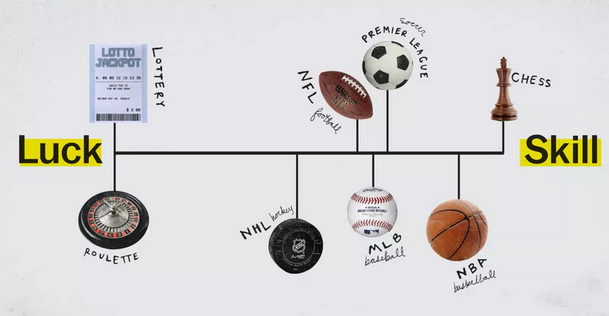
I find the concept of luck vs skill in games to be fascinating, because the common intuitions are just so wrong. The common intuition is that some games involve more luck, and some games involve more skill. On the extreme end of luck, we have the lottery; on the extreme end of skill, we have chess. The orthodox view was best expressed by a Vox article/video, which included the following image:

An image depicting a continuum, with lottery and roulette being on the left "luck" end, and chess being on the right "skill" end. In the middle, we have hockey, football, baseball, socker, and basketball in that order. Each sport is depicted with an image of the ball/puck, and the name of an associated league.

The Vox image also shows several sports, and the position of each sport is based on the statistical analysis of Michael Mauboussin.  The details of analysis aren’t explicitly described, but it’s basically analyzing the national tournaments for each sport, and estimating how much of the variance in outcome is explained by luck or by skill.

Mauboussin did not analyze chess.  Vox added chess in themselves, pulling a claim out of their ass.  Without doing any analysis, I can guarantee that if you applied the same statistical analysis to chess, you would not find that chess was 100% skill.  The analysis will only show that a game is pure skill if the same people consistently win all their games.  I quickly checked the US Chess Championship winners, and while some names show up repeatedly, it is not 100% consistent, and therefore would not be deemed a pure skill game by this analysis.

So what gives?  Is the statistical analysis bogus, or is the claim that chess is 100% skill bogus?  Trick question.  Both of them are bogus.

[Read more…]

On trans athletes

Lately people have been talking about the downturn of the Austin Community of Atheists (see video explaining timeline, or transcript). But the point of me leaving the atheist movement was so I didn’t have to concern myself with all the bullshit that goes on in atheist groups, so I’m not going to talk about it. Instead I’ll address an issue that came up in relation to the drama: the right of trans athletes to compete in athletic events. HJ Hornbeck has been talking about it for literally months, and this is my independent take.

I’ll admit upfront that I don’t care about athletics. The only sports I personally care about are video game speed running and competitive Dominion. I only care about athletics to the extent that I have empathy for things that other people care about.

So a good place to start is with someone else who cares more, and has more expertise. I present Dr. Rachel McKinnon, who is not only a trans athlete, but also a philosophy professor who teaches courses about sports ethics!

[Read more…]

The physics of Dominion

For this month’s repost, I’m publishing up an article I wrote in explanation of a programming project in 2018.  In theory you could find it on Github, but to maintain a layer of pseudonymity I’m not linking it directly.  A few minor revisions have been made to adapt to the audience.

Introduction

The goal of this project is to create Markov Chain simulations showing that the card game Dominion contains phase transitions, much like the physical phase transition between liquid and solid.

Dominion is a popular card game created in 2008. In Dominion, each player has their own deck, and they add/remove cards from their deck over the course of the game. Each game has a unique set of cards available to be added to players’ decks, making the optimal strategy in each game different. However, there are two archetypical strategies, based on two fundamentally different decks. The “Big Money” deck makes the best of the 5 cards drawn each turn. The “Engine” deck includes cards that draw more cards, and tries to draw itself in its entirety each turn.

Because of my background in physics, I recognized that the line between “Big Money” and “Engine” strategies is a phase transition. More specifically, it’s a one-dimensional percolative transition. That explains why there is such a strong dichotomy between the two strategies over a wide range of conditions.

[Read more…]

Different ways of enjoying fiction

In the realm of games, it is widely acknowledged that different people enjoy different aspects of games, and for different reasons. There are several theories that attempt to describe different kinds of fun or different player types. Marc LeBlanc has his theory of 8 kinds of fun: Sensation, Fantasy, Narrative, Challenge, Fellowship, Discovery, Expression, and Submission. Then there’s Bartle’s taxonomy, which classifies players of online multiplayer games into four types: Achievers, Explorers, Socializers, or Killers. In Magic: The Gathering people commonly discuss Johnny, Timmy, and Spike, three archetypes of what people like about the game.

If we can recognize that different people enjoy different aspects of games, then we can also recognize that different people also enjoy different aspects of stories. This may seem like a trivial point, but one that we rarely think about directly.

I think the different ways of enjoying games are more obvious because they often result in different player behaviors, but the different ways of enjoying stories tend to be invisible.  Invisible… except in fandom. So, if you wanted to go looking for theories of how different people enjoy fiction for different reasons, I believe the place to look is in fandom. Unfortunately, I don’t actually involve myself in any fandoms, but I’m sure some of my readers do, so I’d be happy to hear from you.

For now, I’ll just toss a few preliminary ideas around.

[Read more…]