This is a repost of a puzzle I created in 2014. I used to post puzzles on my blog, a long time ago!

Click to enlarge
Rules:

This is a repost of a puzzle I created in 2014. I used to post puzzles on my blog, a long time ago!
Click to enlarge
Rules:
Someone went and got me a subscription to Scientific American. So I’ve been looking at these popular physics articles, marveling at what they look like post-PhD. I will continue doing this until I get bored.
Today, I will look at an article in the February issue, titled “Giant Atoms”, by Charlie Wood. It’s a short article about the MAGIS-100 experiment, which I was previously unaware of.
I got two main points from the article:
cn: Non-graphic references to oral sex
Many asexuals don’t want sex of any sort. However, if you listen to asexual and ace-adjacent experiences, you find a pretty wide range of stories, from people who don’t like to even think about sex, to people who are basically okay with it. You also have stories of people who like certain aspects of sex and dislike others. For instance, some people only like to “give” oral sex, and other people only like to “receive” it.
This is not just an ace thing. Historically, “stone butch” has been used to describe masculine lesbians who don’t want to receive sexual touch. Of course, this leaves out people who want to receive (sexual) touch but not give (sexual) touch. I know of two terms that have been coined to fill the void: “stone femme“, and “paper“. In this post, I will use “paper” because it doesn’t say anything about the gender, orientation, or gender expression of the person.
In sex-positive feminism, people who don’t like to give oral sex are frequently the object of derision, and moral approbation. Recently, fellow FTBlogger Giliell provided an excellent example of both.
Just a few links this month. Enjoy.
[On the word “pedophile”] | Osteophage – Coyote discusses how the word “pedophile” refers specifically to the internal state or intent of perpetrators. This runs counter to my usual philosophy about sexual violence: it’s the action and consequences that matter, not the perpetrator’s motivations. Focusing on motivations is a bad idea because it gives people a way to excuse sexual violence by making unverifiable and irrelevant claims about perpetrators’ motivations AND it raises the potentially derailing question of whether sexual inclinations alone can be morally wrong.
If you’re wondering what words to use instead, the gold standard among researchers and activist organizations is child sexual abuse or CSA. A perpetrator of CSA could be called a child sexual abuser. A couple years ago I wrote a guide to sexual violence terminology, which was mostly based on researchers and activists, and I have to say that “pedophile” wasn’t even on my radar because nobody uses it.
Do not try to understand me | Pervert Justice – Crip Dyke talks about how trying to understand trans experiences can be a hangup for cis people, and isn’t really necessary to begin with. I have to say, that being an ace activist/commentator, at least trying to understand the full range of ace experiences is part of the role. But there are just so many different experiences, some quite far off from my own, that it’s foolhardy for even a dedicated activist to try to understand it all. It’s more important to understand concerns and goals than personal experiences.
One of the best-known pieces of media in the skeptical canon, is a video in which James Randi debunks faith healer Peter Popoff. In the 1980s, Popoff ran a scam where he called out people’s names in a crowd, described their diseases, and claimed to heal them by laying on hands. James Randi and his associates demonstrated that Popoff did not get these names from divine revelation, but instead got them from his wife, who had collected that information beforehand and was speaking to him through an earpiece.
Under media fire, Popoff’s ministry declared bankruptcy in 1987–but rebooted again in the late 90s. As far as I know Peter Popoff is still at large, now on the Black Entertainment Network.
I want to talk about a particular kind of miracle that Popoff is said to perform: allowing people in wheelchairs to walk again. Back when I was more invested in the skeptical movement, I had heard that they just had fully mobile people seated in wheelchairs, and thought “well that explains it”. This is the explanation currently offered by Wikipedia:
Critics later documented that the recipients of these dramatic “cures” were fully ambulatory people who had been seated in wheelchairs by Popoff’s assistants prior to broadcasts.[10]
But years later, I had a quiet realization: such fraudulent tactics aren’t necessary, because many people in wheelchairs can in fact walk!
Dear readers, what is your attitude towards panhandlers?
My husband and I have adopted different attitudes, with him preferring to completely ignore them, and me preferring to politely refuse them. I want to acknowledge their personhood, he is afraid of encouraging them to accost us further.
Maybe that doesn’t make a difference, as neither of us are offering money. I’ve given money to panhandlers a few times over… ten years, but this is an area where I reach moral satiation practically immediately. Giving money to panhandlers feels so bad, because I overthink it afterwards. My whole life I’ve been told that charity feels good but you know what it doesn’t so stop lying to me.
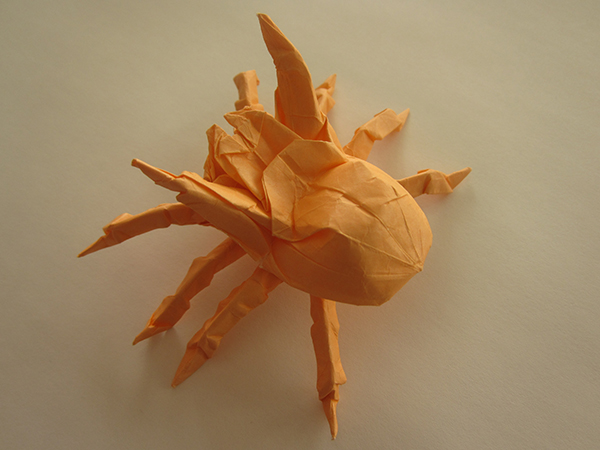
Tarantula, designed by Robert Lang
I hope PZ appreciates all the unsinks I needed to do to make this.
An unsink is when you invert a pyramid, changing it from pointing inward to pointing outward. Often you only have access to one side of the pyramid, so you can’t push it out, you have to pull it. You can see a sequence of unsinks in this instructional video for the tarantula, timestamp 7:06. Although I actually thought the hardest fold was pleating the legs, which consist of up to 40 layers of paper.
I just made this last month! Lately I have been trying out complex one-piece origami models. I am not as skilled at this sort of origami, and my tarantula doesn’t look as clean as most others on the internet. That’s fine though–I will get better and return to the tarantula in the future. (Or maybe next time I’ll just use better paper!)