Regulating data science with explanations

Data science has an increasing impact on our lives, and not always for the better. People speak of “Big Data”, and demand regulation, but they don’t really understand what that would look like. I work in one of the few areas where data science is regulated, so I want to discuss one particular regulation and its consequences.

So, it’s finally time for me to publicly admit… I work in the finance sector.

These regulations apply to many different financial trades, but for illustrative purposes, I’m going to talk about loans. The problem with taking out a loan is that you need to pay it back plus interest. The interest is needed to give lenders a return on their investment, and to offset the losses from other borrowers who don’t pay it off. Lenders can increase profit margins and/or lower interest rates if they can predict who won’t pay off their debt, and decline those people. Data science is used to help make those decline decisions.

The US imposes two major restrictions on the data science. First, there’s anti-discrimination laws (a subject I might discuss at a later time) (ETA: it’s here). Second, an explanation must be provided to people who are declined.
[Read more…]

Review scores: a philosophical investigation

Normally, in the introduction to an article, I would provide a “hook”, explaining my interest in the topic, and why you should be too. But my usual approach felt wrong here, since I cannot justify my own interest, and arguably if you’re reading this rather than scrolling past the title, you should be less interested than you currently are.

So, review scores. WTF are they? I don’t have the answers, but I sure have some questions. Why is 0/10 bad, 10/10 good, and 5/10… also bad? What goals do people have in assigning a score, and do they align with the goals of people reading the same score? What does it mean to take the average of many review scores? And why do we expect review scores to be normally distributed?

Mathematical structure

Review scores are intuitively understood as a measure of the quality of a work (such as a video game, movie, book, or LP)–or perhaps a measure of our enjoyment of the work? Already we have this question: is it quality, or is it enjoyment, or are those two concepts the same? But we must leave that question hanging, because there are more existentially pressing questions to come. Review scores do more than just express quality/enjoyment, they assign a number. And numbers are quite the loaded concept.

[Read more…]

COVID and perspectives on causality

Recently, people have been circulating a statistic from the CDC that says 94% of death certificates listing COVID-19 as a cause of death also list at least one other cause of death. For instance, if someone catches COVID, can’t breathe anymore and dies, perhaps the doctors would also list “Respiratory failure” as one of the causes of death, in addition to COVID. Come to think of it, why do only a third of COVID deaths include respiratory failure as a cause, how exactly is COVID killing people if not by causing respiratory failure?  Before parading around this statistic, I have to ask, do we really understand what it’s even saying?

That misleading statistic came to my attention because a friend wrote a Vox article about it. He brings not a medical perspective, but a psychology perspective, discussing the cognitive biases that make people bad at understanding causation.

Causation is also a favorite topic of mine as well, although I come at it from a different set of perspectives: philosophy, physics, and law. And although I don’t have medical expertise, it’s not hard to find the medical standard of causation from google, so I include that at the end.

[Read more…]

Explaining Roko’s Basilisk

Before I move away from the topic of Rationalism and EA, I want to talk about Roko’s Basilisk, because WTF else am I supposed to do with this useless knowledge that I have.

From sci-fi, a “basilisk” is an idea or image that exploits flaws in the human mind to cause a fatal reaction. Roko’s Basilisk was proposed by Roko to the LessWrong (LW) community in 2010. The idea is that a benevolent AI from the future could coerce you into doing the right thing (build a benevolent AI, obv) by threatening to clone you and torture your clone. It’s a sort of a transhumanist Pascal’s Wager.

Roko’s Basilisk is absurd to the typical person, and at this point is basically a meme used to mock LW, or tech geeks more broadly. But it’s not clear how seriously this was really taken in LW. One thing we do know is that Eliezer Yudkowsky, then leader of LW, banned all discussion of the subject.

What makes Roko’s Basilisk sound so strange, is that it’s based on at least four premises that are nearly unique to the LW community, and unfamiliar to most anyone else. Just explaining Roko’s Basilisk properly requires an amusing tour of multiple ideas the LW community hath wrought.

[Read more…]

Effective Altruism: an outsider perspective

As readers know, I like to take retrospective looks at the New Atheist movement. What can I say, I was involved for ten years and I have grievances. But there’s another adjacent community I think a lot about, even though I was never personally involved: the Rationalist community, also known as the LessWrong community.  I also think about Effective Altruism (EA), a significant spinoff community that focused on philanthropy.

I always had issues with the Rationalist community, as well as personal reasons to keep my distance. But looking back, I honestly feel like Rationalism left a better legacy than either the Skeptical or New Atheist movements did, and that legacy came in the form of EA. I keep my distance away from EA, but at the end of the day they’re doing philanthropy, and encouraging others to do philanthropy, and I really can’t find fault with that.

[Read more…]

Intrinsic value of choice

I know that this question has practical and political implications, but for now, I’m treating it as a “just for fun” philosophical question.  Just wanted to be upfront.

What is the value of freedom of choice?  Does it have intrinsic value, or is its value purely instrumental?

A thing has “intrinsic value” if it is valuable in itself.  It has “instrumental value” if it is valuable because it is a means to get something else of value.  For instance, suppose we have a choice between mushroom and cheese pizza.  This choice has instrumental value, because it’s a means for people to have the kind of pizza they most prefer.  But does the choice also have intrinsic value?

Under an initial analysis, I thought the answer was “no”.  If I’m presented with a one-time choice between A and B, and I choose A, did the other option B do any good?  At least within a consequentialist ethical framework, it sure doesn’t seem like it.  After all, option B had no bearing on the consequences.

[Read more…]

Chess involves luck, and other propositions

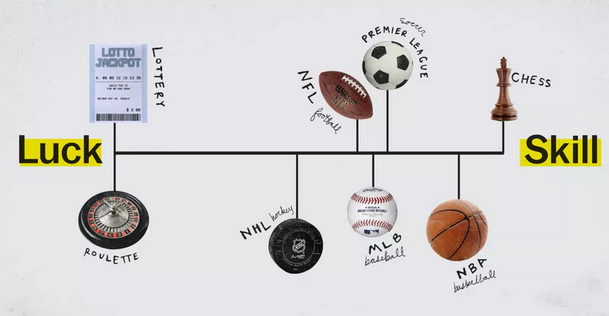
I find the concept of luck vs skill in games to be fascinating, because the common intuitions are just so wrong. The common intuition is that some games involve more luck, and some games involve more skill. On the extreme end of luck, we have the lottery; on the extreme end of skill, we have chess. The orthodox view was best expressed by a Vox article/video, which included the following image:

An image depicting a continuum, with lottery and roulette being on the left "luck" end, and chess being on the right "skill" end. In the middle, we have hockey, football, baseball, socker, and basketball in that order. Each sport is depicted with an image of the ball/puck, and the name of an associated league.

The Vox image also shows several sports, and the position of each sport is based on the statistical analysis of Michael Mauboussin.  The details of analysis aren’t explicitly described, but it’s basically analyzing the national tournaments for each sport, and estimating how much of the variance in outcome is explained by luck or by skill.

Mauboussin did not analyze chess.  Vox added chess in themselves, pulling a claim out of their ass.  Without doing any analysis, I can guarantee that if you applied the same statistical analysis to chess, you would not find that chess was 100% skill.  The analysis will only show that a game is pure skill if the same people consistently win all their games.  I quickly checked the US Chess Championship winners, and while some names show up repeatedly, it is not 100% consistent, and therefore would not be deemed a pure skill game by this analysis.

So what gives?  Is the statistical analysis bogus, or is the claim that chess is 100% skill bogus?  Trick question.  Both of them are bogus.

[Read more…]