The Whiteness of America’s Gun Laws.

Armed members of the Black Panther Party leave the Capitol in Sacramento, California May 2, 1967.

Armed members of the Black Panther Party leave the Capitol in Sacramento, California May 2, 1967.

…We cannot know if police would have reacted differently to the two allegedly armed men if Sterling and Castile were white, but simple fact is that deaths like these keep happening. And they keep happening to black men.

The whiteness of America’s gun laws, and of how those laws operate in practice, is nothing new. Indeed, when black activists took advantage of loopholes allowing them to rather extravagantly exercise their own gun rights, those loopholes were rapidly closed by an icon of white conservatism — the sainted Ronald Reagan himself.

Enter The Black Panthers

[…]

Yet the dramatic events that led to the Mulford Act becoming law also reveal how quickly white conservative lawmakers were willing to act when the face of gun rights was black. And this response stands in stark contrast to modern day conservatives’ reaction to similar antics by white activists.

When Gun Rights Are White

GW

[…]

Rather, the point is that, as the face of gun rights grew whiter over the last several decades, white conservatives grew increasingly more sympathetic to efforts to elevate these rights. The position Ronald Reagan took on guns in the 1960s would make him a pariah in today’s Republican Party. Even the National Rifle Association (which, admittedly, was a far less political organization in the 1960s) supported legislation like the Mulford Act. Indeed, they actually helped shape similar laws in many other states.

You can get white conservatives to enact gun laws in the United States, but it’s hard to do if the face of gun rights isn’t black.
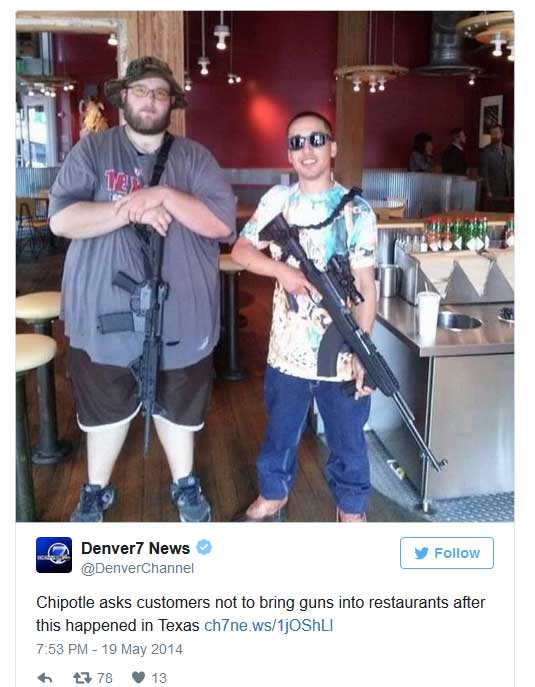
An excellent article, and a nifty recap of how swiftly gun restrictions were made into law when it was the Black Panthers holding the guns. I remember all that happening.

Trans Guidelines: 10 More States Sue.

Shutterstock.

Shutterstock.

A second lawsuit has been filed by states objecting to the Obama administration’s call for schools to avoid discriminating against transgender students, including the recommendation that trans students be allowed to use restrooms and locker rooms matching their gender identity.

Ten states led by Nebraska filed the suit in federal court in that state, the Associated Press reports. The other states in the suit are Arkansas, Kansas, Michigan, Montana, North Dakota, Ohio, South Carolina, South Dakota, and Wyoming. Eleven other states, led by Texas and joined by some school districts and public officials, filed a similar suit in May. Both name the U.S. departments of Education, Justice, and Labor as defendants, plus the Equal Employment Opportunity Commission.

The new suit uses much of the same language as the previous one and contends that federal government departments and agencies do not have the right to interpret the law as they did, declaring that a prohibition on sex discrimination in education also bans discrimination based on gender identity. The sex discrimination clause is in Title IX of the Education Amendments of 1972.

I knew this was coming, but it really hurts to see ND in that list.

The federal guidance document on treatment of trans students, issued in May, is not legally binding, but it does advise schools on how to comply with their legal obligations to students. Schools that do not comply may lose federal funding.

The new filing means that nearly half the U.S. states are challenging the Obama administration’s guidance, and doing so based on a “1972 understanding of sex,” notes Zach Ford at ThinkProgress.

They can’t go home to the 1950s, but they’ll take it as close as they can get.

Full story here.

Photographing the Radioactive Past.

Jeremy Bolen.

Jeremy Bolen.

Bolen’s featured works at Newspace include a series named after Vieques, an island belonging to Puerto Rico that was used for weapons testing by the United States between when the US bought about two-thirds of the island 1941 and when the military left the island in 2003.

According to Arizona State University’s Walter Cronkite School of Journalism, “More than 80 million pounds of chemical weapons, bombs and ammunition were dropped on the eastern portion of the island for a good part of the 20th century. Its soil still harbors bullets filled with radioactive depleted uranium and unexploded bombs.” In 2010, about 7,000 residents of the island jointly sued the US Navy claiming that military operations on the island were the cause of Vieques’ higher-than-average rate of cancer, along with a slew of other long-term medical issues. A Puerto Rican Federal District Court dismissed the lawsuit, and the US First Circuit Court of Appeals upheld that dismissal in 2012 due to the Navy’s right to sovereign immunity.

Bolen went to Vieques—though not to the restricted-access area on the eastern side of the island—and buried some of his film in the soil before it was exposed to visible light. He later dug the film back up and developed it, finding chromatic irregularities in the resulting prints. The artist’s prints are accented by bits of dirt (occasionally painted or gilded), and accompanied by a photo of the location where he buried his film, hung behind swatches of window screen.

For Bolen, adding the dirt to his irradiated film elucidates the “tension between the visible and the invisible,” that comes with living at these sites, as many in Vieques still do.

Full story here.

Granite Claw Flower.

From Lofty:

I had a botanist friend over who identified this bush in our garden as a Western Australian native, “Calothamnus graniticus”, normally found in sandy soils derived from granite. It grows well in our garden, it was here when we moved in 20 years ago.

So fuzzy! Click for full size.

graniteclawflower

© Lofty. All rights reserved.

Heartsick

NC

This is now war. Watch out Obama. Watch out black lives matter punks. Real America is coming after you. – Joe Walsh.

No. No. Racism and guns cannot help. They can’t “win”. Racism, guns, and cops being allowed to murder people of colour got us here.  Rescue those shreds of humanity, please. Listen to Charles Blow:

“You can’t have selective outrage and selective grief” — @CharlesMBlow discusses the #Dallas shooting.

Holy F*ckin’ Smoke

HSCelebrating slaughter, even after your dead. Golly, doesn’t that just scream American? There’s a company in Alabama that will take the cremated remains of someone, and pack them into hollow point bullets or shotgun shells.

Several years ago I was talking with my friend and co-worker at work one evening. We were discussing the passing of one of our relatives and the topic of conversation turned to our own demise and whether we preferred burial or cremation.  I told my friend that I had some cost, waste of space and ecological issues with burials and that I thought I wanted to be cremated and in some fashion, have my ashes tossed into a river or spread through the woods.

My friend  smiled and said “You know I’ve thought about this for some time and I want to be cremated. Then I want my ashes put into some turkey load shotgun shells and have someone that knows how to turkey hunt use the shotgun shells with my ashes to shoot a turkey. That way I will rest in peace knowing that the last thing that one turkey will see is me, screaming at him at about 900 feet per second.”

You’ll rest in peace, knowing the very last vestige of you will be used to cause the death of another being. Pity you couldn’t mange to rest in peace by letting another being rest in peace and aliveness.  All that shootin’, huntin’, and killing during your lifetime just isn’t enough, I guess. I’m, uh, just out of words.

Holy Smoke.

A Fuzzy Statement.

blm_4

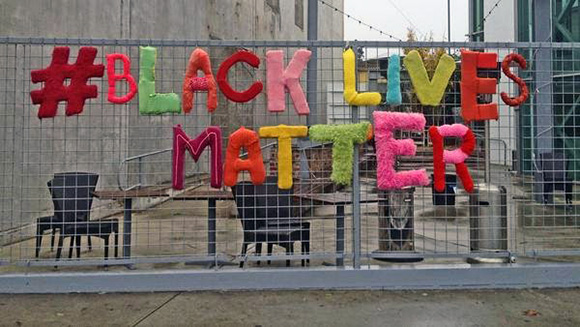
#BLACK LIVES MATTER at the Craft and Folk Art Museum. | Photo: Courtesy Craft and Folk Art Museum.

Self described “knit graffiti collaborative” Yarn Bombing Los Angeles’ (YBLA) most recent bid to colorize and textualize our streets hangs directly to the east of the Craft & Folk Art Museum, two rows / seventeen characters worth of multi-hued text lashed to a grey metal fence and projecting north across Wilshire towards the La Brea Tar Pits.

The materials and phrase are both easily taken in in their entirety during a quick drive-by: “#BLACK LIVES” at rough eye level with “MATTERS” just below, all of it in pink, red, mustard, orange, blue and green knit (some shag carpet-like pile?) laid out on an area about the size of two tightly parked vans. The letters on Wilshire are part of Urban Letters, an ongoing project of YBLA’s where epigrammatic or gnomic texts “that might otherwise remain unsaid” are solicited online in order to be made softly manifest IRL.

Full Story here.

A Noble People.

Matt Barber and Peter LaBarbera Matt Barber and Peter LaBarbera got together once again and I guess it just wasn’t quite enough to carry on with their usual fear and loathing of all people and things queer. Matt Barber, a white man, has decided to go the noble savage route with black people. Yep. Barber had to condescendingly whitesplain the problem with those people of colour who are accepting and tolerant.

Last Tuesday on the “Jesse Lee Peterson Radio Show,” Peter LaBarbera of Americans for Truth About Homosexuality told guest host and fellow anti-gay activist Matt Barber that the gay rights movement is “a liberal cult,” “an anti-God movement” and a “sin movement.”

Barber argued that with African-American leaders’ acceptance of gay rights, “secular socialism” has “infested the black community.”

“The blacks are a noble people, certainly, and there are many … Bible-believing Christians who are offended and disgusted by these illegitimate comparisons between mutable, changeable, deviant behaviors, homosexual behavior, and immutable, neutral characteristics such as skin color,” Barber said. He claimed that “black leaders have completely sold out to the radical LGBT lobby and are complicit in making these illegitimate comparisons.”

I’m sure that black people everywhere will sigh in relief at having a white bigot explain to them that they are so very wrong, and that it’s downright sinful to employ empathy, love, and compassion. Surely, the shocking news that black people, while noble,  are also sellouts will make every single person change their views, immediately.

I have a lot of problems with the use of Noble and the concept of nobility. It’s a long shadow cast from the days of Ancien Régime (and much earlier, actually), this idea that a certain class of people are better, simply by virtue of being in said class. Nobility is nothing more than power and privilege, writ large, all across history, and still plaguing us today. The concept and history of Noble Savage is a long and demeaning one.  Most people are familiar with it being applied to Indians, but it was also liberally applied to other people of colour, when they were free, and when they were slaves. There was a sort of grudging admiration, of the type one would aim at a clever animal. We like to think all that has really changed, a lot. It hasn’t, though. A lot of people still subscribe to the noble savage concept, like Mr. Barber. Other people have tossed the ‘noble’ part straight out of the window, settling on straight ‘savage’ when busy justifying why it’s perfectly okay for cops to murder people of colour.

And yes, throughout history, white people were tromped on by the noble classes, too. Before anyone gets seriously into a whine about that though, think very hard on the amount of privilege you get to walk around with, and how that privilege acts and works, every single day of your life, easing interactions and keeping you much safer than people of colour. Think about how you are not subject to respectability politics. Think about how many people would rush to your defense and make one excuse after another if you did something unthinkable, like pick up a gun and started shooting people. Think about how if you are white, you’d most likely still have your life in such a case. No, cops killing a few armed white people over the years does not redress the awful imbalance. Consider: You read two news stories on the same day. One story is about a cop shooting and killing a black man. The other story is about a cop shooting and killing a person’s pet dog. Which one of those stories elicits immediate empathy and outrage? Be brutally honest with yourself here.

Consider how you think of people of colour, and have the spine to stop yourself thinking “well, hey, I have ____ friends!” You can have a non-white friend or friends, and still not get it. You can have those friends, and still be biased as hell. Consider whether or not you give space to the noble concept in your head some where. That will take a bit of work, and it will definitely take honesty. Work for a better understanding of how white people come to have certain viewpoints, and why they can be so defensive of them:

Whites are taught to see their perspectives as objective and representative of reality (McIntosh, 1988). The belief in objectivity, coupled with positioning white people as outside of culture (and thus the norm for humanity), allows whites to view themselves as universal humans who can represent all of human experience. This is evidenced through an unracialized identity or location, which functions as a kind of blindness; an inability to think about Whiteness as an identity or as a “state” of being that would or could have an impact on one’s life. In this position, Whiteness is not recognized or named by white people, and a universal reference point is assumed. White people are just people. Within this construction, whites can represent humanity, while people of color, who are never just people but always most particularly black people, Asian people, etc., can only represent their own racialized experiences (Dyer, 1992).

The discourse of universalism functions similarly to the discourse of individualism but instead of declaring that we all need to see each other as individuals (everyone is different), the person declares that we all need to see each other as human beings (everyone is the same). Of course we are all humans, and I do not critique universalism in general, but when applied to racism, universalism functions to deny the significance of race and the advantages of being white. Further, universalism assumes that whites and people of color have the same realities, the same experiences in the same contexts (i.e. I feel comfortable in this majority white classroom, so you must too), the same responses from others, and assumes that the same doors are open to all. Acknowledging racism as a system of privilege conferred on whites challenges claims to universalism.

At the same time that whites are taught to see their interests and perspectives as universal, they are also taught to value the individual and to see themselves as individuals rather than as part of a racially socialized group. Individualism erases history and hides the ways in which wealth has been distributed and accumulated over generations to benefit whites today. It allows whites to view themselves as unique and original, outside of socialization and unaffected by the relentless racial messages in the culture. Individualism also allows whites to distance themselves from the actions of their racial group and demand to be granted the benefit of the doubt, as individuals, in all cases. A corollary to this unracialized identity is the ability to recognize Whiteness as something that is significant and that operates in society, but to not see how it relates to one’s own life. In this form, a white person recognizes Whiteness as real, but as the individual problem of other “bad” white people (DiAngelo, 2010a).

You can read White Fragility in its entirety here.