Restorating the Kitchen Table and why “Sustainability” Can’t Work Within Capitalism

Everybody in a long term relationship knows the horrors of buying furniture. You may have been together for a decade, have basically the same interests, plans in life, you combined your families and friend circles, and then you need to buy furniture. Suddenly your beloved looks like a total stranger. How can the person you love more than anybody else like that couch? If your relationship survives the first round of furniture shopping, you may survive as a couple. And then you are together for so many years that you have to do it all again. Especially when you have children. Especially when your children are alien monsters in a cute disguise.

Last year around autumn the little one managed to actually break the legs off a chair. The other ones weren’t very stable either any more, so we needed to go out and buy new ones. And the table looked horrible as well. 14 years of eating, crafting, living had taken their toll on the plates. Nevertheless, while we could agree quickly on new chairs, we could also agree quickly that the tables were not an option. Our table needs to be large and extendable. For some reason, the large tables all had a plate that is split lengthwise, and at that point (apparently they changed since) , could only extended by inserting a plate lengthwise, which doesn’t make sense, since it doesn’t sit more people, but make sitting down and getting up  difficult since the table is too wide now.

The only one available at the big Swedish furniture shop that suited our needs was the exact same one we already had… so i decided to restore that one instead, which only took me about 10 month to get done.

©Giliell, all rights reserved

This is how the table looked before. The varnish has basically disappeared in the areas most used, there are big scratches and dents. I seized the opportunity to get a random orbit sander and got to work. I removed the old paint and nasty scratches at 60 grit.

©Giliell, all rights reserved

Then I did a second round at 150. In the image below one half is already sanded, the other half is not. People who work with wood can feel the image.

©Giliell, all rights reserved

Last round was done at 220 grit and off we went for varnishing.

©Giliell, all rights reserved

I used varnish for wood floors/stairs, since that is the most durable, and you saw what already happened to the table once.

I applied a total of three layers of varnish, giving them ample time to dry in between.

©Giliell, all rights reserved

A first coat of varnish. I lightly sanded in between applying the coats, but by hand and with a 800 grit. One thing about the varnish is that it doesn’t “pull even”. It keeps a bit of a structure, and if you look closely, you can see it (though not in this pic). It also hides dirt until it’s dried and it’s too late…

The legs got some repairs where needed. Down at the feet, where you stub your toes, ant the bars where you put your dirty, sweaty feet. I had to do that inside, it was not nice.

Table legs in the kitchen

©Giliell, all rights reserved

Finally, here we are. The two plates have been sanded and painted. The middle extension isn’t done yet, but we don’t need it every day.

©Giliell, all rights reserved

©Giliell, all rights reserved With bonus husband running into the pic

Now, what does my little project have to do with capitalism? It’s easy when you think about it: Capitalism wants me to buy a new table. Capitalism needs me to buy a new table. Capitalism makes it impossible for most people to not buy a new table. A new table would have been around 300€. The materials for restoring the old one were 80 bucks for sanding discs and varnish and brushes, and 150€ for the tools (though I still have those, but they lost about half their resale value the moment I carried them out the door.) That’s 230€ with no guarantee that this would work.

It also took me almost a full week. I have an outdoor space for sanding, but of course that required the rain to stop occasionally, and an indoor space for painting and drying. Also a separate living room with a separate table we could eat on in the meantime. And most importantly: I had the time AND skills to do this and it’s actually something I enjoy. Nobody who dislikes crafting would do this to save maybe 100€. Unless you’re completely poor and have to hope that somebody else throws away their perfectly usable but pretty shabby table.

Now imagine we built our world not around consumption, but around community. Imagine community repair centres. There are tons of people, especially elderly people who can’t / don’t want to do a full work day, but who will happily work a few hours a week. Imagine such a centre where you can go and together (or without you) you can restore your furniture, repair your bike or learn how to fix your leaky sink. Imagine having the time to do so. Sounds good, doesn’t it?

My Dearest Deer (plush of the month)

I made another plush from NazFX Studios, just in time before the next project is looming around the corner (yay for holidays).

This one is a cute little fawn, with true Bambi vibes.

©Giliell, all rights reserved

©Giliell, all rights reserved

©Giliell, all rights reserved

I changed my deer a bit from the original version. I used tan instead of white, left off the antlers, and moved the ears to a more natural position. Isn’t she cute? And I’m never going to make another one. Really. You’d have to pay me serious money, but this won’t become a “you remember it’s my birthday” pattern. It’s a good pattern, and it’s a lovely plush, but it’s also a hell lot of work. But I’m glad I finished her and she’s already been adopted by the other plushies.


Lost And Found Birdies

Today, I’m sharing 2 beautiful photos that were taken by Emily Davis, in La Jolla, during March of 2019. They were submitted by her mother, Anne, Cranky Cat Lady, in that same month and, upon receipt, I carefully filed them away in the wrong place! Then, I promptly forgot all about them until a few days ago, when I found them while I was looking for something else. So, here, at last, are two very pretty birds.

American Robin, ©Emily Davis, 2019

Hooded Oriole, ©Emily Davis, March 2019.

Slavic Saturday

Today again a little crossover with the Behind the Iron Curtain series.


Jan Hus and Jan Žižka are to this day considered great figures of Czech history. Even the communist regime venerated these two men to a great degree, so much so that it was during this regime that one of the largest bronze equestrian statues in the world was made to commemorate Jan Žižka in 1950. And movies were made about both. Today, we also have a national holiday on the day Jan Hus was burned at the stake.

We were taught in school that Jan Hus was a great reformer who has challenged and criticized the corruption within the catholic church, and that was true. We were taught that he has sparked a national movement that has fought against the hegemony of said corrupt, hypocritical, and oppressive church, and that was also true. However what was ignored was that he also sparked a fanatical religious movement that was not solely inspired by a desire for a better and juster society, but also by a merely different interpretation of holy writ.

As for Žižka, he was and is considered to be one of the greatest Czech warriors there was, and perhaps in history, as this short video suggests.

We were taught about his military successes, especially about the fact that he was able to take a bunch of peasants and merchants and convert them into a fighting force capable of defeating several crusades consisting of professional soldiers who trained in combat from childhood. What we were not taught was that he also burned at stake several dozen of “heretics” who took reinterpreting the scripture way too far for his liking.

To this day there is a lot of people who romanticize Jan Hus, Jan Žižka, and the whole Hussite movement. Perhaps there is some value in that. But I think it is also important to remember that whilst they were somewhat progressive in their times, today they would probably both be considered insufferable religious fanatics. They certainly would not approve of today’s Czech atheism.

The Art of …

… Netsuke, a small carved object made to wear with traditional Japanese kimono.

A netsuke is a small sculptural object which has gradually developed in Japan over a period of more than three hundred years. Netsuke(singular and plural) initially served both functional and aesthetic purposes. The traditional form of Japanese dress, the kimono, had no pockets. Women would tuck small personal items into their sleeves, but men suspended their tobacco pouches, pipes, purses, writing implements, and other items of daily use on a silk cord passed behind their obi (sash). These hanging objects are called sagemono. The netsuke was attached to the other end of the cord preventing the cord from slipping through the obi. A sliding bead (ojime) was strung on the cord between the netsuke and the sagemono to allow the opening and closing of the sagemono. Source – World of Netsuke.

19th Century Netsuki, artist unknown. Image from Skinnerinc.com

Netsuke of Mice with Corn, Meiji period (1868-1912). Image from Carter’s Auctions.

19th Century netsuke, artist unknown. Image from Picryl Public Domain Source.

Netsuke, Autumn grasses with praying mantis.Image from Asian Antiques.


The Art of …

… needle lace, by Hungarian artist Ágnes Herczeg

Born in the town of Kecskemét, Agnes Herczeg is a talented Hungarian textile artist. She graduated from the Hungarian University of Fine Arts in 1997. While studying, she has learned many traditional handicraft techniques, from embroidery and lace-making to macramé, and weaving. Creating her works, Agnes uses only with natural materials – tree branches, roots, fruits, seeds, yarns, threads, textiles, which supplement in a single composition. They seem imbued with rays of light, their stories are unusual, the embodiment of elegance and harmony. Combining innovative techniques with traditional handicraft, Agnes has created one-of-a-kind art gallery. In particular, combining lace with various materials – ceramic, wood, and coconut shell. According to Agnes, lace-making is an extremely time consuming occupation. For example, it takes Agnes several days just to complete a small piece. – source Art Kaleidoscope

I encourage you to check out either of the above links to see more of this artist’s work. I’m amazed at the amount of fine detail and emotion that Herczeg is able to capture in such small pieces of art.

The Garden, Agnes Herczeg. Image from TextileArtist.org


Lace Art by Agnes Herczeg. mage from Fubiz Media

The Bath by Agnes Herczeg. Image from Textileartist.org

Grasshopper by Agnes Herczeg. Image from the artist’s website.


Mirror, Mirror…

I have finished the two fullered blades that I intended to mirror-polish for research purposes. It went reasonably well, I must say. The new jig helped a lot to smooth out and polish the fullers and although I had to resort on occasion to my old method of wrapping the abrasive around a bottle cork or popsicle stick, my fingers were spared or the worst of the worst. They are not perfect, but they are good enough for it to take some time to spot the irregularities and imperfections.

I think that next time I will do even a bit better because I did not have the jigs from the start for these, I have developed and tinkered with them during this project. One such tinkering that I forgot to mention in my previous post was to coat the idler wheels on my belt grinder with PVC flooring offcuts. That has reduced the chatter when grinding and polishing the fullers on the belt grinder, so I could actually use the belt grinder for polishing, and the handmade jig was subsequently only used to remove the perpendicular scratches and replace them with longitudinal ones. And because next time I will have all this equipment and the knowledge already, the results should, at least in theory, be better and with less work.

So here are some pictures containing the main things that I am writing about – blades, flowers, and insects.

© Charly, all rights reserved. Click for full size.

© Charly, all rights reserved. Click for full size.

The pumpkins are flowering nicely and there seem to be enough solitary bees around to pollinate them.

The blade on the left is the one that I have almost tossed. The fullers align well near the hand, but they diverge towards the tip quite noticeably, at least a few mm. Both fullers on both blades are a bit irregular.

I have a love-hate relationship with mirror-polished blades. They are very difficult to make, it is a lot of hard manual work that busts fingers and back so I hate doing it because I am tired and I do not recover as well as I should from physical exertion. But I also like doing it because it is very rewarding and satisfying to see the gradual change with each step as one progresses from 40 to 7000 grit and then to the buffing compound.

But they are never truly finished because the mirror polish exacerbates every minute irregularity to an absurdly high degree. A few microns deep divot will be seen at a certain angle. Also one thinks all scratches are removed and then, a few days later, you look at it at a very specific angle in a very specific light and suddenly you see that some gossamer-thin scratches are still there.

Then there is the practical side of course – although the steel is hardened, at mirror polish you can literally scratch it if you cut cardboard or office paper with it. They are very precious flowers indeed – basically, the wind blows a speck of dirt on the blade, you wipe it off and it leaves behind a scratch that will be visible in some light. That was one of the main reasons why I have decided to make a tumbled finish for my friends’ knife and why I am going to use it for most of my knives because that hides all but the most egregious scratches.

All in all, although these two blades are not perfect to a degree that I would be perfectly content with them, they are good enough that I shall go on and finish them with high-end fittings.

The Art of …

… the spoken word. One of the best perks of being part of this blog is the opportunity to showcase the art of our readers. Today, I’m sharing a new form of art for us. About a month ago, I posted a poem called The Mall, by Canadian poet Evelyn Lau. Dakotagreasemonkey (Rick) then took the time to record himself reading it aloud for us. He has a deep, resonant voice and I found his reading touching. I think he may have a future in dramatic arts and I hope he explores his talent and finds other ways to express himself. I’m sure you’ll all enjoy it. I’d also like to take a moment to thank Marcus (Stderr) for his technical assistance. (The photo in this clip is mine. It’s a place called Plage Nord and it’s across the street from my mother- in- law’s home in Perce, Quebec. Jack and I spent a lot of happy time there.)

The Mall

Today I chose it over the ocean.

Over the trees, their fall leaves

a flock of orange parrots perched on branches.

Over the chandelier of sunlight broken

on blue waves, over flowers

shaped like teacups or trumpets,

over the jade garden where once I dreamed

I wore a green velvet dress

clasped tight at the waist

like the grip of a man’s hand.

I walk toward it like a Zombie,

this strange planet suspended in time,

a space station in the rainforest

inhabited by teenage girls wearing glitter eyeshadow

and slippery lipgloss. I skate

along its arid walkways

as if on an invisible track, away

from my life. Here it could be day or night,

the walls stripped of clocks,

music moaning a mindless refrain,

not a window in sight.

The stores hold their mouths open

like seductresses, radiating heat and light

and a bright array of wares,

a sorbet rainbow of merchandise

delectable as pastilles.

Outside, the lives of grasses

and insects and breezes go on.

After a day at the mall,

stepping back into what’s left of the world,

the sunlight will sear your skin,

and the gallons of fresh air

will pour over you like pain.


by Evelyn Lau


Mammoth Wasp

An amazing capture from Nightjar,

I didn’t have my camera with me when I saw this huge wasp on a wild leek flower last month, but I didn’t know what it was so I tried to use my phone to get good enough photos that could let me ID it later. I wasn’t surprised to learn it’s called a Mammoth Wasp. It really is big. While I wish I had taken my camera, the photos didn’t turn out so bad and I thought of sharing them since it’s such an impressive bug.

©Nightjar, all rights reserved.

©Nightjar, all rights reserved.

Fulleramajig & Joy and Depression of Knifemaking

My friend got the knife I conspired with his wife to make for his 40th birthday. He wasted no time and tested it on a BBQ that very day. Afterward, he called me and thanked me and sung praises of his new toy. I must admit that it made me happy for a moment because this is the main reason why I am making knives – to make the end recipient happy that they got something unique, beautiful, and useful as well. That is the good news out of the way, lets go to the somewhat miserable part now.

In my previous post about that knife, I commented that making the fuller was a pain in the fundament, to which Marcus helpfully replied by reminding me about an old video by Walter Sorrels in which he made a small handheld jig to polish fullers. That has inspired me to make my own jigs for making fullers.

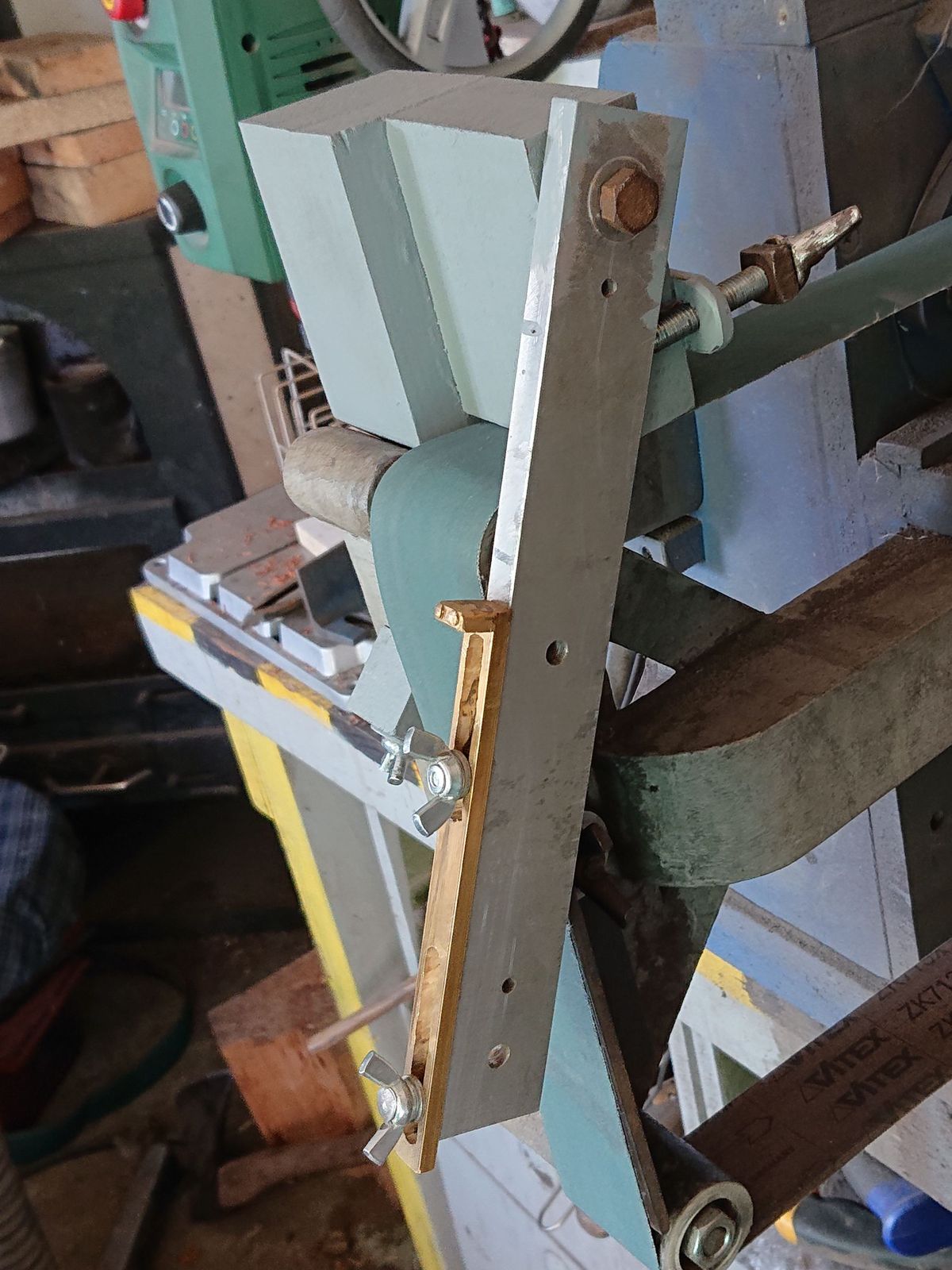
First I made a semi-functional attachment for my belt grinder.

© Charly, all rights reserved. Click for full size.

The aluminum arm can freely swivel around the rusty screw along the right side of the upper idler wheel. It is held in position by an M8 screw on the back and the brass L- part is an end stop. When grinding, the screw on the back sets the maximum possible depth of the fuller and the brass end stop sets the distance of the fuller from the blade spine/edge depending on how I put the blade on the jig.

It works, somewhat. It does not allow me to make the fuller too deep by accident, which is a definitive plus. But it has the major disadvantage of being asymmetric, whereas blades are (mostly) symmetrical. When grinding one side, the back of the blade lays against the end stop, when doing the other side, it is the edge. That makes it difficult to make the start and finish at the same point on both sides of the blade – I have made two blades with it so far and whilst one is reasonably symmetrical, on the other the fuller is off by about 3 mm towards the tip. I wanted to toss the blade but my mother says I should finish it, so I will. Whether I will attempt to sell it, we shall see.

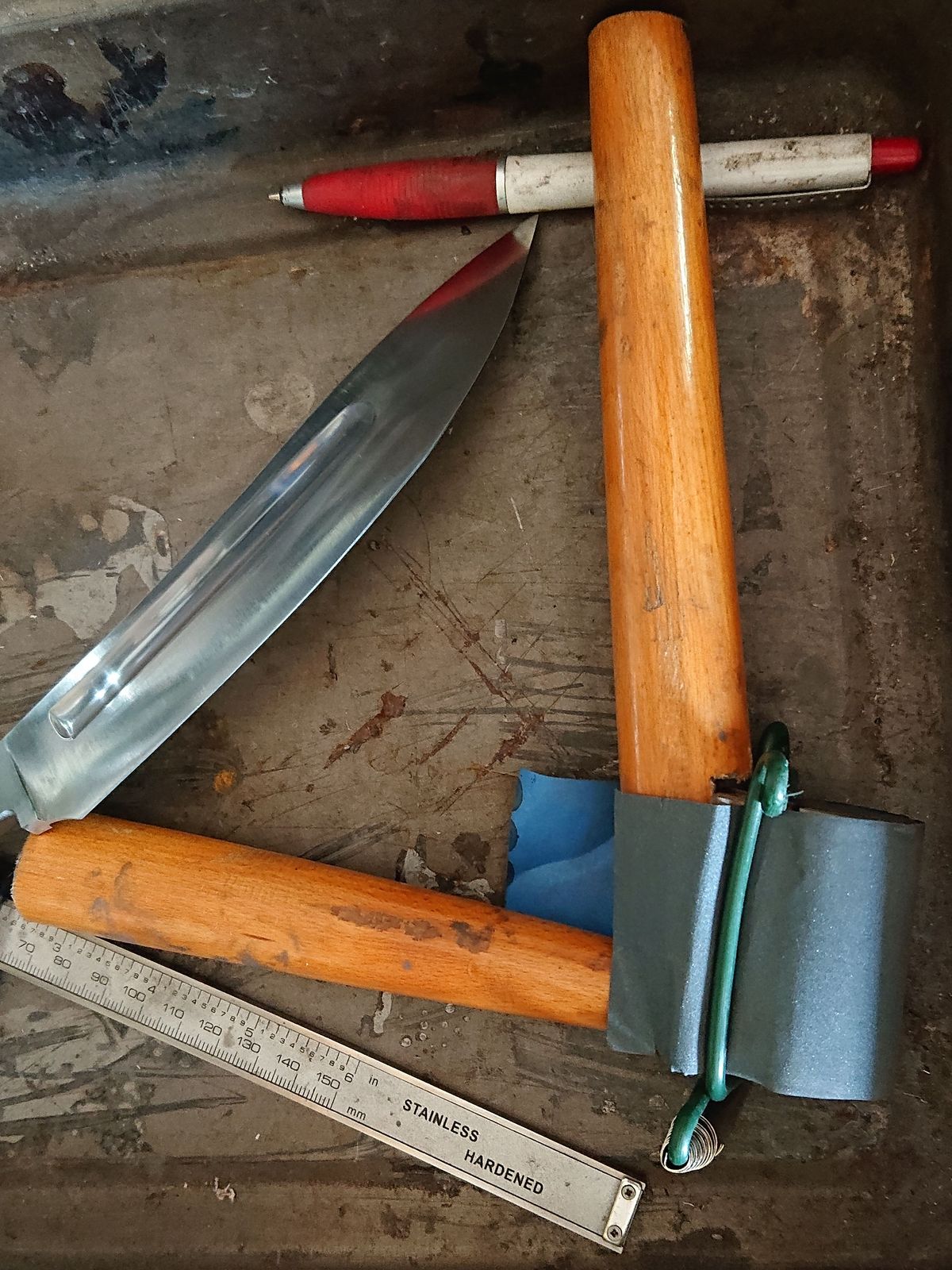
I intend to polish both of these blades to mirror polish, to see how much work that is and how it will look. And to polish the inside of the fuller I have made a small jig from an old furniture leg.

© Charly, all rights reserved. Click for full size.

© Charly, all rights reserved. Click for full size.

It is along the same general lines as the one by Walter Sorrels, only from cheaper materials and less precise. Putting the paper on is a bit fiddly and I will try and come up with a bit better system, but it does work. It is elbow-grease powered of course, so it is a lot of work, but it does allow me to apply the pressure with wrists/palms instead of fingers, so I can put my whole body weight behind it when needed. I got the fullers to 800 grit reasonably fast so I do think that I will manage to get mirror-polish without extreme suffering and pain.

And last update to my workshop is this.

© Charly, all rights reserved. Click for full size.

I would love to have the grinder in a separate room, but alas I cannot afford that. And the dust was getting on my nerves, as well as everywhere else. So I have bought ash vacuum particle separator for my shop-vac. The inlet is made from a piece of leftover sheet metal held with insane amount of ductape on an extendable tube recycled from another, defunct, vaccum cleaner. It works reasonably well and although it does not catch all of the dust, it does catch most of it. As a result my workshop is a lot cleaner and I need not vacuum every surface as often as before.

And now to the total misery.

I was happy to get my licence to actually sell my knives, but I feel miserable all the same. I need to buy and set up accounting software, set up a separate bank account, contact tax/accounting consultant and buy and set up a webshop. And I am procrastinating all of those things because that is the one actual part that I hate.

I have done almost all of the things above as part of my various previous jobs (exception is setting up webshop, but I do have experience with setting up and maintaining webpages), so the problem is not that I do not know what to do. The problem is that if I do not do anything, I cannot fail, whereas when I do all those things, I can. I know it is totally silly, I know that the only way to actually succeed is to do the things that need to be done, but subconsciously (and partly consciously – the odds are not in my favor) I am just expecting failure and I do not want to go through all the hard work just to toss it after a year or two and get emploeyed at some shitty deskjob again. I want to make knives and I would love to give them away for free. But if I did that, I would not be making them for much longer. Attempting selling them is the only way how I maybe can keep making them . And I hate, hate, hate that.

I am depressed. It is irrational, and I know it, but that does not help.

Tummy Thursday: It’s Pokémon Birthday Cake Time

The kid’s birthday was already at the start of the month, but of course with my body being an asshole again I couldn’t make a cake for her actual party. Thank goodness teenagers mostly require insane amounts of food and not attention, so she could have her friends over for a small party.

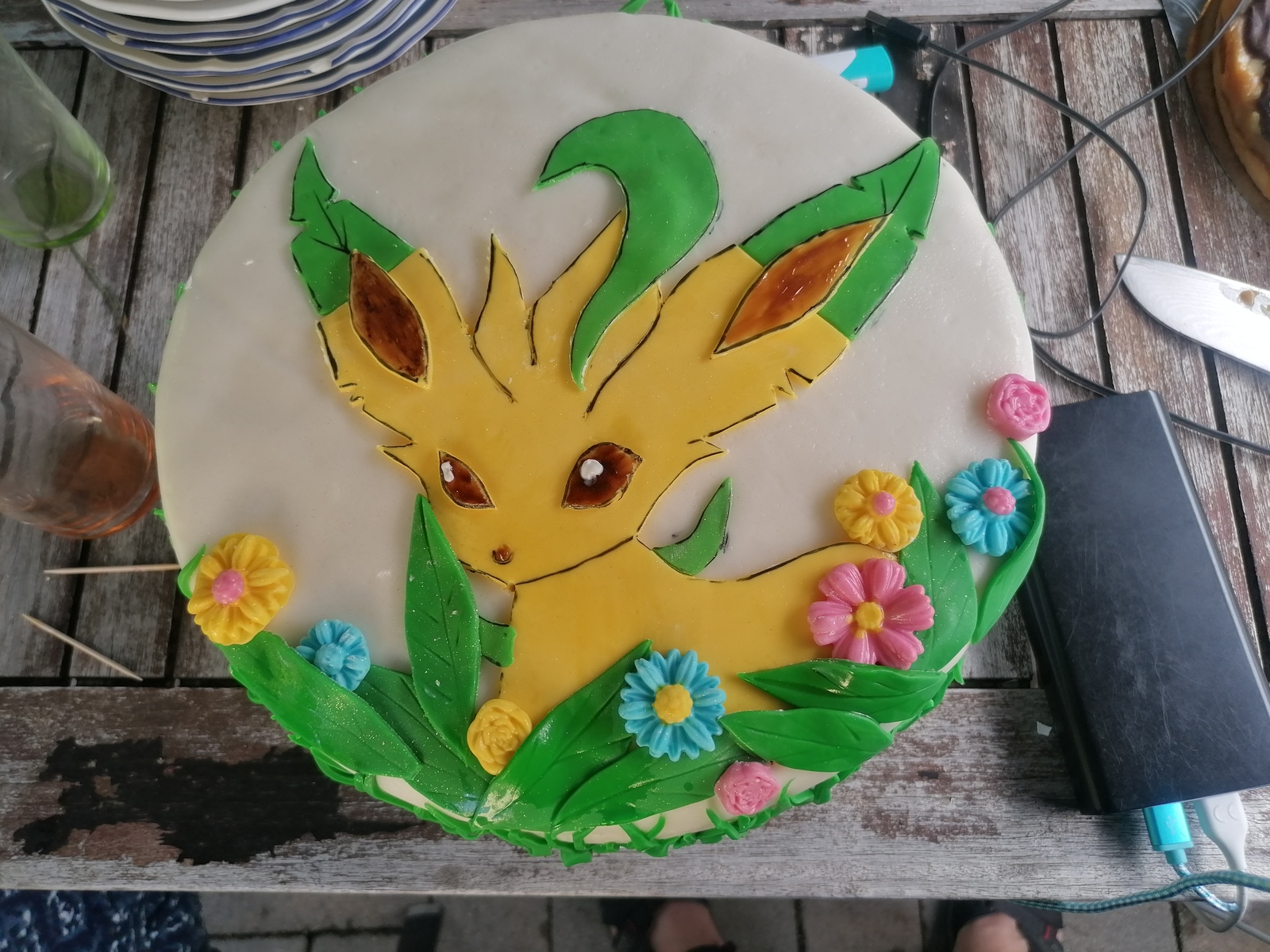
Last weekend we celebrated with our friends and she got her cake for that day. She went for her favourite Eevilution, Leafeon.

©Giliell, all rights reserved      The eyes are not my best work.

©Giliell, all rights reserved Yes, that’s a ton of individually cut and applied grass blades

The inside of the cake is a standard vanilla cake with a cream cheese and cream filling. The filling was really easy and tasty: I used a packet of lemon flavour jello to mix with the cheese and the whipped cream, added some lime zest and cut canned peaches. The only problem that I had was cooling it down quickly enough for the jello to work so it wouldn’t run all out on me. I then covered the whole thing in a thin layer of buttercream before adding the fondant.

Because a German buttercream (butter with custard) has too much liquid for fondant and an Italian meringue buttercream (my usual go to buttercream) was too much work for the state of my recovery, I made an American buttercream. I usually consider American buttercream the symbol of everything that is wrong with American cake making: It’s just butter and sugar, too heavy and too sweet. I love watching cake videos, but quite often the American ones leave me a bit puzzled: Yes, this looks amazing, but all you have in there is cake and buttercream. Where’s the flavour? Do Americans really spend 200 bucks on a cake that looks great but doesn’t taste of anything but butter and sugar? Please do tell me.

It did work well here, btw, because it was only a small layer to get the surfaces even and it contrasted nicely with the tart lemony filling.