2017: The 20 Most Powerless People in the Art World.

Ahmed Rabbani, “Untitled (Binoculars Pointing at the Moon)” (2016) is one of the works by present and former Guantanamo detainees that could be impacted. (image courtesy Art from Guantánsmo Bay exhibition).

Ahmed Rabbani, “Untitled (Binoculars Pointing at the Moon)” (2016) is one of the works by present and former Guantanamo detainees that could be impacted. (image courtesy Art from Guantánsmo Bay exhibition).

3. Guantánamo Inmates: We can’t imagine a more awful position for someone to be in, but the US government is adding to the humiliation of indefinite detentions without trial by deciding that Guantanamo inmates no longer own the art they create, and they will probably destroy it. Hard to see what good could come of this.

Hyperallergic has their list of the powerless up, and unsurprisingly, the bar just gets lower, as in the case of those people detained at Guantanamo. As always, some people maintain their position on the list of the powerless:

5. Female Artists: Most of the stories were anecdotal before, but now studies are reinforcing what we knew already, namely that art made by women sells for almost half their male counterparts. Analyzing auction data and experiments with thousands of respondents, researchers found that the perception of an artist’s gender consistently affects how their work is valued. Now that we have the data, how do we remedy this?

Click on over to Hyperallergic for the full rundown.

A Diverse Eye Chart.

Click for GIANT size.

Click for GIANT size.

This amazing eye chart was put together by George Mayerle, in 1907.

This fantastic eye chart — measuring 22 by 28 inches with a positive version on one side and negative on the other — is the work of German optometrist and American Optometric Association member George Mayerle, who was working in San Francisco at end of the nineteenth century, just when optometry was beginning to professionalise. The chart was a culmination of his many years of practice and, according to Mayerle, its distinctive international angle served also to reflect the diversity and immigration which lay at the heart of the city in which he worked. At the time it was advertised as “the only chart published that can be used by people of any nationality”. Stephen P. Rice, from the National Library of Medicine (who house this copy presented here), explains just how throughly thought through the different aspects of the chart were as regards the aim to be as inclusive as possible:

Running through the middle of the chart, the seven vertical panels test for acuity of vision with characters in the Roman alphabet (for English, German, and other European readers) and also in Japanese, Chinese, Russian, and Hebrew. A panel in the center replaces the alphabetic characters with symbols for children and adults who were illiterate or who could not read any of the other writing systems offered. Directly above the center panel is a version of the radiant dial that tests for astigmatism. On either side of that are lines that test the muscular strength of the eyes. Finally, across the bottom, boxes test for color vision, a feature intended especially (according to one advertisement) for those working on railroads and steamboats.

You can also see and download this wonderful chart here.  Via The Public Domain.

Jay.

Bibliothèque Municipale de Troyes, MS 177, Folio 154v. A multi-colored jay with a crest on its head.

Bibliothèque Municipale de Troyes, MS 177, Folio 154v. A multi-colored jay with a crest on its head.

Text Translation:

[Of the jay] Rabanus says of the jay: ‘The jay gets is name from its talkativeness, garrulitas; not, as some would have it, because jays fly in flocks, gregatim; clearly, they are named for the cry they give. It is a most talkative species of bird and makes an irritating noise, and can signify either the empty prattle of philosophers or the harmful wordiness of heretics.’ More can be said of the nature of the jay. For jays signify both gossips and gluttons. For those who devote themselves to gluttony take pleasure, after eating, in repeating gossip and in lending an ear to slander. The jay lives in the woods and flies chattering from one tree to another, as a talkative man ceaselessly tells others about his neighbours, even the shameful things he knows about them. When the jay sees someone pass, it chatters, and if it finds anyone hiding from the world, it does the same, just as a talkative man slanders not only worldly men but also those hidden whom a religious house conceals.

[Read more…]

Cancer Chronicles 3: The Naming.

It’s amazing how one thing can make such a big difference. In my case, stomach muscle. That’s sliced in order to do the colostomy, and it’s sheer agony to force that muscle into action, and there’s no choice about that, either. You can’t just lie flat for the time it takes to heal. Well, I suppose you could, but that’s not me, and I don’t like catheters. Anyroad, while you’re still in hospital, the mass amount of drugs helps to blunt the pain a bit when you have to get into a sitting or standing position. Once you’re home, it’s a symphony of contortion and pain trying to figure out the easiest way to get yourself sitting or standing. The injured and screaming stomach muscle, along with the stoma, feels incredibly heavy, you feel very weighed down. I’m 10 days out now, and the stomach muscle still feels sore, like it would after a heavy workout, but it’s a world of difference, being able to sit up, stand up straight, and be able to get into and out of bed without mass problems. I don’t feel weighted down, either. So. Much. Better.

I’m finding a need to hang on to my sense of humour with everything I have. Still on a lot of fart humour here. Makes me feel very juvenile, but that’s okay. Better than feeling ancient. So, as we’ll be living together quite a while, I figured it was time to name my stoma. Yeah, yeah, it’s silly. I don’t care. I have this very old name book, and I was flipping through, when a meaning caught my eye and made me laugh: helmeted battle maid. I looked down at my stoma, freshly bagged, and thought “that’s perfect!” The name? Grimhild. Seriously perfect. Out of curiosity, I looked Grimhild up – turns out in any incarnation, she wasn’t a nice lady type. That works too, because I am not feeling at all nice towards this part of me gone rogue.

Things get better when you get your appetite back, too. This took me quite a time, I didn’t have much appetite at all until a couple of days ago, and eating small amounts throughout the day/evening works best for me, rather than trying to do standard meals. I’ve also learned it’s best to be very fluid when it comes to sleep. This isn’t an option for everyone, especially those who want to get back to work; but I’ve found I often just can’t get to sleep when I want, so whenever I feel like I could nod off, I lay down and sleep for as long as I need. So far, that’s keeping me feeling fair energetic.

Now, I do believe Grimhild is making noises along the lines of ‘feed me’, so breakfast it is.

Bat.

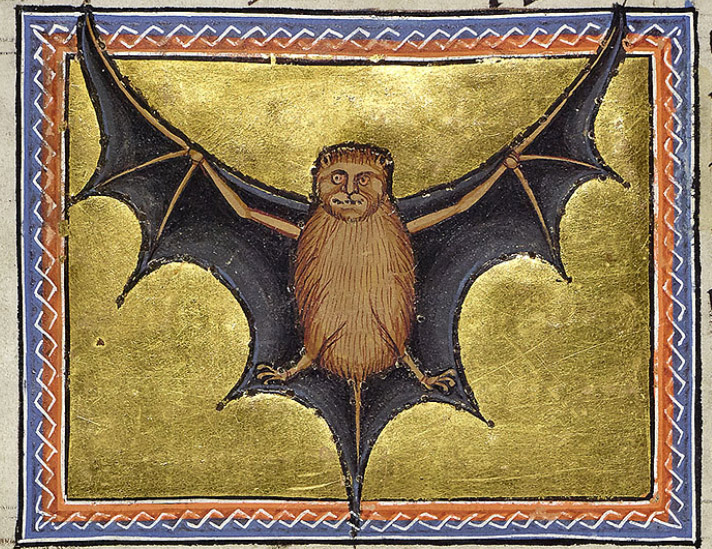
Portrait of the bat. Compared with many other bestiary illustrations, this is a fairly accurate ventral view of a bat whose wings are shown as a membrane stretching from its three fingers down to its toes and tail. Its furry face has the typically uncanny human look. The artist has realised that the flight membrane joins the fingers, legs and tail even though there should be five fingers with four supporting the wing. It is classified as a bird because of its wings rather than as a mammal because of its fur.

Portrait of the bat. Compared with many other bestiary illustrations, this is a fairly accurate ventral view of a bat whose wings are shown as a membrane stretching from its three fingers down to its toes and tail. Its furry face has the typically uncanny human look. The artist has realised that the flight membrane joins the fingers, legs and tail even though there should be five fingers with four supporting the wing. It is classified as a bird because of its wings rather than as a mammal because of its fur.

Text Translation:

[Of the bat] The bat, a lowly animal, gets its name from vesper, the evening, when it emerges. It is a winged creature but also a four-footed one, and it has teeth, which you would not usually find in birds. It gives birth like a quadruped, not to eggs but to live young. It flies, but not on wings; it supports itself by making a rowing motion with its skin, and, suspended just as on wings, it darts around. There is one thing which these mean creatures do, however: they cling to each other and hang together from one place looking like a cluster of grapes, and if the last lets go, the whole group disintegrate; it a kind of act of love of a sort which is difficult to find among men.

Folio 51v – the bat, continued. [De gragulo]; Of the jay.