Jack’s Walk

Through the meadow, ©voyager, all rights reserved

Toward Perce Rock and Mt. Joli, ©voyager, all rights reserved

So much Blue, ©voyager, all rights reserved

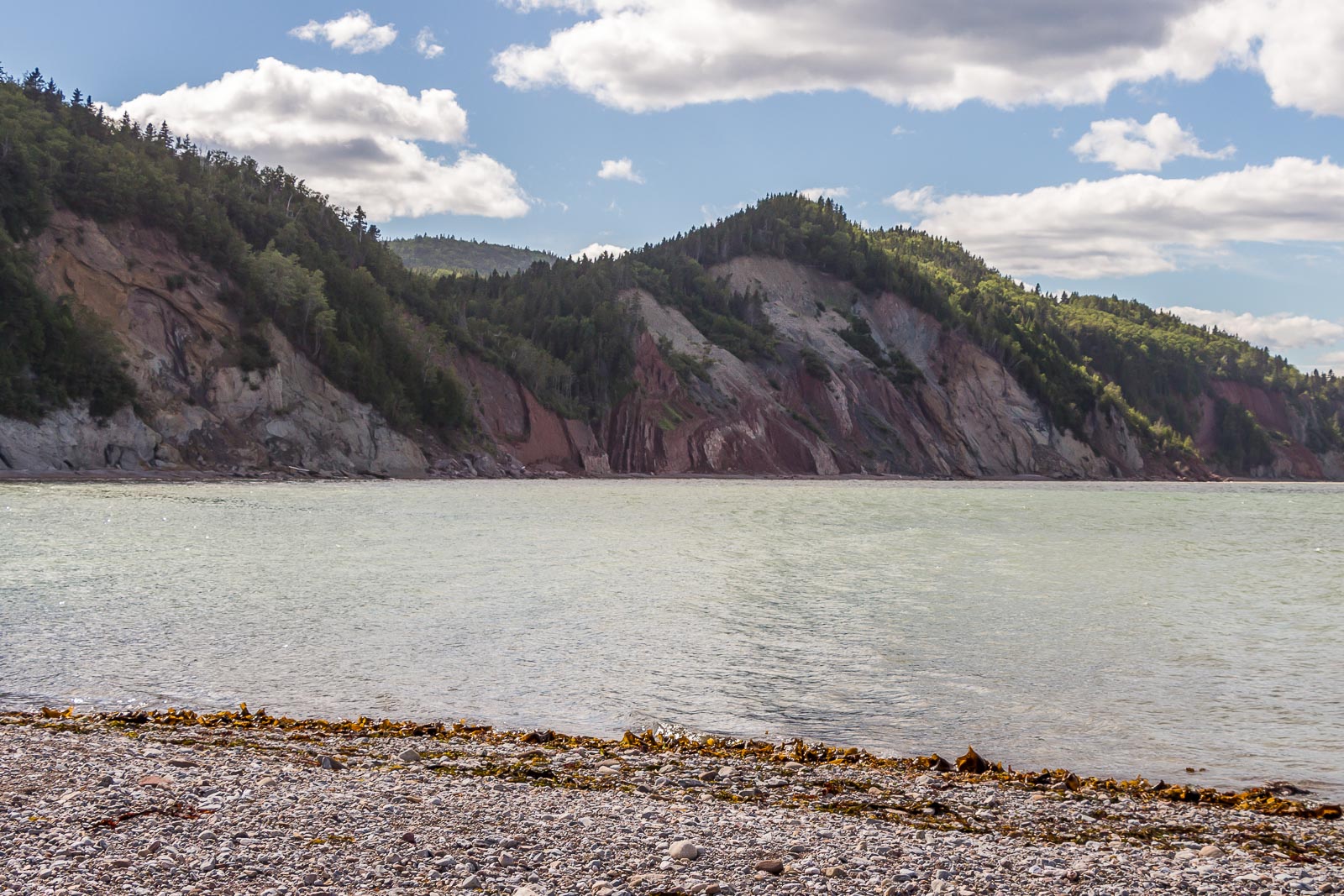
The weather here is perfect today, a rare treat for the Gaspe where it is frequently cool and damp. Jack and I decided to walk the meadow path that leads to the edge of the cliff overlooking North Beach. The ocean looks so blue today and the sky so clear that we wanted to take it in from on high. You can walk even higher, all the way up to the cross which sits atop Mt. Joli, but that’s a steep climb we’ll save for another day.

Making a Rondel Dagger – Part 15 – Troat of the Scabbard

I have decided to make the fittings for the scabbard from the same shovel that provided steel for the rondel. It is good carbon steel of appropriate thickness and I reasoned that after I grind it to remove all pitting from the outer side, it shall be thin just right. However, because I wanted to bend the steel at least in part whilst it is cold, I had to first anneal the shovel – in case you do not know, shovels are hardened and tempered. So I have decided to burn some more rotten wood, bbq dinner and anneal the shovel at the same time. Luckily the droughts in the place where I live are less severe than in the rest of CZ, so we do not have ban on fires (yet). Nevertheless, despite how it might appear, I am actually careful with fire – I always watch the direction in which the wind is blowing, I have water prepared and I douse all coals when I am done. And I have portable fireplace that I position in the middle of a gravel field¹.

I proceeded to make a paper template by wrapping it around the scabbard and adding about one cm for length. That I transferred onto the shovel and I cut the rough shape with angle grinder.

My improvised bending setup did not work as intended. The main problem being, that this steel proved to be extremely tough and hard, even annealed. I tried and tried, but it just did not work. After a few attempts I gave up and had to think up another way. I have decided that I have to do what I did not want to – forge it hot.

I could not go outside and make fire, because firstly it was way too hot outside for that and secondly because my improvised anvil for this delicate task was an old annealed file held in a vice. As a source of heat therefore I had to do with handheld propane torch and a few fireclay bricks as an impromptu forge. Unfortunately I forgot to make more detailed pictures of this process so you have to be content with red-hot glowing steel on fireclay brick laid on a granite paving stone laid on wooden bench. I see you cringe with my mind’s eye and I agree. For subsequent works I moved the whole assembly onto the circular saw table (also seen in the picture) which is made from metal and therefore fireproof. Needles to say, bucket of water was on standby the whole time and I checked the workshop a few times after I finished. I do not like doing these things inside, I will have to get some better setup, perhaps a mobile vice? I will have to think about it.

The bent strip did not fit neatly around the scabbard whatever I have done, so I decided in the end to shorten it even more so the ends do not meet, but lay just outside the stitches in leather. And to cover that gap with another slim strip of steel. this proved to be a very good fit all around.

I was thinking about whether to make the throat covered in steel or whether to let it be just the wood and leather on the inside. I decided to go for steel, which of course meant third piece, flat piece covering the throat with cut-out rough shape of the blade. Very rough. I was not even trying to aim for a good fit and I left a good 0,5-1 mm free space on all sides.

When thinking about how to connect those three parts in the most authentic manner I decided to go for silver brazing. I do not know how much silver is actually in the brazing rod I bought, but it costs 12,-€ a piece. Compare that with brass brazing rods that costs 5,-€ per five (or more) pieces. Whew. But I wanted to first try it with the more expensive silver rod because it has lower melting temperature than brass and my welding, brazing and soldering skills are not top-notch, to put it mildly. I also hoped that the silver solder will have less profound color contrast with the steel than the brass one would have. Which it does, but the color contrast is still very strong.

It took three attempts to braze the thing together with no gaps anywhere and I used up almost the whole rod. Oopsie-daisy, this is proving to be expensive. So when removing all the excess solder, i was filing it carefully and slowly onto a piece of paper and collecting all the silver dust into a little plastic bowl that I later have sealed with a lid. I hope to be able to mix that dust with boric acid and use it for brazing the chape. I certainly would not like to spend another 12,-€ on the chape alone.

As far as I know – and I would love to inspect some medieval originals sometimes – medieval craftsmen did not take particular care about the “back side” of the scabbards and scabbard fittings, or even swords for that matter. After all what is the point in finely polishing something that will not be seen? Today the aesthetics sense is slightly different and people expect things to look just perfect from all angles. I have decided to not overtly polish the back side, but I did somewhat polish and buff it for the sole reason that polished steel resists corrosion better. But, unlike on the front, I did not remove all pitting and I did not bother about some minor file scratches remaining visible there. And here you can see the result of my works these last few evenings. I will buff it with hematite befoe fixing it ont he scabbard for good.

©Charly, all rights reserved. Click for full size.

The most important lesson of this exercise was perhaps that I should do these metal fittings before I shape the scabbard to its final shape and cover it with leather, and not the other way around. In retrospect it seems like something from The Collected Sayings of Captain Bloody Obvious, but fitting a piece of soft wood and leather into a steel tube should be easier than to form a steel tube around a piece of soft wood and leather. I tried to google how to do scabbard throat before I did anything of this, but I do not remember seeing this mentioned anywhere.

Last piece in the mosaic is the chape then. And then there will be pictures.


1 – The bough you can see is one that I “harvested” near the road, where it broke off of an elderly apple tree. The city seemed unwilling to clean it up, so I confiscated it for knife handles.

Jack’s Walk

Perce Rock…going…

…and gone.

Fog is pretty common in Perce and it shows up at any darned time of the day. One minute it’s sunny and the next minute there’s a thick fog. When Jack and I set out this morning the sun was shining and the air was warm and clear, but by the time we got to the beach (a 5 minute walk) the fog was thick and there was a cool breeze. I like the film noire feeling of walking in the fog so Jack and I set out as usual down North Beach where suddenly the Perce Rock disappeared in the mist.

Stupid Work

Do you know this when you’re doing something that is physically and intellectually easy but takes so much time you cannot believe it? As you may know I started a new job this week, which is as a special ed teacher.

Now, I’m not a tidy person. Actually, saying that is probably like the Queen claiming to be not amused when her house just burned down. And because I’m chaos incarnated, I need to be very organised, because I cannot be trusted. So to have a good start, I created a folder for all my kids, with their files, their names printed on colourful paper sorted by their class, note paper,…

That stupid shit just took me two hours of my life. Who has got time for this? Do tidy people simply get a few hours more a day in whi9ch they can be tidy?

Blue folder on a cluttered desk

As you can see in the clutter behind the folder, I struggle with keeping my workspace clean.
©Giliell, all rights reserved

Tree Tuesday

Over the past few weeks Giliell has been sharing her wonderful holiday photos of Barcelona with us and as part of that series she has sent us an incredible tree to add to our collection. It’s called a Yellow Flamboyant and the name is certainly appropriate. This beautiful Spanish tree is filled with flaming color and style. Its flowers are big and bright and plentiful and Giliell’s photos show them off beautifully against a warm summer sky. The photos are all gorgeous, but I am absolutely in love with the last one, looking up through the tree. Flamboyant indeed.

Thanks Giliell.

Yellow Flamboyant tree, ©Giliell, all rights reserved

Flowers of the Yellow Flamboyant tree, ©Giliell, all rights reserved

Looking up through the Yellow Flamboyant tree, ©Giliell, all rights reserved

Anatomy Atlas Part 19 – Torso Muscles

Compared to the back, muscles on the front of the torso are relatively well-known even to laypeople. Prominent pectoral muscles and the famed “six-pack” are shown-off in comic books, movies, advertisements etcetera ad nauseam.

©Charly, all rights reserved. Click for full size.

However Professor Kos had nothing interesting to say about any of the muscles shown here, except the musculus platysma, which is not on the torso but on the neck.

It is a thin sheet muscle, directly under the skin to which it is connected with fascia. In humans it is a muscle of relatively minor importance, nearly a vestigial organ. But vestigial of what? According to Professor Kos, its function can be really well observed in horses and cattle. These animals use their tails and ears to try to keep flies and mosquitoes at least somewhat at bay, however they cannot effectively reach their necks and parts of torso. However what they can do, and do (I have in fact observed this myself) they can flex their  musculus platysma and similar thin muscle sheets directly under the skin, thus giving their skin a mighty shake in some places that can scare some insects off.

It is a nice story, but I doubt that this is original purpose of this muscle and its equivalents somewhere else on the body. More likely it is its repurposing for another function. Who knows?

Barcelona, the Zoo 2: Gorillas

Since we were talking about apes anyway…

My favourite great apes are gorillas. I could watch them for hours, especially their eyes. The group in Barcelona just gor some snacks when we were there, so some of the images will be them foraging.

Gorilla on green grass

©Giliell, all rights reserved

Young gorilla climbing a rope

©Giliell, all rights reserved

Young gorilla sitting

©Giliell, all rights reserved

Gorilla, eating

©Giliell, all rights reserved

Jack’s Walk

North Beach, Perce, Quebec, ©voyager, all rights reserved

Jack and I took a stroll along North Beach this morning. This is one of our regular go-to places when we’re here because it’s just across the road from where we stay and it’s seldom busy. It’s also beautiful and full of fossils, sea glass, agates and pretty stones of many types.

Barcelona: the Zoo 1

We’re leaving the Aquarium, but stay with the animals. Zoos are something we love to visit wherever we go. The zoo in Barcelona has the perk of having not one but two species of hippos, and I love hippos. These are the pygmy hippos, which are a solitary species, quite unlike the “normal” hippos who live in groups.

Something to keep in mind the next time somebody tries to tell you about human behaviour because of chimps or something.

Pygmy hippo with open mouth

©Giliell, all rights reserved

Side of pygmy hippo

©Giliell, all rights reserved

Pygmy hippo, full length

©Giliell, all rights reserved

Backside of pygmy hippo going into a pond.

Bye!
©Giliell, all rights reserved

Jack’s Walk

Perce Rock, ©voyager, all rights reserved

It’s been a long and difficult journey this year, but we’ve finally arrived. We won’t have internet access until tomorrow, but once we do I’ll share more photos and stories. For now, I’m still posting with my phone. This is the classic tourist photo of the Perce Rock, but it doesn’t really give any idea of scale. I know a better spot to take this photo, but there are so many tourists in town today that I just couldn’t get there.

The Completely Wrong Way to Cook Shrimp. Deliciously.

No politics today. Giliell¹ got me drooling so I cooked myself really generous lunch today and now, two hours later, I am still barely able to move. And because I did not follow any recipe anywhere and was more “freestyling” I have decided to make pictures just in case. And write-up the recipe and share it, because it turned out very tasty.

The Ingredients. ©Charly, all rights reserved

The ingredients are, as you see, one very big tomato, one lime, two cloves of garlic, about one half of a leek and a very, very small pattypan. The lime and the leek are store-bought, the rest is the courtesy of our garden. Not shown here is rice, because rice is rice and there is nothing interesting about it.

However with rice I started, because I like natural rice and that takes half an hour to cook. So first thing I have done was to start cooking rice, start the timer for half an hour and then proceed to make the next step.

Shrimp Bath. ©Charly, all rights reserved

Next step was prepare the water for cooking shrimp, because those need a bit of time to cook too. For this I have used the lime and I squeezed all the juice out of it into about half a liter of water. I added white pepper, shredded caraway, about a tea-spoon of salt and splashed in some olive oil with garlic essence (If I did not have olive oil with garlic essence, I would have thrown in third clover of garlic). I have set the water to boil and proceeded to cut or otherwise preparing other ingredients.

Preparing the shrimp was easy. Take the bag out of the freezer, take out one serving of shrimp, give shrimp into a mug, give the bag with the rest of the shrimp into the freezer.

Chopped up veggies . ©Charly, all rights reserved

Rest of the ingredients had to be chopped. Well, except the peas. The pattypan into about 20×20 mm bits 5 mm thick, the leek into rings and the garlic into tiny bits, but not too tiny. And the tomatoes into thin crescents, although ring would work just fine too.

I cut all the green stuff out of the tomato and toss it away. It has unpleasant taste and contains unhealthy toxin, so it hardly counts as wasting food.

The pattypan was rather harder than I thought it would be, To cut it and peel of the 1 mm waxy skin I had to use a small knife, because the big one was not a safe option for that task.

At this stage the water for shrimp started to boil, so in they went, still frozen. I had to ramp up the power afterwards for a bit so it starts to boil again quickly, and once it did I have put a lid on it and let it slowly boil for about 15-20 minutes.


Leek Rings. ©Charly, all rights reserved

Frying pattypan. ©Charly, all rights reserved

I put a generous amount of sunflower oil into a frying pan, heated it up to 150°C and fried slightly the leek rings. When they just about started to turn transparent, I have thrown in the pattypan bits and also fried them to the point when they surface started to turn transparent and darkened. As I said, I was freestyling, but I had a reason to do it this way – the darkening signifies the breaking of cell walls and it is the point where the veggies start eventually lose water and suck in the fat. And I did not want too much of that.

Simmering Veggies. ©Charly, all rights reserved

When I judged the leek and pattypan to be at the right stage, I tossed in the tomato with a pinch of salt and the green peas and with occasional stirring gently simmered it under cover for about ten minutes.  The tomato was very juicy, but still I had to add a bit of water twice, because I have kept the temperature relatively high.

Tomatoes actually lose a lot of taste to fat, but this was exactly the reason why I used generous amount of oil at the beginning. Because I have done similar thing before, with different vegetable mixes, but the cooked shrimp were always relatively bland and without much taste – they were not bad, exactly, but they were not delicious either.

Frying Shrimp. ©Charly, all rights reserved

Therefore this time I had another plan for the shrimp than just to cook them. When the veggies were cooked I put them into saucer and I poured as much of the sauce and oil back into the frying pan as I could manage. And after that I have thrown in the shrimp with the finely chopped up garlic and ramped up the powah.

The shrimp simmered with the garlic for a bit in the sauce, and when the water evaporated and only mostly oil remained, they started to fry as well. I was frying them for just a few minutes, until they changed colour from opaque white-pink into just-barely transparent gold-brown, but not as long as to burn the garlic which would have turned bitter. When I considered them finished I took them out of the oil and onto the veggies and rice in the saucer they went.

And here it is. It turned out also to be ever so slightly more than one serving, so if you decide to reproduce my recipe, take that into account when scaling for more people. However I cannot guarantee you will enjoy it as much as I did. This time, the shrimp were juicy and their unique taste was finally brought out with just a touch of garlic and not completely outcompeted by the vegetables.

A very generous serving. ©Charly, all rights reserved


1 –  Not blaming, quite the opposite.