Making Kitchen Knives – Part 22 – Second Evaluation

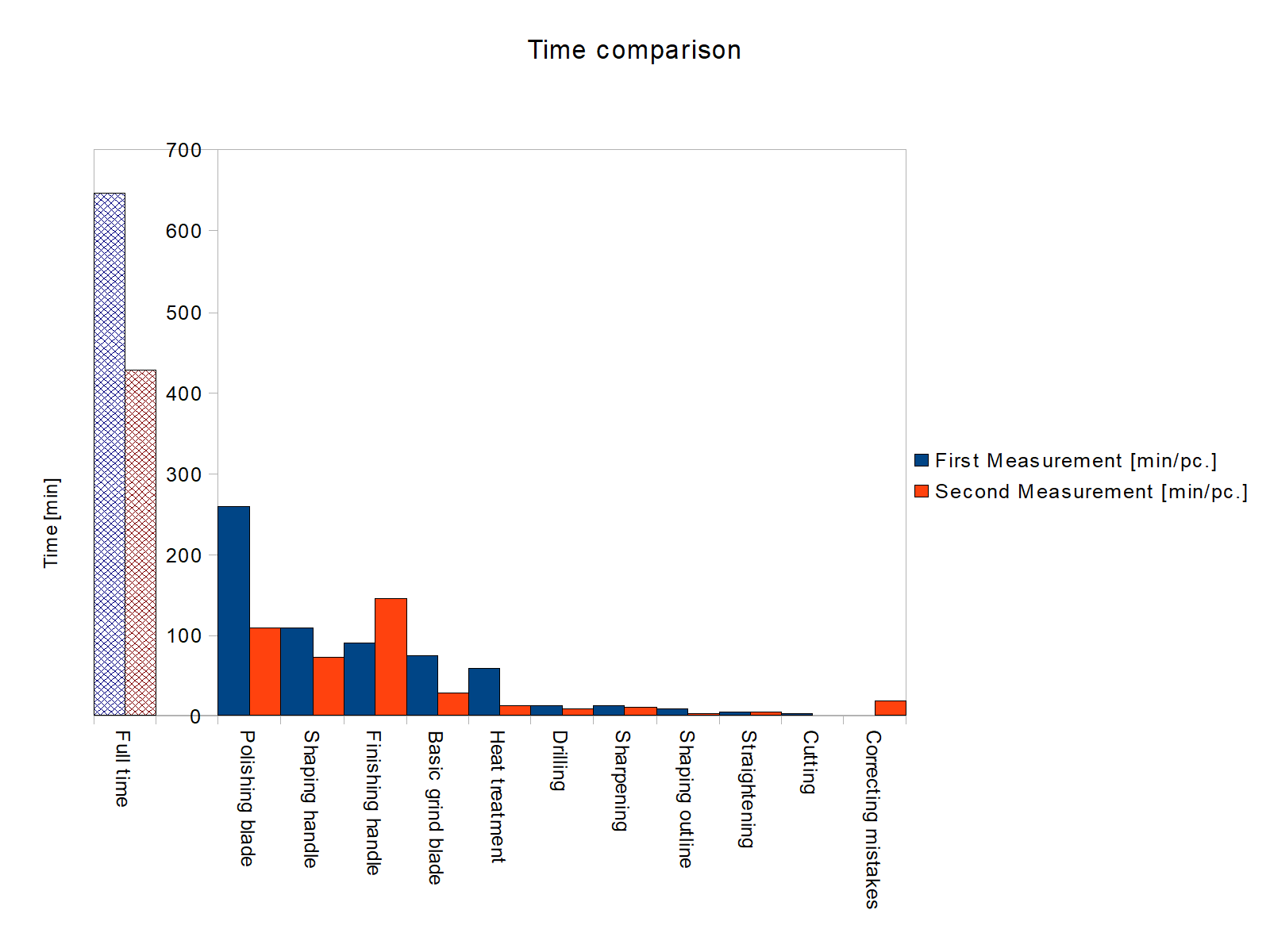
The results are in, and there is not too much to say. First, a picture that is worth a thousand words:

© Charly, all rights reserved. Click for full size.

As you can see, I have indeed reduced the time needed to manufacture a knife by working in bulk, but only partially. The biggest time-saving was in the polishing of the blade, and that was mostly achieved by changing the method from manual polishing to mirror-polish, to satin-finish with the tumbler.

Where I have saved time by working in bulk, was in the basic grind of the blade – here has also significantly helped the magnetic jig that I have later improved again – and later on in heat treatment – here I did save a lot since I did not have to wait for the forge to heat-up and I only had to prepare everything once.

The small savings in other steps are “nice to have” but they are mostly insignificant. What I have to concentrate on now is the 20 minutes time per piece that I have spent correcting various mistakes, like re-grinding curly blades etc, and the nearly an hour that my workload grew for finishing the handles. But I think there I can only significantly save time by working with resin stabilized wood, which is not possible for all the woods involved (oak, jatoba, black locust), but could significantly help with the semi-decomposed wood that turned out some really beautiful pieces.

The overall time reduction of nearly three hours is nothing to sneeze at. Plus, it would probably be even better had I really worked on this consistently from start to finish and not with various interruptions over the span of over a year.
From this point onward I won’t write about this project in detail, but I will continue to take time measurements and trying to optimize my manufacturing process some more.

Making Kitchen Knives – Part 21 – The Last Six Knives

There is not much to say about these, they are all made from one partially rotten palette. Therefore I do not know precisely what kind of wood it is. I suspect it is birch because one of the boards had still a bit of bark on it, but the palette was obviously made from scraps, so there could be several species involves. So other realistic possibilities are poplar and beech.

Since it was from planks, I had no control over grain direction, but I have at least paired the slabs to the best of my ability so they are of the same species – they varied wildly in coloration – and in three cases, I ended up with pairs where one slab had more interesting grain. And, in those cases, I have given this slab on the right side of the knife, where the signature is.

© Charly, all rights reserved. Click for full size.

© Charly, all rights reserved. Click for full size.

© Charly, all rights reserved. Click for full size.

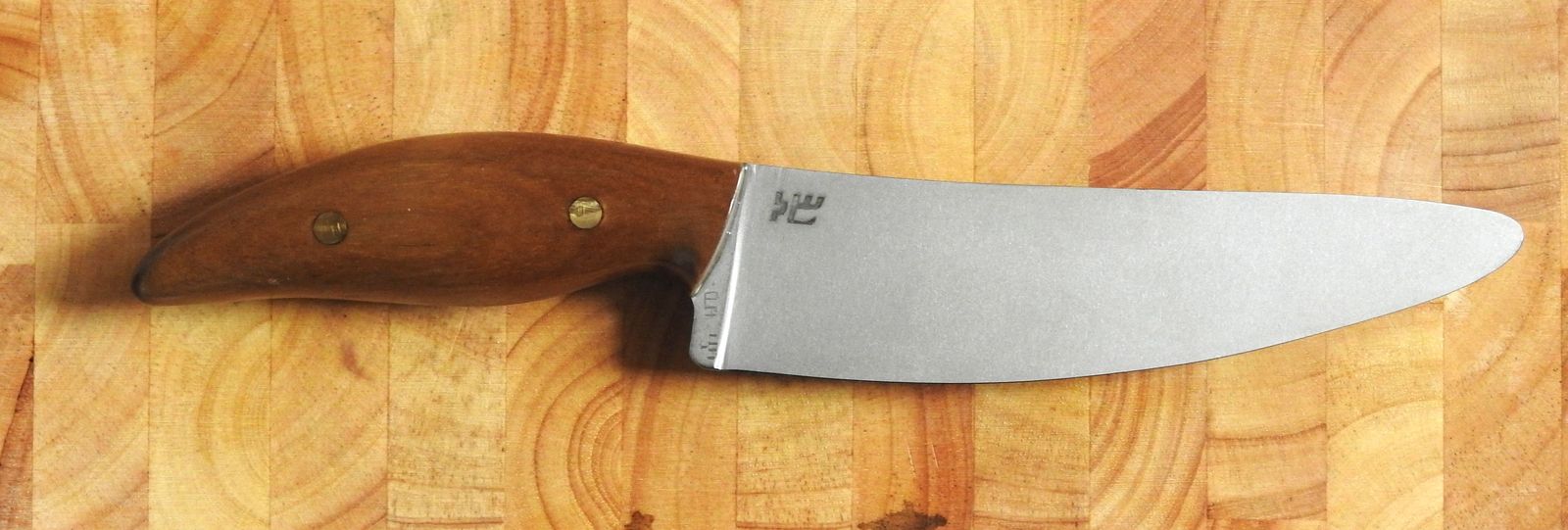
These three are those with more plain-looking handles, besides rich brown color from the ammonia fuming there is not much to see here. I have no idea why the logo etched so strangely on the second one, it just did. Maybe the metal was a bit dirty so it etched only on the edges, where there is stronger current? I did wipe all blades with acetone, but maybe not enough.

© Charly, all rights reserved. Click for full size.

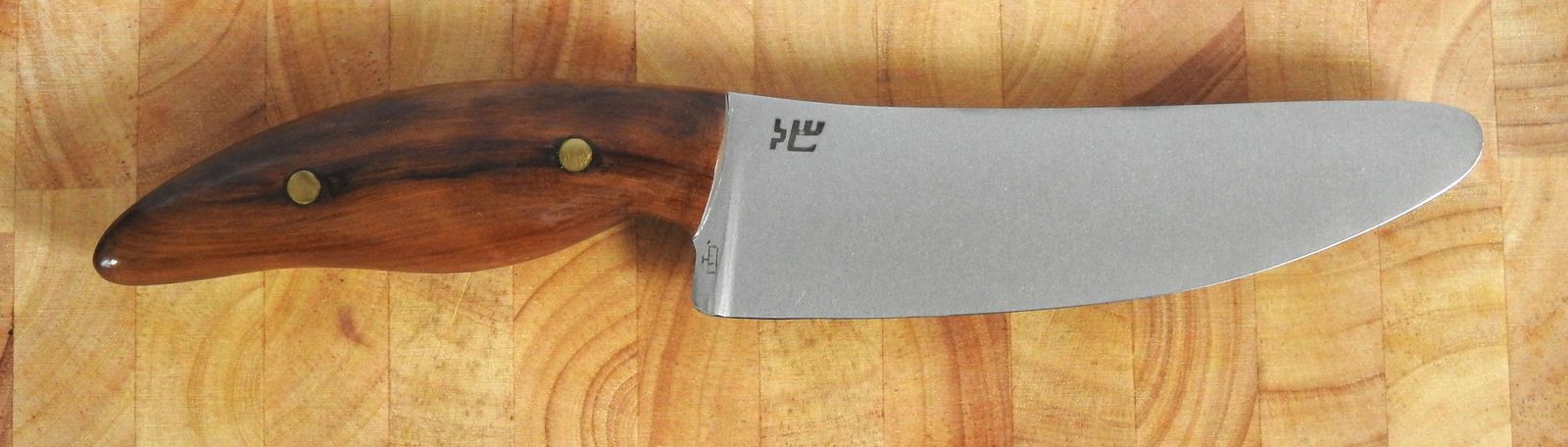
This one has a nice dark stripe of ever so slightly more decomposed, but still hard, wood running down the middle. The placement of the pins is purely coincidental, at least I do not remember consciously putting the holes exactly into the stripe.

© Charly, all rights reserved. Click for full size.

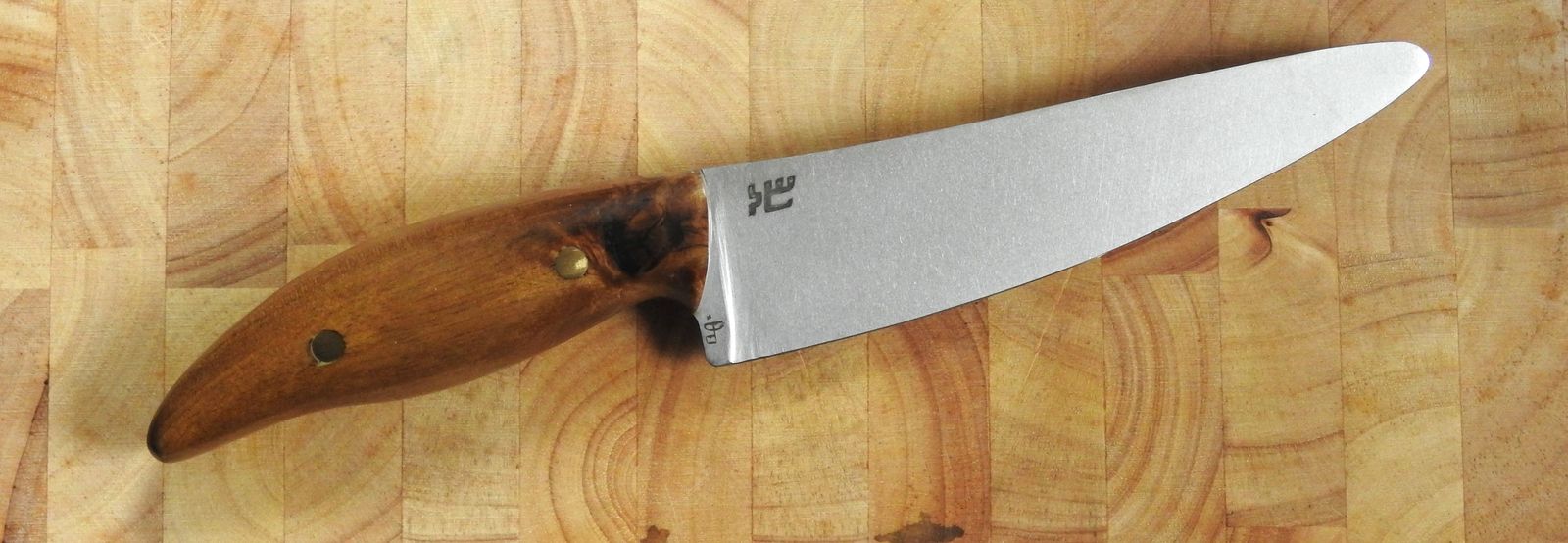
This one has a knot in the wood. Unfortunately, it is so dark, that I currently cannot make a good photo of it without overexposing everything else. The blade on this one is one of those that curled on the edges, so I had to re-grind it into narrower shape.

© Charly, all rights reserved. Click for full size.

© Charly, all rights reserved. Click for full size.

And lastly a piece with extremely beautiful grain, almost like a burl. This one piece really shows that half-rotten wood is not necessarily only fit for burning.

Making Kitchen Knives – Part 20 – Three Finished Knives

Works on this project are finished, so today I will share three more of the resulting products with a bit of commentary about the lessons learned with each.

First a knife with handle from larch.

© Charly, all rights reserved. Click for full size.

This single piece is one of the biggest reasons why I have lost a lot of time with the finishing of handles. Larch wood, as it turns out, is pretty, but it is really shitty for knife handles. It is softwood, but that would not necessarily be a problem in itself. The problems are two: 1) It is stringy, so it has a tendency to tear-out, burning, and gumming up belts. 2) The late-summer-growth is significantly harder than the spring growth and that causes all kinds of problems when trying to shape it to anything other than a plank.

Further, the ammonia fuming did nearly nothing to it, except perhaps making it a bit darker.

I suspected that it is probably not a very good wood for this purpose, and my suspicion was confirmed. I won’t use this wood anymore unless perhaps stabilized with resin. I only used this one piece because it was a gift by a former colleague, who is in turn the intended recipient of this knife. The result is not ugly, but it is much more work than it is worth.

Next is jatoba.

© Charly, all rights reserved. Click for full size.

© Charly, all rights reserved. Click for full size.

This was commissioned, so this is the only blade that will be sold (for a very moderate price). Part of the order was the etched star on the left side. I am a bit anxious about how the knife will be perceived. This customer too was warned that they cannot expect perfection, because I am still learning, but you never know. If they toss it on my head, I will have to deal with it.

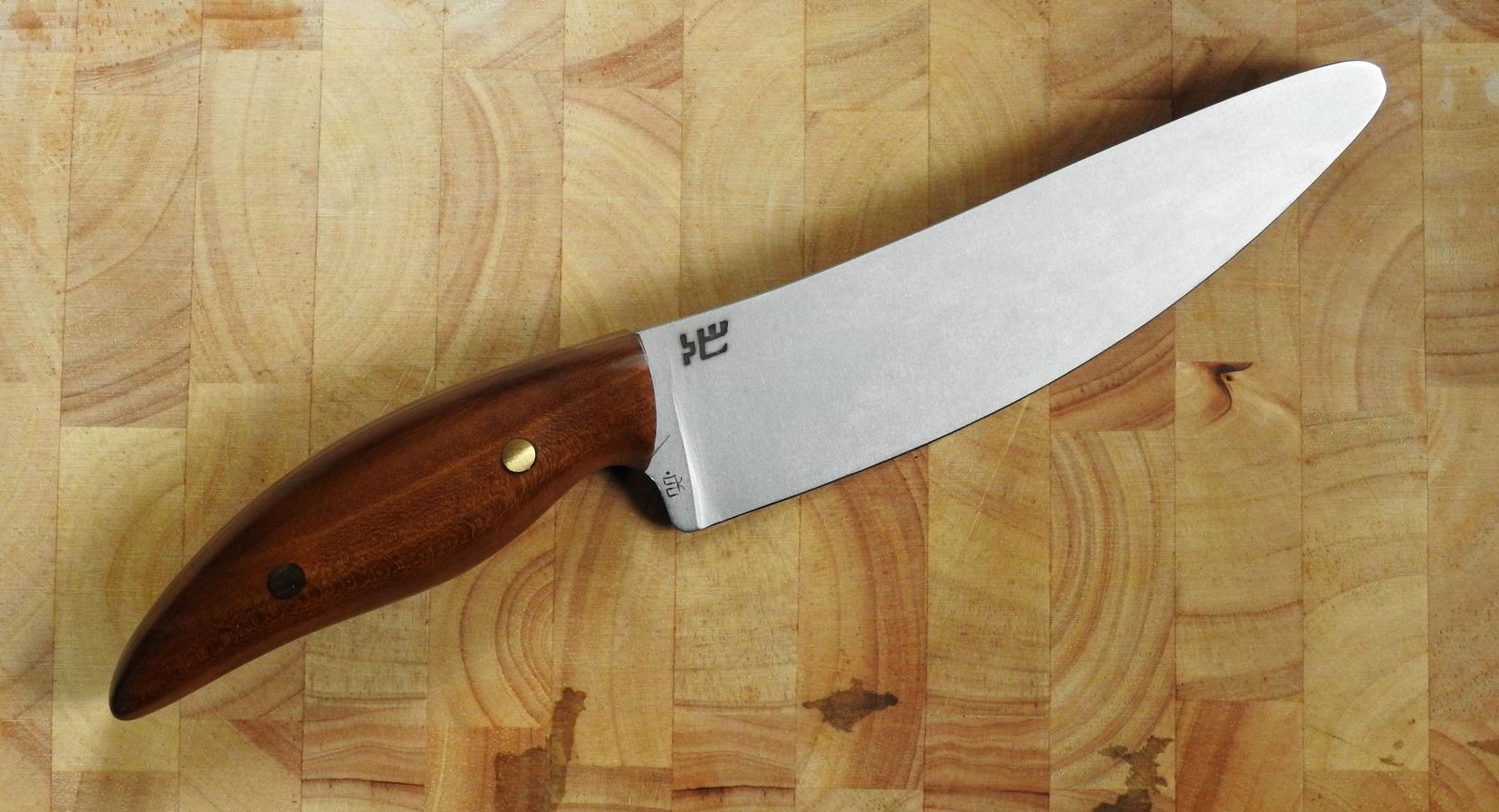
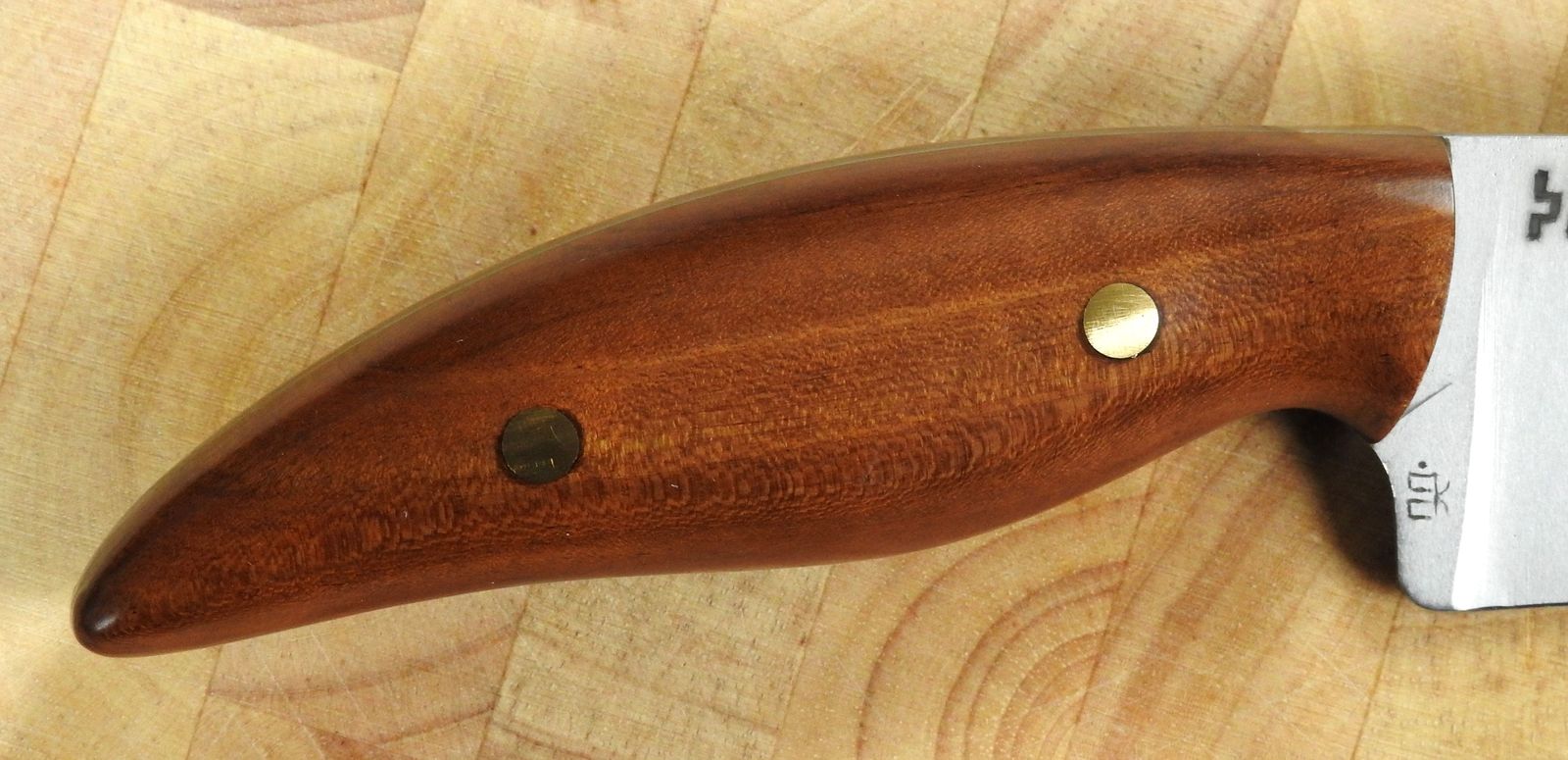
I probably will not bother with treating jatoba with ammonia in the future, not in big chunks. It only makes the wood significantly darker and it is prone to develop cracks in due course, nothing else. It is not ugly – otherwise, I would toss it away – but I personally do not think it is worth the hassle. What untreated jatoba looks like you can see here.

And last today cherry.

© Charly, all rights reserved. Click for full size.

© Charly, all rights reserved. Click for full size.

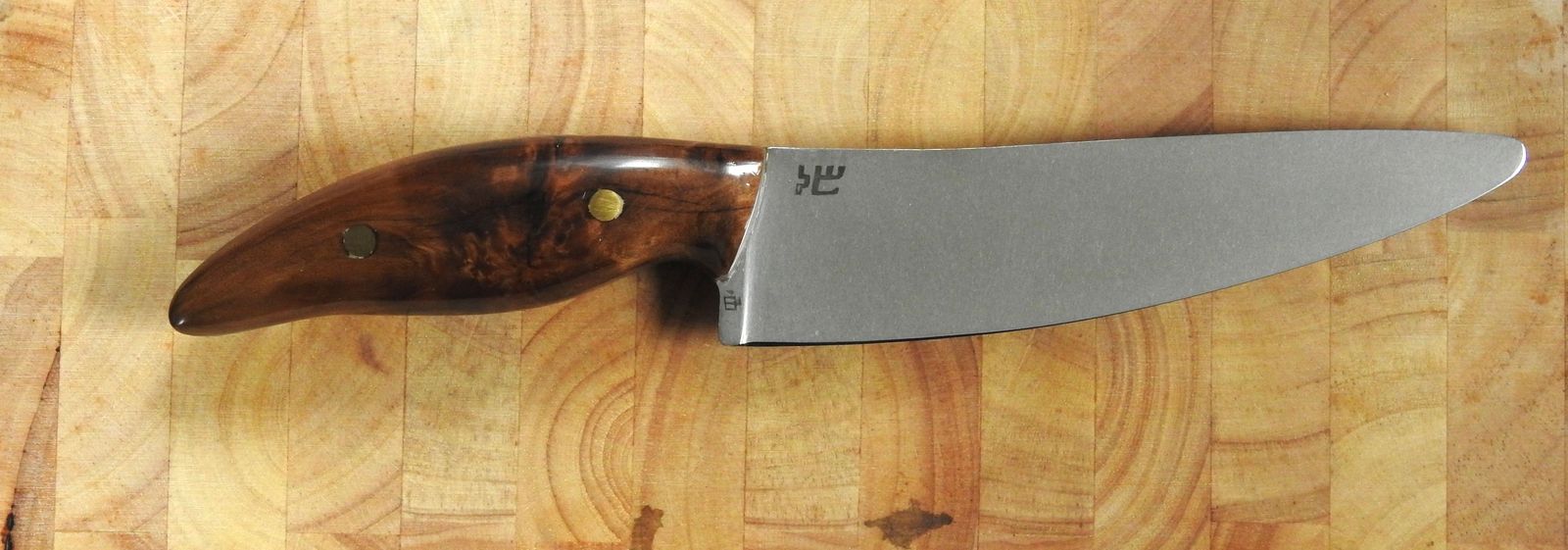
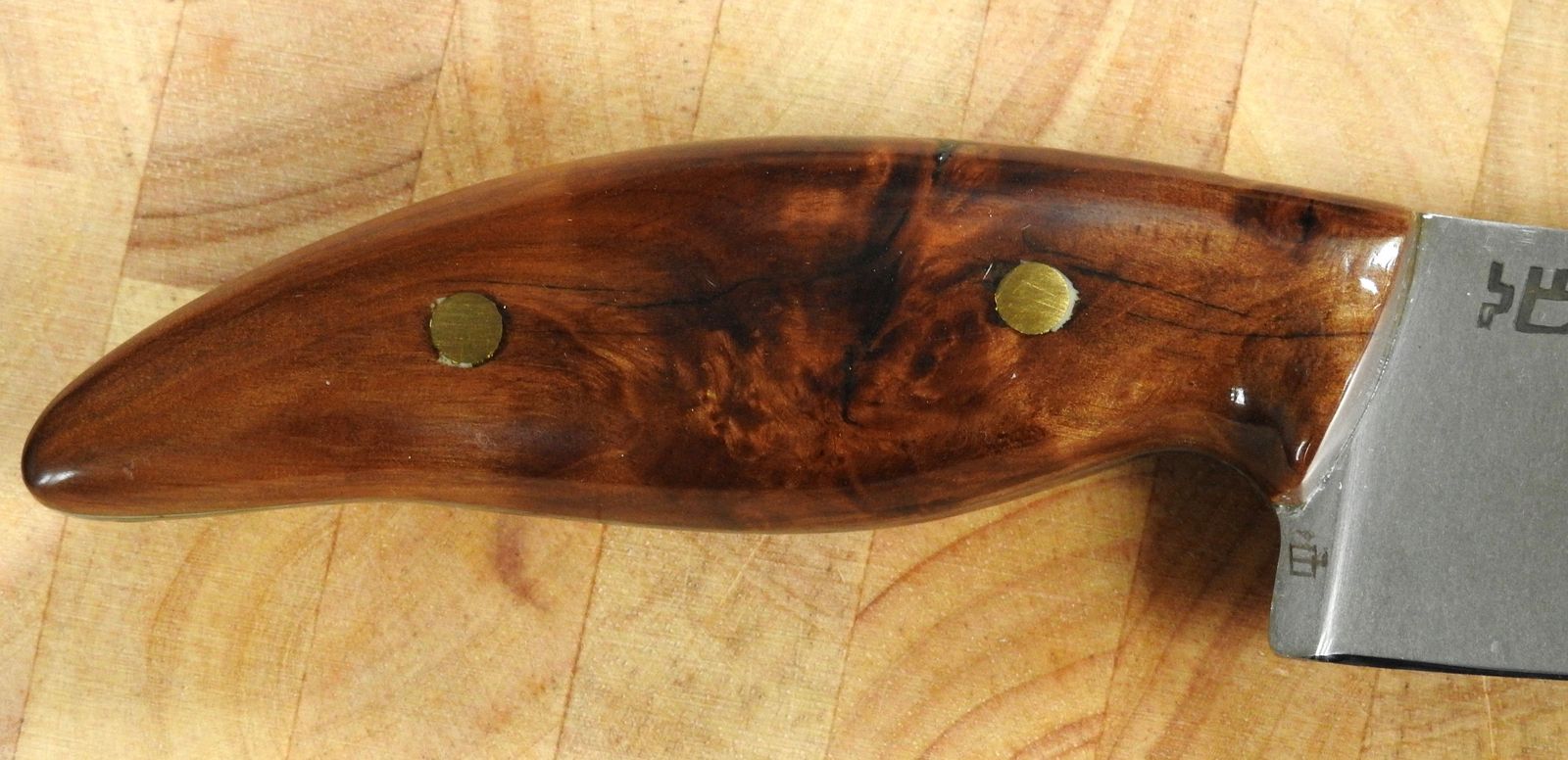
I am a bit ambiguous about how this turned out.  I love the look of untreated cherry wood (see here) and I was hoping perhaps, that the orange color will become richer and deeper. Instead, it has turned into chocolate brown. Not ugly brown, mind you, but brown all the same. Cherry wood is also very prone to develop cracks, but these two pieces almost miraculously were crack-free, I suspect that the strictly perpendicular and straight grain orientation has played a role (they were split from a log, not cut). I will perhaps do the fuming for cherry in the future for thinner pieces with straight grain to use them as a contrast with untreated cherry for intarsia, spacers, inserts, etc. The wood is a joy to work treated as well as untreated, I would use nothing else if I had enough of it.

I have messed up the etch of the number, you can see the straight line where I have accidentally run with the etching graphite rod over the edge of masking tape. But nobody is going to complain about this, because I am keeping this knife for myself.

There will be one more post with the remaining six knives and then we shall look at the time-analysis.

Magnetic Chuck for Grinding Bevels

You may have noticed my previous iterations on building a chuck to help with grinding consistent bevels on kitchen knives. Well, I had a lot of thoughts about it and I thought I can significantly improve it. And luckily I have managed to buy some raw materials before the shops were closed.

I am not going to write full how-to instructions this time, a few words, and the finished thing must be enough for this time around I was still figuring some things on the fly and there were some issues that did not go as planned. However I will probably make another, smaller one, for shorter blades and if I manage to not mess that up, I will make a full tutorial on that one, with clean pictures and components and so forth.

© Charly, all rights reserved. Click for full size.

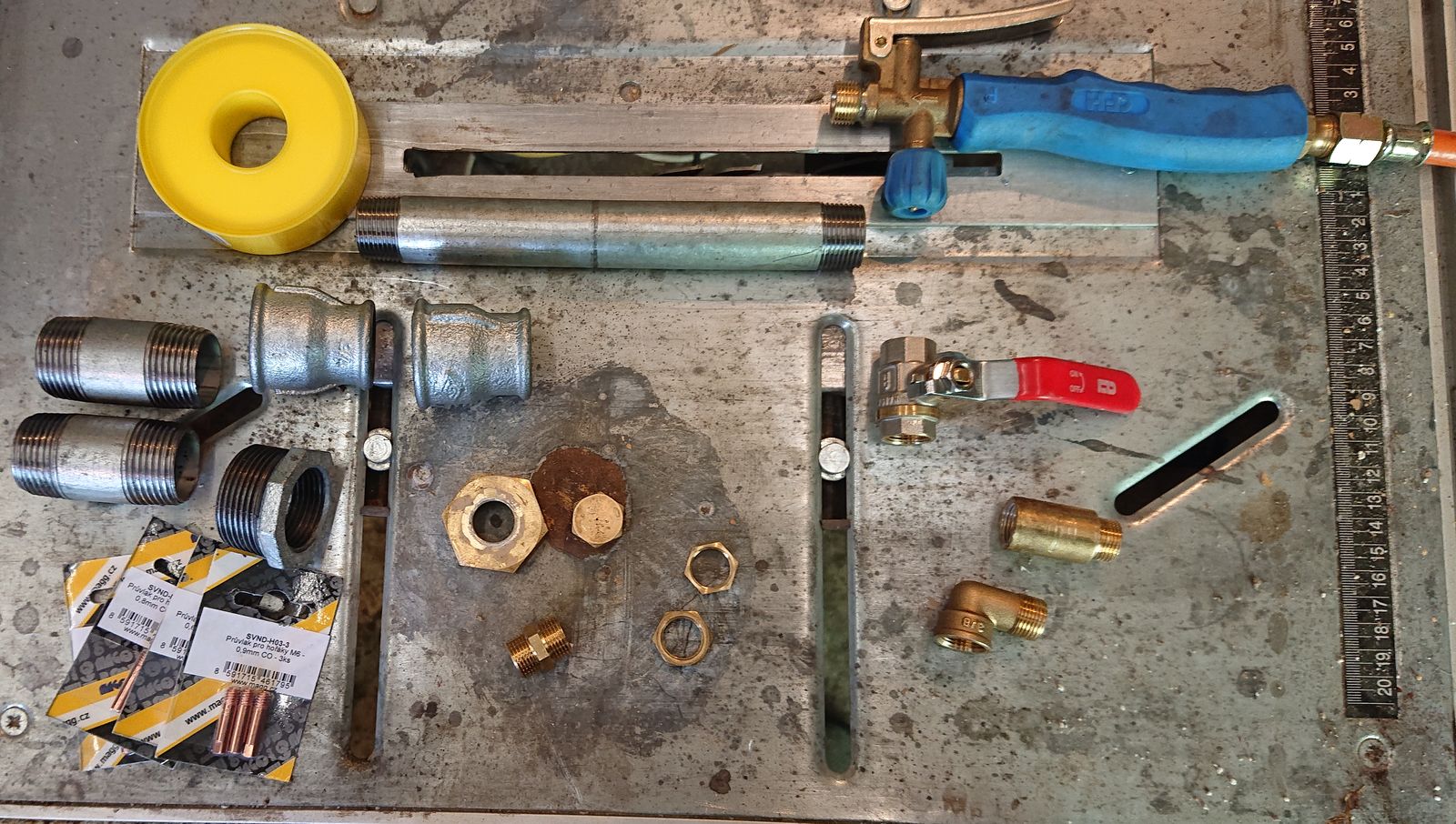
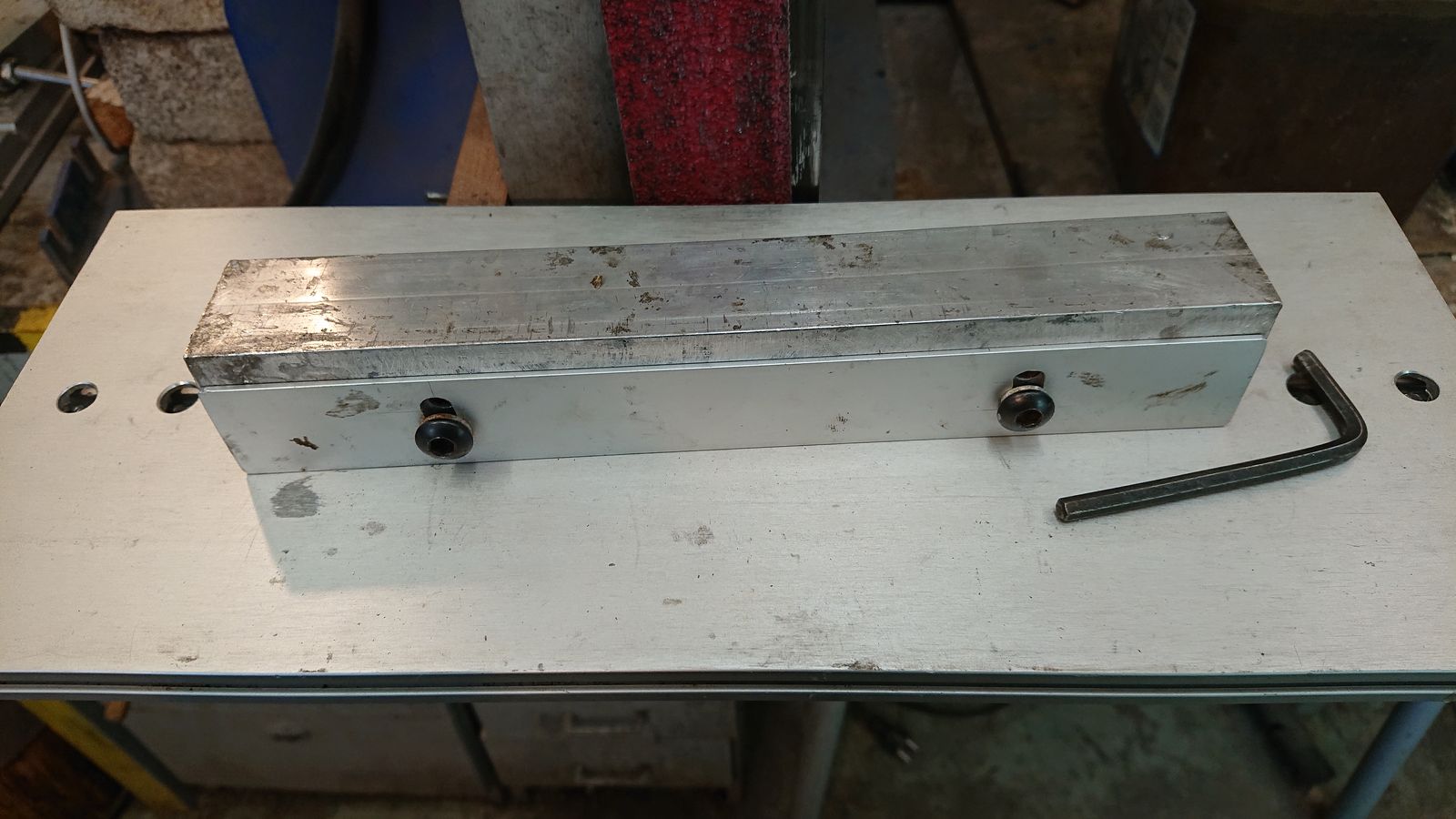
Here you can see the face with four magnet batteries up front and a tiny ledge on the bottom to have a reference point for the top of the blade. I have made magnets using the same method as last time, only this time I have glued pieces of aluminum between the faces of the mild steel slabs. The body is made from a square aluminum pipe. I cut openings for the magnets in it and to fill the hollows, I have used squared beech timber. That allowed me to simply glue everything together with epoxy and added a bit heft to the piece. I have also used square pieces of aluminum to glue in the sides of the pipe to get perfect seal all-around against water.

© Charly, all rights reserved. Click for full size.

Setting the angle on the last one was a bit difficult. It was done by means of four screws protruding from the bottom, and if they did not stick out all exactly the same amount, it could wobble during work which is not ideal. And they did catch on the edges of the grinding table. Here you can see the simplest solution to that problem that I could think of. On the back of the chuck are two holes with M6 thread. On these two M6 screws hold a flat aluminum profile through two elongated holes. To adjust the angle I simply loosen the screws, slide the aluminum profile up/down as needed, and tighten them again. Against the last iteration, this has the advantage of full linear contact with the base plate all the time, even on the edges, and also it is much easier to set up.

I am trying to get my ducks in the row again, finishing finally the current batch of kitchen knives and preparing for the next one. I hope the two and a half days that I have spent with making this were well spent. I still have no functioning forge, but I work on that too, and hopefully, I will have something to say about that soon.

Law and Order Are Not Intrinsically Good Things

Trump likes to refer to himself as the president of “Law And Order” these days and his sycophants in the Geezers Only  Party repeat those three words as a mantra. And their voters, presumably, lap it up as a chant worth following, as if those words represent something intrinsically good.

They do not.

Laws can be, and quite often are, impractical, counter-productive, or downright immoral and wrong. Lawful behavior is only as good as the laws that it follows, and unlawful behavior is only as bad as the laws it breaks are good. The order that ensues from enforcement of laws is in this regard completely value-neutral. It has no moral property in itself, it only reflects that of the legal system that has brought it into existence.

To anyone who yearns for Law and Order and not paying particular attention to what kind of Law and what kind of Order, I would like to put forth following points for consideration:

  • In the former USSR and indeed the whole Eastern Bloc order was rigorously enforced and kept by harsh punishments against anyone who disobeyed the law.  And if that is too far in the past for you, today’s China has plenty of laws too, and oh boy do the police keep order there. I could also Godwin it here and say Nazi Germany has had many laws about what can and cannot be done by whom and to whom and its orderliness was quite proverbial, with some quite fancy police departments enforcing said laws.
  • The people who cry for “Law and Order” in USA today are often those who bemoan the dangers of Communism and Socialism and whatnot.

Draw from that any conclusions you want.

Blackheaded Cardinal Beetle

This little buddy has climbed out of a hollow brick yesterday when I was processing dog-daisies into chemical weapons against wooly aphids infesting my bonsai trees (long story).

It was kind enough to remain in place for quite some time, allowing me to take pictures from all possible angles.

© Charly, all rights reserved. Click for full size.

© Charly, all rights reserved. Click for full size.

© Charly, all rights reserved. Click for full size.

© Charly, all rights reserved. Click for full size.

© Charly, all rights reserved. Click for full size.

© Charly, all rights reserved. Click for full size.

© Charly, all rights reserved. Click for full size.

A Lawyer Talks About Lafayette Square Gassing

I have never seen LegalEagle lose his cool on camera, although I did not watch all his videos.

I have also never expected to live through a deadly pandemic and USA coming apart at the seams at the same time.

Life is full of surprises. To all our USA readers – please stay safe. Our hearts are with you, although we cannot do anything to help.

This Little Fellow Gave Me Quite a Start

Today when I went into the workshop  I had to light the fire because, despite reasonably sunny weather, the temperatures are really low. And this little fellow was sitting on one piece of wood and he gave me quite a start, for I have mistaken him for a wasp. Which is the point of its coloration, of course.

Unfortunately, I was only able to make these two pictures. The beetle was quite sluggish in the cold workshop, but when I took it outside in the sun, it warmed up quickly and flew off before I could make more with better camera settings. I hope my entomologist friend will be able to identify the species. Preliminarily I think it is some species of longhorn beetle that has emerged from a pupa in firewood.

© Charly, all rights reserved. Click for full size.

© Charly, all rights reserved. Click for full size.

Making Kitchen Knives – Part 19 – Two Finished Knives

I have decided to throw the pictures at you piecemeal and not all at once. I want to say a bit about each blade and I think that cramming that all in one post would be counterproductive, it would take too long before I could do it and I might get depressed by writing about all the things I did wrong with every piece all at once. I hope you don’t mind.

Two knives are not only finished already, they are with their owners. I did not get any feedback on their use, because for that was not an opportunity yet, but they were well received, despite their flaws. But, well, they say don’t look a gift knife in the mouth or somesuch…


First, let’s say a bit about this universal kitchen knife for my favorite aunt.

© Charly, all rights reserved. Click for full size.

It is one of the best blades, strong, straight and stiff. Exactly what I was aiming for, capable of cutting leeks as well as melons. The handle is made from black elder (Sambucus nigra) wood.

You can see tiny cracks on the faces. I personally do think they can add a bit of a character to the wood – especially if the wood is partially decayed, as you will see on some of the next blades too – but that is not always the case and sometimes they are just blemishes. From a functional standpoint, they won’t be a problem. They are filled with the boat lacquer and thus sealed and glued shut. Anything that destroys the wood now would destroy it even if it were pristine. But it is something I have to figure out how to prevent. I will probably have to seal the ends with silicone or epoxy glue before pickling the wood in ammonia next time, or make the pieces a lot longer (I did make them longer prior to pickling, but apparently not enough).

© Charly, all rights reserved. Click for full size.

And pickling black elder wood I shall, that one thing is sure. Untreated elder wood is yellowish, but the color is nowhere near this bright and rich. I have always loved yellow color, and I think this canary-yellow looks just beautiful. Unfortunately, I cannot show you untreated wood for comparison here, but I will at some point in the future.

What I do not like are the dark shadows around the pins. They are not burned wood (they are grey-ish, not brown-ish), but maybe they are dirt from polishing that got stuck in the epoxy. I will have to look into this next time and maybe not go on too high grit polish before the lacquering and maybe carefully scrape it instead. The wood is beautiful, hard, has small pores, and is a joy to work, but it dirties easily.


The second presented today is a fish gutting & filleting knife for one of my uncles.

© Charly, all rights reserved. Click for full size.

This was ground from one of the blades that came out curly, but it was my plan to take one of these blades and re-grind it for a fish knife from about November 2019, when my uncle expressed a wish for it. The blade is very thin, flexible, and pointy. It would cut vegetables of course too, but I do not think it is suitable for tackling difficult cabbage.

The handle is made from black locust (Robinia pseudoacacia), and this is one of the woods that had a really strong and a bit surprising reaction to the ammonia. You can see in one of my previous posts that untreated black locust wood is honey-yellow/brown with a greenish tint to it. But it apparently contains a lot of acidic components that react with the ammonia and its color got real funky in the process.

When working it, I thought at first that I am burning the wood, and I was trying to sand it slowly and carefully not to do so. It took me a while to realize that whilst I indeed can burn this wood (it is super-hard), I am not doing it. It just looked that way. My subsequent reaction during the work was somewhat “meh” and I thought I won’t bother with this in future anymore, there is plenty of brown woods out there.

And then I have changed my mind.

© Charly, all rights reserved. Click for full size.

© Charly, all rights reserved. Click for full size.

What you, unfortunately, cannot see in the picture is a sort of tiger’s eye effect the lacquer has brought out in this wood’s grain. It looks iridescent and it changes color from light brown with a golden glint to nearly black depending on the angle you look at it. So I went from ” I won’t bother with pickling this wood again” to “I am going to pickle this in buckets”.

Regarding flaws, this knife suffers from uneven shoulders, and it won’t be able to correct them with exercise. I only noticed when I was etching the logo, that I ground the forward-facing facets on the scales slightly askew. Nothing major, but it is visible with the naked eye.

Slight asymmetries in the handle scales that I have spotted too late are actually a bit of a theme in this batch and it is something that I too will have to try and figure out how to prevent. Eyeballing the things during grinding until my eyes start to water apparently still is not enough.

And that’s it for today.