When the Guinness Book of Records initially came out, it consisted of information that could settle the kinds of debates that one has with friends about some bit of trivia, like how old was the oldest person who ever lived. But then people started doing feats of endurance (like “How long can you dance?”) or pointless (like “How many people can be on a single bicycle?) just to get themselves mentioned in the Guinness book. I shudder to think how much energy and time people have spent over the years just in the effort to get the moment of fleeting fame of getting mentioned in the book.
But with the internet, this has been cranked up to 11, because now you don’t have to go through the tedium of getting approved judges and the like to ratify your claim. Now you can simply do something bizarre, post it on social media, and hope to become a viral sensation. This has taken off with so-called ‘challenges’ where people duplicate the same stunt. We saw before the ice-bucket challenge (where people filmed themselves having a bucket of ice water poured on their heads) and now we have the milk crate challenge. But this one carries risks that doctors are warning about.
[Read more…]
In an earlier post, I wrote about the FDA trying to stamp out the practice of some people using the livestock deworming drug ivermectin as a Covid-19 treatment. We have even reached a stage where people are going to court to force hospitals to provide it to patients.
When there is a matter of urgency like covid-19, a lot of exploratory research is done on treatments, using small samples or on animals or in petri dishes. In the age of the internet, the results of such studies can become widely known and people can seize on any positive information and think that the treatment should be freely used, even if there is the potential for danger. In the case of ivermectin, it has not yet been shown to be an effective treatment against the virus and can be dangerous in large doses. Preliminary results showed no appreciable efficacy.
[Read more…]
Who hasn’t encountered people in the workplace who are never satisfied with what others do but feel that they have to make suggestions for improvement even if they have no idea what they want or are completely unable to articulate it?
No one? I thought so.
Incidentally, the sound engineer who does not speak at all says the most with his expressions.
Where I live there is a small regional airport and from my window I can see planes coming in to land or after taking off. On the Nextdoor neighborhood community discussion board there was a post by someone claiming that the airport does not follow standard aviation rules for which direction to take off and land depending on the wind direction, giving as the source for their complaint the responses they got when they did a search on Google on “what direction do planes fly with NW wind”.
Really? This person thinks that the people working in air traffic control and the pilots have no idea what they are doing and that this person knows better than people who do this for a living and who are well aware that lives depend on them getting it right? In response to the complaint, one commenter posted “Monterey Airport is HIRING!!! They are looking for employees just like you. Currently nobody knows what they are doing 😂😂😂 instead of criticizing maybe you should go help out.”
This illustrates the problem that we have, that people think a quick Google search makes them an ‘expert’ on pretty much anything. We see this most clearly with medical treatment, especially with covid-19. It is one thing to go on the internet and seek out information so that you can be better informed and have more meaningful discussions with your health care professionals by asking more pertinent questions and being better able to appreciate their answers. It is something else entirely to think that your judgment is now superior to that of those who do what they do for a living, day in and day out.
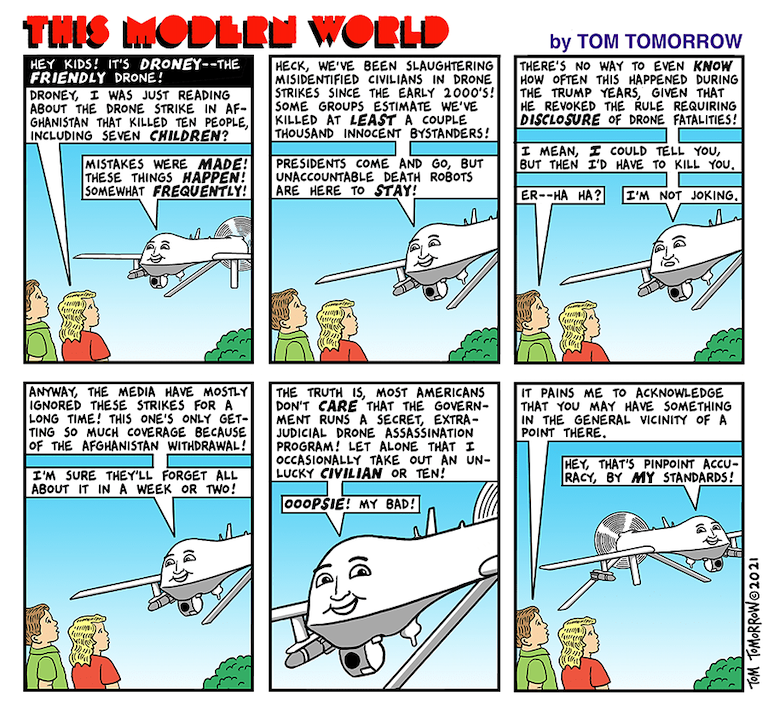
Whenever the US suffers a military setback, it reacts the same way. It lashes out in revenge, usually by bombing the hell out of some people in an effort to show that it is still powerful and to distract attention from its failures. While the US military always says that it aimed at and hit military targets, more often than not innocent people are among the victims of its actions. This seems to be the case with Joe Biden’s bombing of targets in response to the bombing near the Kabul airport that killed over a hundred people. The US military’s initial reports, as usual, claim that mostly militants were hit and that any civilian casualties, if any, were inadvertent or even the fault of the targets.
[Read more…]
Cartoonists have a very difficult task because they do not have space to fill in all the necessary information and have to use images to convey a lot of background information so that people get the joke. But in doing so, they are heavily dependent on the reader getting the allusions.
As an example of how much background knowledge is needed for humor, take this cartoon.
To get the joke, you have to recognize the person as William Shakespeare. You have to know that he was a playwright and thus his works were performed by actors, that many of his plays were done at the Globe theater, and be familiar with the aphorism written on his shirt.
This makes humor hard to cross cultural boundaries.
We seem to be awash in various culture wars that seem to never end. So it is good to consider one that was major war less than two decades ago that seems to have ended quietly. A new survey suggests that the war between evolution and various forms of creationism has resulted in science winning a resounding victory. A paper based on survey results gives the reasons for this shift. Its abstract says:
The public acceptance of evolution in the United States is a long-standing problem. Using data from a series of national surveys collected over the last 35 years, we find that the level of public acceptance of evolution has increased in the last decade after at least two decades in which the public was nearly evenly divided on the issue. A structural equation model indicates that increasing enrollment in baccalaureate-level programs, exposure to college-level science courses, a declining level of religious fundamentalism, and a rising level of civic scientific literacy are responsible for the increased level of public acceptance.
Wassily Kandinsky (1866-1944) is considered a pioneer in abstract art. In an example of art-within-art, director Nastia Korkia chose to display his 1932 work Dramatic and Mild in what was once the dingy break room of a Moscow power station and film the reactions of the viewers where only one or two people could see it at a time after standing in line for a long time.
This article describes the background to this unusual exhibit.
Whether it’s the Mona Lisa being crowded by selfie-happy tourists at the Louvre, or perhaps, more recently, a digital, from-your-desk tour of the Metropolitan Museum of Art, setting is an inescapable vital part of how we respond to an artwork. Capturing a scene in which three disparate elements – the Wassily Kandinsky oil painting Dramatic and Mild (1932), a small room, and an exceptionally fit security guard – come together in the context of a unique exhibition, this short from the Russian director Nastia Korkia invites viewers to contemplate the central role of place in the experience of art.
On its surface, Korkia’s film – eponymously named for the Kandinsky painting at its centre – is an unfussy exercise. It chronicles a small slice of the 2017 ‘Geometry of Now’ arts festival, which was held inside the decommissioned power station-turned-art-complex GES-2 in Moscow. With a fly-on-the-wall observation style, the short unfolds almost exclusively within what was once (and still very much looks like) a small workers’ lounge, where Kandinsky’s painting is on temporary display. However, that painting doesn’t make a cameo until the very end, as Korkia’s focus is on the people and small interactions that percolate in the space.