Seriously, who has the time to waste on watching these people talk drivel?
Mano Singham
Just another Freethought Blogs site

Seriously, who has the time to waste on watching these people talk drivel?
Recall how in one of my recent posts on the radiation paradoxes, I spoke about how you can measure the spinning rate of the Earth by looking at the stars and also by measurements taken purely on the Earth and that these two methods produce results that are remarkably close. This was used in support of the claim by Bishop Berkeley that it was the stars that exerted a dynamical influence on the Earth and that our motion was relative to, not space itself as Newton thought, which he felt was an unobservable entity and thus had no relevance.
The rate at which the Earth is spinning on its axis is not fixed though. Over time it has been slowing down, meaning that the days have been getting longer. Around 600 million years ago, the day was about 21 of our present hours. But a new wrinkle appeared in the last half century in that the rate of rotation was increasing slightly and this caused problems. As our ability to measure time became more accurate with the adoption of atomic clocks, this required the regular adoption of the so-called ‘leap second’, which was a second added to clocks to bring them back into sync with the time as measured with respect to the stars.
[Read more…]
It is easy to feel a sense of despair at the news these days. The coronavirus seems to once again have defied predictions and infections are on the rise with the new omicron variant. We have ignorant but influential people still discouraging people from taking vaccines that could save their lives. We have a Republican senate, aided by Democratic senators Joe Manchin and Kyrsten Sinema block legislation that would improve the lives of so many people. And we have a US Supreme Court seemingly poised to roll back the right to an abortion and otherwise advance a reactionary right wing agenda.
Rebecca Solnit is one of the most thoughtful writers and analysts and she has come out with an opinion piece that suggests that what we are witnessing is not the rise of a major reactionary movement but the dying gasps of a desperate minority waging a bitter rearguard battle against historical forces that they realize are going to overwhelm them and take away the power they have held for so long.
[Read more…]
Some people who do not want to get the vaccine but are required to do so because of their work are claiming the right to a religious exemption. At least when it comes to the military, they are finding that a very tough sell.
More than 12,000 military service members refusing the COVID-19 vaccine are seeking religious exemptions, and so far they are having zero success.
That total lack of approvals is creating new tensions within the military, even as the vast majority of the armed forces have gotten vaccinated.
The services, urgently trying to keep the coronavirus pandemic in check by getting troops vaccinated, are now besieged with exemption requests they are unlikely to approve. Meanwhile, troops claiming religious reasons for avoiding the shots are perplexed because exemptions are theoretically available, yet seem impossible to obtain.
…Obtaining a religious exemption is rooted in a process that predates the pandemic and has been used for decisions such as whether troops on duty can wear head coverings or beards for religious reasons.
In addition to discussions with chaplains to determine whether they have a “sincerely held belief,” troops must meet with commanders and medical personnel. The final decision is made higher up the chain of command and is also based on whether the person’s vaccine exemption will pose a risk to mission accomplishment, unit cohesion, the health and safety of the force, and military readiness.
Even in the past, few troops have cleared those hurdles to get religious exemptions. And because the pandemic can directly affect the force’s health and readiness, the bar is even higher, so military leaders aren’t surprised by the lack of approved exemptions.
It is increasingly common for the catalytic converters on cars to be stolen. This is because the precious metal that forms a key element of the converters has become more expensive. That element is a rare one called rhodium which is, by weight, reportedly the most expensive element on the planet, beating out gold and silver and other precious metals. It is one of the rarest, just one part in a billion, compared with 5% for iron.
The converter on regular fuel vehicles is simple: a stainless steel shell surrounds a ceramic honeycomb monolith— that monolith is coated with three important precious metals: platinum, palladium, and rhodium.
As the car’s exhaust passes through this honeycomb the metals heat up and act as catalysts: turning carbon monoxide into carbon dioxide, unburned hydrocarbons to H20 and C02, and nitrous oxides into nitrogen and Carbon-dioxide.
Because these metals, and especially rhodium are so stable and durable they can perform this function over an extremely long lifetime of the car part—suffering very little loss in performance.
On the surface mass, like space, seems like a simple and straightforward concept but there are deep subtleties involved here too. In order to bring out the subtleties about mass, I had a practice of asking students in my introductory physics classes to explain what they understood when they spoke of the mass of some object. The would usually give some vague formulation along the lines ‘the amount of stuff’ it has. When I pressed them by asking how that differs from their concept of volume, they would sharpen their answer, usually saying that volume was a measure of the amount of space that was occupied by the object but mass was a measure of how heavy it was. There are teachers who insist that we must emphasize that mass and weight are different but I am not one of them. After all, we all know from experience that objects with greater mass are heavier to lift. The intuitive idea that mass has a relationship to weight is a good enough starting point for learning about the subtleties of mass.
[Read more…]
Thanks to reader Birger Johansson, I learned of this obituary that celebrates a decidedly unconventional life.
Some obituary notices open with the grand achievements of a life well-lived, or the tender details of a person’s passing with loved ones at their side. The death in El Paso, Texas, of Renay Mandel Corren, however, was marked in somewhat more unorthodox fashion. “The bawdy, fertile, redheaded matriarch of a sprawling Jewish-Mexican-Redneck American family has kicked it,” it read.
…They include her birthplace of McKeesport, Pennsylvania, “where she first fell in love with ham, and atheism”; Kill Devil Hills, North Carolina, “where Renay’s dreams, credit rating and marriage are all buried”; and Miami, Florida, “where Renay’s parents, uncles, aunts, and eternal hopes of all Miami Dolphins fans everywhere, are all buried pretty deep”.
…“Renay has been toying with death for decades, but always beating it and running off in her silver Chevy Nova,” the obituary states.
“Covid couldn’t kill Renay. Neither could pneumonia twice, infections, blood clots, bad feet, breast cancer twice, two mastectomies, two recessions, multiple bankruptcies, marriage to a philandering Sergeant Major, divorce in the 70s, six kids, one cesarean, a few abortions from the Quietly Famous Abortionist of Spring Lake, NC or an affair with Larry King in the 60s.”
It also lists her many talents: “She played cards like a shark, bowled and played cribbage like a pro, and laughed with the boys until the wee hours, long after the last pin dropped.”
“Renay didn’t cook, she didn’t clean, and she was lousy with money, too. Here’s what Renay was great at: dyeing her red roots, weekly manicures, dirty jokes, pier fishing, rolling joints and buying dirty magazines.”
As I wrote before, so many of the January 6th rioters gleefully posted vivid accounts of what they did on that day on social media that they pretty much eliminated any reasonable legal defense that could be mounted in court. The only option left was to throw themselves at the mercy of the courts, using permutations of “I am really sorry”, “I was stupid”, and “I was misled by Trump and others”. That defense is getting mixed results.
[Read more…]
Retailers have realized that people are more likely to buy something if they can return it later if they are not satisfied. When it comes on online purchases, they are even more likely to do so if the company offers to pay for the return mailing costs. This has resulted in some people taken advantage of this to essentially get free short-term loans of products that they use for a specific occasion or period and then return.
I had thought that retailers simply put the retuned items on the shelves to be resold. But according to Samantha Bee, much of this stuff is just thrown away and ends up in landfills, a tremendous waste.
Take a look at this graph that disaggregates the rates of covid-19 deaths according to vaccination status.
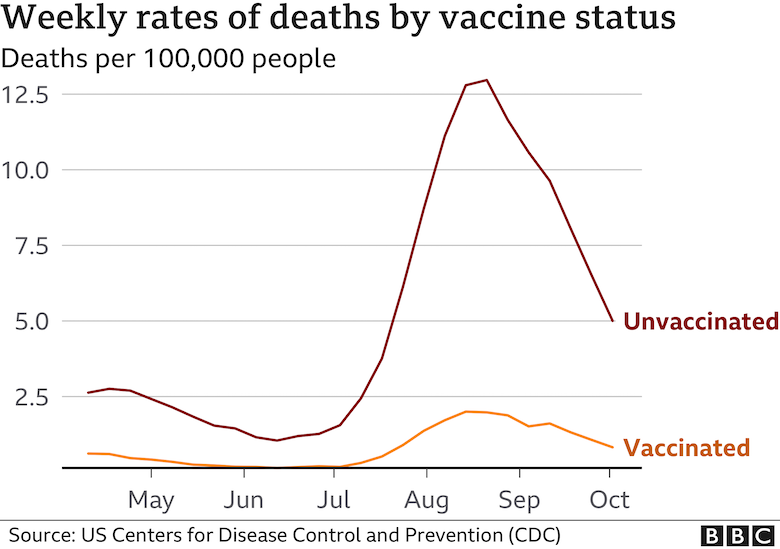
Note that if you are unvaccinated you have at least a five-fold greater risk of dying. This is a massive difference. And yet, many people choose to ignore information that is effectively smacking them upside the head and telling them to get vaccinated.
Compare this with how people are willing to adopt all manner of practices that promise even small benefits. People start taking things like turmeric, acai berries, pomegranate, and adopt all manner of diets, exercise routines, and things like detoxing even though the promised benefits may be just a few percent reduction in cancer or a slight increase in longevity, and the like. And even those benefits have been shown to not be that robust or are even spurious. This behavior reminds me of something that Jesus said in Matthew 23:24 about people straining at a gnat while swallowing a camel.
[Read more…]