Mano Singham
Just another Freethought Blogs site

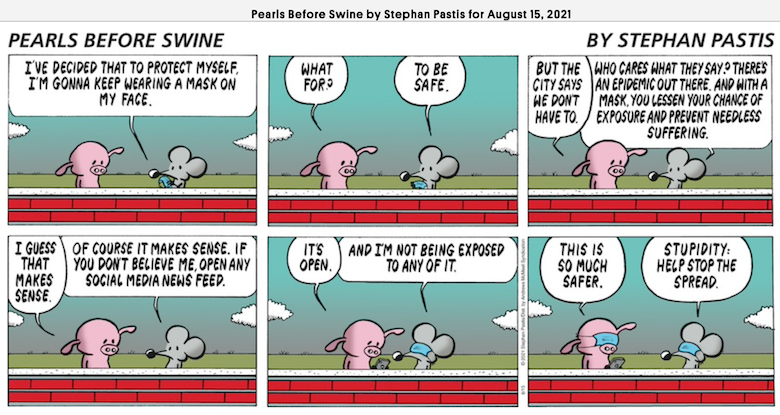
I just returned from a trip to the supermarket and noticed that pretty much everyone, except for four people of whom three were young, is wearing masks again. While I always wore masks there and at any indoor venue where I was not sure that everyone was vaccinated, I had noticed last month that mask usage had dropped considerably. I wondered whether people would be more resistant to the advice to mask up again and was glad to see that, at least in this area, people seem to have adopted them again. The county has as yet not mandated that everyone mask up indoors, though with the rising number of infected people due to the Delta variant, I expect to see such a mandate soon.
[Read more…]
The so-far unsuccessful search to find direct evidence for the existence of dark matter is raising an issue in science that is often misunderstood and rarely gets the attention it deserves. And that issue is how we know in science that something does not exist. I discuss that in some detail in my book The Great Paradox of Science (yes, yet another plug for those who have not read it to buy it!) because it is hard to understand the logic of scientific progress without it. The history of science is replete with things that were once thought to exist but are no longer so. The aether and phlogiston are two famous example and another is N-rays. Trying to understand why we think those entities no longer exist will enable us to better understand when it might happen that dark matter is also thought to not exist.
[Read more…]
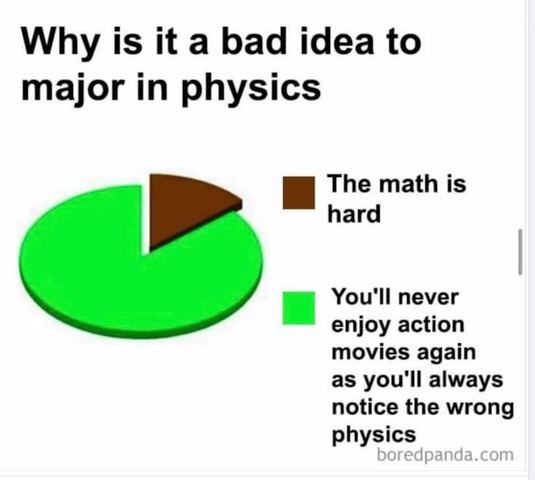
Especially the part about action films.
The new report by the Intergovernmental Panel on Climate Change (IPCC) lays out the basis for “the most up-to-date physical understanding of the climate system and climate change, bringing together the latest advances in climate science, and combining multiple lines of evidence from paleoclimate, observations, process understanding, and global and regional climate simulations.”
The warnings are getting more and more dire, though the situation is not yet hopeless.
Earth is getting so hot that temperatures in about a decade will probably blow past a level of warming that world leaders have sought to prevent, according to a report released Monday that the United Nations called a “code red for humanity.”
“It’s just guaranteed that it’s going to get worse,” said report co-author Linda Mearns, a senior climate scientist at the U.S. National Center for Atmospheric Research. “Nowhere to run, nowhere to hide.”
But scientists also eased back a bit on the likelihood of the absolute worst climate catastrophes.
The authoritative Intergovernmental Panel on Climate Change (IPCC) report, which calls climate change clearly human-caused and “unequivocal” and “an established fact,” makes more precise and warmer forecasts for the 21st century than it did last time it was issued in 2013.
…The 3,000-plus-page report from 234 scientists said warming is already accelerating sea level rise and worsening extremes such as heat waves, droughts, floods and storms. Tropical cyclones are getting stronger and wetter, while Arctic sea ice is dwindling in the summer and permafrost is thawing. All of these trends will get worse, the report said.
In a reasonably healthy society one would expect life expectancy to rise or at least approach a plateau as the limits to which we can extend life (assuming that there is a limit) get reached. Dropping life expectancy should be a source of serious concern since it implies that something is seriously out of whack. So the recent dramatic drop in life expectancy in the US has to be a cause for alarm.

Diving, like gymnastics, involves a lot of acrobatics in the air and it takes place too quickly for me to be able to judge it in real time, which tells you something about how difficult it must be to judge the event. The only indicator I have for how good it is at the very end. In the case of gymnastics, it is the landing. In the case of diving, it is how small a splash the diver makes upon entry into the water. In the Tokyo Olympics Chinese diver Quan Hongchan broke all manner of records with her gold-medal winning performance. Even an ignorant observer like me could tell that she was spectacular.
We are now in the third, fourth, or fifth wave of the pandemic in the US, depending on who’s counting. What is undeniable is that following an average low of around 80,000 weekly cases on June 22, we have now reached about 640,000 cases, an eightfold increase. Death rates reached a low of 1,500 on July 5th and have started rising since then, following the expected pattern of death rates lagging infection rates by about two weeks. Almost all this rise is among the unvaccinated and these people tend to be concentrated in places where there is a high level of vaccine hesitancy and outright resistance, mostly in Republican-dominated areas. But there are encouraging signs that those people who have been vigorously campaigning against vaccines and masks and other measures to combat the pandemic are losing the battle.
[Read more…]
I usually only watch the track events at the Olympics and that too only after it is over. I was watching the finals of the women’s 100m and noticed that the top three medal winners (all from Jamaica) all had long ponytails, with the silver medalist’s hair an eye-catching yellow and red.
I wondered whether having long hair might slow them down just a fraction due to increased wind resistance. It is true that resistance is not as significant as in swimming where everyone wears caps. But in an event where one-hundredth of a second can make all the difference, wouldn’t sprinters want to minimize drag as much as possible?
Since almost all the eight finalists had long or longish hair, I have to assume that they have concluded that it does not matter and that does seem to be the case.
Flowing locks increase air resistance insofar as they boost a runner’s surface area. More hair creates more opportunities for friction between the runner and the air, so a full-headed athlete would have to work harder to maintain the same speed as a bald one. And since Olympic sprinters are already close to maxing out in terms of effort, any situation that requires them to do more work has the potential to extend their times.
But hair is pretty light, so athletes know it’s the styling, not the quantity, of their tresses that could dash their hopes. Hairdos like ponytails, braids, and or buns, which comb the mane behind the neck, have little effect on overall surface area, while hair that sticks out from the sides of the head increase it (and might also whip into the runner’s eyes).
All the sprinters had their hair in ponytails that stayed behind their backs and did not swish back and forth.
We know that the relationship between climate change and weather is a statistical one, in that rising global temperatures will cause more extreme weather patterns to occur more frequently. But that causal arrow goes just one way, in that we cannot take any particular weather event, however extreme, and unequivocally blame it on climate change. This puts the scientifically minded at a disadvantage when arguing with climate change skeptics who have no compunction about taking isolated anomalous events (such as the recent cold snap in Texas) and using it to proclaim that global warming is not occurring or is a hoax. Most of us refrain from fighting anecdotes with anecdotes.
[Read more…]