The Crisis of the Mediocre Man

I was browsing YouTube videos on PyMC3, as one naturally does, when I happened to stumble on this gem.

Tech has spent millions of dollars in efforts to diversify workplaces. Despite this, it seems after each spell of progress, a series of retrograde events ensue. Anti-diversity manifestos, backlash to assertive hiring, and sexual misconduct scandals crop up every few months, sucking the air from every board room. This will be a digest of research, recent events, and pointers on women in STEM.

Lorena A. Barba really knows her stuff; the entire talk is a rapid-fire accounting of claims and counterclaims, aimed to directly appeal to the male techbros who need to hear it. There was a lot of new material in there, for me at least. I thought the only well-described matriarchies came from the African continent, but it turns out the Algonquin also fit that bill. Some digging turns up a rich mix of gender roles within First Nations peoples, most notably the Iroquois and Hopi. I was also depressed to hear that the R data analysis community is better at dealing with sexual harassment than the skeptic/atheist community.

But what really grabbed my ears was the section on gender quotas. I’ve long been a fan of them on logical grounds: if we truly believe the sexes are equal, then if we see unequal representation we know discrimination is happening. By forcing equality, we greatly reduce network effects where one gender can team up against the other. Worried about an increase in mediocrity? At worst that’s a temporary thing that disappears once the disadvantaged sex gets more experience, and at best the overall quality will actually go up. The research on quotas has advanced quite a bit since that old Skepchick post. Emphasis mine.

In 1993, Sweden’s Social Democratic Party centrally adopted a gender quota and imposed it on all the local branches of that party (…). Although their primary aim was to improve the representation of women, proponents of the quota observed that the reform had an impact on the competence of men. Inger Segelström (the chair of Social Democratic Women in Sweden (S-Kvinnor), 1995–2003) made this point succinctly in a personal communication:

At the time, our party’s quota policy of mandatory alternation of male and female names on all party lists became informally known as the crisis of the mediocre man

We study the selection of municipal politicians in Sweden with regard to their competence, both theoretically and empirically. Moreover, we exploit the Social Democratic quota as a shock to municipal politics and ask how it altered the competence of that party’s elected politicians, men as well as women, and leaders as well as followers.

Besley, Timothy. “Gender Quotas and the Crisis of the Mediocre Man: Theory and Evidence from Sweden.” THE AMERICAN ECONOMIC REVIEW 107, no. 8 (2017): 39.

We can explain this with the benefit of hindsight: if men can rely on the “old boy’s network” to keep them in power, they can afford to slack off. If other sexes cannot, they have to fight to earn their place. These are all social effects, though; if no sex holds a monopoly on operational competence in reality, the net result is a handful of brilliant women among a sea of iffy men. Gender quotas severely limit the social effects, effectively kicking out the mediocre men to make way for average women, and thus increase the average competence.

As tidy as that picture is, it’s wrong in one crucial detail. Emphasis again mine.

These estimates show that the overall effect mainly reflects an improvement in the selection of men. The coefficient in column 4 means that a 10-percentage-point larger quota bite (just below the cross-sectional average for all municipalities) raised the proportion of competent men by 4.4 percentage points. Given an average of 50 percent competent politicians in the average municipality (by definition, from the normalization), this corresponds to a 9 percent increase in the share of competent men.

For women, we obtain a negative coefficient in the regression specification without municipality trends, but a positive coefficient with trends. In neither case, however, is the estimate significantly different from zero, suggesting that the quota neither raised nor cut the share of competent women. This is interesting in view of the meritocratic critique of gender quotas, namely that raising the share of women through a quota must necessarily come at the price of lower competence among women.

Increasing the number of women does not also increase the number of incompetent women. When you introduce a quota, apparently, everyone works harder to justify being there. The only people truly hurt by gender quotas are mediocre men who rely on the Peter Principle.

The like ratio for said talk. 47 likes, 55 dislikes, FYI.Alas, if that YouTube like ratio is any indication, there’s a lot of them out there.
The Death of the ACA

I’ve been catching up on YouTube videos, and this interview with John Iacoletti and Chelsea Rodriguez really hit me. It’s bad enough that some jerks threw transgender people under the bus to protect a bigoted YouTuber, but think about what else these people have done:

Almost every organization runs on trust. The exceptions, like the US Department of Defense and Facebook, can only get away with it because their “customers” have no alternative. People in need of a medium-sized atheist/skeptic non-profit have a number of good alternatives to pick from, in contrast.

At this point, would you trust the ACA enough to collaborate with them instead of another organization? Would you donate money to help keep them afloat? [Read more…]

Matt Dillahunty is Garbage

Here’s something weird. Listen to Matt Dillahunty talk about the recent hosts who had left the ACA:

[29:57] There are four people who were previously on The Atheist Experience, who have left The Atheist Experience. Some of them have left the ACA to go pursue their own interests, and other things, some of them are still involved in ACA or taking a break, or whatever else, and that would be Tracie, Jen, Phil, and John Iacoletti.

Wait, what about Clare Wuellner? She too was a former host, and she too left. She certainly didn’t host as often as Tracie or Jen, but she was a board member for six years, and responsible for both restarting Godless Bitches and starting Parenting Beyond Belief. Clare was no small part of the ACA, so her omission is odd. It’s possible Matt wasn’t too close to her, but they both hosted AXP at the same time within the last year, and when Matt wanted to complain during the livestream he messaged Clare.

Some evidence could explain the omission, though. [Read more…]

Cherry Picking

With the benefit of hindsight, I can see another omission from Rationality Rules’ latest transphobic video. In his citations, he cites two sporting bodies: the International Association of Athletics Federations and the Australian Sports Anti-Doping Authority. He relies heavily on the former, which is strange. The World Medical Association has condemned the IAAF’s policies on intersex and transgender athletes as “contrary to international medical ethics and human rights standards.” The IAAF has defended itself, in part, by arguing this:

The IAAF is not a public authority, exercising state powers, but rather a private body exercising private (contractual) powers. Therefore, it is not subject to human rights instruments such as the Universal Declaration of Human Rights or the European Convention on Human Rights.

Which is A) not a good look, and B) false. If you won’t take my word on that last one, maybe you’ll take the UN’s? [Read more…]

The Progressive Secular Alliance

I was a little amazed at how few people wanted the Atheist Experience blog to remain on FtB. I counted two people arguing for them to remain, one that was ignoring the contents of the original post, and the other had a history of transphobia themselves, before the thread inevitably descended into debating whether or not transgender women are women. The Atheist Community of Austin’s new board have trashed the organization’s prior reputation and destroyed people’s trust, and the odds of them rebuilding it are effectively zero thanks in part to Matt Dillahunty‘s shoddy leadership.

But I was also surprised that a name never came up. When any organization of that size undergoes this sort of scandal, it’s inevitable that some former members will branch off and form their own group. In this case, that group is the Progressive Secular Alliance. They currently have a YouTube channel and Facebook page. It’s still early days, but so far I’ve heard good feedback about them. If you’re an Austin-area atheist, give them a look, and even if you’re not remember that many of these people helped build and maintain the former ACA. Their content will likely be similar to that which drew you into being a fan of the ACA originally.


And the Beat Goes On

Essence of Thought has published a timeline of the Rationality Rules affair. If you’re missed any of the last five months, it’ll bring you up to speed.

Cripes, has it been that long already?! I had a look through my archives, and all but two of my posts over the last two months have been focused on Rationality Rules, and even those two were about transphobia. I know, I know, the constant drumbeat is getting a bit repetitive and boring. But there’s a reason for it.

[11:31] Now, some of the walkouts had formed a support group, which I was later added to, and reading through their accounts is truly horrifying. Many discussed the abuse they suffered thanks to Woodford and his audience. There are numerous discussions on how their sleep was impacted, about how they’re having to see psychiatrists and other specialists. I’ve even seen [a post?] discussing suicide in relation to what had occurred. That’s the level of severity we are talking about with this issue: people discussing suicide. That’s the damage Woodford and his supporters have caused this one group, this one organization.

I don’t have any way to verify this part, but some of it tracks with comments I’ve read elsewhere, the claims have remained consistent over time, and it would explain why ACA members seem willing to talk to Essence of Thought despite the ocean between them.

One thing I do know: the odds of anyone holding Rationality Rules responsible are basically zero. Some big names in the atheo-skeptic sphere, such as Matt Dillahunty and AronRa, either agree with RR or don’t care enough to do their homework. The ACA tried to do the right thing, but it appears RR supporters elected themselves into a majority on the ACA’s board, possibly breaking the rules in the process, and promptly started kissing their abuser’s ass.

In order to remove any ambiguity in the following statement, I wish to make clear that the ACA earnestly and sincerely apologizes to Stephen Woodford (Rationality Rules) for vilifying his character and insinuating that he is opposed to the LGBTQIA+ community. The Board of Directors has officially retracted our original statement.

Rationality Rules was so confident nobody would take him to task, his “improved” video contains the same arguments as his “flawed” one. And honestly, he was right; I’ve seen this scenario play out often enough within this community to know that we try to bury our skeletons, that we treat our minorities like shit, that we “skeptics” are just as prone to being blind followers as the religious/woo crowds we critique. And just like all those other times, I cope by writing words until I get sick of the topic. Sometimes, that takes a while.

This is one of those “a while” times. If it helps, I’m actively trying to avoid covering topics other people already have, and elevating the voices of others to break up the monotony.

Lies of Omission

In Rationality Rules’ latest transphobic video, one phrase in particular caught my ears.

[3:57] The way that the IAAF put it, was that double-amputee sprinter Oscar Pistorius is ineligible to compete at the Beijing Olympics because his prosthetic racing legs give him a clear competitive advantage; or in other words, the IAAF ruled the Pistorius’ prosthetics disqualify him because they make him faster than what he would have been if he had not lost his legs. Now this reasoning is critical, as it embodies both the principle of “fair play” and the principle of therapeutic use exceptions, otherwise known as TUE’s.

[5:42] … a collection of experts criticized the cited study for only testing Pistorius’s biomechanics at full speed while running in a straight line, unlike a real 400 meter race, and for not accounting for the disadvantages that he suffers, such as having trouble leaving the starting block; and as a result, Pistorius is ineligible status was lifted. He was allowed to compete. … [6:24] as we move on to the transgender athletic debate, please keep in mind the principle of “fair play,” the principle of TUEs, and Pistorius’ case as a whole.

[20:02] I am not opposed to trans women who have experienced male puberty competing in the female category of SOME events because they’re trans. I am opposed because the attributes which are granted from male puberty that play a vital role in some events have not been shown to be sufficiently mitigated by HRT. It’s not about whether or not they’re women, it’s about whether or not “fair play” has been maintained.

Rationality Rules never details what “fair play” is, in fact you’ve just read every mention of the term in that video. At the same time, his argument strongly relies on it. That makes the lack of any definition a curious omission. [Read more…]

“Rationality Rules STILL Doesn’t Understand Sports”

Picking apart Rationality Rules’ science has been well covered, both by myself and by others, so it’s refreshing to watch someone take an entirely different approach.

[9:54] They outlawed dunking the basketball, because Kareem Abdul-Jabbar won too many championships doing it. In nearly every possible example of a rule change in relation to individuals dominating, it comes only after that individual… well, dominated.

[10:16] In conclusion – to steal an ending as well – sport is not defined by fairness of starting point. If it was, we wouldn’t love sports. Sports are about the adversity, about overcoming the odds. It’s not about bleaching them into a robotic simulation in a computer.

Xevaris’ critique is more about the fundamental character of sport, like what it means to compete, and delves deep into history. It’s worth your time. I also want to point you to it because I cover similar territory in an upcoming post.

I really only have one complaint: there’s no closed-captions! There are plenty of reasons to keep them enabled on your videos, YouTubers.

Special Pleading

Dang, I need to correct something I wrote.

Every human right applies to every person, equally. When rights conflict, one is temporarily granted precedent. It’s why the Canadian Charter of Rights and Freedoms is ordered the way it is; rights listed earlier in the document are more important than those listed after, greatly simplifying the analysis of any rights conflict.

I’d gotten that impression because Section 1, which allows any right to have restrictions placed on it to preserve a safe and free democracy, was placed up front while later sections deal with things like elections and criminal trials. In reality, they’re all “indivisible.”

Human rights are indivisible. Whether they relate to civil, cultural, economic, political or social issues, human rights are inherent to the dignity of every human person. Consequently, all human rights have equal status, and cannot be positioned in a hierarchical order. Denial of one right invariably impedes enjoyment of other rights. Thus, the right of everyone to an adequate standard of living cannot be compromised at the expense of other rights, such as the right to health or the right to education.

=====

All human rights are indivisible, whether they are civil and political rights, such as the right to life, equality before the law and freedom of expression; economic, social and cultural rights, such as the rights to work, social security and education , or collective rights, such as the rights to development and self-determination, are indivisible, interrelated and interdependent. The improvement of one right facilitates advancement of the others. Likewise, the deprivation of one right adversely affects the others.

=====

All human rights are universal, indivisible and interdependent and interrelated. The international community must treat human rights globally in a fair and equal manner, on the same footing, and with the same emphasis.

This, of course, makes dealing with conflicting rights much more complicated. Usually, you have to demonstrate significant harm to place limits on a right; for instance, in Canada we allow restrictions on free speech only because they can cause physical harm and a loss of security, while even prisoners and foreign nationals are granted “full access to Canada’s human rights protections.”

Note also that these restrictions come from the state, not private individuals. Google cannot throw you in prison or seize your home, and even when they vacuum up your private info that’s only because they claim you agreed to give up a few specific types of personal information when dealing with them or authorized third parties, and because they can point you to tools that allow you to delete any data they have on you. Liability waiver forms shield some of the parties to the contract from being sued in connection to what happens in a specific time and place, they don’t prevent you from launching all lawsuits and they don’t prevent lawsuits in the case of extreme gross negligence. In no case can a private individual or corporation unilaterally take away a right, and any action that could place limitations on a right must be done by mutual consent.

I think you know where I’m going with this, especially since EssenceOfThought got there first, but humour me. The UN Declaration of Human Rights wasn’t considered legally binding on all countries that signed it at the time, but it’s evolved into precisely that while also expanding to encompass new rights.

Victor Madrigal-Borloz, the Independent Expert on protection against violence and discrimination based on sexual orientation and gender identity, said Advisory Opinion OC-24 issued by the Court on 9 January 2018 was a significant step toward upholding the dignity and human rights of persons with diverse sexual orientation and gender identity.

Pathologizing persons with diverse gender identities, including trans women and men, is one of the root causes behind the grave human rights violations against them. Madrigal-Borloz underlined that the Court concluded that requiring medical or psychological certifications or other unreasonable requirements for gender recognition was not in line with the American Convention.

“I am very pleased with the Court’s reasoning, which is permeated in equal measure by legal rigour and human understanding. Advisory Opinion OC-24 is a veritable blueprint for States to fulfil their obligation to provide quick, transparent and accessible legal gender recognition without abusive conditions, respectful of free/informed choice and bodily autonomy, as was also exhorted last May by a group of United Nations and international human rights experts,” he said.

Gender identity is a fundamental right, at the highest level. But because it took the UN a while to get there, other countries have already granted that right themselves. At the federal level, Canada made it official in 2017.

For all purposes of this Act, the prohibited grounds of discrimination are race, national or ethnic origin, colour, religion, age, sex, sexual orientation, gender identity or expression, marital status, family status, disability and conviction for an offence for which a pardon has been granted or in respect of which a record suspension has been ordered.

I’m proud to say we even allow non-binary sex designations on our passports. Even my home province of Alberta, one of the most conservative in the nation, considered gender identity a fundamental human right as of 2015.

WHEREAS it is recognized in Alberta as a fundamental principle and as a matter of public policy that all persons are equal in: dignity, rights and responsibilities without regard to race, religious beliefs, colour, gender, gender identity, gender expression, physical disability, mental disability, age, ancestry, place of origin, marital status, source of income, family status or sexual orientation.

If gender identity is a human right, then private organizations cannot prevent individuals from being treated according to how they identify, unless both parties mutually consent. If one person says “no,” then any such differential treatment is a human rights violation. Only the state can say otherwise, and even then only if the alternative does significant harm.

So when Rationality Rules says this …

[19:00] And my answer to the more controversial question, “do trans women who have experienced male puberty have an unfair athletic advantage?” is: it depends on the sport. […]

… he’s arguing that private organizations should have the ability to suspend human rights, and that rights are divisible, contrary to decades of legal precedent across multiple countries. And when he says this …

[20:02] I am not opposed to trans women who have experienced male puberty competing in the female category of SOME events because they’re trans. I am opposed because the attributes which are granted from male puberty that play a vital role in some events have not been shown to be sufficiently mitigated by HRT. It’s not about whether or not they’re women, it’s about whether or not “fair play” has been maintained. Do I make myself clear?

… he is making himself abundantly clear. He considers the maintenance of “fair play” in sports vital to the operation of a free and fair democracy, so vital that it justifies removing human rights from some transgender people. In the process, they’ll have fewer rights than convicted criminals.

There’s two ways to rescue Rationality Rules from this absurdity. One is simply that he’s ignorant; in the two months he spent researching the topic and consulting with biologists, physiologists, and/or statisticians [17:50-17:59], he never ran across the human rights argument. The other way is that he doesn’t agree with the concept of human rights. The second path is kind of awkward, as it has him rubbing shoulders with the religious figures he likes to critique. At any rate, he’s closed off both means of escape.

This video can be considered the remake, and I’ve done my utmost best to illustrate that this is not about people’s rights, it’s about *what constitutes fairness in sport*. You, me and everyone else have the right to compete in sports, but that doesn’t mean that we have the right to compete in any division we want.

So there’s no dodging it, Rationality Rules is engaging in special pleading. He wants an exception to an existing rule without justification, even if he has to throw out over fifty years of human rights law in the process.

Now, to be fair, everyone makes mistakes. Rationality Rules isn’t the first atheist/skeptic to be guilty of special pleading, and he won’t be the last. In most cases, this just due to ignorance: they don’t know their logical fallacies, and thus don’t realize they’re engaging in them. If he wants to brush up, I’d recommend he play “Debunked.”

Debunked is a highly strategic card game of logic, reason and nonsense! There are two decks, one full of fallacious arguments, and the other full of everything else – which includes logic to debunk the arguments, ways to improve your hand (such as resurrecting a card from the discard pile), and, most importantly, ways to mess with your opponent (such as making them skip their go). It’s very simple to learn, but hard to master… like logic itself. …

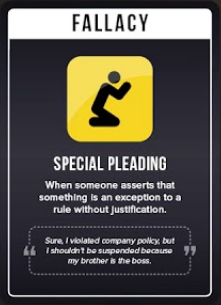
I know it’ll help him in this particular case, because it contains a “special pleading” card.

A playing card titled "Special Pleading," which it helpfully describes as "When someone asserts that something is an exception to a rule without justification."

The card game is currently a Kickstarter project, so the only way he can get a copy is to contact…. oh. Oh dear.

… Hey, I’m Stephen Woodford, the man behind the YouTube channel Rationality Rules, and this game is my attempt to combine my two loves – reason and gaming. Debunked is first and foremost a thoroughly enjoyable and repeatable game, saturated with varying strategies and hilarious themes, but it’s also a fantastic tool for learning logic; the arguments are real, and so too are the fallacies they commit – hence, the logic cards genuinely can teach people a thing or two about valid argumentation (or at the very least remind them).

If you thought I was exaggerating when I said “he’s lost his grip on reality,” bear in mind that I had this card up my sleeve at the time. It had plenty of company, too.

[HJH 2019-07-14: Finally got around to adding the “fair play” link.]