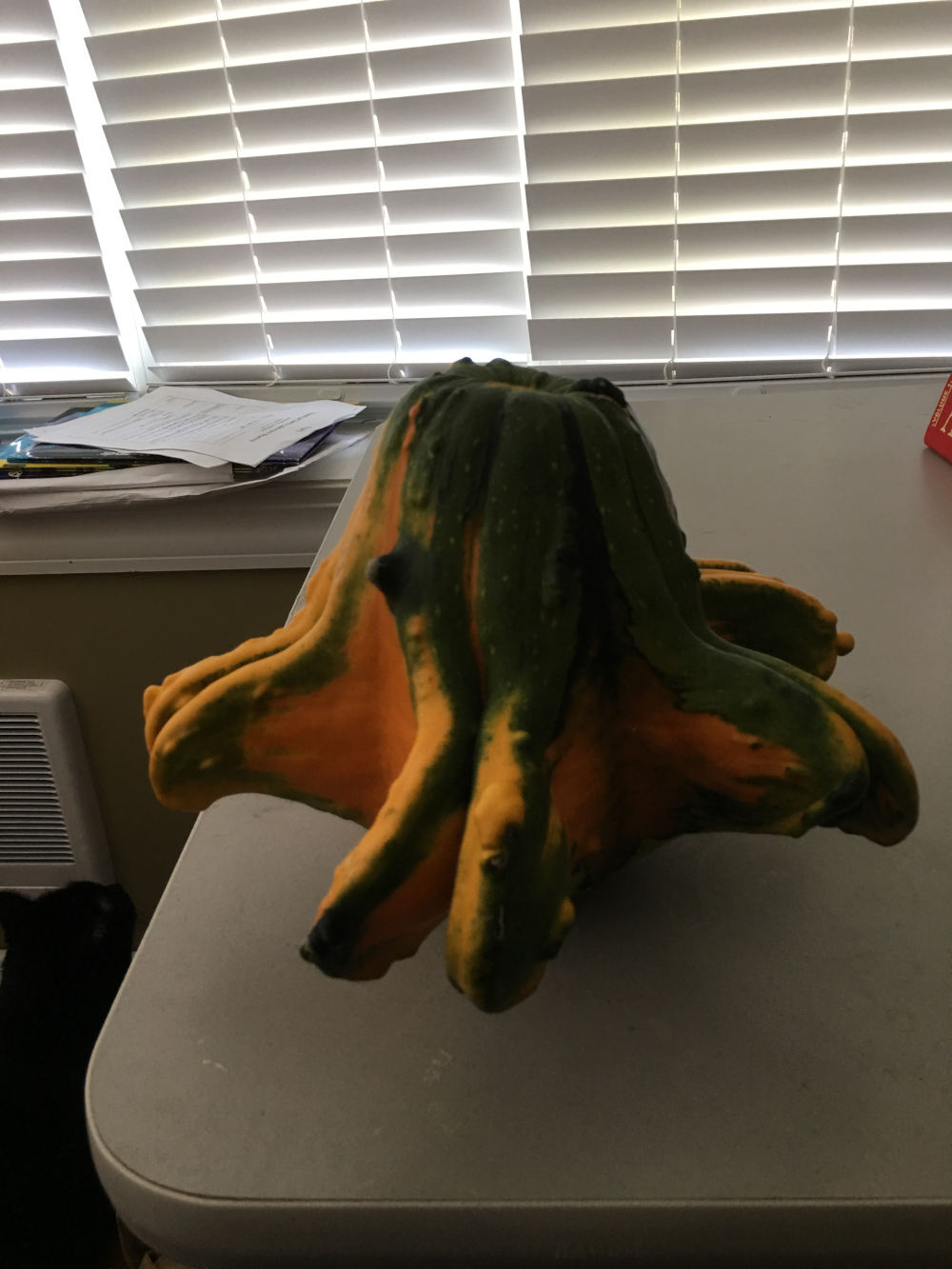
Be not surprised, for I bring you tidings that were goddamned predictable

It takes great courage to step out and expose powerful, awful people, and as she knew ahead of time, Christine Blasey Ford is also facing the consequences of her bravery.

Christine Blasey Ford was hesitant to come forward with allegations of sexual assault against Supreme Court nominee Brett Kavanaugh because she feared facing public attacks. “Why suffer through the annihilation if it’s not going to matter?” she said in an interview with the Washington Post.

Her fears were not unfounded. Within hours of revealing her identity, personal attacks were launched against Ford. Some senators expressed their doubts about the truthfulness of Ford’s statements. Senator Orrin Hatch asserted that Ford was “mixed up.”

Now, the New York Times is reporting that Ford is being sent death threats. An unnamed source told the Times that following the threats, Ford and her two teenaged children moved out of their home. Ford also hired private security. One of the messages reportedly said that Ford had “6 months to live, you disgusting slime.”

I hope those two kids are fully aware of the sacrifice their mother made for the truth, and they’re proud of her for it.

When humanists go bad

This guy, Angelos Sofocleous, was elected to head the humanist group at Durham University. He has resigned. He has to blame someone.

In light of recent events, I have taken the difficult decision to resign from the position of President-Elect of Humanist Students.

These events involved a retweet of mine saying ‘RT if women don’t have penises’, and certain other criticisms of the transgender movement, as well as suggestions to improve the movement’s actions. Sadly, these views were taken to be ‘transphobic’ by individuals who cannot tolerate any criticism, either of their movement or their ideas, and are unable to engage in a civilized conversation on issues they disagree on.

Would you believe he’s a philosophy and psychology student? I’m kind of curious about those “certain other criticisms” and about how he defines “woman”, because he seems to treat it as a simple distinction based on the presence or absence of a penis. It seems rather superficial and narrowly phenomenological for someone in either of those disciplines, but on the other hand, I also don’t want to play into his hands and debate the subject with him, because he also says this, along with hiding behind “freedom of speech!”:

Even if one makes statements which are wrong beyond doubt (e.g. ‘Homosexuals shouldn’t have the right to marry’, ‘Nazis did nothing bad’, ‘Slavery is moral’, ‘Women are inferior to men’), one needs to have a conversation with that individual and explain why they are (obviously) wrong. Engaging in a debate does not mean that you give equal status to your opponent.

This is where the fetishizing of free speech and debate goes bad. I get to deny your basic humanity and your right to exist, and you now need to convince me otherwise. I get to freely make assertions that don’t challenge my privileged status but do potentially do great harm to you, and I have no responsibility or obligation to others — others who may even consider those statements “wrong beyond doubt” — to make defensible statements, and the onus is entirely on you to address them, and if you don’t, you are an intolerant tribalist. Why do you get so angry when I merely want to deny your civil rights, or enslave you, or kill you? That’s not very logical.

Don’t you realize that Sofocleous is the victim here?

I hope we belonged in an environment in which we were able to speak up without the fear of being fiercely attacked and silenced.

I think there are a lot of people who would like to be able to simply exist without the fear of being fiercely attacked and silenced. Can we give them priority before your right to define them away?

Nintendo ought to sue for defamation

Stormy Daniels’ tell-all book tells me a heck of a lot more than I want to know.

Trump’s bodyguard invites Daniels to dinner, which turns out to be an invitation to Trump’s penthouse, she writes, in a description of alleged events that Daniels has disclosed previously but which in the book are rendered with new and lurid detail. She describes Trump’s penis as “smaller than average” but “not freakishly small.”

“He knows he has an unusual penis,” Daniels writes. “It has a huge mushroom head. Like a toadstool…

“I lay there, annoyed that I was getting fucked by a guy with Yeti pubes and a dick like the mushroom character in Mario Kart…

“It may have been the least impressive sex I’d ever had, but clearly, he didn’t share that opinion.”

Thoughts, in no particular order:

  • Ick. TMI.

  • Who cares? Penis shape is not a criterion for a good or bad president.

  • I hate to break the news to you guys, but every man’s penis is a weird-looking thing.

  • I’ll never be able to unsee this.

  • Toad is cute & cheerful, and not how I’d metaphorically describe any part of the president’s anatomy.

  • I’d rather have President Toad.

Persistence is a key ingredient to getting a degree

Have you ever wondered how kooks like Ken Ham get teaching certification? He does have a degree in education from a real university, you know, unlike that other fraud, Kent Hovind. From his bio:

Ken’s bachelor’s degree in applied science (with an emphasis on environmental biology) was awarded by the Queensland Institute of Technology in Australia. He also holds a diploma of education from the University of Queensland (a graduate qualification necessary for Ken to begin his initial career as a science teacher in the public schools in Australia).

Here’s a dirty little secret. Getting into or attending a university does not automatically make you smart or knowledgeable. It is possible to go through the motions, meet the minimal requirements, and not learn anything. And in some cases, even the minimal requirements may be waived, as some Australian universities are intent on demonstrating.

Students who leave high school with the lowest scores — some close to zero — are being offered places in teaching degrees at universities, a secret report has found.

It shows some prospective teaching students had an Australian Tertiary Admission Rank (ATAR) that was often as low as zero to 19 — far below the Federal Government’s official data.

These figures, which have never been publicly reported by universities, show that in NSW and the ACT in 2015, students who scored in the bottom 50 per cent of school leavers made up half of all those offered places in teaching degrees.

I’m happy to undermine my own authority by telling you that having letters after your name doesn’t make you brilliant. And conversely, lacking those letters doesn’t make you stupid.

Mystical Experiences @ Death!

That was the title of the lecture I attended last night, by our distinguished visiting professor, Allen Kellehear of the University of Bradford. It was … frustrating. Kellehear does have an excellent background in caring for the dying, and I would have enjoyed (if that’s the word) a discussion of the material and emotional needs of the dying, or hospice policy, or something along those lines, but instead it was an hour of Near Death Experiences (NDEs). I also agreed with his conclusion, that these phenomena are a complex outcome of cultural expectations, and that we actually don’t know much about the biology. It’s just that the journey there was a catalog of unlikely interpretations of mundane events.

He began with the facts and figures, and told us that, for example, 20% of resuscitated individuals report having an NDE, and 30% of people report having a visitation from the dead. My question is: how are these numbers at all meaningful? There is a huge amount of selection bias here (which he admitted to), because my story of losing consciousness and later waking up is not going to draw any attention at all, while Eben Alexander’s fabulous story of going to heaven and meeting an all-powerful, awesome lord of creation gets on the New York Times bestseller list. It’s nice to have statistics, but I want to know how they were collected and interpreted, and without that, they’re meaningless.

I was also confused because later he mentions that these NDE-like experiences were also expressed by people in many stressful situations, like trapped miners. So once again, 20% of what? Shouldn’t the fact that I lost consciousness when I went to bed last night, as I’ve done every night for 6 decades, and did not have an other-worldly, out-of-body experience be counted among the negatives?

He also gave us a list of the canonical events during an NDE: the dark tunnel, the Being of Light, the visiting of dead relatives, etc. I felt like pointing out that he, an authority on this subject, has just now primed a large audience on exactly what they’re supposed to experience if they had an NDE. Not that that’s his fault: there are movies and books and stories told on daytime television that reinforce these perceptions, and there’s a widespread cultural idea about them that we’re already soaking in.

I also wondered…if I were in a coma, and woke up and reported that my consciousness spent that time wandering in a cosmic darkness, or that I remembered visiting the shores of an alien sea and meeting Space Squid, would that even count as an NDE? He’s got a checklist, you know, and if I were asked if I saw the Being of Light, and I said “No,” would that mean I didn’t have an NDE?

Most annoying of all, though, was all the neuroscience bashing. He really is not impressed with the neuroscientific explanations of the phenomenon, and neither am I, because he gave us a long list of scientific explanations that did not include the dominant hypothesis. He talked about scientists sticking electrodes on the heads of unconscious patients to record EEGs during their NDE, or drawing blood to measure blood gases, and hypotheses about anoxia, or endorphins, or ocular pressure increases, or similar attempts to explain NDEs as events that occurred during the trauma or the coma, and the one time he named one of these neuroscientists, it was Michael Persinger. We’re talking fringe of the fringe. The neuroscientists I know would just roll their eyes at these accounts, in the same way we’d dismiss those weird experiments with putting dying people on precision balances to measure the weight of the soul at the moment it left the body. It’s missing the whole point.

But he didn’t even mention how most neuroscientists would explain NDEs. They don’t occur during the event, because the brain is not functioning at all well during that time. They are confabulations assembled by the brain once its function is restored.

Minds abhor gaps. Our consciousness works hard to maintain the illusion of continuity, and we even invent stories to explain where our consciousness “went” during its absence. We do this all the time without even thinking about it.

A mundane example: have you ever lost your keys, or your glasses? It happens all the time. We’re often not thinking about routine events, and we don’t bother to store them in our memories, so I get up in the morning, stumble about in a fog while doing the things I do almost every day, and I don’t have to pay conscious attention to them. But maybe later I wonder where I put my glasses, and my wife tells me, “They’re here on the kitchen counter,” and my brain instantly generates a plausible explanation. “I must have put them there when I was making the coffee,” I think. If I were asked at that moment, I would even put together a fairly detailed narrative about walking into the kitchen and taking them off as I was filling the pot with water — but the thing is, I didn’t know this. I don’t actually remember it. If I had, I wouldn’t have been wondering where I’d put them.

We do this constantly. Memories aren’t detailed recordings of everything you’ve done or experienced, they’re a scattered set of anchoring specifics with a vast amount of narrative filler generated as necessary by your brain, based upon a plausible model of how the world works. So I don’t remember taking my glasses off, but I do have a model of the world that includes me taking them off while doing kitchen tasks, so voila, a story is easily assembled. If I had a world model that included elves, I might have built a story that said, “Those pesky elves must have put them there!”, and then the fun begins, because the observation that my glasses were where I hadn’t remembered putting them becomes confirmation of my model of the world that includes elves.

We really don’t like the idea that our consciousness isn’t always present in our heads, that it’s an epiphenomenon of constant invention, so we have explanations for where it goes when it isn’t particularly active. I intentionally put my glasses on the counter, I just forgot. Most interestingly, we go through a period of unconsciousness every day, and we don’t freak out about where our minds went. We were “sleeping”, we say, our minds were still there, busily doing nothing, and this word “sleep” consoles us that our consciousness did not stop existing for hours and hours.

Similarly, NDEs are a conscious narrative we build to explain what happened to ourselves during radical, traumatic events. We blanked out, our minds stopped humming along, where did our self go? It had to have gone somewhere, it can’t just stop, so our brains build a story from conventional expectations to prevent an existential crisis. It’s what we do. And if it’s near-death, how convenient that we throw in Dead Uncle Bob, who we know is dead, but we have these niggling questions about where Uncle Bob went, so clearly we must have both gone to the same place. The idea that a consciousness ceased to exist is inconceivable, after all.

If Kellehear had actually discussed what neuroscientists believe, it would have been something along those lines, on the ephemeral and contingent nature of consciousness, and he wouldn’t have brought up silly ol’ crackpot Persinger as representative. It would have also revealed that neuroscientists are actually in alignment with his ideas about the importance of history and culture and religion and emotion in shaping human responses to death, that it’s not really a hard-wired part of our neural circuitry. So that was a little unsatisfying.

There was also a bit near the end where he got into a bit of Dawkins bashing — but for all the wrong reasons. He railed against the arrogance of a scientist claiming to know that there is no god. I felt like saying that that arrogance pales in comparison with the ubiquitous, overbearing hubris of claiming to not only know that there is a god, but that one knows exactly what kinds of sexual behaviors that god enjoys, and that one has this certainty in spite of the fact that there is no independent evidence of any kind that this supreme being even exists. But I was being nice. It was also an event packed full of community members — “townies” — who were there to listen to an academic reinforce their model of the world, and they weren’t going to appreciate someone telling them that elves aren’t real.

Blame the innocent

A neighborhood in Ipswich has been sporadically awakened to the sound of a children’s nursery rhyme being played over loudspeakers. Creepy weird, huh?

The owners of the speakers have an explanation. This doesn’t help.

The sound is only supposed to act as a deterrent for opportunistic thieves that come onto our property, and it’s designed only to be heard by people on our private land.

It’s an odd choice of an alarm, but OK. I guess if you want to instill bafflement in thieves, it would be effective. But then they go a step further and place the blame on innocents.

We are now aware of the problem – the motion sensors were being triggered by spiders crawling across the lenses of our cameras and it looks like we’ve had it turned up too loudly. We’ve spoken to the resident who brought it to our attention and adjusted it so this shouldn’t happen again.

Oh, sure. Blame the spiders. I think we’re seeing another instance of unthinking bigotry against the poly-armed community.