Hey, I know those cells!

Everyone has been telling me about this time-lapse video from the Nikon Small World competition. I twitch a bit when I see it. It’s just too familiar, because I used to work on those cells.

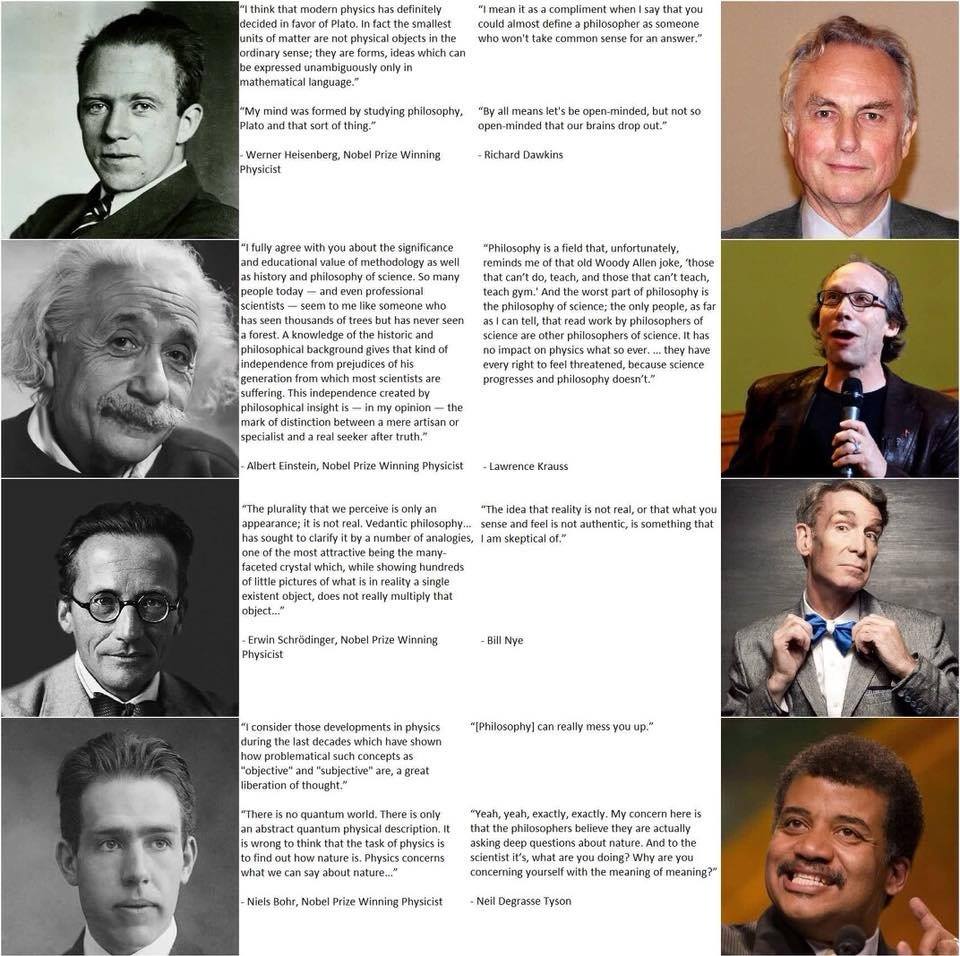
Just to orient everyone, that’s an embryonic zebrafish, head to the right, tail to the left, lying sort of upside down with a 3/4 twist, so you’re looking down on the dorsal side and also seeing the left flank of the animal. Does that help?

As you watch it, you’ll initially see two parallel rows of cells located in the dorsal spinal cord — those are called Rohon-Beard cells, and what they’re going to do is a couple of things. They build a longitudinal pathway within the spinal cord so you’ll see they’re all connected by a bright line of labeled nerves running through the spinal cord, from tail tip to hindbrain. They also start sending out peripheral growth cones, building a network of fine axons that cover the animal just beneath the skin. These mediate tactile sensation in the fish.

About a third of the way through, another pathway will become obvious: it’s the lateral line nerve, which starts growing out of a primordium just behind the ear and makes a bright pathway along, in this case, the left side of the fish. I presume there’s another one on the opposite side that we just can’t see.

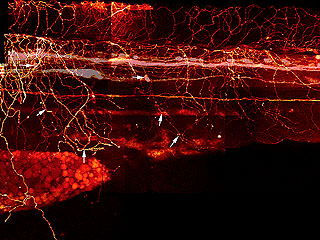
What makes me twitch is that years ago, I tried to figure out how the Rohon-Beard cells make that meshwork. I had a Ph.D. student, Beth Sipple, who collected a lot of data the hard way, by labeling one or a few cells at a time, fixing them, and then trying to reconstruct the interactions from these single cell, single time-point observations to get an idea of how the growth cones were crossing over each other. She also injected dye into that longitudinal pathway to fill a subset of the Rohon-Beard cells and see how their peripheral arbors were organized, as in this image from her thesis.
DiI Labeling of Rohon-Beard and Dorsal Root Ganglia Processes in a 3 d Embryo
Rohon-Beard and DRG processes were labeled by injecting DiI into the DLF and back-filling cell bodies and processes. * indicate the Rohon-Beard dorsal fin processes. Long arrows indicate position of Rohon-Beard cell bodies. Short arrows indicate the position of DRG peripheral processes

It would have been so much easier if we’d been able to just label the whole mess and watch them develop. There’s as much information in this video as there was in hundreds of samples made the old-fashioned way.

This is how we framed it, a few decades ago.

If one looks at the network of Rohon Beard cell sensory arbors once they are well established, the pattern of innervation is quite dense and complex. It is almost as if someone laid a series of irregular nets, one on top of another in random fashion, over the surface of the skin. There appears to be no regular morphological pattern to the arbors individually or as a whole. This is unlike the situation seen in the Comb cell projections of the leech (J. Jellies) which have a distinct shape and a well distributed outgrowth pattern. So how does a Rohon Beard cell arbor (or any developing sensory arbor for that matter) ‘know’ how to grow and branch its dendrites optimally in order to cover an entire receptive field (the skin)? An optimal pattern would arborize over a region such that:

  • no point in the field is further than a given distance from a neurite
  • no point in the field is excessively innervated
  • all regions are equally densely innervated

In other words, each arbor should have a few holes and no clumping regions, as is seen in this image of a Rohon Beard cell arbor at about 23hpf below:
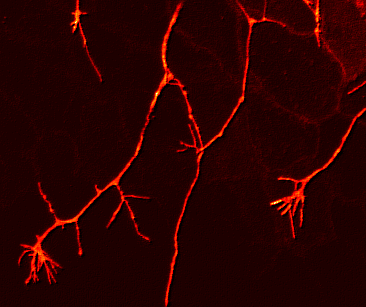
The question I was interested in was how to form a distributed network, with minimal clumping or gaps, and I measured all kinds of lengths and angles and rates and densities to try and figure out how it assembled itself. We inferred a couple of things: that individual axons avoided fasciculating with each other, but that there was no aversion to crossing over each other, and we also inferred that the growth cones had a weak preference for regions of the skin that were not already innervated.

I’m looking at the video and saying, “we were right”, but still wanting to get in there and measure branch angles and trajectories. And also, “oh, man, this technology would have made everything so much simpler.”

How gracious

I guess the bad PR was getting to be a bit much: Amazon has raised its minimum wage to $15/hour, up from the US minimum wage of $7.25. It’s still too low, but christ, how can someone live on seven bucks an hour? American labor policies are disgraceful, and it sure would be nice to have a political party that hadn’t abandoned support for workers ages ago.

But still…

Amazon’s market capitalization currently stands near $1 trillion; it paid Bezos, its founder and CEO, $1.68 million last year. But as Amazon’s stock has risen, so has Bezos’ net worth — it’s currently estimated around $165 billion.

Anyway, it’s a little progress, so this seems appropriate.

Nuts to the Nuttings

I really was considering going to the Nuttings’ creationist seminar in Minneapolis this week, but I decided not to. I’m sure it will be totally pants, but then I discovered that a student, Elliott Jungers, will be presenting his senior seminar in Science 1020 at 5pm today on “Pax6 mutation in the model organism Astyanax mexicanus“, and a colleague in geology, Keith Brugger, will be presenting a faculty seminar in HFA at 5pm Thursday, titled “Small Science to Global Climate Models: or Why Anyone Would be Interested in Colorado’s Weather 20,000 Years Ago”. All are open to the public.

Why should I drive 3 hours to hear garbage people lie and talk garbage science when I can stay right here and listen to good stuff? In fact, I bet there are better talks going on at the Twin Cities campus all of the days that the Nuttings are babbling.

Betty was HUNGRY!

It’s October. That means I’ve got free rein to post horrifying spider videos, right?

I’ve got a feeding schedule for my colony, so every Monday and Thursday I open up the incubator and fling a bunch of living, walking, wingless Drosophila into every spider tube.

Today is Monday.

Now usually, the spiders sit unperturbed by the intrusion of insects into their domain, and they’ll just watch and wait, and the next day I find the withered corpses of their prey in their webs. Today, I guess Betty was hungry, because she leapt unto one of the hapless flies within seconds of it landing on the web. She was so fast she had it trussed like a Christmas turkey before I could get her under a camera.

I got a bit of the aftermath in a video, at least. It’s below the fold. It’s probably not a good one for the arachnophobes to watch.

[Read more…]

How to force-fit preconceptions about gender into science

I mentioned this persistent idea that male variability explains their “superior” intellectual abilities in my last post. There’s another example of the prevalence of this odd, unsupported idea going around — a twice-retracted paper that purports to find a mathematical basis for a sex difference.

The variability hypothesis generally states that the males of a species vary more widely in physical and physiological traits than the females. This theory is controversial because, since the beginning of the 20th century, it has mostly been used to refer to cognitive abilities—the purported greater frequency of both lower and higher extremes in intelligence among human males compared with females.

As Penn State University professor of psychology and women’s studies Stephanie Shields covered in her 1982 historical review (and in a follow-up 2016 review), scientists in the early 1900s asserted that there was a difference in the variability of mental traits between the sexes and attributed this difference to genetics, not considering environment and societal factors.

Again, I don’t find the idea credible at all. It’s entirely based on wishful thinking and a strange idea that nature is fair, and tries to support it with an unsupported belief that all biases must be symmetrically distributed. This paper was rejected for more specific, detailed problems, though.

The major flaw in the paper, according to Mark Kirkpatrick, a mathematical geneticist at the University of Texas at Austin who has published models of the evolution of mating preferences and selected traits, is that the rules of inheritance are not taken into account. “The paper’s conclusions are simply wrong,” he says. “The genes of the successful individuals in a population are transmitted to the offspring and [Hill’s] model does not have any equation that links up the genes of one generation with the genes of the next generation.”

Reed Cartwright, a computational evolutionary geneticist at Arizona State University, agrees. “My primary issue with Hill’s model is that it lacks any notion of genetics, and you cannot ignore genetics and make evolutionary conclusions,” Cartwright writes in an email to The Scientist. The model also ignores the role of gene-environment interactions, which are particularly important for complex traits, according to Cartwright. “Hill did not appreciate that if the difference between his two populations of males was due to environment and not genes, then his conclusions would be invalid.”

Yeah, if you invent an evolutionary model that handwaves away that awkward necessity of a mechanism of inheritance, you’re going to find that biologists are unimpressed. It reminds me of the time I attended a lecture by a mathematician/computer scientist on epidemiology, and she had tested her hypothesis with a simulation of viruses that she started by explaining that her model was the first one that used male and female viruses. Nope nope nope nope.

How awful can Alessandro Strumia be?

He’s one of those physicists — the ones who despise the humanities and are quite confident that white men are the crown of creation because he is one. He gave a talk at CERN that was basically about how his analysis of citation indices proves that women are inferior at physics, but they get hired over men anyway.

The talk was so appalling that CERN stripped it from their website and chastised Strumia for it without naming him.

CERN considers the presentation delivered by an invited scientist during a workshop on High Energy Theory and Gender as highly offensive. It has therefore decided to remove the slides from the online repository, in line with a Code of Conduct that does not tolerate personal attacks and insults.

The organisers from CERN and several collaborating Universities were not aware of the content of the talk prior to the workshop. CERN supports the many members of the community that have expressed their indignation for the unacceptable statements contained in the presentation.

CERN is a culturally diverse organisation bringing together people from dozens of nationalities. It is a place where everyone is welcome, and all have the same opportunities, regardless of ethnicity, beliefs, gender or sexual orientation.

Lucky (?) for us, someone grabbed a copy of the slides and uploaded them for all of us to see. CERN may have made a mistake by deleting the original copy, because they’re demonstrably bad.

An example:

The first thing that jumped out at me when browsing the slides was just how incoherent and badly laid out they are, full of bad grammar and numbers for the sake of numbers. We did three job searches last year, for positions which require clarity and teaching ability as well as great scientific content, and we wouldn’t have hired anyone whose idea of a presentation was to vomit up that kind of incomprehensible stream-of-consciousness, and apparently the slides are less incoherent than the talk.

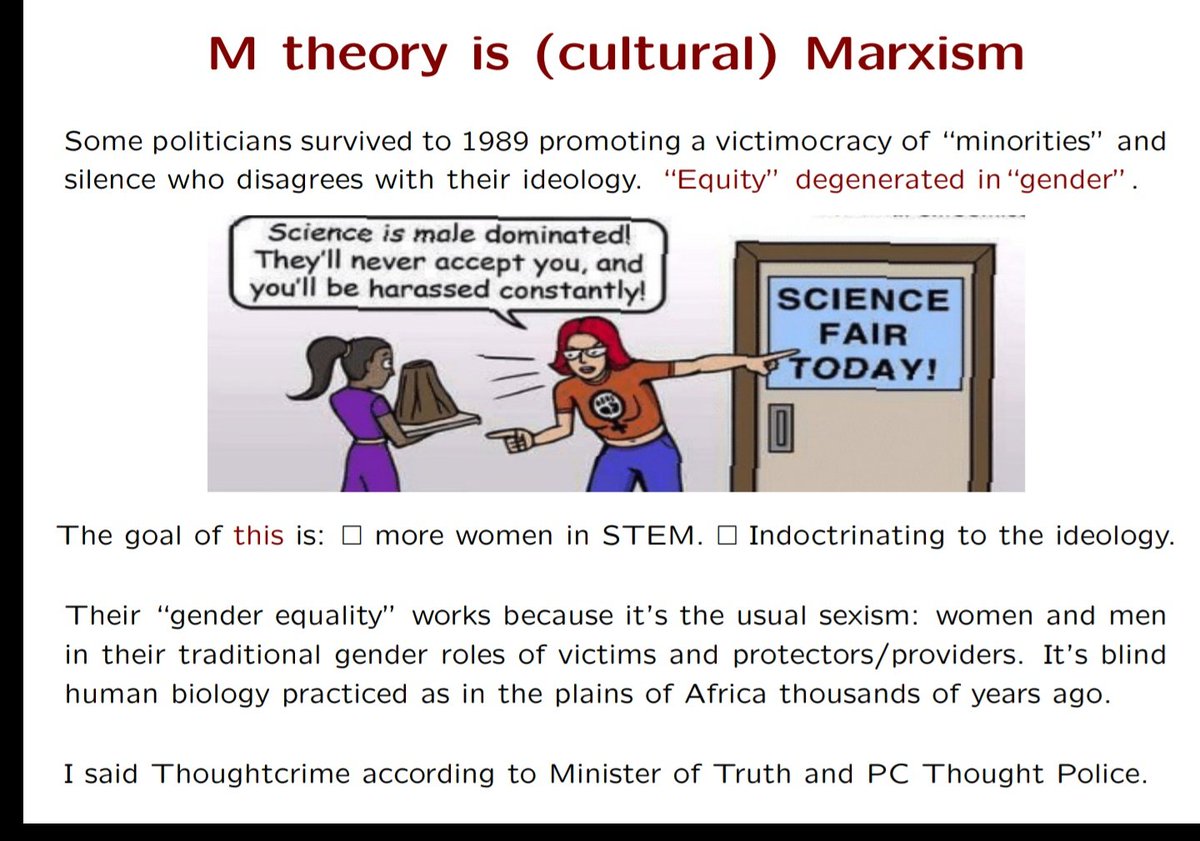
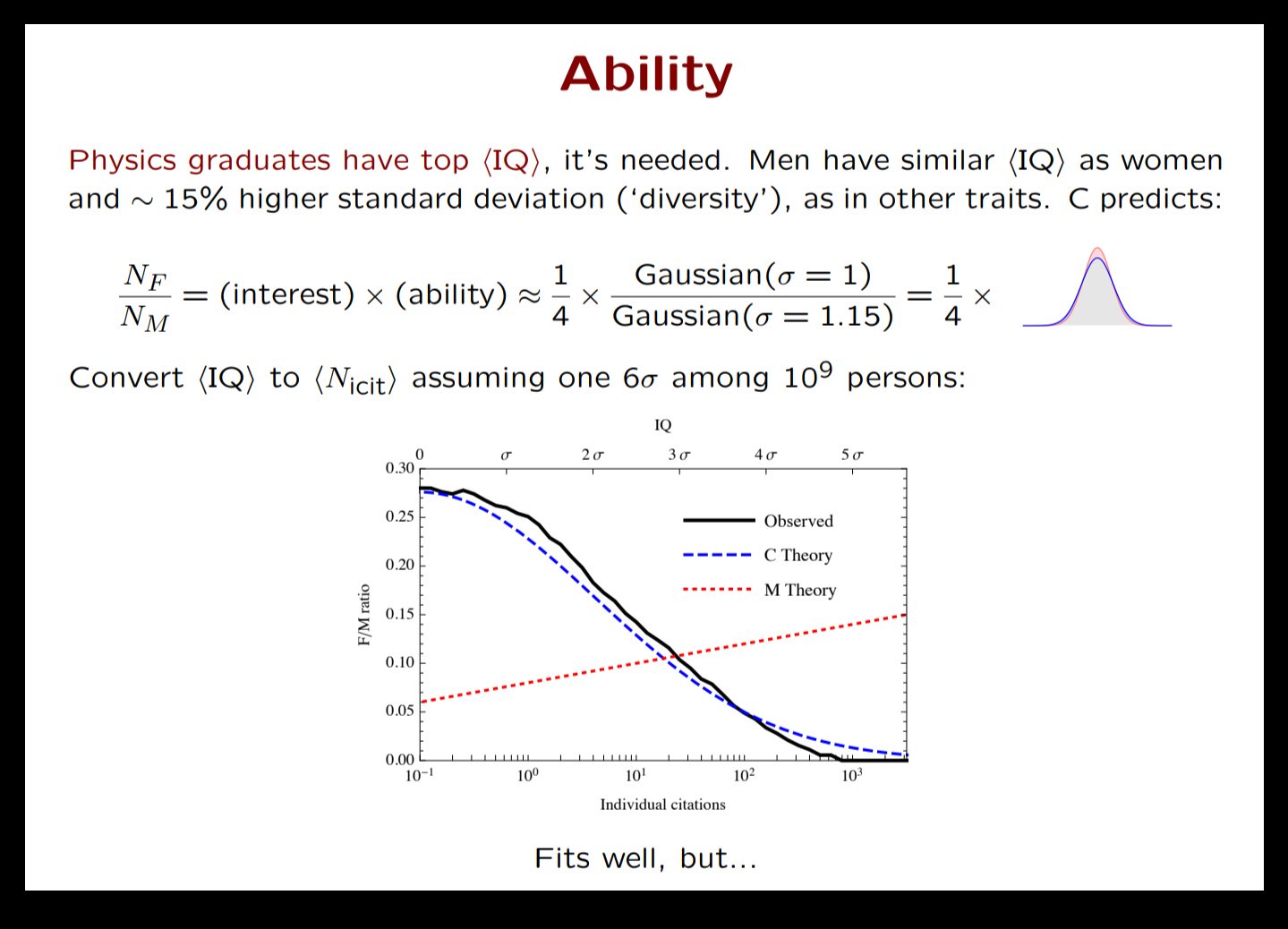
As for the content…he claims to be using citation analysis to distinguish between two theories explaining asymmetries in the hiring of men and women in physics. The “M” or “Mainstream” theory is that it’s broken by discriminatory hiring practices; “C” or “Conservative” theory is that it’s not unfair, that it’s a meritocracy and men bubble to the top because they’re simply inherently superior. To demonstrate that “C” is correct, he really overworks the citation numbers to claim that not only is the number of citations an accurate measure of academic talent, but is also correlated with IQ, and that women are just lacking in both. You see, Physics invented and built by men, apparently on the plains of Africa thousands of years ago, and if you disagree, you’re one of those “cultural Marxists”.

Anyone who blathers about “cultural Marxism” is a fool not qualified for any kind of intellectual position.

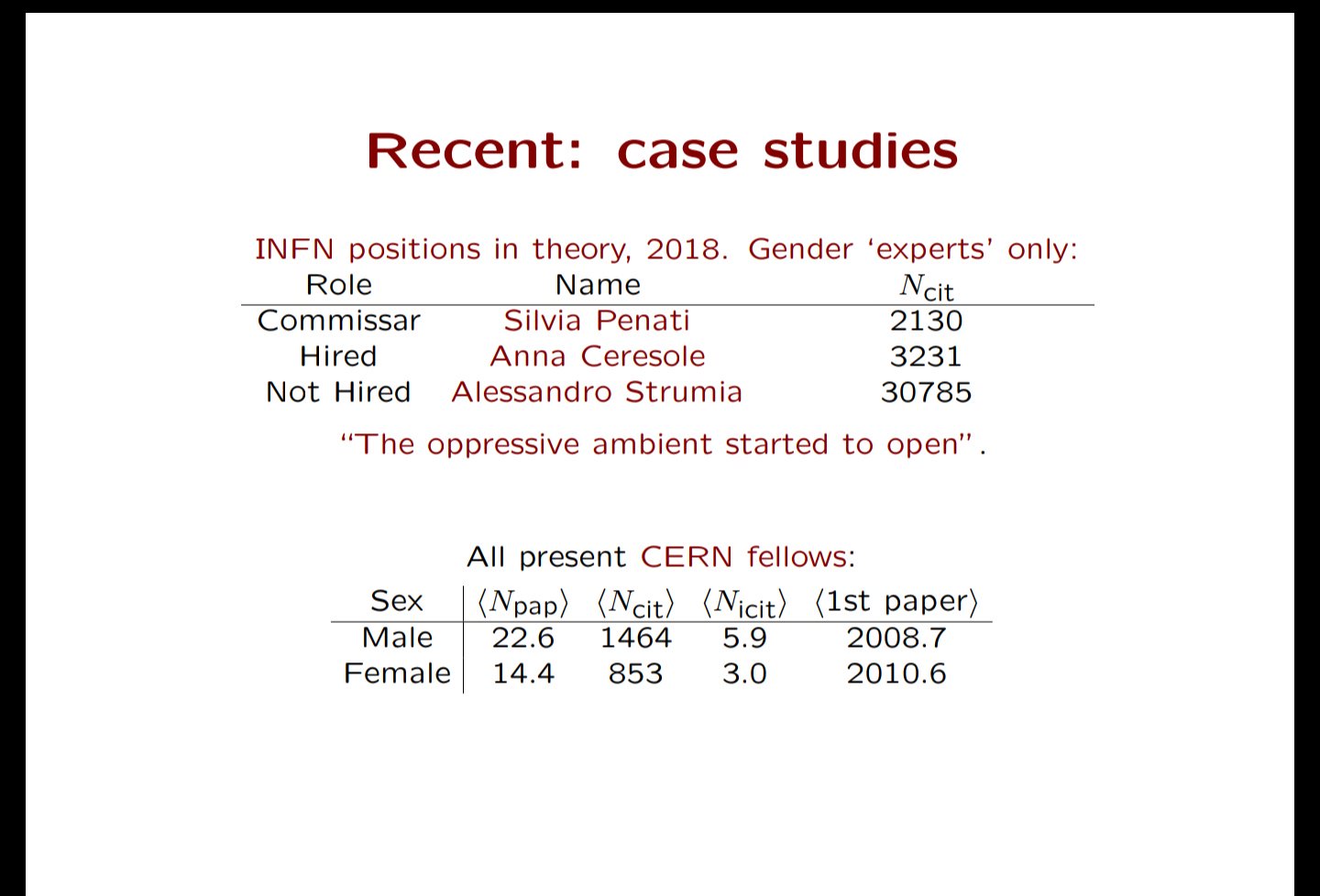
Of course, he reveals his real motivations, and they are hilarious. He applied for a job, and he was not hired — but a woman was. And this was despite the fact that he had a much, much bigger Ncit than she did!

You know, job searches would be much easier if we just had a simple numerical metric to assess the candidates. To apply, just send us a piece of paper with your name and your IQ score, and we’ll sort them and hire whoever comes out on top. But no, we insist on meeting the person face-to-face, and looking at all the complexity of their career, and getting recommendations, and looking at how they interact with colleagues and students, because professional positions involve a heck of a lot more than extracting your brain, putting it in a jar, and marveling at how quickly it can do calculations.

Judging from this talk, Alessandro Strumia probably gave an interview that demonstrated that he was a raging asshole, so he wasn’t hired for good reason.

One of the canards he trotted out was the old argument that men exhibit greater variation than women, so we ought to expect that, just as men exhibit a greater frequency of mental deficiencies, they ought also to exhibit a greater frequency of mentally superior individuals.

Why we should believe this, I don’t know. Because we’re supposed to assume biology is fair, and is going to compensate one sex with more talents, just to balance out the problems? I see no reason to think that the genetic biases are going to be symmetric. People who are hit on the head with hammers will experience a greater frequency of crippling health problems afterwards; we don’t predict that, to be fair, nature will give an equal number of victims super-powers. For some reason, though, this idea is common, especially among worshippers of the bell curve.

Just to complicate matters, I’ll propose that personality is multi-dimensional (I doubt anyone will argue), and that if IQ is one dimension, another is the AQ — the asshole quotient. If the distribution of the AQ is also bell-shaped, and men exhibit greater variation, then more men will have a high AQ and are therefore not fit for the company of human beings, and hiring discrimination against men is justified.

Uh-oh. I get the Tim O’Neill treatment

And it’s a long treatment, so brace yourself.

I’m not going to disagree with his major points, but am just going to say that I think our background disciplines also tend to color our interpretation of the data. As a biologist, this summary resonates perfectly with me.

As already noted in relation to Myers’ rather different form of “agnosticism” on the question, historical analysis of pre-modern evidence simply cannot arrive at definitive answers and can only make structured, evidence-based but subjective assessments of what is most likely.

Evolutionary biology does the same thing: we gather all the evidence we can, sieve through it, and try to make a best assessment that accounts for all of the data with as little subjectivity as possible…but since we’re human, we can’t eliminate it all. We also try to conform our explanations to existing models of how the world works, and I think that’s where we often get conflicts. When I say there’s a question of parsimony here, I’m really saying is that I have a model in my head, and what’s the simplest way to fit these data to it? And as a biologist I have one model that involves thinking about populations and downplaying individuals (individuals make a transient contribution that is then broken up and blended with all the other individuals in the population), while a historian might focus more on specific instances and place greater weight on an individual’s role. So that’s where this bit doesn’t fit as well into my head.

The problem is that the whole of Mythicism, in all of its forms, is based on a fundamental supposition – that a non-historical Jesus form of early Christianity existed – which has no sound evidential foundation. And Occam’s Razor makes short work of this kind of idea.

This is how the Principle of Parsimony applies to the question. It is not merely that, as Myers seems to think, the idea of a single person as the point of origin is “simple” therefore it is most likely. It is that the sources all say that there was a historical preacher as the point of origin of the sect and all of the alternative explanations for how this could be is based on a weak foundational supposition which can, in turn, only be sustained by contorted readings of the texts which are also propped up by still more suppositions.

OK, I agree with the point that “the sources all say that there was a historical preacher as the point of origin of the sect”. If you’re just going to accept the sources as your sole objective data (a fair decision!), then sure, an argument between informed historians is going to converge on a single answer, as he does.

Unfortunately, that collides with my biases as a non-historian evolutionary biologist who tries to answer historical questions about organisms. When we try to identify the last common ancestor of all tetrapods, for instance, we don’t have any doubt that such a thing existed, but the “thing” is not a single individual (it ain’t Tiktaalik!), but a population, or a group of populations, or even a few loosely interbreeding species, and we’re averse to holding up a fossil and declaring, “here is the mother of all four-legged vertebrates!”, because we know it’s not true.

So I look at the Middle East of a few thousand years ago (or even today), and I see a fermenting chaos that is throwing up preachers and prophets all over the place, and to point to one guy and say he’s the one seems to avoid the bigger question of what was going on in that particular environment. Wouldn’t it be better to acknowledge the cross-fertilization and interbreeding of ideas that had to have been going on? This Jesus fellow is just one focus, and given how little we know about him, not even a particularly interesting focus.

I also have to question the reliability of the sources that all say there was one man. Writing that Christianity was produced by a committee, or the complicated interplay of a gang of scholars living in one little town, isn’t as compelling a story as saying it was this one enlightened individual. It’s like how in evolution the popular press seems to be locked into the idea of a “missing link”, looking for that one bone that ties a convoluted history into a pretty package, even as all the biologists try to tell them there wasn’t one link, and it’s not all missing, but parts of it will always be lost to us.

But all right, I can accept that historians have reached a practical consensus based on available evidence that there was a guy named Jesus who triggered a major religious movement 2000 years ago, and that denying his existence is a pointless exercise in pedantry that is often misused by lazy denialists. After all, if some revisionist came along and tried to claim that Devonian sarcopterygians were a fantasy and illusion cobbled up by Carboniferous limb apologists to justify the righteousness of tetrapody I’d also find them annoyingly obtuse.

Another thing: if you’re an atheist already, this is an argument that is totally irrelevant. If we had definitive evidence that Jesus existed — a time machine goes back, snaps a photo and takes a DNA sample — it wouldn’t change my mind at all, nor would it persuade Christians to abandon their faith. If the time machine goes back, and the time travelers flounder about, unable to identify which of the multitude of preachers is “the one”, that similarly is not going to change the mind of anyone about the truth of Christianity. It’s a kind of peculiarly bad pattern of argument that doesn’t resolve anything that matters at all.

I guess if you’re the kind of atheist who wants to say, “Hur hur, Christians are wrong about something, therefore there is no god,” maybe it would appeal. But this is like picking the most fuzzy, vaguely definable claim with known deficiencies of data that you can find and then splitting hairs to find a way to say the other guy is wrong, and doing it in the face of a whole mob of scholars who are telling you that your interpretation is non-standard. Tactically, it doesn’t sound smart.

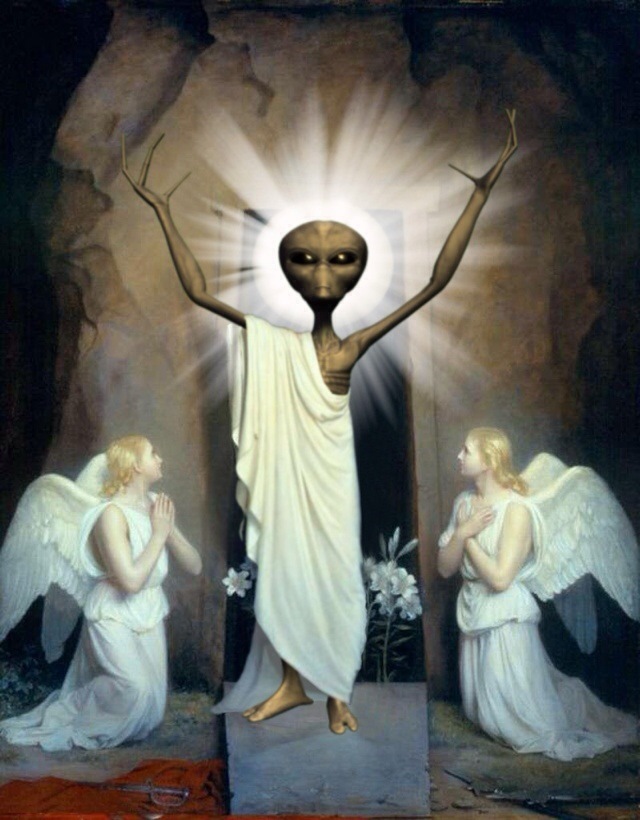
We might as well be arguing that Jesus was an alien. The whole debate just puts us in a looney-tunes cartoon.

That Wilkins guy loves to rub it in

Yeah, John, I know.

As he points out, this is probably more a difference of timing than Nobelist vs. pop science communicator. A modern university education has had to pare away so much to meet the demands of a population that just wants to get to the point and get a degree and get out and get a job, that a biologist, for instance, can complete a four year program and never once take a philosophy course, take almost no history or language or arts course (we do demand that our students take ONE course in those disciplines), and so you can be a competent scientist with almost no awareness of the breadth of human knowledge.

And then there are right-wing hacks like Jordan Peterson who want to completely abolish the humanities and to worsen the situation even more.