
Excellent — it’s even gender-neutral, so I can send it to my wife. You can send it to your beloved, no matter who they are!

Excellent — it’s even gender-neutral, so I can send it to my wife. You can send it to your beloved, no matter who they are!

Curtis Yarvin, AKA Mencius Moldbug? Seriously? Here’s a whole excessively long article about Yarvin, which name-drops a whole army of deplorables like JD Vance and Blake Masters and Peter Thiel.
Besides Vance and Masters (whose campaigns declined to comment for this story), Yarvin has had a decade-long association with billionaire Peter Thiel, who is similarly disillusioned with democracy and American government. “I no longer believe that freedom and democracy are compatible,” Thiel wrote in 2009, and earlier this year, he declared that Republican members of Congress who voted for Trump’s impeachment after the January 6 attacks were “traitorous.” Fox host Tucker Carlson is another fan, interviewing Yarvin with some fascination for his streaming program last year. He’s even influenced online discourse — Yarvin was the first to popularize the analogy from The Matrix of being “redpilled” or “-pilled,” suddenly losing your illusions and seeing the supposed reality of the world more clearly, as applied to politics.
I’ll be shorter than the article: Yarvin’s schtick is to advocate for the dissolution of the American republic so that it can be replaced by a theocratic capitalist monarchy by writing long-winded pretentious articles that are both incoherent and much beloved by Silicon Valley tech-dudes, because their bottom line is always rationalized by Yarvin, who wants to make them the rulers of everything.
Hey, this is the morning I got slammed with a couple of painfully wordy media about fascist dorks. Here’s an hour-long video about Peter Thiel, which also mentions Yarvin. Sorry.
These are all good and thorough dissections which need to be done, but I’m feeling a bit squeamish. If I were to walk into a public toilet and see someone has left a multi-colored turd with strange filamentous spines and twitching blisters containing squirming invertebrates, I would hope that there’s a doctor somewhere who would do a careful inspection and a biomedical analysis of that person’s fecal output, but for me, I’m just going to flush it without asking a lot of questions.
It shouldn’t take that much inspection to figure out that JD Vance, Blake Masters, Trump, and all those creepy Thiel-supported nerds ought to be flushed.

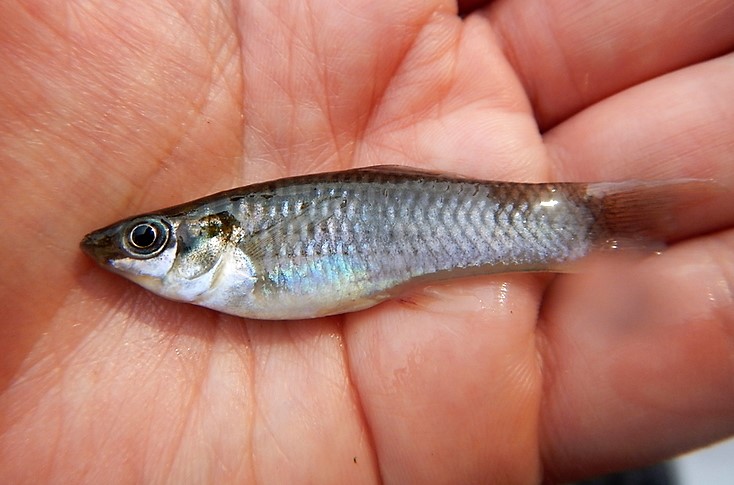
As anyone who has ever raised aquarium fish knows, they’re all different. Maybe you think a fish is just a fish, not very different from one another and all rather stupid, but I spent years sitting next to tanks of zebrafish, and I can tell you you’re wrong. I’d watch them gamboling about, and you’d quickly realize that oh, that one is aggressive, that one likes to hid, that one gets the zoomies and darts about the tank. You can learn to recognize individual fish by their behavior.
I always wondered about that. These were highly inbred animals, with only slight genetic differences between them, but could those little genetic variations account for strong differences in behavior? Then I acquired a new line of zebrafish, one that was the product of hybridization between our inbred lines and wild-caught native stocks, and oh boy, their behavior was radically different, instantly distinguishable. Maybe it is genetic. Maybe? I never did a formal, rigorous behavioral experiment, so I don’t know for sure.
But now a new study comes along that does what I would have been excited to know about 20 years ago (and I still am!). This is an analysis of The emergence and development of behavioral individuality in clonal fish, and it’s a bit surprising. Laskowski and others are working with the Amazon Molly, a small tropical fish that reproduces clonally, producing clutches of babies that are all genetically identical to each other — so even better than my old zebrafish — that can then be separated and raised apart from their mothers and siblings. This rules out the possibility of genetic differences causing individual differences, and leaves us to consider alternative sources of variation.
To determine the causes and mechanisms that can generate behavioral individuality in the absence of genetic and environmental differences, it is essential to first pinpoint when behavioral individuality emerges and how it continues to unfold after emergence. Birth marks a critical time point: if individuality is present at birth, this points to pre-birth influences––such as epigenetics, maternal effects, and/or pre-birth developmental stochasticity––as being key drivers of individuality. Alternatively, it could be that individuality primarily emerges after birth. This emergence could happen both gradually throughout early life, which would suggest that individuality is driven by positive feedbacks between behavior and the internal and/or external environment, or abruptly at particular points early in life, if it is linked to critical sensitive windows.
So if cloned fish are behaviorally identical to one another at Day One, but become different later on, that suggests the differences are generated by varying experiences over time. If, on the other hand, the genetically identical fish are different on Day One, that suggests that pre-birth factors (I’d lean towards favoring developmental stochasticity, just random variations at the cell and molecular level) generated the variation.
To cut to the conclusion, Amazon mollies differ on Day One, with all that implies.
I think their chosen behavior is a bit simple, they’re just looking at mean swimming speed — does a fish have the zoomies, or is it a calm quiet little guy? — which is fine, since they do get an early difference. They also used motion analysis software, so I presume they could go back and reanalyze the data for more subtle differences, but they got their answer with just one parameter. They also looked for other possible correlations.
Individuality is present at day one after birth and is not explained by differences in maternal identity or body size.
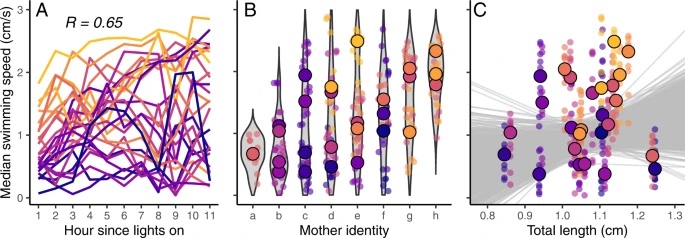
Repeatability of median swimming speed at hourly intervals on the first day after birth (A); each line represents one individual (N = 26). Maternal identity (B) did not explain variation in swimming speeds among individuals. Small and large points indicate the hourly (i.e. 11 data points per individual) and daily median swimming speeds, respectively, of individuals from each mother on day one after birth; see also Table 1. Behavior on day one after birth (C) was not related to an individual’s total length on their first day of life; see also Supplementary Table 3. Small and large points indicate hourly and daily median swimming speeds for each individual respectively; gray lines indicate posterior estimates for the effects of body size on behavior. Throughout, lines and points are colored according to the individual’s behavior in hour one on day one (yellow represents higher swimming speeds; purple indicates lower swimming speeds).
In panel A you can see that there was a huge amount of individual variation in swimming speed. In B, different mothers all produce progeny with a wide range of behaviors. That one has me wondering, though: Mama a’s babies were all a bit on the sluggish side. If they raise a second clutch from Mama a, does the second set exhibit a range of behaviors similar to that of the first set? Is there any genetic bias at all in this behavior?
Panel C shows that there was also variation in body length on Day One, which doesn’t surprise me at all — developmental stochasticity again. Body length is not a predictor of swimming speed, though, these seem to be unlinked variables.
Another feature of the study is that they observed the fish longitudinally, over 10 weeks of development. Variation increased, which would surprise no one, and it was correlated with Day One behavior. Zoomy fish stayed zoomy and became even more zoomy, while slow fish generally stayed slow for their life.
Individuality increases gradually throughout the first 70 days of development.
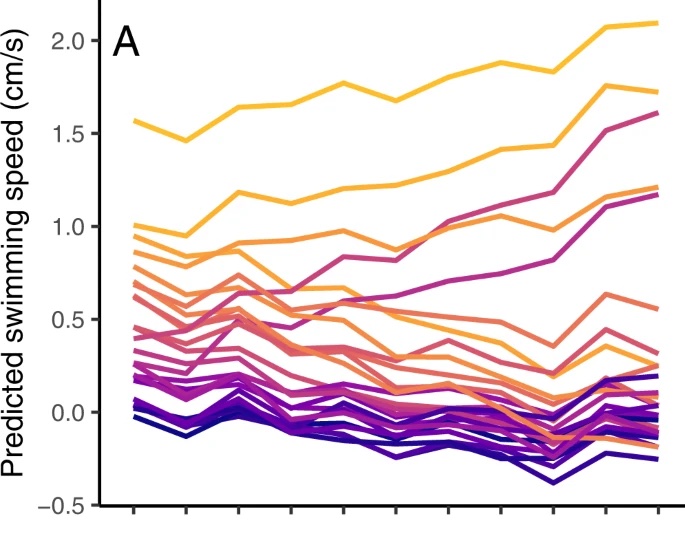
The predicted values of median individual swimming speed diverge over time (A) leading to gradual increases in the among-individual variance and hence repeatability (B, not shown here) of behavior. These models included only the 26 individuals on which we had complete data for the first 10 weeks of life to ensure that absolute levels of variation would remain comparable over time. Individual lines in (A) are colored according to their predicted behavior in week 1 with yellow indicating greater swimming speeds and purple indicating lower swimming speeds.
What have we learned?
Evidence is accumulating that even genetically identical animals reared under near identical conditions develop behavioral individuality, yet little is known about when exactly these differences emerge during ontogeny and how they continue to change during early life development. We show that genetically identical individuals already exhibit substantial behavioral individuality on their first day of life, highlighting pre-birth influences as being of critical importance to initializing durable behavioral differences among individuals. Epigenetic and maternal effects mediated through mechanisms such as changes to DNA methylation patterns or differential resource or hormone allocation, could influence the phenotype of offspring.
I’m still intrigued by the role of chance in development and evolution.
Another non-mutually exclusive hypothesis is that the behavioral variation we observed is the result of developmental stochasticity, that is, stochastic variation in any molecular, neurological or physiological markers that occur over ontogeny. An intriguing possibility is that the phenotypic variation we observed here––whether arising from epigenetic, maternal, and/or developmental stochasticity effects––might itself be adaptive, for example, as a potential bet-hedging strategy. Generating phenotypic variation among one’s offspring by such non-genetic means might be especially relevant in clonal organisms such as the Amazon molly. There is, for example, evidence in clonal fish, and poecilid fish specifically, that DNA methylation mechanisms and developmental plasticity more generally might be especially sensitive to environmental influences, offering a mechanism through which mothers can generate variation among their otherwise genetically identical offspring.
Developmental stochasticity as part of an evolutionary bet-hedging strategy sounds like an interesting model, and probably important in species like fish (and spiders!) that pump out huge numbers of offspring with concommitant high likelihood of death.
This kind of behavioral analysis of organisms with limited genetic variation is one motivation for what I’m doing in the lab — taking the offspring of one spider parent and then inbreeding them over multiple generations to reduce genetic variability in one lab population. A couple more generations, and then it’ll be time to work out some behavioral assays to identify differences that we can select for. Swimming speed won’t be one of our parameters, though. Not even speed in general, they tend to all be quiet lurkers. Web configuration, aggression, pigment patterns, though, those are all candidates for analysis down the line.

Fox News shows have gotten creepier and more demented and more histrionic over the years. They’ve also gotten more openly anti-education. Here are a couple of Fox News women working hard to find something to find something to hate about college students — like that they might like cats, which tells us that students are weak.
Fox hosts are PISSED about an innocuous study that said cats on college campuses are good
Campagno: "I don't think these kids need cats, I think they need discipline, I think they need a slap in the face!" pic.twitter.com/WagnZ46io8
— Lis Power (@LisPower1) November 1, 2022
They think students should just toughen up, they can’t possibly be stressed. And if they’re stressed, they shouldn’t be able to find the energy to protest injustice. They really are serving up a heaping bowl of bullshit in this segment. If you like cats, you’re a snowflake! If you can’t make it in college, then just drop out, said in a pitying tone of voice, because spending four years in advanced and difficult studies of complex topics is soooo easy, and they’re there just to take advantage of the freebies
.
What freebies? College is expensive (it shouldn’t be) and it’s mainly a lot of hard work and stress, genuine stress.
Then they invent stupid problems, like that students are man-handling
the cats. They think the appropriate way to help students learn is to take the George C. Scott approach, and slap them. Nope. Colleges are staffed with trained professional educators who know better, and are aware that physically assaulting people is not a good way to motivate them.
Who are these appallingly stupid people on this panel? I don’t want to know. I also don’t understand how this is going to appeal to their base. Where I live, that base is a population of farmers with barn cats and a good ol’ dog on the front porch and kids who are in 4H and love their farm animals to bits, who will watch movies like Old Yeller and Dog and struggle to hold back a tear at the end. This is just desperate reaching for something to despise about young people getting educated, and being smarter than every hateful dolt on that network.
On a more pleasant note, here is Archie, UMM’s campus therapy dog.
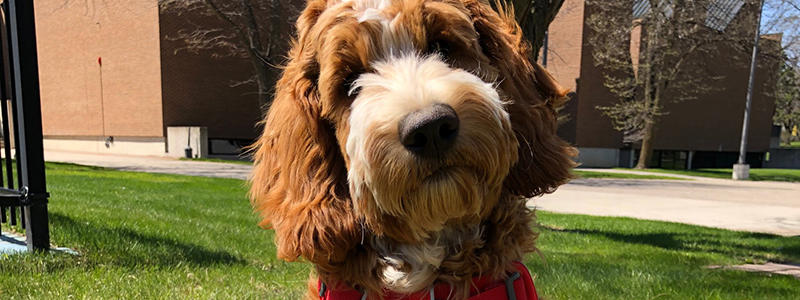
He’s a sweet, friendly pup who is often seen around campus and loves to be petted. He’s a good dog.
Fox News wants to slap him and make him homeless and shoot him.

I have to admit that the rhetoric and the cadence are pretty damned effective. Jamal Bryant was busy taking out the trash.
That’s an art form, that’s what it is.


You get an email that starts with this sentence:
I hope you’re enjoying the Halloween festivities tonight with the family and aren’t being bombarded by too many election ads.
Can you guess what it is?
A. A note from a friend.
B. A family member exasperated with all the election ads they’re getting.
C. An invitation to a Halloween party.
D. An election ad. Give me money!
Everyone who answered “D” is awarded 1000 bronze quatloos. Everyone else needs to wake up to reality.
Don’t worry if you got it wrong, it’s one week until the election, and you’ll be getting lots to practice discernment on.

Uh-oh. The workers aren’t working as hard as they should..
Employers across the country are worried that workers are getting less done — and there’s evidence they’re right to be spooked.
In the first half of 2022, productivity — the measure of how much output in goods and services an employee can produce in an hour — plunged by the sharpest rate on record going back to 1947, according to data from the Bureau of Labor Statistics.
The productivity plunge is perplexing, because productivity took off to levels not seen in decades when the coronavirus forced an overnight switch to remote work, leading some economists to suggest that the pandemic might spark longer-term growth. It also raises new questions about the shift to hybrid schedules and remote work, as employees have made the case that flexibility helped them work more efficiently. And it comes at a time when “quiet quitting” — doing only what’s expected and no more — is resonating, especially with younger workers.
That certainly is troubling to employers. This article tries to answer why, and the journalist sets off on a quest to find the causes. I’m not going to discuss the answers at all because they’re garbage, but I instead browsed the article to see who they talked to.
“professor of economics…”
“Tech CEOs…”
“Microsoft chief executive…”
“Leaders…”
“founder of Career/Life Alliance Services…”
“Managers…”
“chief operating officer…”
“economist Lawrence H. Summers…” (Fuck Larry Summers)
“lead economist…”
“chief economist…”
“chief economist at the Kenan Institute of Private Enterprise…”
“senior economist…”
“many economists…”
Wow. That reporter sure spent a lot of time on the phone & email talking to people about why workers were in a slump. There’s talk about burnout, and the pandemic, and the recession, and the labor shortage, and workers setting more boundaries, and “quiet quitting”, but I noticed that someone was missing. There’s someone — a lot of someones — nobody talked to.
Workers.
Gosh, that’s a peculiar omission. You try to find out why worker productivity is down, so you go talk to the employers to try to figure out why, and you get a lot of fuzzy, vague answers and shrugs. I wonder why?
My personal answer would be that what I’ve experienced and learned in the last few years is that I don’t like managers and tech CEOs and bosses and economists and think tanks and executives and good goddamn, fuck Larry Summers and why the hell do journalists still talk to him? It’s clear to me now, at last, in my old age, that capitalist businesses and institutions don’t care about workers except as hands and brains and eyes to be exploited to make money for the middle men and executives, and that very little of the vast profits management makes will trickle down to the people who do the work. Instead, they’ll use that money to buy politicians and found new companies that will find fresh ways to squeeze blood from the masses. Oh, you brought home a few pennies from a day’s work? Then you can afford to spend them on insurance and health care, those executives love to wring out your pockets, too. What’s this? You need a place to live? All the houses have been bought by landlords, who are eager to raise your rents. And if anyone notices they’re being gouged, well, we’ll distract them with lurid tales of drag queens reading children’s books and trans people using the bathroom and black folk protesting the denial of their rights and if that’s not enough, we’ve got a well-armed paramilitary police force staffed with bullies and haters.
That’s my answer. The system is so broken that the curtain hiding the machinations of the CEOs and big money executives is in tatters, and we are starting to see how our labor is stolen by the people we used to trust to manage our workplace, our communities, our country. Why should I work harder? Any extra effort is going to gain me nothing, because it’s going to be siphoned off by some asshole in a suit with a McMansion and a vacation home and an overpriced car and a condo in Cabo, paying private school tuition to keep their kids away from my kids, all built on my faith and trust and confidence in the system.
Well, guys, my faith and trust and confidence have been blown to flinders in the last few years. You’re going to have to find some other sucker to play your con game. I suspect a lot of workers are feeling the same way.
But you won’t know because you don’t talk to them.

Roofers were working on the science building all last week, hammers pounding all day, and debris being tossed off the roof to the ground below. They inadvertently made a Halloween Tree for us!

I like it. Maybe next year I can do something similar for a tree in my yard, intentionally.

Musk is off to a rip-roaring start. During his first weekend of Twitter ownership, he fired off a tweet suggesting that the attack on Paul Pelosi was his fault — that it happened in a drunken gay tryst. It was just the worst kind of right wing libel from crazy town.
Elon Musk and a wide range of right-wing personalities cobbled together misreporting, innuendo and outright falsehoods to amplify misinformation about last week’s violent assault on Paul Pelosi to their millions of online followers.
A forum devoted to former White House adviser Stephen K. Bannon’s right-wing radio show alerted its 78,000 subscribers to “very strange new details on Paul Pelosi attack.” Roger Stone, a longtime political consigliere to former president Donald Trump, took to the fast-growing messaging app Telegram to call the assault on House Speaker Nancy Pelosi’s husband an “alleged attack,” telling his followers that a “stench” surrounded mainstream reporting about the Friday break-in that left Pelosi, 82, hospitalized with a skull fracture and other serious injuries.
I guess this is where Twitter is going, transitioning to a collection of those lunatic Facebook posts your demented uncle reposts online. Content is going to suck, but also…they call Musk a brilliant businessman? He has no idea what he is doing. He wants to increase the profitability of the platform instantly by charging to get a blue check mark on their account.
Now that he owns Twitter, Elon Musk has given employees their first ultimatum: Meet his deadline to introduce paid verification on Twitter or pack up and leave.
The directive is to change Twitter Blue, the company’s optional, $4.99 a month subscription that unlocks additional features, into a more expensive subscription that also verifies users, according to people familiar with the matter and internal correspondence seen by The Verge. Twitter is planning to charge $19.99 for the new Twitter Blue subscription, though that price is subject to change. Employees working on the project were told on Sunday that they need to meet a deadline of November 7th to launch the feature or they will be fired.
Musk has been clear in the months leading up to his acquisition that he wanted to revamp how Twitter verifies accounts and handles bots. He is also keen on growing subscriptions to become half of the company’s overall revenue. On Sunday, he tweeted: “The whole verification process is being revamped right now.”
This is nuts. For years they’ve given users the ability to get “verified”, that is to have their identities confirmed, which would grant them the glorious reward of having a blue check mark next to their name. That’s it. They never made a good case for what benefit this would provide, other than bragging rights and ego stroking, so I never bothered to apply for it. The features offered by Twitter Blue, and not worth $5/month, let alone $20.
He has also informed Twitter engineers that they must get these boring new features implemented by 7 November, or they’ll be fired. Brilliant.
I was assuming that Musk would let Twitter limp along, making incremental changes, but it looks like his plan is to accelerate the implosion of the company as fast as he can.


Even Racist Dobby the House Elf can get a Cambridge appointment
Nathan Cofnas is another of those guys who has made an academic career out of racism, and it has paid off! He just got a three year appointment to Cambridge University!
An American academic who has expressed controversial views about racial differences in intelligence has been made an early career fellow in the University’s Philosophy faculty.
In 2019 Nathan Cofnas became embroiled in controversy over an article he wrote, in which he argued that genetic differences in IQ could exist between racial and ethnic groups. In the article Cofnas also said that since “truth is intrinsically valuable”, it is scientists’ duty to uncover it even when controversial.
“Controversial”. “Controversial” is not an adequate criterion for legitimate science. Here, Cofnas is using “controversial” as a substitute for “contradicted by the evidence”. Here’s a much better article that rebuts Cofnas’s nonsense.
With that in mind, we would like to respectfully point out that when racial realism is described only as being “provocative” or “controversial,” that comes disconcertingly close to saying that creationism, anti-vaccination, or climate change skepticism are just scientifically controversial ideas. Like these fringe ideas, racial realism belongs to a group of ideas that insist on their legitimacy in spite of (and not in the absence of) disproving empirical evidence – the quintessential definition of being unscientific. Hence, where the claims made by anti-vaxxers, creationists, climate denialists, and racial realists are, by many, seen as provocative, scientists find it lamentable when these ideas seep into academic journals, where they certainly do not belong.
Unfortunately, some people at Cambridge decided this “controversial” guy deserved a philosophy appointment. I hope they enjoy the controversy that follows!
