Articles about nutrition are among the least interesting science articles I read. I’d like to care more, nutrition is important and affects our lives significantly, but so many of them look like this:
A research team in Hangzhou, China, found that frequent consumption of fried foods, especially fried potatoes, was linked with a 12% higher risk of anxiety and 7% higher risk of depression than in people who didn’t eat fried foods.
They fit into a simple template. We fished up a small statistical correlation of simple cause A to complex behavioral/physiological phenomenon B.
It’s annoying because they don’t have a mechanistic explanation, only a correlation, and their result is the product of a huge amount of work.
The study evaluated 140,728 people over 11.3 years. After excluding participants diagnosed with depression within the first two years, a total of 8,294 cases of anxiety and 12,735 cases of depression were found in those that consumed fried food, while specifically fried potatoes were found to have a 2% increase in risk of depression over fried white meat.
The study had also found that the participants consuming more than one serving of fried food regularly were more likely to be younger men.
One hundred forty thousand subjects over 11 years! And all they have to show for it is that feeble increase in likelihood that young men who eat fried foods are somewhat more depressed and anxious. Oh, how surprising. Have they considered that cheap fried fast food might be what people who are depressed and anxious might choose to eat? Or worse, might have limited choices in what they can eat?
Instead, let’s look to animal models, specifically zebrafish. These researchers do some impressively detailed, thorough analyses of zebrafish behavior after they add up to 0.5mM acrylamide to their tanks. The fish didn’t like it.
In the new study, the researchers suggest that acrylamide, a chemical formed during the frying process, especially in fried potatoes, is to blame for the higher risk of anxiety and depression.
In a separate paper referenced in the new study, the researchers exposed zebrafish to the chemical, finding that long-term exposure had caused the fish to dwell in dark zones within the tank, a common sign of a higher anxiety level in the fish.
The zebrafish had also displayed a reduced ability to explore their tanks and socialize, as they did not swim closely with other zebrafish, even though zebrafish are known to form schools with their species.
I worked with zebrafish for many years and am familiar with their behavior. They are flighty and sensitive; it’s easy to provoke changes in behavior. They’re like people in that regard. Throwing software at detailed video analyses of their behavior might generate tons of numbers and lots of graphs, but I fail to see what we learn from it, beyond that short summary: they didn’t like acrylamide.
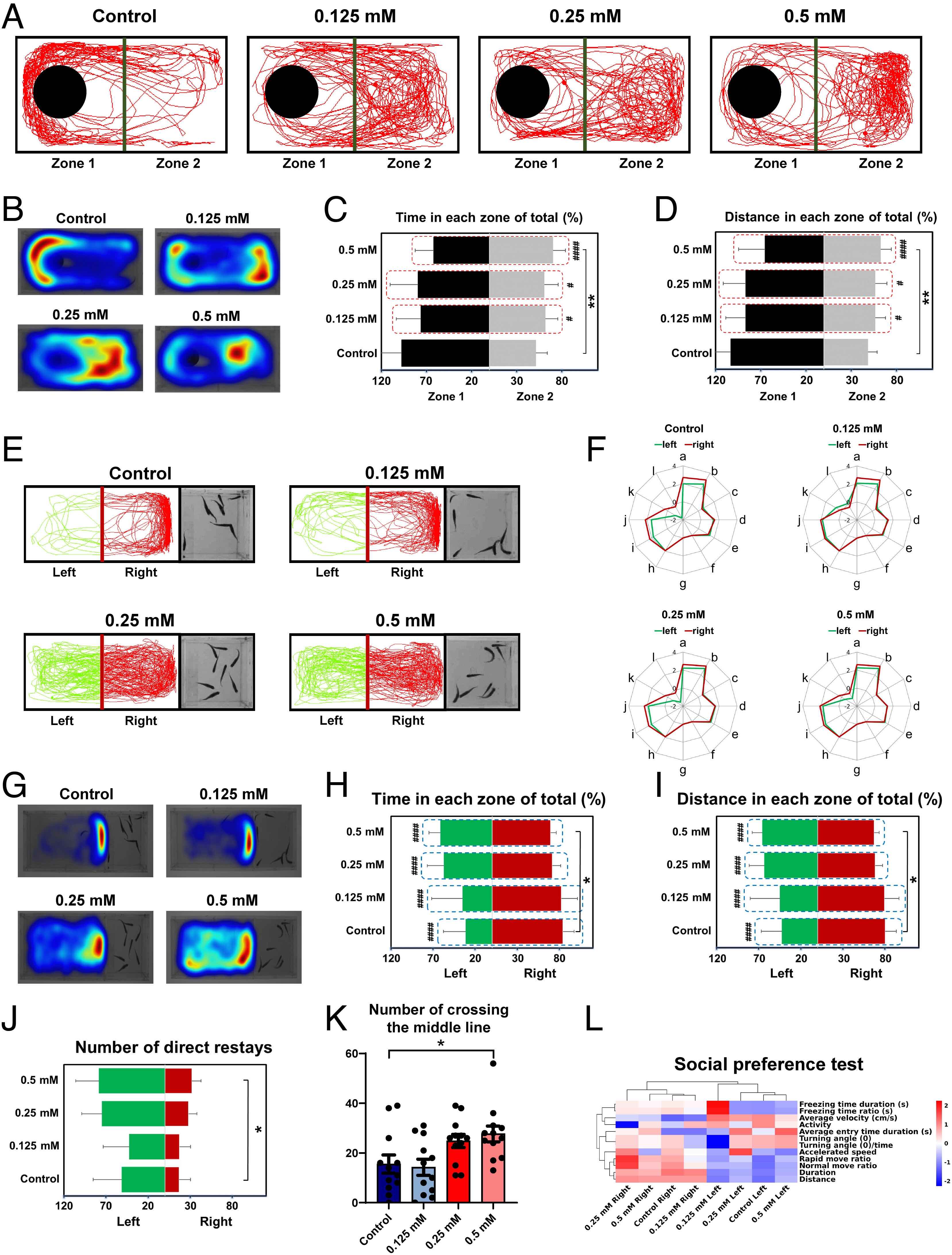
Behavioral profiles of zebrafish by the long-term exposure to acrylamide in the novel object exploration test and the social preference test. (A) Representative swimming trajectories of zebrafish in the control group and three acrylamide exposure groups (0 mM wide type, 0.125 mM, 0.25 mM, and 0.5 mM). A novel object for zebrafish was placed in the left part (Zone 1) and the right part was Zone 2. (B) Heatmap visualization of zebrafish trajectories in the novel object exploration test. (C) Duration time spent in Zone 1 or Zone 2 of total time (%). (D) Distance traveled in Zone 1 or Zone 2 of total distance (%). (E) Representative swimming trajectories of zebrafish in different groups (0 mM wide type, 0.125 mM, 0.25 mM, and 0.5 mM). (F) Radar chart of 12 behavioral parameters of zebrafish in different groups (0 mM wide type, 0.125 mM, 0.25 mM, and 0.5 mM). a, duration; b, distance; c, average velocity (cm/s); d, accelerated speed; e, average entry time duration (s); f, turning angle (°); g, turning angle (°)/time; h, activity; i, rapid move ratio; j, normal move ratio; k, freezing time ratio (s); l, freezing time duration (s). (G) Heatmap visualization of zebrafish trajectories in the social preference test. (H) Duration time spent in the left or right chamber of total time (%). (I) Distance traveled in the left or right chamber of total distance (%). (J) Traversing times between the left and right chambers. (K) Numbers of crossing the middle line. (L) Hierarchical clustering of zebrafish in the social preference test. All the histograms were present with mean ± SEM, while all behavioral parameter data were analyzed by the two-way ANOVA followed by multiple comparisons or the one-way ANOVA followed by the Turkey post hoc test. The level of significance was defined as *P < 0.05, **P < 0.01, ***P < 0.001, ****P < 0.0001; #P < 0.05, ##P < 0.01, ###P < 0.001, ####P < 0.0001 (* indicates significance between different groups and # indicates significance between different regions within the same group).
Yep, I believe it. Stress zebrafish by dosing their tank with a strange small molecule, and stressed zebrafish are stressed. They proved it, I’m satisfied. I am more than satisfied, I must concur: they have quantified to a remarkable degree that zebrafish are stressed by the presence of one component of french fried potatoes in their tanks. That’s total overkill.
I would just ask, do you think fast food workers are stressed by the omnipresent smell of fried foods in their clothes, their hair, the air they breathe? Does that suggest that you have identified the specific biological agent that causes anxiety and depression? No, it does not.
I respect the amount of work that went into the analysis, and think that every bit of knowledge we gain from research is worthwhile. But is it “run to CNN and let the world know that french fries cause depression” level of worthwhile? Is it even “publish in PNAS” worthwhile? OMG, is it “16 authors!” worthwhile?
Anli Wang, Xuzhi Wan, Pan Zhuang, Wei Jia, Yang Ao, Xiaohui Liu, Yimei Tian, Li Zhu, Yingyu Huang, Jianxin Yao, Binjie Wang, Yuanzhao Wu, Zhongshi Xu, Jiye Wang, Weixuan Yao, Jingjing Jiao, and Yu Zhang (2023) High fried food consumption impacts anxiety and depression due to lipid metabolism disturbance and neuroinflammation. PNAS 120(18) e2221097120.