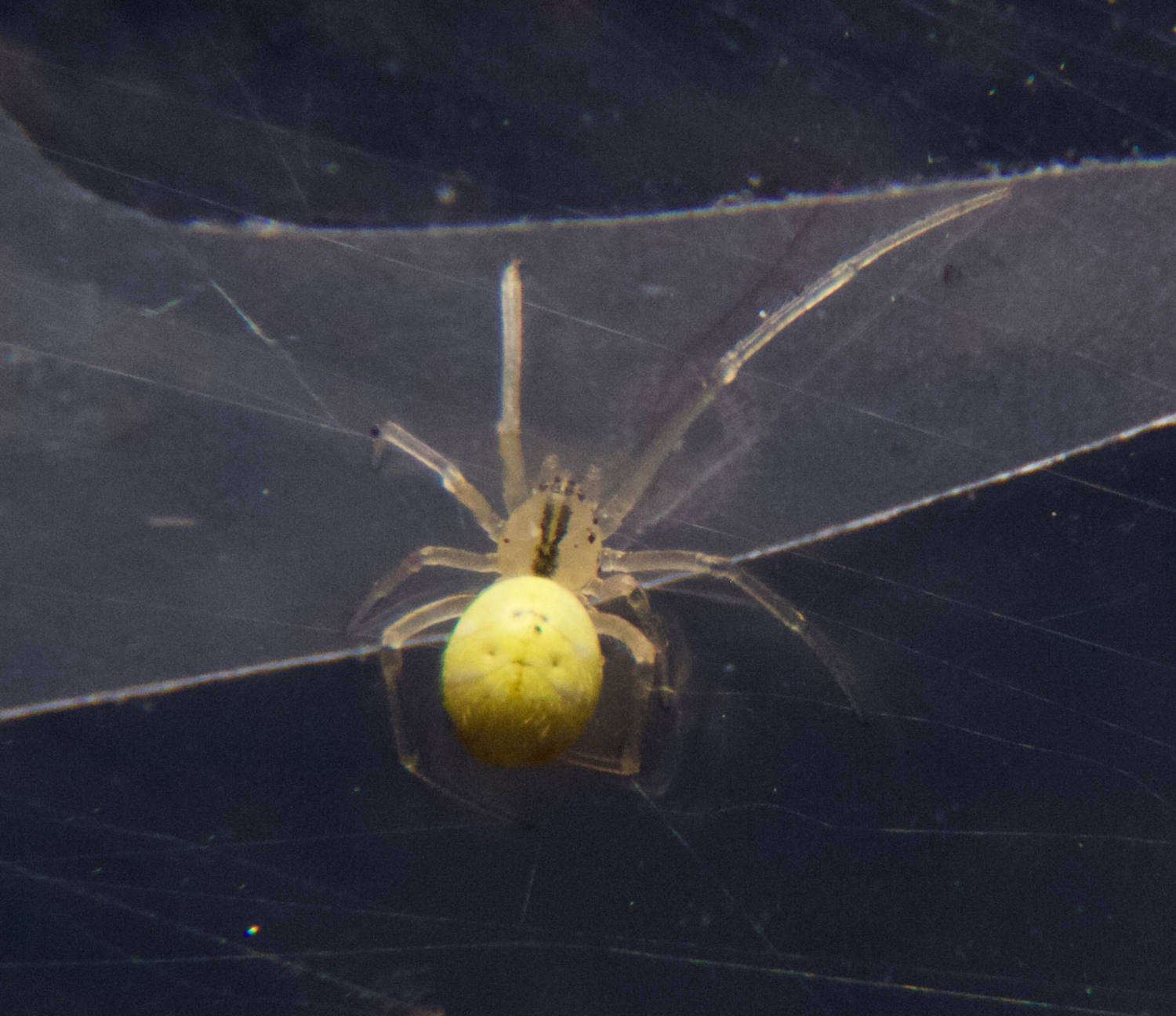
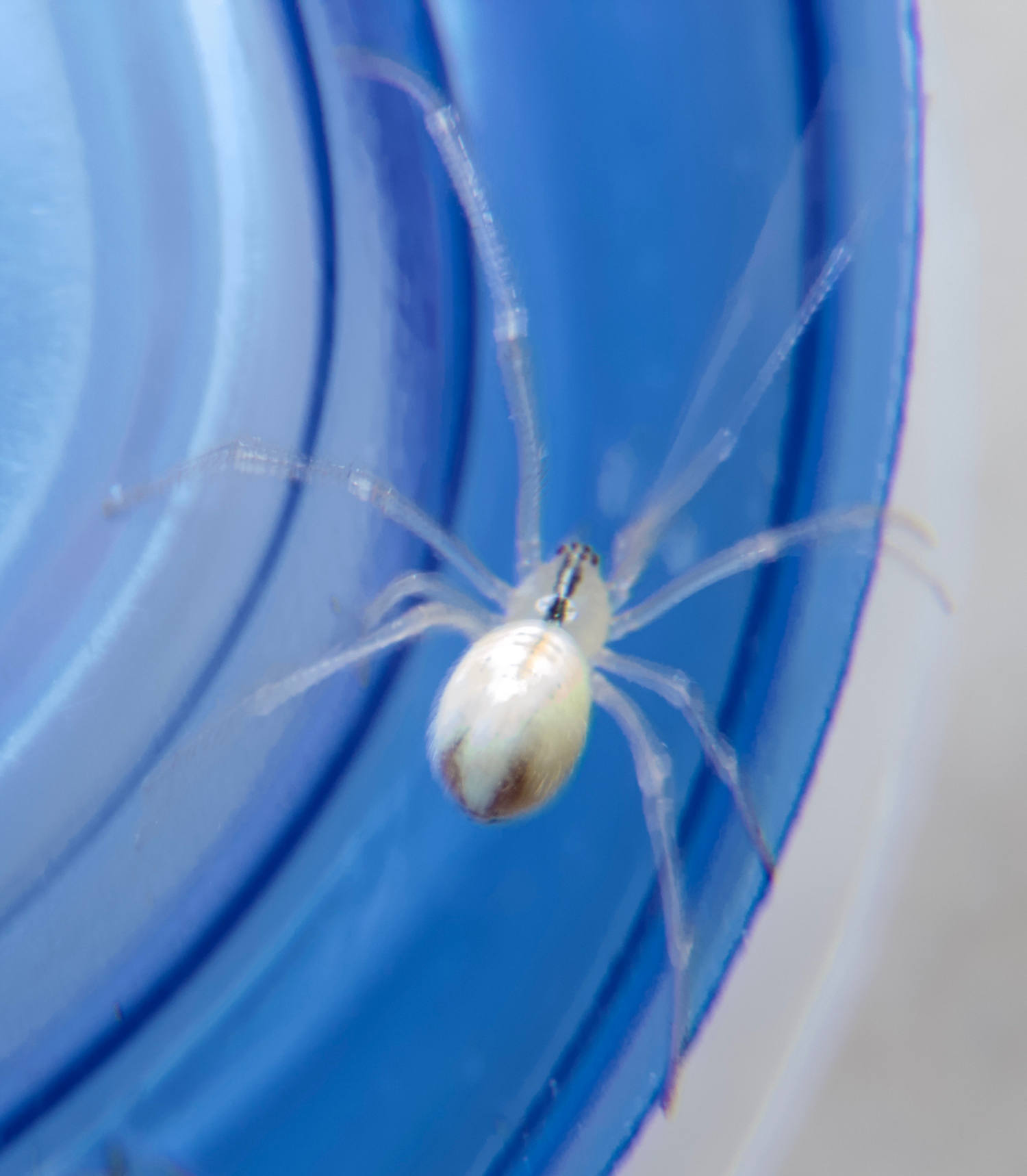
We poked around the garage where we found those little spiderlings, and we found this pale little cutie nearby. Maybe they’re related?
I’m guessing Enoplognatha, but I could be totally wrong and it’s Pityohyphantes. Or maybe something else?
We poked around the garage where we found those little spiderlings, and we found this pale little cutie nearby. Maybe they’re related?
I’m guessing Enoplognatha, but I could be totally wrong and it’s Pityohyphantes. Or maybe something else?
We went on a spider walk around the house last night. I thought it would be interesting to see what the spiders do after the sun sets — I’ve read that the species I’m most interested in is more active at night — so we put on our head lamps and prowled about the house and garden in the dark, to see what we could see.
It’s a different world. We saw a cicada, and lots of moths (they liked our headlights), and crickets, and mosquitos, and flies, and mosquitos, and mosquitos, and mosquitos, and mosquitos, and mosquitos, and mosquitos. This was a perilous journey if you’re anemic or fear blood loss. We were there for the spiders, though.
Our house is already festooned with theridiidids, and we saw even more. Mary has been noticing an expansion of sheet webs down near the foundation, and had been wondering who was responsible, and they were out, these cute little grass spiders. They hang out in the space underneath our siding, and what we saw at night is that they’d half emerge. They stick out their head and legs from spaces in the wall, but keep their butts hidden away. They were very shy, and when we got close…thwip, they’d instantly dart back into their hidey holes.
Mary wanted to try out the photography thing, and discovered that it’s harder than it looks. You’ve got so little working space in front of the lens, and you’ve got to move the snout of the camera right up next to anything before you see more than a blur, and to focus, you physically move the camera forward and back until you get the little spider right in the plane of focus, and then you have to click the shutter, but on an unfamiliar camera you’ve forgotten where the shutter button is, so you look and find it, and then you have to find the spider again. Repeat until you have it momentarily in view, then click, click, click. She did a serviceable job on this little Parasteatoda, she just needs to practice a little more. Look at that, the hind leg is in perfectly sharp focus!
More practice and she’ll be as addicted as I am, and then the last voice of sensible restraint in our house will be browsing camera catalogs, and instead of food we’ll have all the lenses I could want, and a couple of new camera bodies, and overpriced image processing software, and…
This grass spider is giving me the evil eye. I think I’ll let her go before I get a spider curse put on me.
Word on the street in these here parts is that you should ignore the warmth and the sunshine and wake up to the fact that the weather is going to change. Spiders are smarter than humans that way.
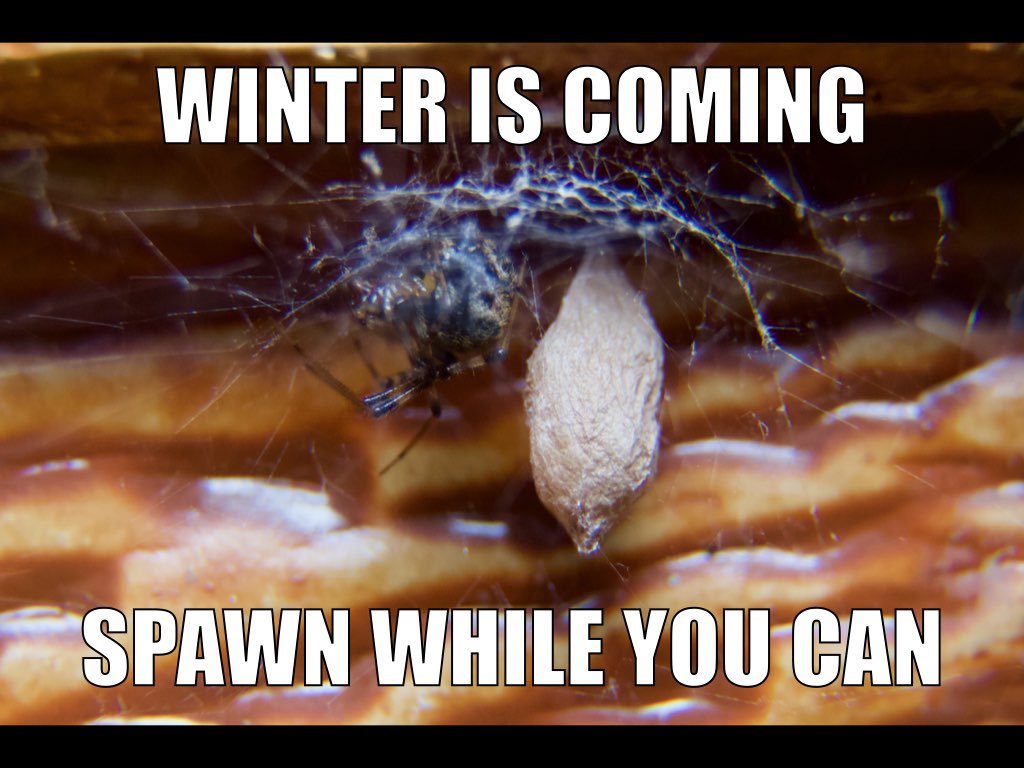
Seriously…so many egg sacs are appearing all over the place. I think the spiders are instinctively preparing for the catastrophe that is a Minnesota winter, and also responding to the bumper crop of mosquitos and other insects that are swarming everywhere right now.
The students and I have plans for this week.
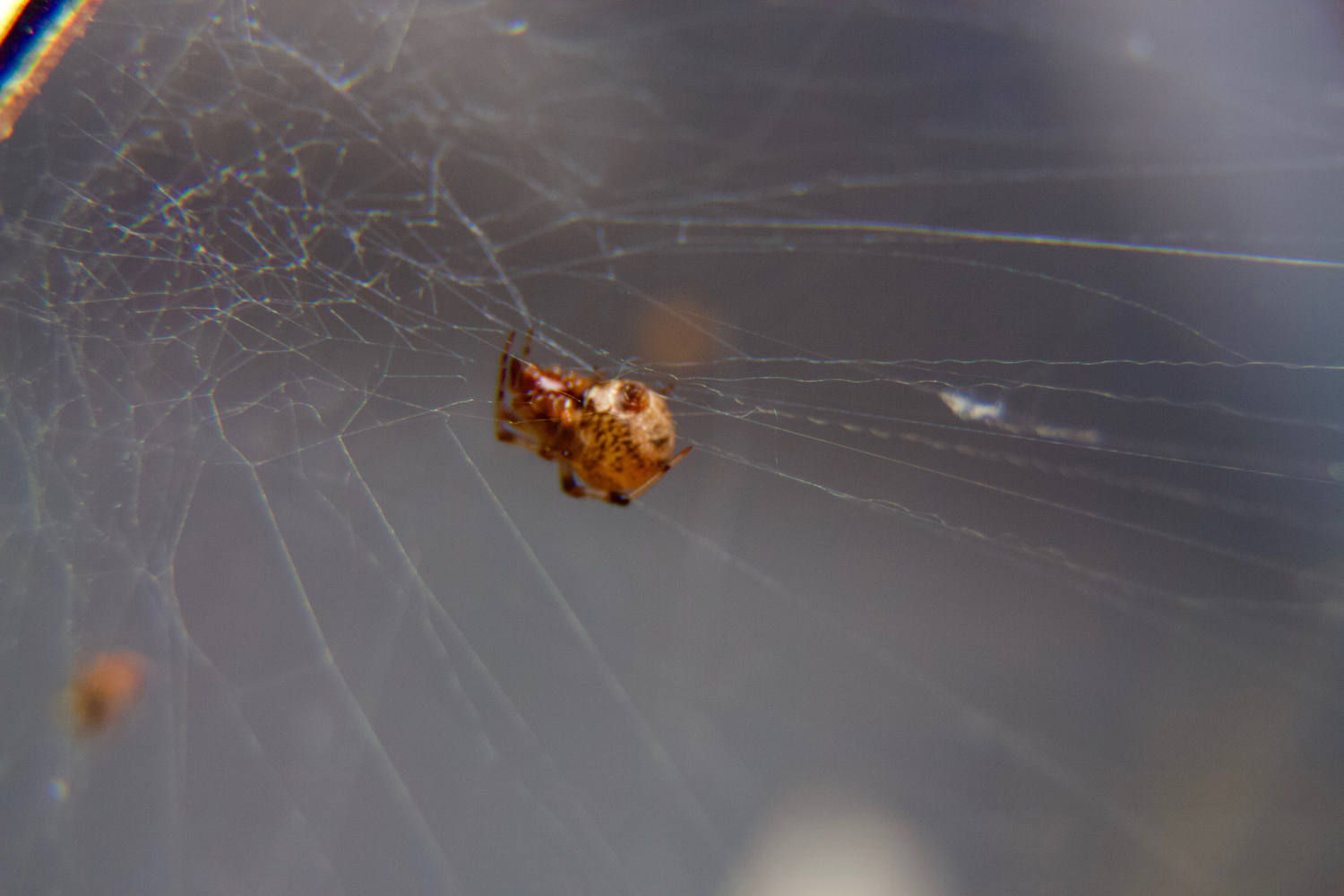
This is a different spider from the colony, but the photo just managed to capture a bit of the 3-D intricacy of the cobwebs they build in the frames.
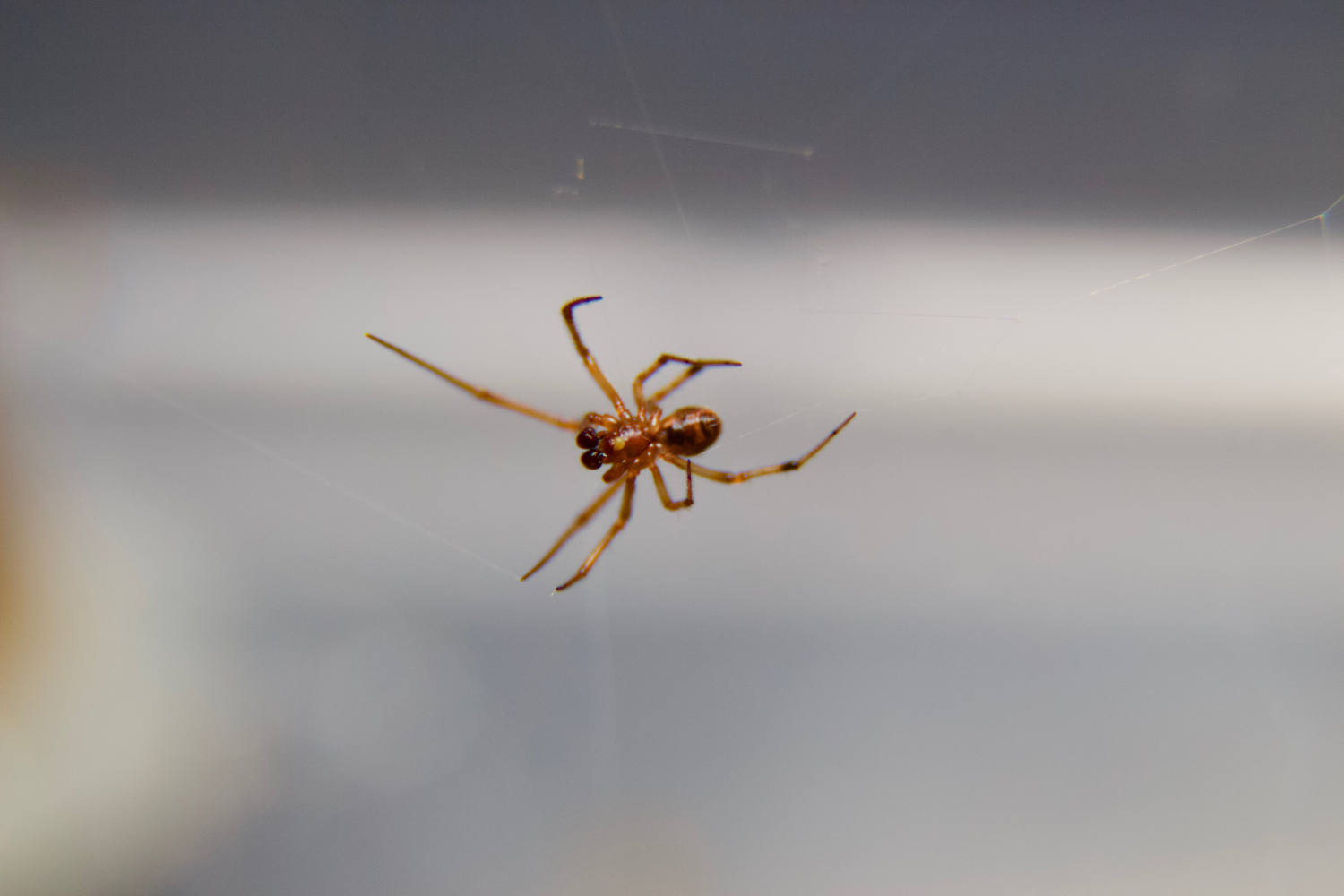
Here’s the proud papa of that egg sac.
By the way, he’s cohabiting with his partner with no conflicts at all. She hasn’t tried to eat him even once.
It was a long day in the lab — I had to catch up with washing glassware, a disgusting job since the main chore was all the fly bottles. There was a reward, however. I’ve been waiting for the colony to take off, and finally, they’re just pumping out spider eggs. We counted nine egg sacs at various stages of development today. Here’s one proud mama with her gigantic egg sac. Yes, all that came out of little ol’ her. She’s looking a bit deflated since this weekend.
In case you’re wondering what you’re looking at, we cut up cardboard boxes that contained mini-cans of pop, which turn out to be just the right size for our sterilyte containers. We cut out the center of the boxes, leaving just the edges and corners, which makes for a nice frame for them to spin cobwebs on. The big advantage is that we can pick up the whole cardboard frame, carrying along the spider and her web undisturbed, and rotate it around to find where she was hiding. In this case, she’s snugged up in one corner of the light cardboard box with an egg sac that is, I swear, twice her size.
If you compare this photo to yesterdays, you can see that yesterday the embryos were in the process of molting, with the prosoma free and the abdomen and legs still trapped in the old cuticle. Today the legs are free and the old cuticle is a shriveled white mass at the end of the abdomen.
We have lots of healthy looking babies from this clutch, which worries me…we’ve got three more egg cases that will probably hatch out this week, and we’re going to be swimming in baby spiders. I’m going to need a lot more flies, I think.
Here’s a closer look at its cute l’il baby face.
There was some concern about a clutch of embryos that I accidentally removed from the egg sac prematurely. I was worried that they wouldn’t develop properly. Well, concerns allayed. They’re busy making legs just fine.
One catch, though, that I discovered to my horror. There’s a reason for that protective silk egg sac: at this age they’re just a delicate membrane over a ball of fluids, and they rupture at the slightest touch. I’m going to have to leave them alone until they’re tough enough to walk about on their own.
I’m back! I have to say that, after drinking margaritas with Iris, the next best part was the spider tour, and in particular this one place, the Thompson Hill Information Center and Rest Area, which was magical.
I had a good feeling when I saw all the plants growing up right next to the building, and I was right. I went to the left behind the shrubbery and there in the corner, I saw this:
All those dark dots running down the center? Spiders. All Parasteatoda. I counted 9 in just this one little strip, and there were more and more all around the building, and then there were multiple picnic shelters that were home to many more. It was a spider bonanza!
Want to see a few? Look below the fold.