Everyone needs a pet spider!

If there’s just one thing I miss from my zebrafish days, it’s being surrounded by fish tanks. Lovely burbling fish tanks, filled with little dancing fish, so soothing. So nice. So restful.

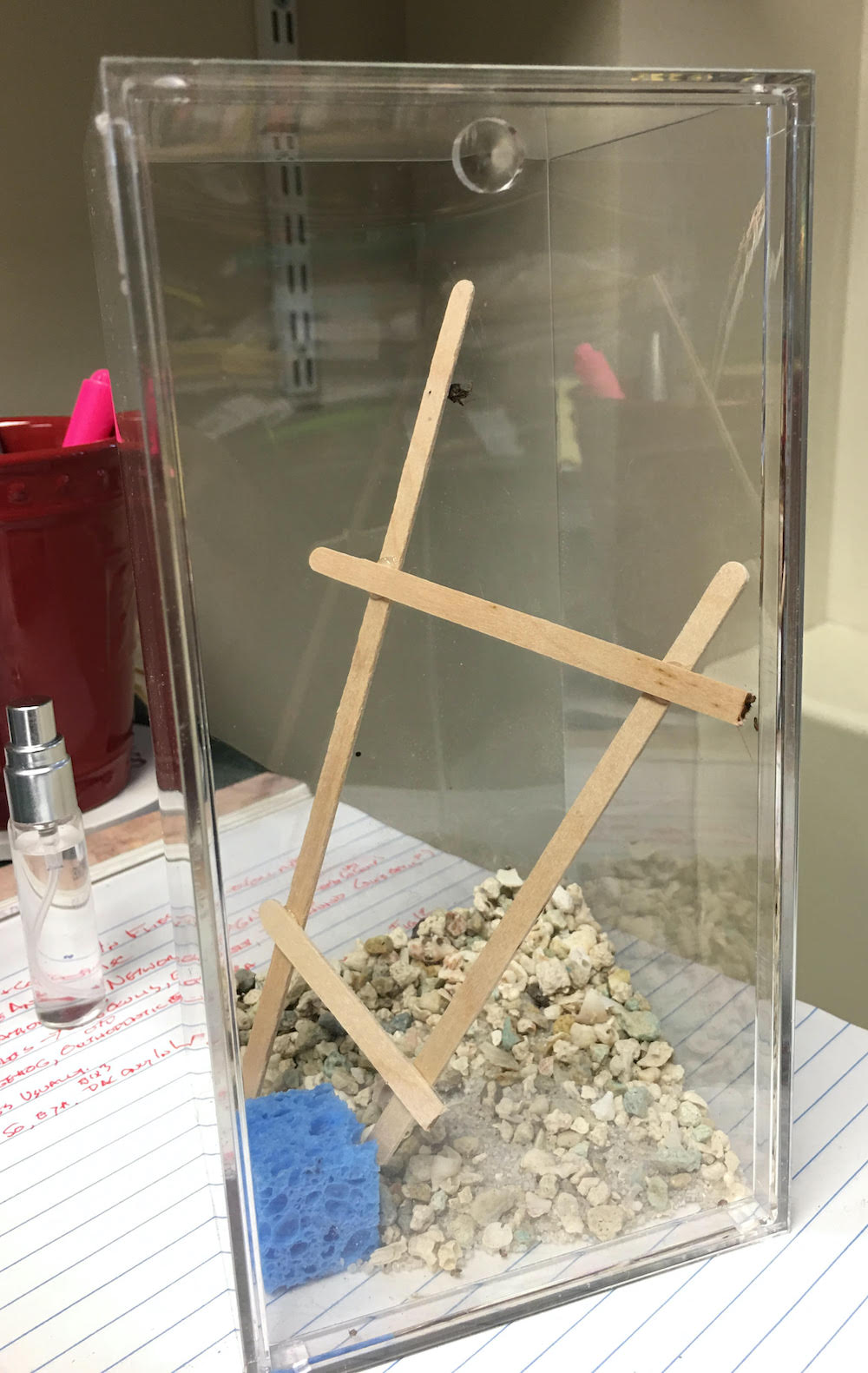
Well, they’re gone now, so I wanted something to replace them, so I threw together a couple of terraria with spiders. It was easy. First I thought of repurposing all these fish tanks I’ve got, but they’re too large — my spiders are small, these aren’t tarantulas — and the lids were perforated and wouldn’t be any kind of obstacle. Then I found these acrylic display boxes, which are intended for 1/32 scale model cars, or dolls, or action figures. I can do better than that — spiders! So I made a few.

The one on the left holds a bronze jumping spider and a chunk of stick, while the one on the right is Parasteatoda with a simple frame I slapped together with coffee stirring sticks and hot glue. The jumper has its own charm, but is a little on the small side right now (I’ll fatten him up). The house spider is fascinating and is a real distraction in my office. She immediately started assembling a web on the frame, scurrying about, jumping from stick to stick. I really recommend them for everyone’s office. You should get one or two or four.

I also needed some distraction. Oh no! Another egg sac erupted with babies!

I’m not sure what I’m going to do. My incubators are full to capacity. I might have to try feeding them en masse, until they’re big enough to thrive, and then turn them all loose somewhere. Like my house. Mary won’t mind.

Alternatively, you could all buy some of those acrylic display boxes, stop by the university, and I could stock them up for you. Seriously! They’re fascinating! Like aquarium fish, only dryer!


In case you have no idea what you’re looking at in that last picture, here’s a key.

Hope that helps!

Spider feeding day!

It’s been a long day of preparing my mighty army of baby spiders. All have now had flies sacrificed to them, so while I was flicking flies into vials, I recorded and uploaded this short clip of one Parasteatoda happily finishing off her prey.

They are so young, and yet they’re already murderous hellbeasts. At least from the perspective of Drosophila.

Spiders of the Industrial Wasteland

Today I had to take the car in to get new tires. We’re a rural bit of the country, but that doesn’t mean we’re all green and soil and fresh sprouts — this was a tire store next to the railroad tracks with a line of grain elevators across the street. I wasn’t about to hang around in the waiting room, so I went prowling about the industrial wasteland next door.
What did I find? Cryptic machinery, corrugated sheet metal buildings, and iron rails, of course. With spiders!

[Read more…]

Dispelling the aura of danger around spiders

I keep telling everybody — spiders aren’t as scary/dangerous as you think. Now I have a paper that quantifies the risk of deadly spider venom. It’s low.

• The increasing popularity of pet arachnids urges some governments to take protective steps to prevent serious envenomations.

• A literature review was carried out to assess which arachnids can be classified as potentially dangerous.

• About 0.5% of all spider and 23% of all scorpion species were classified as potentially dangerous.

• Even envenomations from the most dangerous arachnids have a low percentage of serious or even fatal consequences.

• We conclude that the public threat from pet arachnid envenomations has been overrated.

Here’s the list of potentially dangerous genera.

Note that the list errs strongly on the side of caution. It lists Eratigena, the hobo spider, but says in the text that “there is not a single verified bite that confirms E.agrestis or other members of this genus as dangerous to humans”. Latrodectus, black widow spiders, do have a real record — 23,000 incidents reported over 8 years — but less than half of those cases involved envenomation, and only about 1% exhibited severe effects, and there were 0 deaths. The Parasteatoda and Steatoda species I work on are only briefly mentioned and dismissed because their effects are much weaker than those of Latrodectus.

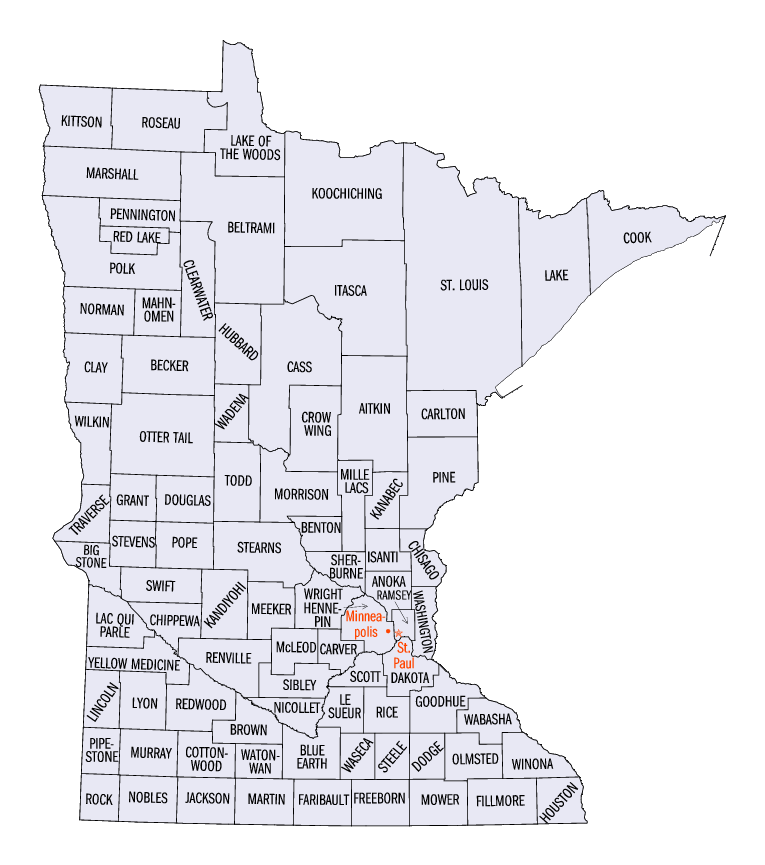
I’ve also never encountered any of the spiders they list, and I’ve been looking. I guess if I lived in Malaysia or Brazil I’d experience more of the thrill of danger, but here in Minnesota we’ve got a non-existent concern, and even in those tropical countries it’s a relatively minor worry.

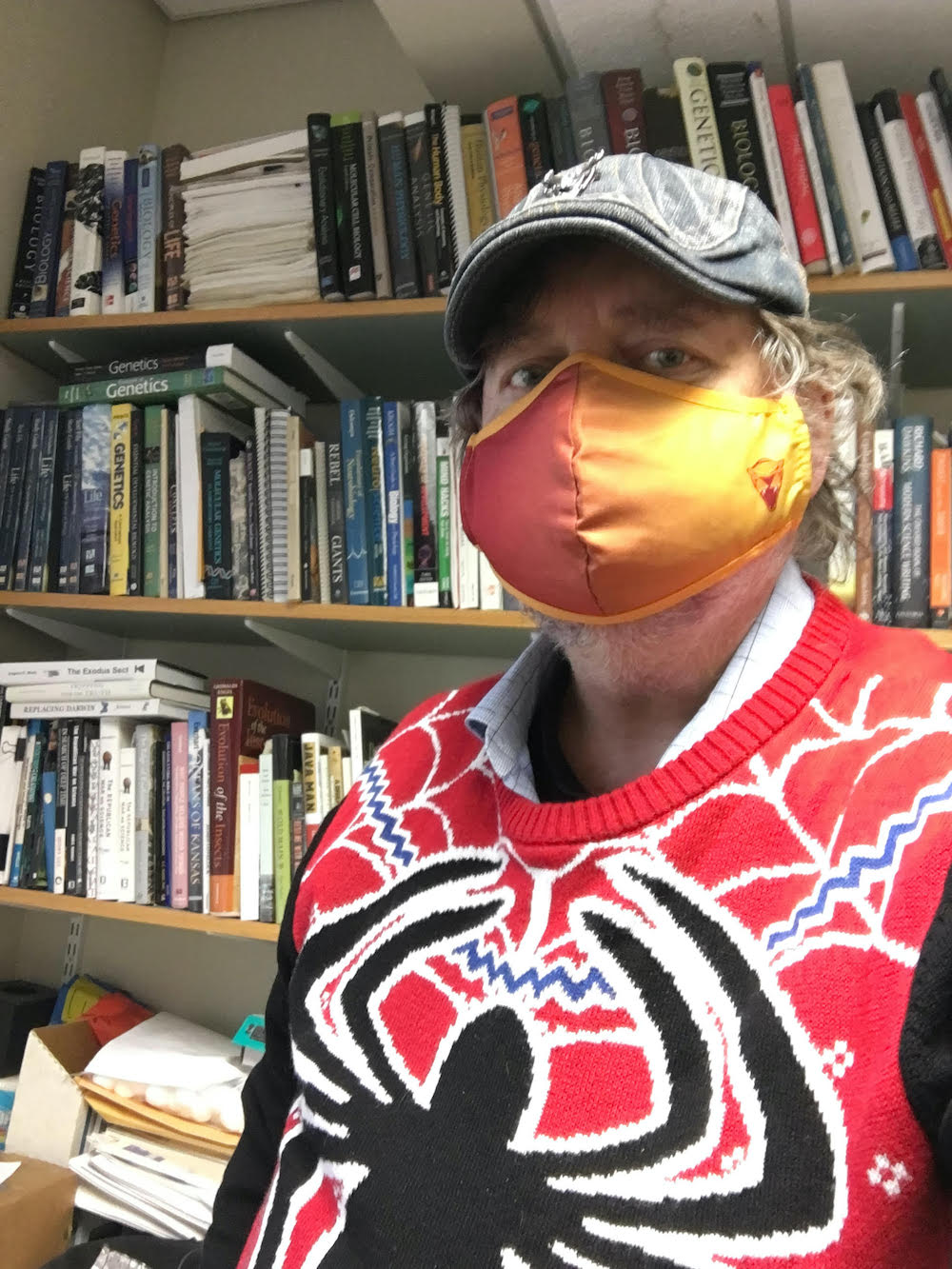
(Of course I learned about this paper from Gwen Pearson. It’ll be useful if anyone at the university expresses concern about the hundreds of spiders currently in my lab.)

Answers in Genesis gets everything wrong

Tonight, at 9pm Central, I’m going to try and wade through the bullshit Ken Ham threw everywhere in a recent video. He’s complaining about atheism, abortion, molecular biology, development, and of course, evolution, all in one crowded half hour, so I’ll start going through it all and see how far I get.

This is also an experiment for me, to see if I can simultaneously put up a YouTube video and make commentary. I don’t know, seems like a tool it would be handy to have in my toolbox.

Tell me again how evolutionary psychology is not a con game

This is how evo psych works: state your hypothesis about past human societies with absolute confidence in the absence of any evidence, and then follow up with how The Lord of the Rings supports your model of a transition from a brutish form to a more gracile, effeminate form. Geoffrey Miller demonstrates:

So, the kill count competition between Legolas and Gimli is easily understood evidence of the evolution of warfare. Does that make Aragorn a transitional form?

Where is the informed discussion of alien life on the internet?

Oh, god, the assumptions. I like speculations about alien life, just as I appreciate the diversity of life on Earth, the different forms of life in the past, and the prospect of evolution in the future, but every time I read about this stuff in astronomy-related journals, I feel like they’re making an effort to reduce my intelligence. The problem is that they have no imagination and no biology, but they’re trying to imagine the nature of alien biology, and all they end up doing is running around in circles trying to figure out why little grey humanoids aren’t landing their flying saucers en masse to march out and shake hands with the president. It’s all Fermi Paradox this and Drake Equation that, two stupid ideas that have captured the eyeballs of everyone with these biased priors, and they always go trotting off to get the opinions of the same spectacularly ill-informed people. Take this bad article in Universe Today.

The first horror: they favorably cite Robin Hanson, the creepiest economist in America, and they quote a contradictory statement by him.

Humanity seems to have a bright future, i.e., a non-trivial chance of expanding to fill the universe with lasting life. But the fact that space near us seems dead now tells us that any given piece of dead matter faces an astronomically low chance of begating such a future. There thus exists a great filter between death and expanding lasting life, and humanity faces the ominous question: how far along this filter are we?

Why? Why do you think a “bright future” is equivalent to “expanding to fill the universe with lasting life”? Why do you think that’s the road we’re on, when there’s a total absence of viable colonies of humans on other worlds, and all the other planets in our solar system are uninhabitable, and planets around other stars are unreachable? What is the basis for thinking that we have that particular “bright” future in front of us, especially when you immediately admit that the chances are astronomically low?

This is my problem with the general tenor of these speculations. They all assume that we, that is human-like intelligences, are desirable, inevitable, and the only proper kind of life; they’ve read far too many science-fiction novels prophesying a colonialist destiny led by strong-jawed Anglo-Saxons with glinting eyes and a finger on the trigger of their blaster. They never seem to consider that the truly successful clades on Earth are things like algae, grass, protists, and insects. If we were to speculate on the species with bright futures, they’d all be weedy and prolific and adaptable to a wide range of environments. They wouldn’t be overgrown monkeys who can’t even imagine a non-monkey future.

The second person the article cites is weirdo philosopher Nick Bostrom. It’s funny how these kinds of stories always shy away from talking to evolutionary biologists. It’s probably because we tend to get all squinky-eyed and sarcastic about their faulty premises. Or is that just me?

The Great Filter can be thought of as a probability barrier. It consists of [one or] more highly improbable evolutionary transitions or steps whose occurrence is required in order for an Earth-like planet to produce an intelligent civilization of a type that would be visible to us with our current observation technology.

See? That’s what I’m talking about. They’re always going on and on about the likelihood of finding an intelligent civilization like ours. Why not speculate about finding a planet that has produced kangaroos? Or stomatopods? Or baobab trees? These are all unlikely outcomes of a contingent, complex process that produces immense diversity, and they’re all wondering what the “barrier” is that prevents our kind from winning the cosmic lottery every time. Get over it, we’re not a favored outcome, there’s no direction to evolution, and that’s why there aren’t smarty-pants bipeds tootling about the galaxy stopping by for tea. That and physics, probably. I also don’t understand why mobs of physicists aren’t rising up and pointing at the speed of light and the energy requirements for interstellar flivvers and saying “That’s why!”

Then this article has to take a predictable slant in a section titled…

Gotta Love the Drake!

No, you don’t. The Drake equation is a simplistic collection of variables with no suggestion of mutual dependency that are concatenated to provide a whole string of excuses for why human-like aliens aren’t sending us their version of “I Love Lucy”. It’s basically a Ouija board for apologists for science-fiction outcomes. It’s a tool for churning out meaningless crap. It’s kind of like how the article ends with this self-serving statement.

We have written many interesting articles about the Great Filter, the Fermi Paradox, the Search for Extraterrestrial Intelligence (SETI), and related concepts here at Universe Today.

Again, no you haven’t. If I were an editor at Universe Today, I’d scratch out the word “interesting”, and maybe, to throw them a bone, write in “infuriating”.


One more thing that annoys me. They cite Hanson again, saying that one of the benchmarks for his preferred flavor of alien intelligence features Wide-scale colonization. I’m just thinking, given his other criteria, that any planet suitable for colonization is already going to contain a fascinating extraterrestrial biota — they wouldn’t have an oxygen-rich atmosphere, or soil, or exploitable organic materials otherwise — and from a biologist’s point of view, the “colonization” he considers desirable is going to involve the destruction of native species on a large scale. We’re lucky, given that it’s Hanson, that he didn’t speculate on the universality of rape. That’s more his thing.