Pharyngula
Evolution, development, and random biological ejaculations from a godless liberal


This weekend, I got into an argument with Eneasz Brodski, Eliezer Yudkowsky, and David Brin about immortality. We each took a few minutes to state our position, and I prepared my remarks ahead of time, so here they are, more or less.
First, let me say that I’m all in favor of research on aging, and I think science has great potential to prolong healthy lives…and I’m all for that. But I think immortality, or even a close approximation to it, is both impossible and undesirable.
Why is it impossible? I’ll cite the laws of thermodynamics. Entropy rules. There is no escaping it. When we’re looking for ways to prolong life indefinitely, I don’t think there’s enough appreciation of the inevitability of information loss in any system in dynamic equilibrium, which is what life is — a chemical process in dynamic equilibrium. What that means is that our existence isn’t static at all, but involves constant turnover, growth, and renewal.
We already have a potent defense against death put in place by evolution: it’s called more death. That sounds contradictory, I know, but that’s the way it works. Every cell replication has a probability of corruption and error, and our defense against that is to constrain every subpopulation of cells and tissues with a limited lifespan, with replacement by a slow-growing population of stem cells (which also accumulates error, but at a slower rate). We permit virtual immortality of a lineage by periodic total resets: reproduction is a process that expands a small population of stem cells into a larger population of gametes that are then winnowed by selection to remove nonviable errors…but all of the progeny carry “errors” or differences from the parent.
In all the readings from transhumanists about immortality that I’ve read, none have adequately addressed this simple physical problem of the nature of life, and all have had a naively static view of the nature of our existence.
The undesirability of immortality derives from the proponents’ emphasis on what is good for the individual over what is good for the population. There’s a kind of selfish appeal to perpetuating oneself forever, but from the perspective of a population, such individuals have an analog: they are cancers. That’s exactly what a cancer is: a unit of the organism, a liver cell or skin cell, that has successfully shed the governors on its mortality and achieved immortality…and grows selfishly, at the expense of the organism.
Of course, it then all spun on from that and much more was said on all sides.
The transhumanists certainly had an ambitious vision for the future — they talked rather blithely about living for billions of years or more, but just their idea of individuals living for 10,000 years seemed naive and unsupportable to me. I don’t think it’s even meaningful to talk about “me”, an organic being living in a limited anthropoid form, getting translated into a “me” existing in silico with a swarm of AIs sharing my new ecosystem. That’s a transition so great that my current identity is irrelevant, so why seek to perpetuate the self?

Think about what you’re seeing in this video of the floor of the Sea of Japan: through most of it, small animals are getting gouged and shredded and dragged down into sarlacc pits and chewed up alive or swallowed whole. When the cephalopods show up, it’s a relief — they’re just looking pretty onscreen (or in the case of the baby cuttles, looking adorable).
OK, and the orange frogfish with her hopeful suitor toddling along was also nonviolent. But it’s mostly a horrible world!

This was something of a lost weekend for me, with a lot of behind-the-scenes distractions, so I forgot to put up a Friday Cephalopod. So here’s a belated Monday Cephalopod to make up for it all.

Here, at long last, is proof sufficient to most systems of jurisprudence that I am not PZ’s alter ego.
It’s the video from the #FtBCON panel Science, Skepticism, and Environmental Activism, held Saturday evening California time, also featuring Madhu Katti and Jennifer Campbell-Smith, my colleagues from the Coyot.es Network. The panel also featured Piasa the European starling.

Reddit finally took action and shut down an incredibly racist forum. How racist? It was called “r/niggers”.
As the offensive name implies, r/niggers was a place for users to bond over their disdain for black people. While Reddit itself boasts 69.9 million monthly users, r/niggers had only 6,000 members. On the other hand, on a percentage basis, it was one of Reddit’s fastest growing online communities this year.
Visiting r/niggers was a mental chore. Emblazoned with icons like watermelons and fried chicken legs, the site maintained a rotating roster of photographs of whites who have presumably been the victims of violence by blacks, as if no white person has ever committed a violent crime. Most of the community’s content was about what you’d expect: news stories about crimes committed by blacks, pseudoscience about black inferiority, and personal anecdotes about troublesome interactions with black people.
But it wasn’t just some dead eddy, a backwater full of inbred ignorant haters slapping each other on the back and telling each other how smart they were to hate black people — no, they proudly intruded on other groups, especially groups frequented by people of the color they hated, to spew out slurs and ignorance. They remind me of a certain other group that will be doing their damnedest to intrude on FtBCON this weekend (and are already dumping crap on the twitter feed).
They also remind me of that group by another attribute: the fetishization of free speech.
Much like posters on r/creepshots and r/jailbait before it, r/niggers subscribers maintain that theirs is firmly a free speech issue; they see themselves as “the last bastion of free speech on Reddit.” They argue that despite their calls for racialized violence and liberal use of slurs, r/niggers is a legitimate “venue for discussing racial relations without censorship or political correctness.”
r/niggers users even see their shadow-bans as “dying” for the cause of free speech. When their accounts are banned, the community’s moderators add their names to r/RedditMartyrs, a kind of online graveyard that honors former r/niggers subscribers with names like CatchANiggerByTheToe and CoonShine. Its sidebar proclaims that they died for their cause, noting, “In 2013, Reddit declared war on freethinking subscribers of an uncensored community known as r/niggers. These martyrs were shadow-banned by reddit admins and turned into ghosts. Gone but not forgotten, we honor their memory and their sacrifice.”
Right — every word plopped out of the mouths of bigots is precious and must be protected.
No, that’s wrong: you get to say it, no one should have any power to reach out and stitch your mouth closed or break your typing fingers, but no one is under any obligation to host bigotry, and free speech shouldn’t mean you are completely free of responsibility for what you say. I’d be more sympathetic to the cause of their free speech if they actually owned their hatred instead of hiding behind demeaning pseudonyms, the internet equivalent of white sheets and hoods, and actually had something intelligent to say.
Here’s one of the milder racist whines posted in that article.
Here’s what anti-whites need to understand. It’s not the skin color that we hate. I mean we hate that too because it looks like the color of shit. But really what we care about is the genetics underneath. Unless you show me a study showing black labs are more likely to murder and rape than golden labs. I’m going to assume they’re the same. That’s the difference between you and us. We look at facts. You think the demise of civilization is something to laugh about.
I really care about the mind underneath. And even if your skin is the same lovely pale shade as mine, the density of your melanocytes says nothing about the quality of your thoughts.
(By the way, a certain word used with high frequency in the linked article — guess which one? — is also on the blocked word list here. Take that into account in your comments.)

Now that we’re regularly getting small numbers of eggs and embryos every day, we thought we’d test out all the other gear by making an extended timelapse video, letting it run overnight. Unfortunately, in the wee hours of the morning, God apparently struck and slaughtered the little baby fish in its chorion, and embryo went splat. We’ll show it anyway.
This happens spontaneously a few percent of the time, a bit more frequently in embryos we’ve poked and jostled and plopped into a stressful environment, so don’t be alarmed. Nature is not kind to embryos.

It’s not the Koh-I-Noor or the Empress Eugenie Brooch or whatever my wife is wearing right now, it’s this:
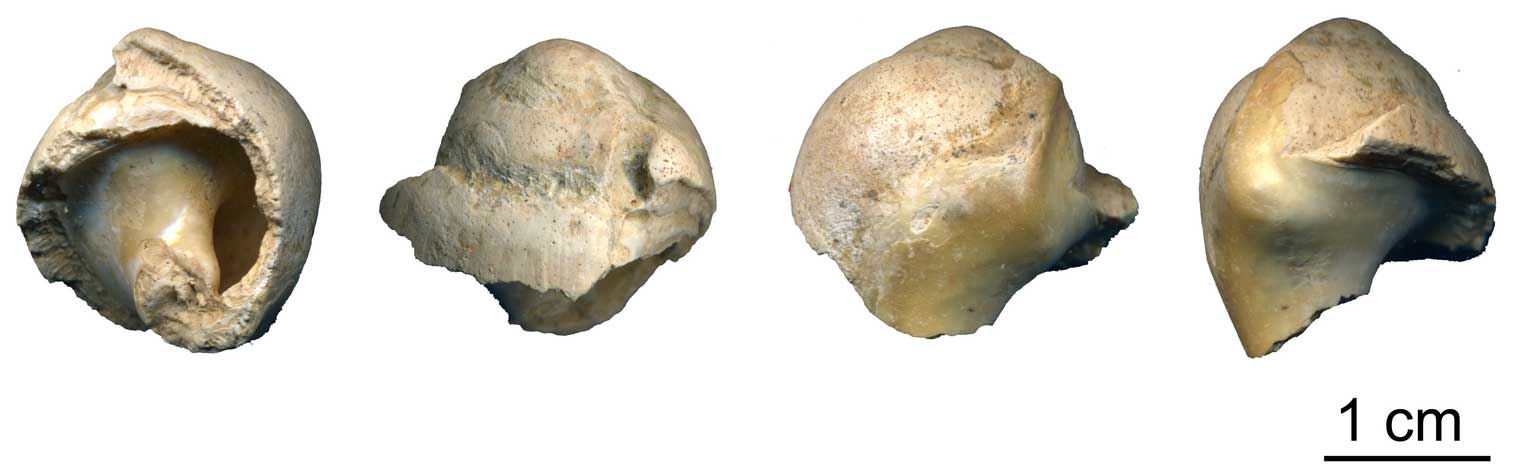
It’s a small, broken fossil shell, collected from a fossil outcrop and transported 110 kilometers to a hole in the ground in Italy. Close inspection reveals that before it was broken, there was a pattern of abrasion in one spot that suggests a hole had been drilled in it and a loop of sinew threaded through it. Although most of it has been worn away by time, bits of material in microscopic pits on its surface reveal that once, this shell had been painted with red ochre.
It doesn’t sound like much. But then, what makes it precious is the burden of antiquity it carries: it’s about 47,000 years old, and it was made by Neandertals.
A few Lower and Middle Paleolithic sites preserve exotic objects with no obvious functional role and striking visual appearance such as quartz crystals, fossils, shells, and natural objects mimicking human or animal shapes. These are interpreted as the first evidence for the ability to distinguish ordinary from exotic items, to create conscious cultural taxonomies, and/or to detect iconicity in the natural world. Some argue these sporadic finds would have prompted the mental bridge between referent and referrer thus igniting the creation of symbolic material cultures. Although this possibility cannot be discarded, three reasons may favor the interpretation of the Aspa marginata from Fumane as a pendant, i.e. an object conceived to be suspended for visual display body through threading or stringing. The attention put to uniformly cover the outer shell surface with good quality red pigment suggests that this action may have been performed to make the object suitable for visual display. The wear detected on the inner lip, made of overlapping groups of striations oriented perpendicular to the shell main axis, is consistent with a sustained friction produced by a cord rich in abrasive particles, such as sinew. The absence of pigment on the shell fracture is most consistent with this item being used as a pendant.
It’s art. Very, very old art, made by a people who are completely extinct today, from a culture of which we have almost no knowledge, just these lost scraps with all context lost. That also adds great value to the object, that it is such a tiny fragment of knowledge, that it reminds us of how little we actually know about these long-gone people. Tens of thousands of years from now, if anyone is going through our decayed rubbish heaps, they aren’t going to find the Mona Lisa, a well-preserved space shuttle, or sheet music from a Beethoven symphony — they’re going to find a broken plastic toy from a McDonald’s Happy Meal, or a nicely symmetrical fragment of a concrete traffic bollard, and I suspect it will be regarded as a great and rare treasure then, too.
I also just find it wonderful to contemplate — that over 40,000 years ago, our relatives found enough stability and security in their communities that they had time to express themselves, and that they naturally exercised their minds and hands to create art, and that they worked to adorn themselves.
Peresani M, Vanhaeren M, Quaggiotto E, Queffelec A, d’Errico F (2013) An Ochered Fossil Marine Shell From the Mousterian of Fumane Cave, Italy. PLoS ONE 8(7): e68572. doi:10.1371/journal.pone.0068572

Looking for information on sugar substitutes? This green stuff is one of them.

via EZGro Garden

Thirty, almost forty, years ago when zebrafish were an up and coming model system and very few labs were working on them, we were used to going to conferences and reciting the zebrafish litany, a list of attributes that justified us working on such an oddball animal: we’d explain, for instance, that it was prolific, fast developing, and optically transparent, so we could see right into the nervous system in the living embryo. And you know, not once have I ever been asked the really simple and obvious question: if it’s transparent, then how do we see anything inside it?
I know. It takes a moment to step outside the assumptions (we say we see stuff, after all) and think about what transparency actually means. Of course, I always have an answer prepared: “With differential interference contrast microscopy, Nomarski optics specifically.” A polysyllabic phrase is always an effective way to shut down the rubes, isn’t it?
But I can also explain it in simple English, especially if I can flail about on a chalkboard at the same time. So let’s try.