Some people actually do keep octopuses as pets; it’s not easy, and it’s heartbreaking when they die. They always die.


Some people actually do keep octopuses as pets; it’s not easy, and it’s heartbreaking when they die. They always die.

This is just a preview — there’s a 20 minute short film hitting the movie festival circuit any time now. I want to see the whole thing.


I’m just curious — did anyone else hear about the big pipeline explosion near Winnipeg? I’m sure that if you lived in southern Manitoba, where thousands were without heat for their homes in January, knew all about it. But I didn’t see much in the news about this terrifying event.

There may be a reason for that. Pipeline explosions aren’t that unusual or newsworthy, I guess.
Carl Weimer, executive director of Pipeline Safety Trust, a non-profit watchdog organization, says that, on average, there is “a significant incident — somewhere — about every other day. And someone ends up in the hospital or dead about every nine or ten days.” This begs the question: are pipelines carrying shale gas different in their explosive potential than other pipelines?
“There isn’t any database that allows you to get at that,” says Richard Kuprewicz, a pipeline safety expert and consultant of 40 years’ experience. “If it’s a steel pipeline and it has enough gas in it under enough pressure, it can leak or rupture.” Many pipelines, says Kuprewicz, aren’t bound by any safety regulations, and even when they are, enforcement can often be lax. Where regulations exist, he continues, corporate compliance is uneven. “Some companies comply with and exceed regulations, others don’t. If I want to find out about what’s going on, I may [have to] get additional information via subpoena.”
The United States has gone fracking mad — Obama even made a point of mentioning that we’ve become a net oil exporter in his state of the union address, without bothering to say how that happened — but we ought to be concerned. It’s easy to ignore the fact that parts of North Dakota and Canada are being shredded and poisoned and torn apart because nobody lives there (well, nearly: low population density rural areas are fair game for exploitation, because biomes don’t sue), but then they run poorly regulated and maintained pipelines straight to our homes.
Another thing that raises my hackles: they’ve taken to naming these pipelines with words to inspire reverence among the rubes. “Keystone” is sort of neutral, but the article above talks about one called “Constitution”. Are you against the Constitution? What kind of ‘Murican are you? I expect any day now to discover a pipeline proposal called “God & Family” or, let’s go straight to the heart of the matter, the “Jesus Loves America and Hates Terrorists Pipeline”.


One of the advantages of working at a small university that puts a variety of disciplines cheek-by-jowl in a single building is that I get exposed to all sorts of different stuff. It sometimes has its downsides — I’m on an interdisciplinary search committee, so next week is consumed with seminars in statistics and computer science, all very mathy, that will sorely strain my brain — but I get to learn stuff all the time, which makes me happy.
So this semester I’m always trundling stuff up and down between the second and third floors for my genetics lab, and the third floor is where all the chemistry labs are taught, so I run into these cool posters that I have to stop and stare at every time I go by. They’re cartograms of the periodic table of the elements from webelements.com, and yes, you can buy them for yourself ($10.14, cheap). Unfortunately, the thumbnails available on their site are fairly low quality and don’t do justice to them — they’re very pretty posters.
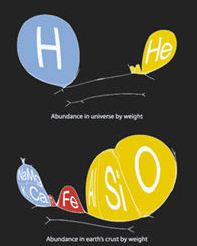
So here’s some perspective for you, two periodic tables where each element is proportionally scaled by abundance (the product of the big bang!), the top one of abundance in the universe, and the bottom one showing abundance in earth’s crust (products of nucleosynthesis in exploding stars).
That’s what the universe is all about: thinly distributed hydrogen and helium in a vast space, with traces of heavier elements occasionally forming in energetic accidents.
Also, any time I see a periodic table anymore — which is all the time — I am reminded of that awful debate with Jerry Bergman in which he claimed that Darwinists were trying to criminalize the periodic table because it revealed that all the elements were irreducibly complex. That’s how out of touch with reality those guys are.

Last night, or 11.4 million years ago, a star exploded in galaxy M82. These photos are about a month apart.
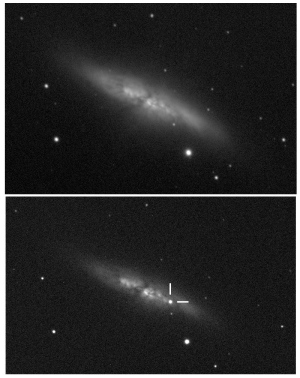
I’m looking at that and thinking, “I bet it was warm there.”
It’s expected to get brighter over the next few weeks, to the point where it might be possible to see it with your home telescope or even a pair of binoculars. Over eleven million light years away, and the supernova is going to be faintly visible from my yard.
Revise my earlier sentiment: I bet it was really warm there.