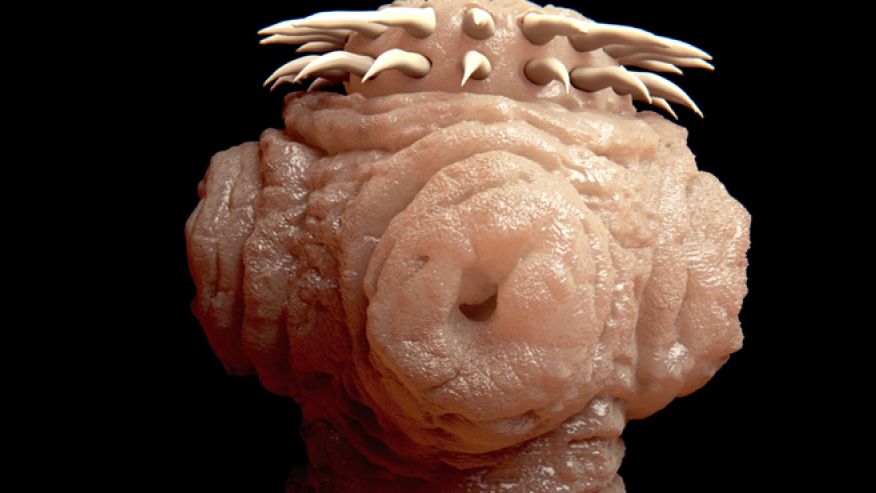
This is the head of a tapeworm that takes up residence in people’s skulls.
You aren’t trying to eat dinner right now, are you?

This is the head of a tapeworm that takes up residence in people’s skulls.
You aren’t trying to eat dinner right now, are you?

I hate textbook churn. Gotta sell a new and slightly different edition every year.

Hint for science journalists: if the hook to get readers to pay attention to your story is to warn them to sit down because a 19th century “law” of evolution has been shown to be wrong, you’re going to irritate scientists, who will then write rude blog posts sneering at your writing. That’s the case with this story titled The Wrists of Birds Reveal Evolution Undoing Itself
, which is also subtitled Contrary to earlier claims, a new study shows that evolution may be reversible
.
It’s describing a paper on the re-emergence of a wrist bone in birds, and it touts Dollo’s Law.
The 19th-century biologist Louis Dollo taught that evolution is irreversible; once a structure is lost, that pathway is closed forever. It’s a principle now known as Dollo’s law.

Just yesterday, Japanese fishermen caught a 6m long giant squid, and it lived for a few hours before expiring. Here’s a video of the rare beastie swimming about, with shots of the tragic corpse afterwards.

If this stuff were in a fantasy movie, you’d snort and say that’s all impossibly unrealistic.
(via The Mary Sue)

I’ve been puttering away on my talk for CFI LA on 15 February — it’s all about how bad adapationist thinking corrupts good science. This is going to be easy, because examples just keep falling into my lap, all the time. Here’s one from just yesterday.

You may recall that sad comment by Scott Aaronson on his blog, Shtetl-Optimized, in which he deplored the way no respect is given to men’s biological imperative to have sex with all the women. Or more recently, Paul Elam’s bizarre appeal to badly interpreted biology and duck rape to justify MRA entitlement. It’s all of a piece, and it’s annoying: it’s reductive nonsense, in which people see a well-established set of scientific principles, and see their own complex situation, and imagine out of whole cloth a clear, simple path from one to the other. And suddenly, they’ve portrayed their messy life as the outcome of a purely determined, clockwork series of inevitable interactions, and they find refuge in the lowest common denominator of possible explanations. “It’s not my fault,” they can say, because of the way electrons interact, because biochemistry and thermodynamics, because genes, because everything follows from astronomical impacts and geology and Chicxlub at the end of the Cretaceous.
As it turns out, that’s what Scott Aaronson (with seemingly little comprehension on his part) was discussing in that notoroious comment section, in part, with someone named Amy. What started as a discussion about a grab-ass professor losing his job evolved into a lot of denial and defensiveness, and of course whenever a lot of nerds try to defend the status quo, they ultimately try to bring up Human Nature and Behavioral Science and This Is How We Evolved. I struggle myself to avoid falling into that trap, and sometimes I do anyway, but a whole gang of male nerds tends to inevitably drift into gross reductionism. Because of thermodynamics, I think, or maybe van der Waals forces.
Anyway, the provocateur behind all that argument, Amy, has now beautiful essay on all the phenomena in the middle that get ignored.

As he heads into his final few years as president, Obama seems to be finally taking a stand on a few things. He is going to veto the Keystone XL Pipeline. Hooray!