Did they have to make it so pretty?

The NY Times has put together a lovely illustrated story about data collection on Greenland. The story is prettily terrifying, though. The ice is melting, and forming lakes of liquid water on the surface of the ice cap, which then drains away in fast-running rivers that cut deeper into the ice and then drain into holes that run even deeper into the glacier — it’s a dangerous place, and if you fall in, you’ll be swept away and instantly dumped into a pit. It also means the ice sheet is porous and riddled with rot already.

In addition to the personal terror for the researchers, this work is about a process that’s going to affect us all.

But Mr. Overstreet’s task, to collect critical data from the river, is essential to understanding one of the most consequential impacts of global warming. The scientific data he and a team of six other researchers collect here could yield groundbreaking information on the rate at which the melting of Greenland ice sheet, one of the biggest and fastest-melting chunks of ice on Earth, will drive up sea levels in the coming decades. The full melting of Greenland’s ice sheet could increase sea levels by about 20 feet.

Is that scary enough for you yet? Hang on, there’s worse: our Republican congress.

But the research is under increasing fire by some Republican leaders in Congress, who deny or question the scientific consensus that human activities contribute to climate change.

Leading the Republican charge on Capitol Hill is Representative Lamar Smith of Texas, the chairman of the House science committee, who has sought to cut $300 million from NASA’s budget for earth science and has started an inquiry into some 50 National Science Foundation grants. On Oct. 13, the committee subpoenaed scientists at the National Oceanic and Atmospheric Administration, seeking more than six years of internal deliberations, including “all documents and communications” related to the agency’s measurement of climate change.

I find the behavior of these Republican science-deniers unbelievable. There’s the obsessive derangement rivaling the Benghazi hearings, the appointment of unqualified know-nothings like Lamar Smith and Darrel Issa to play obstructionist games over scientific issues, and the abuse of legal strategies to harass scientists. Someday, we’re going to look back on this time as a period when the American government basically committed global crimes against humanity, as smiling rich fucks did everything they could to impose their ideological delusions on a dangerous reality.

But do read the NY Times article. The aerial views and maps of the ice sheet are gorgeous, and the field scientists are bravely carrying out important work, while the cowards and crooks of congress close their eyes and try to undermine that work.

The reality of a career in biology

biocareers

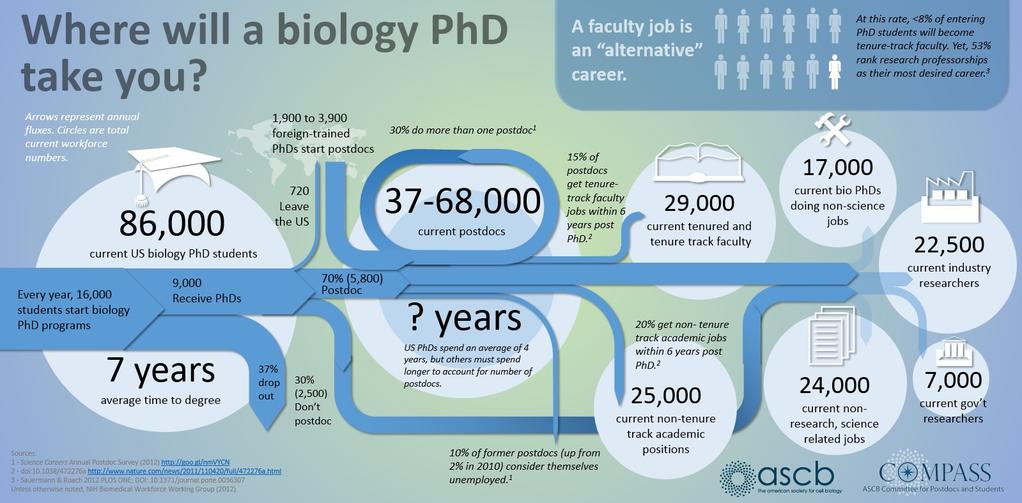
37% of students entering biology Ph.D. programs drop out? Only 8% achieve the goal of getting a tenure track faculty position? That last statistic, at least, isn’t as bad as it sounds, since there are lots of alternatives.

I’d also add, though, that this is another case where random drift, rather than selection, probably dominates. Those 8% aren’t likely to be the best (although some are!), but only the most persistent, or the luckiest.

TONMOCON VI (#tcon6) is on youtube

The whole dang conference is available in one giant 8 hour video, and here it is.

That’s kind of indigestibly huge, so I’ve been going at it in small pieces. I started with Gabrielle Winters at about 5 hours in, with Cephalopod Neurogenomics: Insights into the Evolution of Complex Brains, just because that’s what I’m most interested in. It’s a conference for general audiences, so it starts off with a good basic overview of cephalopods and neuroscience and molecular biology, and then, just as it starts getting interesting, the sound cuts out at 15 minutes…and doesn’t resume for another 15 minutes. Aaargh. You’ll have to get the sense of it from the slide text, and I guess I’ll have to wait for the paper.

I did get the take home message, though: cephalopods have evolved complex brains independently of ours, and the answer to this question is…

convergentevo

No. Cephalopods have evolved novel molecular mechanisms to solve problems in learning and memory similar to ours, which is actually kind of cool. Convergent evolution may lead to similar outcomes, but looking at the underlying mechanisms will expose the different evolutionary histories.

I’ll work through other talks as my time allows — it’s actually rather nice to have a day long conference available so I can just fit it to my schedule — but hey, if you’ve got a quiet weekend, go ahead and watch the whole thing.

What is Intelligent Design Creationism?

Obvs, he did it.

Obvs, he did it.

Larry Moran discusses some apologetics from Jonathan McLatchie, in which McLatchie briefly argues for intelligent design. I think the fact that it’s in the context of Christian apologetics already gives away the store, but at least he gives a succinct definition of intelligent design:

The study of patterns in nature which bear the hallmarks of an intelligent cause

[Read more…]

Another children’s science book

We need more of these, and here’s another: Great Adaptations: A Fantastical Collection of Science Poems. It contains short rhyming summaries of scientists’ work on adaptations, all nicely illustrated.

Here’s one from Sarah Hrdy’s work on empathy and cooperation.

hrdyillo

Doesn’t that make you want to run out and buy it right now? How much would you pay? $5? $10? $25?

Well, you can’t. Instead, you have to go to this website and download it for free.

Writing the book was a labor of love, so I hope you love it too! Lastly, because our objective is to get as many people reading and learning about evolution, we’re offering the E-book for free.

Those wacky scientists. They know nothing of capitalism. Isn’t it great?

Friday Cephalopod: Octopus in disguise

Knobby Argonaut, Argonauta nodosa

Knobby Argonaut, Argonauta nodosa

Also, what’s Brian Switek doing, writing about cephalopods? He’s supposed to be writing about dinosaurs!

But first impressions can be deceiving. In truth, as I later learned from Klug, the paper nautilus is not a close relative of today’s pearly nautilus, nor is it an echo of the long-lost ammonoids. The creature that had ensnared my mind is totally different.

The argonaut is an octopus, and its prehistoric look is created by the way the squishy creature reproduces. The “shell,” Klug says, “is actually an egg case secreted by two specialized arms,” and made of the mineral calcite. As she swims, a female argonaut cuddles her eggs in the shell-like cases pressed against her sides. Lacking cases, male argonauts just look like itty-bitty octopuses.