Pharyngula
Evolution, development, and random biological ejaculations from a godless liberal


Larry Moran rips into the latest hype over epigenetics. Good. There is some valuable biology buried in the field, but I see so much nonsense that even as a developmental biologist who wants to seem more attention to regulative changes in the genome, I’m just seeing so much exaggeration that I think it is doing more harm to our understanding than good (see also Carl Zimmer’s latest discussion of epigenetic over-reach). But this video is just too much.
It’s true — region of the genome can be switched on or off in a coarse way by chemical modification of DNA and associated proteins. It happens all the time. But as Larry points out, this doesn’t just happen by magic. There are regulatory factors that change patterns of gene expression, and they’re probably most responsible as well for triggering the establishment of epigenetic marks.
But here’s my objection: the hype seems to be ignoring development (I know, unforgivable). The problem with assigning too much importance to the inheritance of epigenetic marks is that individual cells and tissues acquire them throughout development and even adulthood…but they don’t matter genetically. Have the proponents never heard of Weismann’s Barrier? Changes in the somatic tissues don’t propagate to the next generation. All that matters are changes in a subset of cells in the gonads, the testes and ovaries. So we’re already dealing with a tiny fraction of our cells that also have unique tissue-specific epigenetic marks, and more importantly, their own specialized patterns of gene regulation.
Then, further, gene expression in the germ line is further refined during maturation of the egg and sperm — both of these cell types are highly specialized and gene expression is honed even more during their development. It’s nice to dream that epigenetics influences neurons in the brain, but you’re not going to inseminate anyone with your neurons, nor are those cells going to migrate down into your ovaries and pass their history on to the next generation.
The video does mention that most epigenetic marks are going to be cleared during gamete formation, and other germ-line-specific marks added, but it just blithely slides past that. It seems to me that the clearest example of epigenetic modification in inheritance is genomic imprinting, which is a consequence of differential gamete-specific modification of sperm and egg, and its main effect is in regulating gene dosage.
It’s strange. I don’t even see the appeal of these epigenetic fairy tales; I certainly don’t see any problem in evolutionary theory that requires patching up with this kind of phenomenon. But Larry includes an excerpt from an interview with the creator of the video, and suddenly all is clear. This bastardized, exaggerated version of epigenetics appeals to people who are uncomfortable with the whole central idea of modern evolutionary theory — who dislike seeing gene transmission uncoupled from the will of the individual.
I came from the world of evolutionary biology. I have always been interested in evolutionary theory but I was never convinced by the neo-Darwinian argument that environmental factors are not a big player in the generation of genetic changes. On the other hand, I never understood the fierce dismissal and often mocking of the Lamarckian ideas in schools and universities; particularly, because Darwin himself never denied Lamarck’s ideas. In epigenetics I found the mechanisms that allow you to understand the action of environmental exposures on the genome.
Whoa. That environmental factors are not a big player in the generation of genetic changes
is sort of true; the environment can influence the rate of genetic changes, but doesn’t play a big role in shaping the direction of that change — that’s all a consequence of changing the frequency of representation of those changes in the population. That he brings up the idea of Lamarck is telling. Lamarckian evolution ain’t coming back, although it’s surprising how often people want it.
Also, Darwin himself never denied Lamarck’s ideas
? Does he know nothing about the history of evolutionary theory? Darwin did not deny them, because his theory of inheritance was all about the inheritance of acquired characters and pangenesis, the generation of a gamete by contributions from all tissues (which, come to think of it, is what you’d need for the epigenetics hype to have any hope of working). He was pre-Mendelian genetics. He was wrong. You can’t defend Lamarck by citing a guy, no matter how influential, who had no viable theory of genetics, and who wrote in the era just before genetics was explored and understood. He might as well support it by announcing that Aristotle didn’t deny Lamarck.
As for the idea that epigenetics somehow explains the effects of environmental exposure to damaging agents…I’m trying to think of any clear examples of how that occurs, and I’m a developmental biologist who has been studying teratology for a few decades. We don’t invoke epigenetics to account for abnormal cell death, or signaling failures, or mismigration, or endocrine disruption, or any of the phenomena that are commonly responsible for non-genetic errors in development. His example is to claim that exposure to DDT in the 50s and 60s somehow led to the current high frequency of obesity.
He’s got no evidence. He has no mechanism, other than to say, “epigenetics!”
The thing to watch out for next is revealed at about 4:00 in the video, where he talks about using diet and behavior to give yourself a “healthy epigenome”, whatever that is. I’m sure some unscrupulous, dishonest someone, somewhere is writing a diet book about super-foods to super-charge your epigenome for you and your baby.
I’m calling it. There are already plenty of pseudoscientific books that mangle the concept of epigenetics. I’m sure the ones that will turn it into a marketing fad are coming up soon. We’ve already got a lot of books touting the microbiome as the cure-all for everything — I can easily imagine the fusion of the epigenome and microbiome hype machines popping up on Amazon.
Can I claim royalties for predicting it?

I get this question all the time, and I just got asked it again: “Did you really say that humans are fish in that Ray Comfort video?” Yes, I did, and I guess I have to explain it again.
There are multiple meanings of “fish”. We can use it to refer to specific species or an extant category of animals: salmon are fish, halibut are fish, herring are fish. No one objects to that, and they all understand that if I said “humans are still salmon”, that would be wrong.
But another way the term is used is as a descriptor for a clade. A taxonomic clade is a “grouping that includes a common ancestor and all the descendants (living and extinct) of that ancestor”.

So, for instance, humans belong to the mammalian clade, which includes mice and cats and cows. If we have transhuman, part-cyborg descendants, they will still be mammals, because, note, by definition a clade must include all the descendants of an ancestor. We’re trapped! There’s no way our progeny can exit the clade!
We’re also members of multiple clades. For example, the tetrapod clade is the group that descended from a 4-limbed ancestor, an early amphibian, so it includes frogs and salamanders, and also reptiles, mammals, and birds, and the fact that we’re weird bipeds that have specialized our two pairs of limbs in odd ways, or that birds have turned a forelimb into a wing, doesn’t get us out of the club labeled “four footed”.
The thing about the clades of mammals and tetrapods, though, is that we have convenient generic labels for the groups: we can say “humans are mammals”, and we don’t get hordes of clueless people gawping and saying, “Did he just call me a mouse? That’s absurd!” But we belong to another clade, all the organisms descended from an ancient fish, and “fish” is the common label there. People generally have such a dim comprehension of the diversity of the fishes, though, that they hear a biologist pointing out that we belong, and will always belong, to the fish clade, and they think, “Did he just call me a sturgeon? That’s absurd!”
One way to get around the problem is to get technical. I could say we’re all gnathostomes, and nobody would freak out because most of them wouldn’t have the slightest idea what I was talking about. So I could hide in technical obfuscation. But the point is that you are descended from an ancestor that was a torpedo-shaped aquatic vertebrate with gills, a fish. You can never escape your ancestry. Embrace Your Inner Fish.

By the way, another way “fish” is defined taxonomically is as a craniate that is not a tetrapod, and if you use that definition, we are not fish. But that requires explicitly creating a paraphyletic group (that’s what you call it when you take a clade and willfully exclude a smaller clade), and that’s just annoying.

The theme of this year’s con is “…and how do we GET there”, which means we really should have a session on octopus locomotion.

I actually have a lot of respect for physicists doing physics, but sometimes some of their most prominent practitioners are really good at getting everything else wrong. Like Stephen Hawking, for instance.
“Six years ago, I was warning about pollution and overcrowding, they have gotten worse since then,” he said. “More than 80 percent of inhabitants of urban areas are exposed to unsafe levels of air pollution.”
Oh. Six years ago, huh? That’s not very impressive, Mr Prophet, when Rachel Carson was warning everyone about environmental pollutants almost sixty years ago, when the filth and disease of major cities like London have been the subject of concern for centuries, and Malthus’ An Essay on the Principle of Population was published in 1798. But I’m glad you’re finally catching on to what everyone else already knew.
But after citing those real problems, guess what Hawking thinks we ought to be worried about?
Hawking warned about artificial intelligence and the fact there is no way to predict what will happen when machines reach the ability to self-determine.
“Once machines reach the critical stage of being able to evolve themselves, we cannot predict whether their goals will be the same as ours,” he said.
Jebus. We do not have self-aware, conscious robots, and their production is not imminent. We do not have an artificial intelligence. We don’t know how to build an artificial intelligence. Skynet is science fiction. The Matrix is not real (and is actually rather hokey). If I had to make a list of real problems we ought to be worried about, it would start with overpopulation, over-exploitation of resources, environmental destruction, and global climate change. It would include the rise of a new fascism, oppression, poverty, growing disparity in wealth, emerging diseases, and a host of other genuine concerns. The sentient robot uprising wouldn’t even make the top 100; it would be somewhere down in the bottom 100, along with the zombie apocalypse, Kardashians taking over the planet, Nazis emerging from their secret base at the center of the hollow earth, and sharknadoes.
But, I know, Stephen Hawking! It takes a world class physicist to make malarkey about nonexistent problems important to the media, I guess.


I’m leaving for Minneapolis later today, and I’ve been planning out my panels, like a responsible participant. Here’s what I’m doing:
The Reproducibility Problem: How Serious is it?
Thurs 12:30 Atrium 2There’s been a lot of discussion about the ability to reproduce experiments, especially in the social sciences. How serious is the problem? What can be done? Panelists: PZ Myers, Vernon McIntosh, Laura Okagaki-Vraspir, Peter Larsen, Topher Hunter (mod)
This one could get heavy: it’s all about statistics. Contrary to the description, I’m going to focus on the cancer reproducibility project, because this isn’t just about those fuzzy social sciences — it’s about any field with an extremely complex data set and a fair amount of individual variability.
What Does God Need With a Starship?
Thurs 2:00 Atrium 4From the Christ-like figure of Superman to the metaphysical adventures of the Enterprise, fantasy and science fiction have long explored religious and philosophical questions. What is it about SFF that touches our spirituality? Panelists: Amanda Larsen, Cetius d’Raven (mod), PZ Myers, phillip andrew bennett low, Kristina Halseth
My role on this panel is to cross my eyes and make gagging noises every time someone says “spirituality”. No, not really, I’ll be nice. My points will be a) science fiction celebrates naturalism, and effectively undermines religious myths, because every time a supernatural being is invoked, they’re treated as a complex material phenomenon rather than magic, and b) SFF doesn’t touch our spirituality, it touches our humanity. Humanism FTW.
Twin Connection: Myth, Science and Confirmation Bias
Thurs 3:30 Atrium 3Cultures worldwide have different myths and legends about twins. How much can science explain? Do twins share a special connection that transcends scientific understanding? This panel will explore myths and facts about twins. Panelists: PZ Myers, Kathryn Sullivan, Windy Bowlsby
The answer to the first question: all of it. Twins are a simple, entirely comprehensible phenomenon. The answer to the second question: NO. Won’t this be fun?
The mention of confirmation bias in the title suggests to me that we’ll all be resonating on the same wavelength (like twins!), so really, it might be fun.
Our Place in Space
Fri 2:00 Atrium 4What are the dreams and practicalities of colonizing space? How might humanity reach beyond our planet? We’ll discuss the science of human spaceflight in reality and fiction. Panelists: Emily Finke, Ryan Consell, Nicole Gugliucci (mod), PZ Myers
As the biologist on the panel, I’ll be there to bring everyone down to Earth. I don’t think “colonizing” is at all likely or practical — we’re not going to establish stable, self-sufficient human populations on other moons or planets in our solar system. We’re just not that adaptable, and the environments are just too hostile. The only possibility is radical genetic modification, in which case the ‘colonists’ won’t be human anymore, and they’ll probably reveal other defects in human potential.
But I still think we ought to be out there: exploration and temporary scientific colonies are a good idea. There is also the possibility of extracting useful resources, but the economics of that seem a little far-fetched.
If somebody suggests that we need colonies to ensure the future of the human race in case of catastrophe, I might just explode, which would be entertaining.
Look at that, though: I get all the work done on Thursday and Friday, leaving the weekend totally free for fun. I’d take credit for my genius, but I didn’t plan out any of the timing, so it’s all by chance.
It’s also science-heavy, which is great. I thought about signing up for some of the more bookish fiction panels, but man, there were a lot of people volunteering to get up on the stage for those (some had a dozen people vying to get up there, and that’s just too many for a good discussion).
See you there!

I’m a developmental biologist, so of course I’m enthusiastic about the potential for stem cell therapies. I’m also aware of the limitations and risks. I absolutely hated that heavy-handed, nonsensical satire of stem cell research that South Park aired several years ago, in which Christopher Reeve was shown eating fetuses for their stem cells, which enabled him to walk.
But then, that’s South Park: almost always great thudding ham-handed bullshit. No way people could believe that just gobbling down stem cells would cure diseases.
Unfortunately, as we’re fast learning in the political arena, there is no bullshit so rank that you can’t find someone won’t chow down on it. Science-Based Medicine discusses stem cell tourism — there is such a thing — where people with serious illnesses travel to countries with less restrictive medical practices to get shot up with stem cells. So here’s the story of Jim Gass, a wealthy man who had a stroke and wanted to be healed…so he did research “on the internet” and got the brilliant idea to repair the damage with stem cells. And then he got worse and needed a more conventional medical intervention.
The surgeon gasped when he opened up his patient and saw what was in his spine. It was a huge mass, filling the entire part of the man’s lower spinal column.
“The entire thing was filled with bloody tissue, and as I started to take pieces, it started to bleed,” said Dr. John Chi, the director of Neurosurgical Spine Cancer at Brigham and Women’s Hospital in Boston. “It was stuck to everything around it.”
He added, “I had never seen anything like it.”
Tests showed that the mass was made up of abnormal, primitive cells and that it was growing very aggressively. Then came the real shocker: The cells did not come from Jim Gass. They were someone else’s cells.
Mr. Gass, it turned out, had had stem cell therapy at clinics in Mexico, China and Argentina, paying tens of thousands of dollars each time for injections in a desperate attempt to recover from a stroke he had in 2009. The total cost with travel was close to $300,000.
Stem cells are not magic. They are plastic cells that are pluripotent — they can differentiate into a variety of different tissues. But they need instructions and signals in order to develop in a constructive way, and the hard part is reconstructing environmental cues to shape their actions. They’re like Lego building blocks — you can build model spaceships or submarines or houses with them, and they have a lot of creative potential, but it’s not enough to just throw the Lego blocks into a bag and shake them really hard. Basically, Jim Gass was getting the cellular equivalent of receiving massive injections of Legos, in the forlorn hope that they would spontaneously repair his nervous system.
Gorski also points out one of the warning signs that this is a quack therapy: the locations where it was done.
Ask yourself this: Why are so many of these clinics located in countries like Kazakhstan, China, Mexico, and Argentina? It’s not because the scientific facilities are so much more advanced there. It’s because regulatory oversight protecting patients is lax to nonexistent.
Con artists always seek out the most permissive environment.

Neil Shubin reports that Bible tracts have begun appearing in copies of his book, Your Inner Fish, in bookstores. He even has photographic evidence.
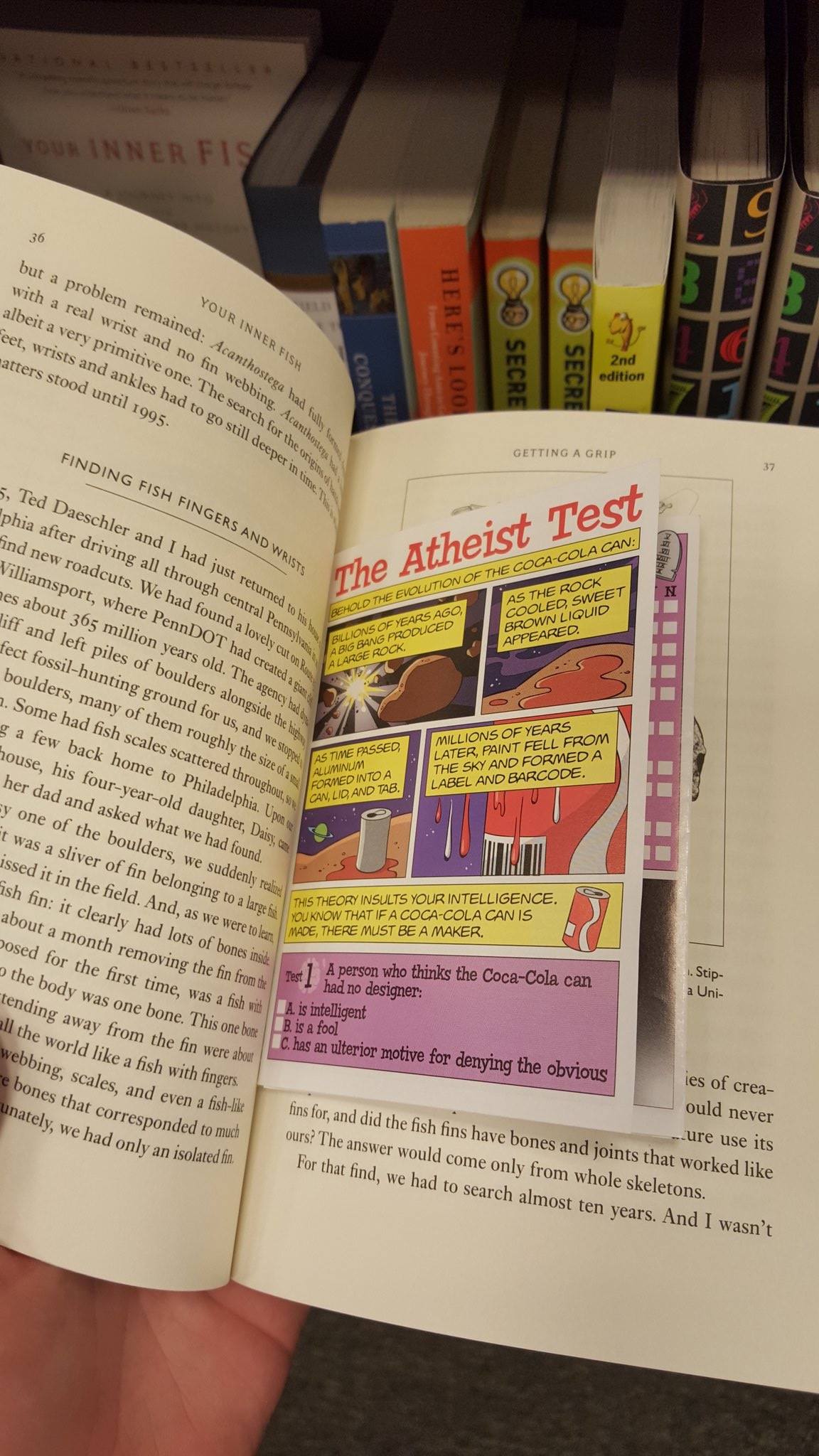
This is remarkable news. We now know how bible tracts are made: they are degenerate forms descended from more complex and sophisticated texts, and they appear spontaneously when two pages, who love each other very much, are pressed together. They’re kind of like coke cans that way, arising without human intervention.
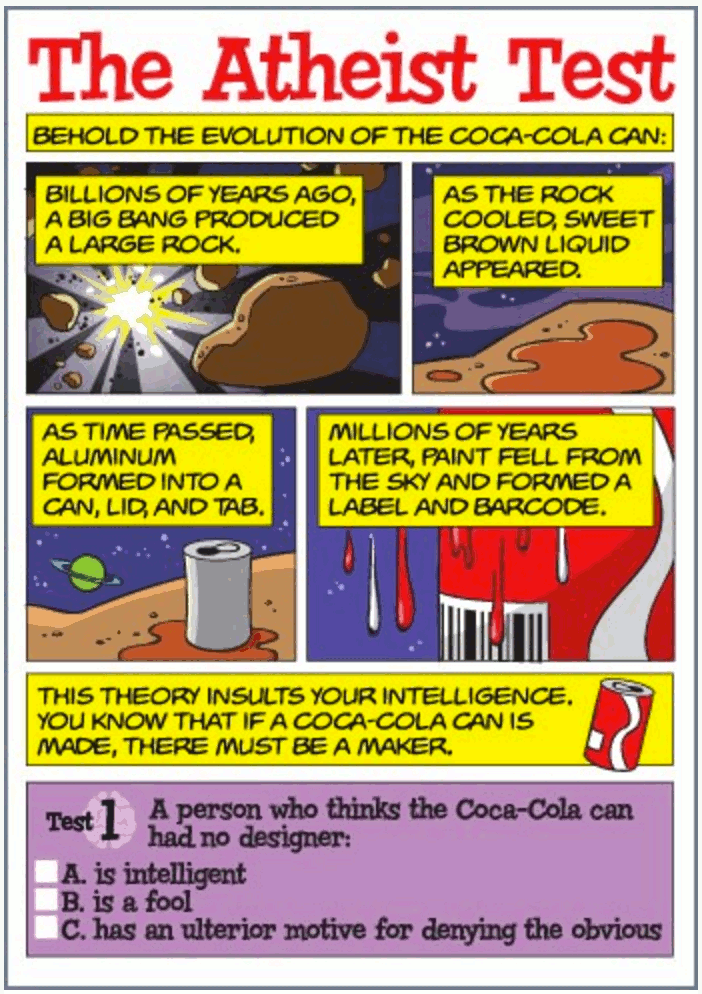
Oh, except that you’d have to be an idiot to think that.

So you want to be a science communicator. You need to read this article on becoming a science writer. Here’s a short list of tips:
- Obtain the highest education possible and dismiss the notion to not pursue formal schooling and, instead, “learn on the job.” The latter is damaging advice, usually given by people without specialized education, or by those who benefit from your unpreparedness. If you actually get the job, you will always “learn the praxis” while on it. But you will never compensate, “on the job,” for the formal education you missed. Science, math and technology are not taught in the streets.
- Read by far more topics than you can write about; develop a sense for science.
- Travel internationally to scientific meetings and try to understand the cultural contexts in which science is done elsewhere; this could be difficult since we all see the planet through parochial preconceptions. However, modern science is done collaboratively and international partnerships are ubiquitous. Writing from home will keep your mind at home.
- Write about science itself, rather than people in science. Do not celebritize individuals, but grant credit to all who deserve it.
- Do not become enticed by the ivory-tower institutions as the sole source of science stories to report; that will turn you into a snob writer.
- And remember that a good science tale should be good by itself, no matter its origin, but only a good story teller would make it shine.
I had some reservations about that first point — the amateur or citizen scientist can be a good contributor. But the good ones have a lot of discipline and drive and focus, and get a specialized education unconventionally, so it’s actually an important point.
What is a total disaster, though, are all the people who think they can master a subject via a combination of Google and Wikipedia. You absolutely can not. You can get quick bits of information, but you don’t acquire this abstract thing called knowledge: you need the depth you get from reading books and soaking in the details of the literature, so that you can make connections and grasp the broader context.
The rest is good advice. I’m putting this on my list of things to hand out to the students in my fall term writing course.

