Pharyngula
Evolution, development, and random biological ejaculations from a godless liberal


Our summer research program is winding down, and preparation for the fall semester teaching is winding up. My student, Katrine Sjovold, and I have been trying to figure out what early melanocytes are doing — it’s a very simple and accessible system to observe cell motility, because the cells label themselves with melanin and we don’t need to do any of that persnickety cell injection stuff, or buy expensive dyes, or buy expensive cameras capable of detecting fluorescence (although we’ve tried a little of that here at the end of the summer, and I’ve been appropriately impressed that my research camera actually can see DiI fluorescence, even if it’s not designed for it).
Anyway, one of the things we’ve been doing is making time-lapse videos of melanocytes after they start making pigment and as they’re linking up and consolidating to form stripes. Here’s one example, a time-lapse where we take one image every 3 minutes over a day and an evening of growth.
You can see that we’re looking down on the dorsal side of the animal, in the region of the hindbrain (see the fourth ventricle, and the ears, deep and out of focus?). You may also notice that one of the melanocytes spontaneously decides to die and quickly breaks down into a few darkly pigmented blobs.
I’ve also uploaded a few other videos, but keep in mind these aren’t polished, perfect videos — these are bits and piece of our working data collection.

Government regulation of research to enforce ethical concerns is a good idea, and I support the general idea. I’d like them to be based on reasonable concerns, though. I’m actually glad that the NIH has ended a ban on research into human-animal chimeras, although I know some people are going to freak out over it, pointlessly.
Here’s the basic idea. Mammalian embryos are relatively plastic. If you take a mouse embryo at the blastocyst stage, when the embryo is just a small number of cells in a spherical capsule, and you take a few cells from a human blastocyst and inject them into the mouse embryo, those human cells will be readily incorporated into the developing mouse. They can then be incorporated into the mouse’s tissues, so you end up with an adult mouse that has a liver made up of human liver cells. Or a human pancreas. Or, what really scares some people, human-derived brain tissue. Or human-derived gonadal tissue — the mouse could be making human sperm or human eggs, and if a boy mouse with human testes meets a girl mouse with human ovaries…well, you can imagine the concerns.
One issue is that scientists might inadvertently create animals that have partly human brains, endowing them with some semblance of human consciousness or human thinking abilities. Another is that they could develop into animals with human sperm and eggs and breed, producing human embryos or fetuses inside animals or hybrid creatures.
That was the thinking that led to the moratorium on such experiments, now lifted. Which is good.
All of those troubling possibilities are rather easily prevented, and also rather unlikely.
The concerns about animals with “some semblance of human consciousness or human thinking abilities” is simply silly. They already do, and you could also argue that humans have some semblance of animal consciousness. Mice aren’t going to be able to construct whole human brains in their tiny little skulls, although maybe a pig chimera could; but even there, our brains have co-evolved with all kinds of circulatory adaptations, and I rather suspect that a chimera with a significant amount of human brain tissue isn’t going to be viable. And most importantly, the point of such research isn’t to make a human brain in an experimental animal — it’s to get human nervous tissue that will have human-like responses to, for instance, pharmacological treatments.
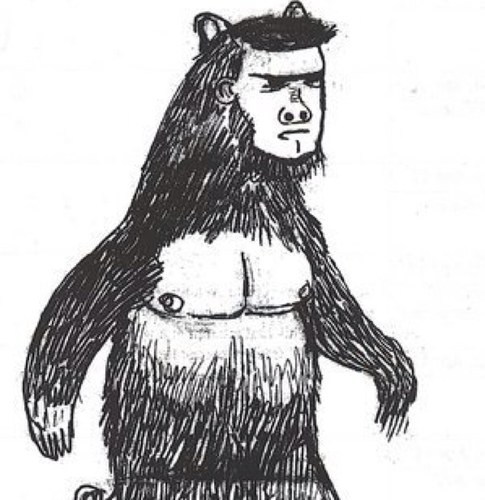
It’s the same with the reproductive tissue. Making male and female pigs with human reproductive organs would be cool and useful, but bringing them together to do something as mundane as producing a human baby is not — and would be a catastrophic result of the research that would probably lead to the shutting down of the lab and massive legal consequences, all to produce a totally useless result. These are labs that are interested in studying the mechanisms of human sperm maturation, or oocyte development, not the mad scientist nonsense of creating ManBearPig.
Of course, some people don’t like the idea of ending the moratorium.
But critics denounced the decision. “Science fiction writers might have imagined worlds like this — like The Island of Dr. Moreau, Brave New World, Frankenstein,” says Stuart Newman, a biologist at New York Medical College. “There have been speculations. But now they’re becoming more real. And I think that we just can’t say that since it’s possible then let’s do it.”
Let’s do what? That’s the crux of this disagreement — no one is interested in creating The Island of Dr. Moreau in reality. Moreau was an idiot who didn’t do anything practical or informative with his imaginary technology, and using dystopian science fiction as your counter-argument really says you don’t understand the motivations behind this research.

There’s a webcam that has been watching a nest full of ospreys growing up, and the birds were almost ready to begin their flying lessons. Then…they get a visitor.
Is there a metaphor somewhere in this comment about America’s national bird?
The predation of an Osprey nest by an eagle might come as a surprise to many, but eagles are the ultimate opportunists. “They take what’s around and what’s available,” Kress says. And while the activity from the Audubon Camp located nearby usually keeps them away, in the end, “there’s nothing you can really do.”

In honor of the nomination of Donald Trump, the corpse flowers are blooming all across the country. It’s actually a blessing; the stench of rotting flesh obscures the reek of the putrescence rising from the Republican party.

There are a few people I might like to fire into the heart of the sun, but I hadn’t realized how difficult that was. Here’s a video and simple simulator that lets you try to fire a rocket right into the sun. It took me a few tries to figure out how to do it — you have to launch directly opposite to the direction of Earth’s travel, and cancel out its velocity…and then it will fall into the sun. If you’re a fair bit off, it flies off into a new orbit around the sun that intersects with Earth’s orbit, which is not good. If you’re a teeny tiny bit off, it just scarcely grazes the sun, and then something cool happens: it slingshots around at tremendous velocity and flies off the screen.
I mostly sent rockets off to Alpha Centauri, or something, which is not quite as spectacularly destructive as slamming into a giant radioactive ball of plasma. But still good.


As Caine mentions, wealthy Libertarian/Republican scumbag Peter Thiel sees great promise in the idea of parabiosis as a way to treat aging, which is just a little too on-the-nose for an overvalued parasite.
It actually works: some markers for aging are reduced in their effects with infusions of blood from younger donors, and it’s actually a promising technique, but not necessarily as a therapeutic treatment, as Thiel seems to think.
I’m not convinced yet we’ve found a single panacea that works. It’s possible there exist single-point things that could work. I’m looking into parabiosis stuff, which I think is really interesting. This is where they did the young blood into older mice and they found that had a massive rejuvenating effect. And so that’s … that is one that … again, it’s one of these very odd things where people had done these studies in the 1950s and then it got dropped altogether. I think there are a lot of these things that have been strangely underexplored.
The reason it was dropped, I think, is that no one saw a way to carry it forward into useful information. You have to understand that those old studies weren’t about just occasionally giving an old mouse a transfusion of blood from a young mouse — they actually stitched the two mice together in a way that allowed blood exchange between them for long periods of time and got a prolonged exchange of fluids, proteins, and cells. This is not practical as a human therapy, although it is very Mad Max.
But it worked! The old mouse in these experiments experienced multiple benefits.
The old parabiont benefits from not just young blood, but also the young organs: heart, lungs, liver, kidneys, thymus, etc; and removal/neutralization by the young parabiont of negative metabolites, chemokines, etc. These together with improved blood oxygenation, normalized glucose/insulin and cholesterol profile are all likely to contribute to the rejuvenated tissue stem cells.
OK, sign me up! Any of you young bucks like to be surgically attached to me for a while, to give me a little pick-me-up? What if I were Peter Thiel and had some buckets of money to give you for this donation?
There might be some concerns. You ought to be asking, if old blood is so deficient that it could be improved by an infusion of my young blood, and if this actually transfers some effective anti-aging components, what happens to the young mouse? Remember, this is a continuous two-way exchange.
The young parabiont has to maintain an additional aged body with poorly functioning organs, inflammation, ongoing pathologies and perturbed immune responses, which could all contribute to the observed slight decline of the young stem cell responses.
Whoops. There might be a few ethical concerns here. Also, ick.
Also, these old experiments had the problem of sorting out exactly what was causing the anti-aging effect, and that was actually the intent of the experiments — to find potential proteins or cell types or other blood factors that might have a positive effect on older individuals. But the fact that these two mice were physically attached to one another also had complicated social effects.
The old parabiont has a much more stimulating environment when sutured with a young rather than an old partner. In contrast to the old and more sedentary animals, young mice are active and the old partner literally has to tag along. The pheromone landscape also becomes changed in hetero-, as compared to isochronic pairs. It is known that pheromones as well as environmental enrichment enhances, whereas environmental deprivation decreases neurogenesis and neuronal plasticity and “mock parabioses” have not been done to control for this.
So I might get the same effect from participating in youthful activities that I would from becoming a temporary conjoined twin with an 18 year old. So rather than undergoing surgery with me, maybe you should just go dancing with me? Except that even taking a grumpy old geezer to the dance club might have a deleterious effect on the poor young person I am afflicting.
So here’s the summary:
One conclusion from the heterochronic parabiosis studies is that the regenerative capacity of old tissue stem cells can be enhanced by the young systemic milieu; however, an over simplistic vision that using small volumes of young plasma or a “systemic silver bullet” will provide rejuvenation, e.g. one circulating molecule, at this point seems unlikely. Aging is a multi-genic process, the list of potential “silver bullets” is short, and some are oncogenic. Notably, while administration of small volume of young plasma to aged mice improved their cognition, the effects on brain or other tissue stem cells or health span have not been studied. Most importantly, the positive effects of young blood on old are only partial for muscle and the increase neurogenesis is nowhere near levels seen in young brain. Moreover the strong inhibition of young tissue stem cells by the aged systemic milieu in vivo and by old serum in vitro have been repeatedly reported. Summing up what is known, introducing small volumes of young plasma into an old host may not work effectively for enhancing tissue regeneration in the old, unless the inhibitory components of the aged circulation are neutralized or removed. And notably, removal or neutralization of these inhibitory systemic factors is predicted to have a positive effect on tissue repair by itself.
Get it? The parabiosis experiments that Thiel is thrilled by were not and cannot be part of a direct treatment approach; they were part of a series of experiments that hoped to identify blood proteins and cells that modulate the effects of aging. They are a first step to figuring out what is going on, and maybe, far down the road, figuring out how to treat the symptoms of aging. It’s a method for studying causes of aging, not necessarily treating them.
Let’s hope privileged billionaires don’t start strapping up young people to their veins to get imagined rejuvenation on the basis of their misunderstanding of science.

Perhaps we need to think more about human psychology. There’s an interesting phenomenon that goes on all the time when people read about evolution: they shoehorn the observations into some functional purpose. There’s just something so satisfying to our minds to be able to say “that thing exists for this particular reason”, and we find it frustrating to say, “there is no reason for it, it’s just chance and circumstance”. It shouldn’t be so, but our minds just try to fit everything into that particular mold.
Now watch: some people — maybe even you — are going to now try and develop an adaptive scenario for why having brains that work that way is a good thing. We try to build a teleological framework around everything, and so it must have a purpose that is being fulfilled, and we rarely stop to think about whether it may be actually limiting us. Maybe it’s not good. Maybe there are other ways that brains can work, and this particular mode of thinking is just a clumsy kludge that resulted from the gradual agglomeration of stuff, mostly unselected, that built up the substrate for human cognition.
A case in point: the female orgasm. There’s a new paper out on the subject, and there are lots of articles being written on it, and they generally start out by pointing out that there’s something puzzling about the phenomenon: shouldn’t it have, you know, a reason for existence? It can’t just be, it has to do something useful for women, or reproduction, or pair bonding, or any of dozens of hypotheses that have been proposed.
So NPR finds closure in an explanation.
A pair of scientists have a new hypothesis about why the female orgasm exists: it might have something to do with releasing an egg to be fertilized.
Nope. That’s not what the paper says. It says it might be a relic of a historical endocrine function, not that it plays any role in women today.
Carl Zimmer sets up a mystery.
An eye is for seeing, a nose is for smelling. Many aspects of the human body have obvious purposes.
But some defy easy explanation. For biologists, few phenomena are as mysterious as the female orgasm.
I would challenge his analogy: what’s so obvious about a nose? Nostrils and an olfactory epithelium, sure — that does have a clear functional role, and we can see signs of selection in the signal transduction apparatus, but why do we have this bony projection with a knob of cartilage on the end? We think we’d look weird without it (like Voldemort), but there’s a wide range of shapes within our species, and related species — chimps and gorillas, for instance — don’t have much in the way of a nose. It doesn’t affect their ability to smell.
(Note: both of those links take you to good summaries. I’m just weirdly conscious of how much we all take adaptive thinking for granted.)
This is the point where I tell you all to go read The Case of the Female Orgasm: Bias in the Science of Evolution by Elisabeth Lloyd, in which she takes apart a collection of adaptive scenarios that simply do not hold up. We ought to face facts: orgasm in women has nothing at all to do with reproduction. It doesn’t facilitate transport of semen, it doesn’t make them want to lie down horizontally, it doesn’t compel them to pair bond with men (since masturbation is a more effective path to orgasm than intercourse, why aren’t we arguing that the clitoris is the devil’s tool to drive women away from men? Oh, some do.)
Fortunately, this new paper by Pavlicev and Wagner, The Evolutionary Origin of Female Orgasm, doesn’t succumb to the fallacy of the spurious adaptive explanation. Instead, it’s following a much more useful evolutionary tradition: everything is the way it is because of how it got that way. Every living thing has a line of ancestry, and we inherit with modification the traits of our lineage, and the necessary way to study these traits, since our ancestors aren’t generally available for examination, is to take a comparative approach. So they do the evolutionary biology thing and ask what functions female orgasm have in related species, and try to infer an ancestral role in pre-humans.
Here, we note that most hypotheses are seeking an explanation for the presence of female orgasm within the human or primate lineage, whether due to direct or correlated effects of selection. Yet we will argue below that female orgasm, as male orgasm, predate the primate lineage, and the orgasm of human females likely evolved from an ancestral and adaptive trait, which might not have all the characteristics of human orgasm and may also have had a different function. We propose that explanations focusing on primate mating system and behavior thus address the primate-specific (or sometimes human-specific) modifications of a previously existent trait rather than its origin (Amundson, 2008). Our focus here will be the question what that ancestral trait may have been. As the lineage-specific modifications or secondary cooption (“exaptation,” in terms of Gould and Vrba, 1982) can take extreme forms under different, internal, or external selective forces, we therefore do not expect to find in animals a female orgasm as we know it in human, but are rather seeking its homologue in other species.
They also place it in the context of more general theories about the basis of the female orgasm.
The field addressing the role of female orgasm is by no means short of hypotheses. The evolutionary hypotheses align in two groups: one group argues that it is not quite true that female orgasm has no effect on reproductive success (e.g., enabling female choice, bonding, etc.), and the other group argues that it may indeed have no reproductive value in the females, but rather its existence is explained as a correlated effect of another selected trait, or a different developmental stage. For example, one well appreciated among the later hypotheses describes female orgasm as a fortunate consequence of the shared developmental basis of clitoris and penis, and therefore a consequence of reproductive necessity of the male orgasm (by-product hypothesis, Symons, 1979). A critical review of the existing hypotheses has been published in Lloyd (2005) and will not be attempted here.
So the two general hypotheses are that it has an as-yet-undetermined reproductive function (this is so far unsupported by the evidence), or that it is a byproduct of other properties. Pavlicev and Wagner are, I think, adding some other nuances to the story, but their explanation is actually orthogonal to those two explanations.
Pavlicev and Wagner point out that induced ovulation is common in mammals, and is probably a basal trait of the clade, although it has been repeatedly gained and lost. It’s an energy saving measure; why should the female spontaneously ovulate all the time, in the absence of an opportunity to become pregnant? We take it for granted — nuns continue to menstruate, after all — but many mammals do not ovulate unless they receive an endocrine signal that announces to their ovaries that hey, you’re actually mating, this might be a good time to drop an egg for fertilization. In these species, the clitoris seems to be the trigger — stimulating it induces an endocrine surge that induces ovulation. So the idea is that humans have female orgasms because our distant mammalian ancestors had all this complex hormonal machinery coupling ovulation and coitus, and we’ve lost the necessity, but the apparatus is still there. We’ve dismantled the factory, but the remnants still make a fine playground.
Another interesting pattern they see is that when ovulation is uncoupled from clitoral stimulation, there is a tendency for the clitoris to waner farther from the vaginal opening. Induced ovulators tend to have the clitoris positioned right near or even within the vaginal opening, but in animals like humans, it’s quite far away and is poorly stimulated by vaginal thrusting. This may be another of those byproducts: the opening of the urethra happens to be between the vagina and the clitoris, so the increasing separation of the clitoris and vagina may be a consequence of increasing the separation of the urethra and vagina.
I do have some slight reservations about the paper, though. One is that the explanation is insufficient. Here’s their diagram of the phylogenetic distribution of induced ovulation.
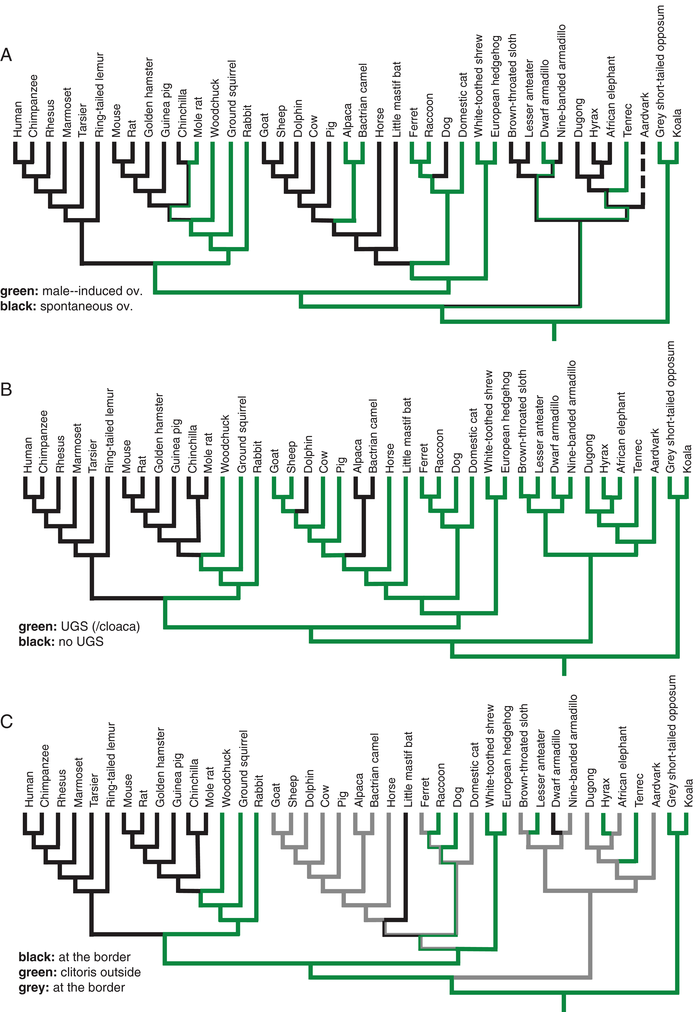
Phylogenetic distribution of (A) modes of ovulation, (B) the presence of the urogenital sinus (UGS; in basal species: cloaca), and (C) the position of clitoris relative to the vaginal orifice (in, border, out). Note the phylogenetic correlation between spontaneous ovulation with the reduction of the urogenital sinus, and the external position of the clitoris. This correlation is suggestive of an ancestral role of clitoral stimulation for the initiation of pregnancy in induced ovulators and the loss of this function in spontaneous ovulators.
Note that our lineage seems to have lost this property at the separation of rodents and primates! One estimate is that this divergence occurred about 96 million years ago, so our ancestors had to have lost the requirement to link clitoral stimulation to reproduction deep in the Cretaceous, yet still maintained the association between clitoral stimulation and orgasm to the modern day.
That retention is still best explained by the byproduct hypothesis — the pleasure circuitry is maintained by ongoing selection for its operation in males, and there’s no purpose to untangling it and removing it from females, and in fact, selecting for anorgasmia in females might have unfortunate reproductive side effects in males.
I’d also suggest that it doesn’t answer another question: why does sex feel good? We have other urges that our physiology doesn’t address by inducing super-charged sensations — I mean, why don’t we have wild orgasms every time we urinate? Why doesn’t my thyroid send ripples of joy through my body when I balance my salt intake? If you’ve ever watched cats mating, you also know that sex for them is more a matter of compulsion than an opportunity to revel in pleasurable sensations by choice. Do salmon enjoy thrashing themselves to death? I might also argue that to some human males sex isn’t a matter so much of feeling good as it is conquest, expressing dominance, and flaunting their social potency to their peers, so there are clearly alternative mechanisms to make sure males mate with females.
I might suggest that the mystery isn’t the female orgasm, but the orgasm, period. But it’s only a mystery if you insist on demanding a direct adaptive explanation for its existence.

I’ve got one of those sedentary jobs, and my hobbies are all rather sedentary, too. That’s bad for my health. But now Steven Novella reports on the latest analysis of the effects of exercise, and it’s good news.
The authors looked at the two variables of interest, exercise and sedentary time. Sedentary time includes driving, sitting at a desk, watching TV, and similar activity. Moderate exercise could be just taking a brisk walk, and they mostly considered the total time of exercise.
Not surprisingly, they found that exercise was associated with decreased risk of death from all causes in the 14 year follow up period, while time spent being sedentary was associated with increased risk of death.
But then they also looked at people who had sedentary jobs and hobbies, but also exercised. They found a decreased risk of death in this group. In fact, the risk of death in this group was lower than for those who did not have sedentary habits, but also did not exercise.
That describes me exactly. For the past year or two, I’ve been ramping up my exercise program, and now walk about 5 miles a day, and this is confirmation that I’ve got “decreased risk of death”.
I just need news that there’s something to offset my bad genetics next. I’m hoping that drinking beer and eating chocolate cake might do something to patch up some ugly genes.