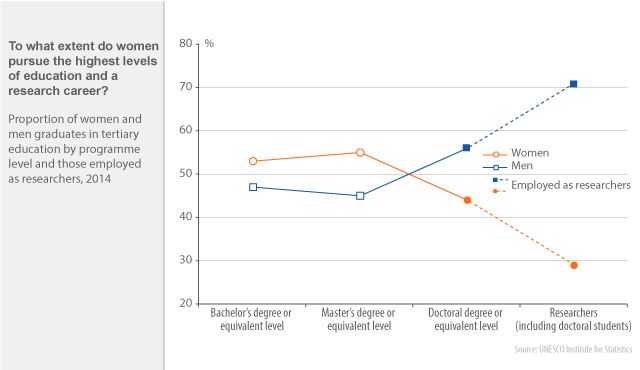
Women in science tumbling off a cliff

Since someone in this thread is trying to suggest that there might be a gender-based difference in ability to pursue careers in STEM fields, this chart is most appropriate.

graphic-proportion-women-men-graduates

That fits with my experience. On average, the undergraduate women I teach are just as capable as the men — if they weren’t confidential, I could show you my gradebook and you’d see that it’s women who consistently stand at the top of the class. Yet somehow, after they graduate, their participation in science careers plummets. I don’t think they turn stupid after getting their degree; I remember my peers from my graduate school and post-doc days, and no, all of them were scary smart or they wouldn’t be there. I think it’s more that harassment takes its toll (most of which I was oblivious to at the time, but afterwards, I’ve had women tell me about it, and it was an eye-opening “Oh, yeah, he was kind of creepy, wasn’t he” sort of revelation), and disrespect (I definitely knew older faculty who saw women as good technicians, but not smart enough to do creative work) and judgmental attitudes (“she’s just going to get married and pregnant and leave the field anyway”).

We are not yet creating equal opportunities. Don’t try to tell me that women are less capable when I deal with brilliant, hard-working women in science every day.

Bobby and Bobby are very foolish boys

There’s a popular scam among creationists: they offer big prizes to anyone who can “prove” that evolution is true. They never award these prizes, and I suspect they usually don’t even have the cash on hand, because they’ve got an ace up their sleeves. They set unreachable criteria. For example, to win Joseph Mastropaolo’s evolution prize, one must present evidence that persuades a team of judges — judges who are hand-picked by Mastropaolo. I think the game is stacked.

Now look who is playing a similar game: Robert Kennedy Jr. and Robert De Niro are offering a $100,000 prize for proof that vaccines are safe. I don’t quite know what they expect would constitute proof, since they seem to disregard the extensive clinical trials that have been carried out, or the lack of significant numbers of dead babies from their shots (almost 90% of infants get a thorough series of vaccinations, yet somehow we don’t have piles of dead babies), or the historical evidence (visit a 19th century graveyard, and you will find those piles of dead babies…modern graveyards are mostly full of old dead people), or the remarkable improvement in public health with the introduction of, for instance, the polio vaccine, and the effective eradication of smallpox, or that measles kills about 100,000 people a year (but very few in the US), all of which would be preventable by vaccines.

You know, that $100,000 prize would help a lot in vaccinating all the people in Asia and Africa who are suffering from measles — about 20 million people each year.

So what are the criteria for winning this prize?

Kennedy explained that the WMP will pay $100,000 to the first journalist, or other individual, who can find a peer-reviewed scientific study demonstrating that thimerosal is safe in the amounts contained in vaccines currently being administered to American children and pregnant women. Kennedy believes that even “a meager effort at homework” will expose that contention as unsupported by science.

Hold your horses, everyone! <rushes to the PubMed link I always keep handy>

Early exposure to the combined measles-mumps-rubella vaccine and thimerosal-containing vaccines and risk of autism spectrum disorder.

CONCLUSIONS:
No convincing evidence was found in this study that MMR vaccination and increasing thimerosal dose were associated with an increased risk of ASD onset.

Administration of thimerosal-containing vaccines to infant rhesus macaques does not result in autism-like behavior or neuropathology.

These data indicate that administration of TCVs and/or the MMR vaccine to rhesus macaques does not result in neuropathological abnormalities, or aberrant behaviors, like those observed in ASD.

Vaccines and autism in primate model.

Administration of thimerosal-containing vaccines to infant rhesus macaques does not result in autism-like behavior or neuropathology.

GIMME MY MONEY, BOBBY2. Those were a few papers that turned up in just the first page of a search — there were 180 more pages, but I didn’t bother looking, because I like the idea of winning a couple of years’ salary for the minimal amount of work. I wonder — could I be even lazier and just send them a link to PubMed?

I suspect that I won’t get paid, because there are other, mysterious excuses they’ll have for rejecting the evidence, just like the creationists do. The stated criteria are just to obvious and simple and have been met over and over in decades of peer-reviewed research.

They won’t pay up, because like the creationists, they’re only going to accept ‘evidence’ that supports their presuppositions, and the purpose of the reward is not to get information delivered to them — that information is freely available already — but to promote a lie. “We offered all this money, and no one could provide evidence, therefore you know that evolution/vaccines are false!” It’s a pretty tacky tactic.

It’s sad, too. I’ve liked many of De Niro’s movies. Now I’ll never be able to watch them again without being conscious that the actor is a colossal dumbass.

Someone needs to start a foundation to help victims of Physicist Syndrome

William Happer is a distinguished emeritus professor of physics. His specialty is optics and spectroscopy, but he’s got Physicist Syndrome bad — he thinks he’s an expert in everything to the point that he can disagree with distinguished professors in other fields, on their specialty. Yes, he’s that kind of idiot.

And he’s being considered for the position of Science Advisor to Donald Trump. Are you surprised? Trump’s chief skill seems to be in ferreting out the worst people and elevating them to positions where they can do the most damage. If you’re wondering why Trump is at all interested in this crank professor, it’s because he’s already been bought and paid for by the fossil fuel industry.

William Happer has accepted funding from the fossil fuel industry in the past. In a Minnesota state hearing on the impacts of carbon dioxide, Peabody Energy paid him $8,000 which was routed through the CO2 Coalition.

In 2015 undercover investigation by Greenpeace, Happer told Greenpeace reporters that he would be willing to produce research promoting the benefits of carbon dioxide for $250 per hour, while the funding sources could be similarly concealed by routing them through the CO2 Coalition.

But make up your own mind. Here’s an interview with the sublimely confident Dr Happer. Let’s start with something I can agree with.

Well, I guess where I see the big problem in our country is science illiteracy in the general population. If I were King, I would figure out some way to get better science teaching into the schools, you know, K through 12, and especially middle school and high school. It’s a disgrace that people get out with high school degrees knowing as little as they do. And I think it’s getting worse. I think it was much better in the ‘30s than it is today. And teaching makes a difference.

I often tell the people this anecdote — I once asked Edward Teller [a key architect of the hydrogen bomb] how it was possible that there were all these Hungarians, you know, there was him and Eugene Wigner and Szilard, von Neumann — a real constellation. They were all about the same age, and made enormous contributions to science. It was easy, he said. We all had the same high school teacher in the Fasori Gimnázium in Budapest. So there’s an example. Whoever this teacher was deserves a medal, you know. Nobody pays any attention to him. But at least in Hungarian society, teaching was an honorable profession, so that this really good guy — probably better than most university professors — produced this galaxy of stars. So I think we should seriously think about improving general education.

Oh man, yes. There was one teacher I’d name as extremely influential in getting me to pursue a career in science — thanks, Mr Thompson, and that chemistry class my junior year in high school. I think we all know of strong teachers who confirmed our commitment to do this thing…we here at the college level are mainly dealing with young men and women who’ve already made up their minds. We should pay public school teachers more, don’t you think?

But then he mounts his high horse.

I don’t know. First of all, just the term denier to someone like me is extremely offensive because it’s carefully chosen to make me look like a Nazi sympathizer. And you know, I dodged Nazi submarines when I was a kid [on a ship carrying immigrants to the United States] and my father fought against them and my mother worked on the Manhattan Project, and I found it profoundly offensive, you know, and many other people feel the same.

I think toning down the rhetoric would help a lot. And it has been very uneven — for example under the previous eight years the President and secretary of state kept talking about the deniers, you know, about the baskets of deplorables, the knuckle draggers, the Neanderthals. That was me they’re talking about.

I don’t think it was the anti-Nazi science kook they are talking about. It’s the, you know, Nazis. Literal Nazis. The people who do Nazi salutes, talk about white supremacy, and voted for Trump — the guy considering you for science advisor. I’m more than a little tired of indignant people who profess their contempt for Nazis while embracing the political party that counts on Nazi/racist support to get elected.

But also it’s impossible to take his concerns about toning down the rhetoric seriously when he just said this:

“There’s a whole area of climate so-called science that is really more like a cult,” Happer told the Guardian. “It’s like Hare Krishna or something like that. They’re glassy-eyed and they chant. It will potentially harm the image of all science.”

But even worse is the simplistic crackpot science he is peddling.

I see the CO2 as good, you know. Let me be clear. I don’t think it’s a problem at all, I think it’s a good thing. It’s just incredible when people keep talking about carbon pollution when you and I are sitting here breathing out, you know, 40,000 parts per million of CO2 with every exhalation. So I mean it’s shameful to do all of this propaganda on what’s a beneficial natural part of the atmosphere that has never been stable but most of the time much higher than now.

You know what else I’m pumping out as I sit here? Water. It’s just oozing out of my pores, evaporating out of my breath. Water is good, right? So more of it would be better. Let’s dump Happer in a big vat of water and let him paddle there, bathing in the life-giving fluid.

Another natural product of my metabolism is urea. I’m going to be even more generous and suggest that he be immersed in a vat of urine. More is better, always, right? So water plus urine has to be an improvement. Also, plants love water, and they love nitrogen. Therefore, it’s even more beneficial and natural.

OK, I forgot. He also likes gasses. We’ll top off the vat with pure, natural, healthful CO2. It’s a win:win!

I would like to remind Dr Happer of an old familiar (and true) phrase: the dose makes the poison. No one is going to deny that CO2 (and water, and nitrogen) are necessary components of a healthy atmosphere for life as it exists on earth. But we need balance in all things: just the right amount of carbon and nitrogen and water, balanced dynamically in cycles of renewal and reuse. That’s how we maximize growth in a sustainable way. Happer thinks throwing the balance out of wack is just as good as a balanced cycle. That ain’t gonna work.

Furthermore, he denies all the chaos and disruption as we roll our atmosphere back to the state it was in during the Carboniferous — which was admittedly a very nice environment for the plants and animals adapted to the Carboniferous, but probably isn’t as favorable to a species that evolved out of the ice ages.

He also ignores the possibility that we have no check on a runaway greenhouse effect — there is no guarantee climate change will stop at a swampy, hot, carbon-rich Carboniferous. I don’t think we’re predicting a roll-back to the Hadean, but it doesn’t take much change to make human life uncomfortable and possibly untenable.

Ultimately, though, his problem is that he’s not as bright as he thinks he is, and that he has a limited, one-dimensional view of geophysics, ecology, biology, and climate…yet, as a victim of Physicist Syndrome, he still thinks his narrow perspective trumps that of geophysicists, ecologists, biologists, and climatologists. That makes him a perfect Trump advisor, although it may chafe when he discovers that Trump thinks he’s even smarter than physicists.

I guess this is a Valentine’s Day story

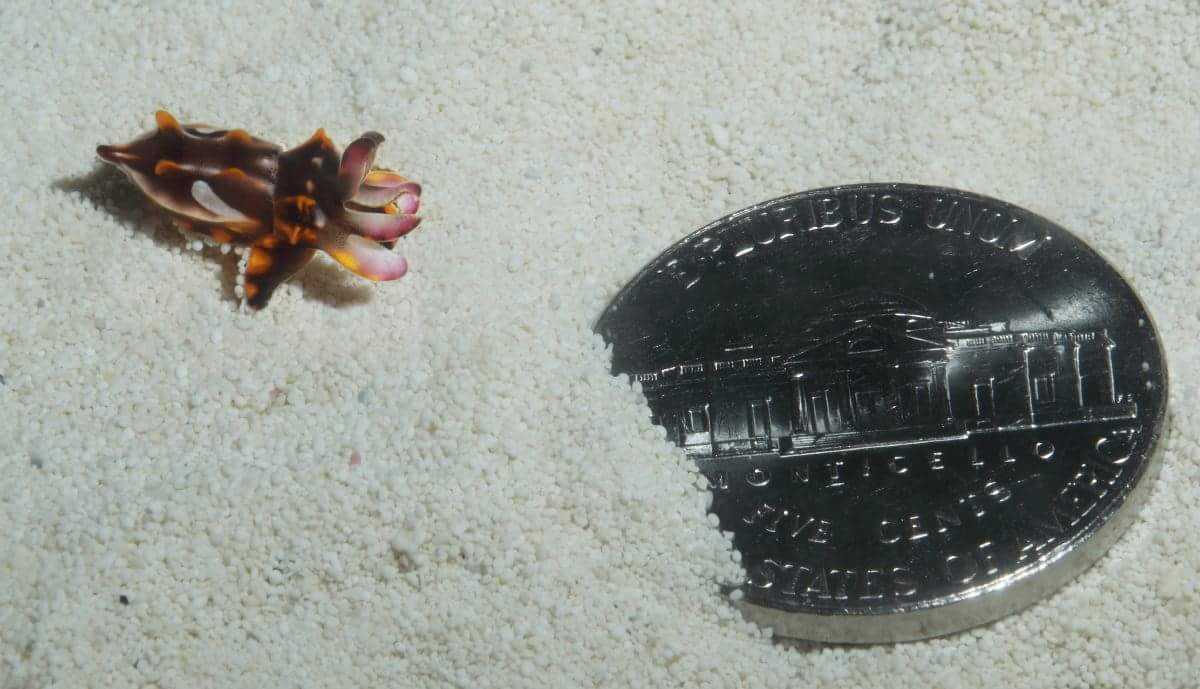
It’s about snails looking for love.

But I just have to intrude rudely and mention that handedness in snail shell coiling has been studied for a long time, and we mostly know the answer: the direction is specified by a maternal effect gene, so what matters is the genotype of Jeremy’s mother, not Jeremy’s phenotype. Jeremy and Lefty are almost certainly heterozygous, the product of a homozygous left-coiling mother and a mate who was almost certainly (because this is a rare trait) homozygous for the right-coiling allele, and because they carry the right-coiling allele, all of their little baby snails will be right-coiling. He’s going to have to look in their grandchildren to find more left-coiling snails.

Technical details of the genetics aside, it must be frustrating to have to take chirality into consideration when trying to mate. Imagine a world where being left-handed makes sex with right-handers require all kinds of twisty gymnastics to line the bits up just right.

But…who is going to the stars?

possums

Kim Stanley Robinson wrote an excellent essay on generation ships — the science-fiction concept of building starships designed to take hundreds or thousands of years to fly to their destination, with generations of people living within them — and summarized all the physical, biological, and ecological problems with them that would ultimately doom such a project to failure. His conclusion is that “Earth is our only home”, which sounds depressing if you look at it one way, but really shouldn’t be, if only we could stop trashing the place.

I agree completely with that essay.

Now Kameron Hurley has written her own excellent essay in response, pointing out that there is a path towards making them viable again. I agree completely with this one, too.

If we figured out how to jettison ourselves from the Earth, we can figure out how to alter ourselves to traverse the incredible distances between stars and even galaxies. And here, then, is the difference in ideas that drives my writing as opposed to that of many other science fiction writers. I understand that space travel and expansion is just as much about altering ourselves, our attitudes, our social structures, our very biology, as it is about altering the places we choose to live.

The one problem is that word “ourselves”. Who are “we”? As Hurley says, the only way this works is if we are plastic and willing to change who we are, adapting to radically new circumstances. We can’t expect to simply put New York in a bubble and lift it off the planet — New York in space is a completely different beast from a New York planted firmly in the BosWash corridor with harbors and airports to connect it to everywhere else. The life of the city would have to change utterly.

The Puritans left England in their ships to preserve their way of life. It didn’t work. It changed everything about them in ways they could not predict, and I suspect that if we could go back in time and show the Puritan emigrants a picture of what America would become and how their descendants would live, they would react with horror and decide that there is no point in leaving after all. If your goal is to shelter your identity, your way of life, and the lives of your children, packing up and moving to a wildly different environment with unpredictable elements is probably the very worst idea you could have. If you want to define “ourselves” as a body of beliefs and ideas, well, sorry, those are extremely fragile and tend not to survive in new environments without some major transformations.

What about our biology? Look at the formation of the Panamanian land bridge and the exchange of North and South American fauna. We couldn’t possibly predict who the winners and losers would be, except, maybe, that there’d be a lot of losers. The grand champion of the invasion of North America was…opossums? Really? Come on. If they’d been sapient, those 5 meter tall phorusrhacid terror birds might have been pretty confident that they were going to kick ass and take over and rule two continents, but instead they all went extinct — as did the Astrapotheria, the Litopterna, the Sparassodonta, and other orders of big strong beasties — and it was the marsupial rat-thingies that thrived?

Hurley is exactly right that generation ships could be doable if we didn’t think of them as shells for people in transit and more as self-sustaining ecological islands cast off to grow and change, but then we have to change our notions of what constitute “us”, because for sure what arrives at a distant star a thousand years from now won’t be Americans, and may not even be recognizable as human any more. We could be building a bridge to Tau Ceti that delivers a chittering cargo of marsupial rat-thingies to a brand new world.

Is that acceptable? Is our vision of ourselves sufficiently flexible that we would consider planting a colony of unicellular eukaryotes on a distant planet to be a success? Would we be disappointed if we didn’t at least get mammals off-world, or are we going to insist on a primate exodus? We’re going to have to have an extraordinarly broad sense of identity for this all to work. Hurley seems to get that, I’d just wonder whether she’s gotten weird enough.

This was a concept I explored deeply in my novel, The Stars are Legion. Because certainly, we will change if we create and inhabit a living organism to which we are intrinsically tied. The Earth has shaped our evolution in every way, and our world-ships will no doubt do the same. Perhaps we’ll never be able to leave these ships. But propelling ourselves across the universe inside a self-sustaining world that can repair and reproduce itself solves the problems of distance and reduces the chance of ecological collapse, particularly if the worlds moved together as a legion and included independent layers of systems so that if one began to decline, another would rise. Think of it as naturally evolving back-up systems.

Exactly. People aren’t an ecosystem. It’s going to require establishing a complex, diverse assemblage of organisms to be self-sustaining, and everything will change year after year. And you aren’t going to be able to predict ahead of time how it will change, only that it will change. And the most fungible, protean, fragile elements will be the highest level bits, things like “societies”.

Those who arrive in the next star system, if they have created societies that allow them to change what we currently consider to be the intrinsically human foibles of war and strife and pettiness and bickering, will require time to adapt to a new environment. Consider how symbiotic parasites can chemically change and shape their hosts to suit them. Now imagine a ship is programmed to merge its flora and fauna with a new planet when it arrives, making the world-ship, now, into a living terraforming machine, a bacterial incubator that rapidly adapts the local environment to sustain its hosts. If symbiotic parasites can do this here on earth, why can’t we hurl something like it through space?

There are nightmares nestled in that idea.

Imagine you fill your ship with high-minded idealists, intellectuals and artists, and plan to export the very best of your culture to distant alien worlds…and by the time it gets there, it turns out that the best survivors are Republican neo-Nazis and televangelists.

Or it isn’t even people who last a thousand years in your starfaring arcology, and the survivors are all marsupial rat-thingies. But I repeat myself.

Try flipping the perspective, too. You’re having a grand time on an ecologically restored Earth, living in balance with all of nature, when a legion of ecological arks from an alien world arrive. They don’t want to exercise the cartoon SF prerogative of exterminating all humans or destroying Earth, they want to merge with us allow change to flow from the natural ecological and evolutionary interactions of diverse species. They aren’t going to kill us, no not directly, they’re going to give us an opportunity to adapt and change, like all good species. Never mind that these kinds of interactions are always catastrophic for some. We send probes up to the oncoming giant space island to figure out what we are going to face, and the astronauts look inside and say, “My god, it’s full of marsupial rat-thingies!”

Or Republicans and televangelists. But again, I repeat myself.

But I am looking forward to reading Hurley’s The Stars are Legion. Maybe I’ll get to it this weekend.

Ask an Evolutionist

I’ll be going through some questions at 12 Central. You can watch it here! You can leave new questions in the comments (or on youtube)! You can berate me for my errors! It’ll be fun, he says, as he prepares to expose himself.

Happy Darwin Day, unofficially!

Charles-Darwin-and-William-Darwin

Hey, like, do you remember when congress proposed to recognize Darwin Day, officially, years ago? Yeah, it’s been kind of bouncing around for a long time. Didn’t pass.

Hey, also, remember when Congressman Paul Broun of Georgia, a member of the House of Representatives Committee on Science, Space and Technology, said a few words about that Darwin stuff?

God’s word is true. I’ve come to understand that. All that stuff I was taught about evolution and embryology and the big bang theory, all that is lies straight from the pit of Hell.

Heh. Good times, good times. Hey, didja know this kind of bill has been proposed over and over again, and always dies in that same Committee on Science, Space and Technology? The one that is currently chaired by Lamar Smith, with luminaries like Dana Rohrabacher on board? I wonder how that happens.

Last month, another Darwin Day bill was shuffled off to that committee. How do you think it will fare?

Oh, well, we shall celebrate evolutionary biology in our hearts. Or on YouTube — I’ll be going live here around noon to play “Ask an Evolutionist” for a while, as promised.

All science is always political

I have been out of the loop for a few weeks — man, my workload spiked recently — but now that I’m catching up, I feel nothing but dismay at the ridiculous complaints from scientists about the March for Science. I could hardly believe that some oppose the idea of scientists expressing vigorous dissent.

Al Gore, bless his heart (as we say in the South), was well intentioned when he made “An Inconvenient Truth” in 2006. But he did us no favors. So many of the conservative Southerners whom I speak to about climate change see it as a partisan issue largely because of that high-profile salvo fired by the former vice president.

Scientists marching in opposition to a newly elected Republican president will only cement the divide. The solution here is not mass spectacle, but an increased effort to communicate directly with those who do not understand the degree to which the changing climate is already affecting their lives. We need storytellers, not marchers.

I’ve heard that so often: don’t rock the boat. We’ve got ours, if you make waves you’re imperiling the precious position we are clinging to by our fingernails. It’s absurd, selfish, and futile. The situation for science has become increasingly dire, and instead of shaking up the situation, putting your position at risk, you want to make sure that scientists are more harmless/helpless, more innocuous, more inoff-fucking-ensive because conservatives who despise science already might use the support of a political movement they hate as more ammo against us?

We have a common word for that. It’s called cowardice.

Then he dares to lecture us on what would be effective science communication? I’ve been through that for years, too. There’s always someone who will lecture at others who are doing the work that they’re doing it wrong. And that someone doing the hectoring is usually terribly ineffective at communicating science, so they are reduced to pontificating about the proper way to do it to the science communicators.

When they tell people “we need storytellers” without recognizing that we already know that, and are doing it, it’s remarkably clueless. We just see the need for something more, that when we reach yet another period of peak crisis, it’s time to add another approach to the toolkit.

And hey, you want to tell stories? Go ahead. No one is stopping you. The only ones trying to suppress diverse methods of outreach to diverse communities are the ones saying there can be only one acceptable way of explaining science.

By the way, I know people who found “An Inconvenient Truth” useful and powerful. That it antagonized the assholes who have been subverting science for decades is a point in its favor.

I thought that op-ed was bad, but here’s a dude complaining that the March is too political…or worse, that it’s the wrong politics. Those damn SJWs! Ruining everything!

What does make me worry is the increasing politicization of the March, which is fast changing from a pro-science march to a pro-social justice march. Now there’s nothing wrong with marching in favor of minority rights and against oppression, but if you mix that stuff up with science, as the March organization seems to be doing, well, that is a recipe for ineffectiveness. What would be the point of a march if it’s about every social injustice, particularly when, as the organizers did, they indict science itself for its racism and support of discrimination? The statement of aims below from the March’s organizers has now disappeared, but the tweet below that is still there. (You can find the full statement archived here.)

We’ve seen this same crap recently from Steven Pinker. The March for Science declares that they are “committed to centralizing, highlighting, standing in solidarity with, and acting as accomplices with black, Latinx, API, indigenous, Muslim, Jewish, women, people with disabilities, poor, gay, lesbian, bisexual, queer, trans, non-binary, agender, and intersex scientists and science advocates,” and boom, the conservative science wing reacts in horror. I don’t get it. Encouraging diversity and new ideas and approaches is exactly what scientists should support — but I guess if you’re part of the establishment now, you’d rather not see the implicit policies that helped you get where you are change. It’s almost as if they’re willing to help others climb the ladder of scientific achievement, but only if they look like the people that are already there. Can’t clutter up the old boys’ club with disabled lesbians and transgender brown people and all that, because they wouldn’t be as committed to doing good science as…privileged white people?

But that would be racist/sexist.

There’s another distractor there, too: fighting oppression is a “recipe for ineffectiveness”. We must focus laser-like on ONE THING, even if we are a massive organization of hundreds of thousands or even millions of members — everyone must be in lockstep on the ONE THING or we won’t get the ONE THING, even if the one thing is so abstract and huge that it’s effectively indefensible. So Movement Atheism must focus on the ONE THING of ATHEISM, which is fiercely defended as the sole principle that there is no god, never mind all the complex cultural baggage associated with that. Scientists must focus on the ONE THING of SCIENCE, a concept so complex that we have a name for the problem of trying to define its boundaries, the demarcation problem.

I have no idea how (or why) this dude plans to narrow the focus of the March. Is the March for Science to consist only of white men looking distracted as they concentrate on the scientific method? Wait — that would look just like a bunch of philosophers, and we can’t have that. A bunch of white men fiddling with telescopes and dissecting cats and punching numbers into their handheld computers as they march? That sounds like a recipe for effectiveness.

There’s another complaint. The organizers for the March for Science have criticized science. How dare they! Clearly, they don’t understand the True Purpose of Science, which is Good and Above Criticism. All Hail Science!

If a March has any chance of being effective, it can’t consist of a bunch of penitentes who flagellate themselves loudly and publicly for bad behavior. After all, stuff like “immigration policy”, “native rights”, and many other issues of social justice are not, as the organizers maintain, “scientific issues.” They are moral issues, which means they reflect worldviews and preferences that are not objective. Of course once you set your goals on immigration, pipeline locations and who should not be near them, and so on, then science can inform your actions. But to claim that all issues of social justice are “scientific issues” is palpably wrong.

This is just weird to the point of incomprehensibility to me. Science must have an objective purpose? But most of it doesn’t! Science is about curiosity and wonder and exploration. What objective purpose was Thomas Hunt Morgan pursuing when he was searching for sports in his fly colony? What was the objective purpose of Santiago Ramón y Cajal spending long nights drawing the beautiful filigree of Golgi-stained neurons, or writing lovely prose about the growth cone?

Please, do tell me how to define this criterion of “objectivity”. It seems to me that this arbitrary distinction would make postage stamp collecting, which has discrete, specific, measurable criteria, more scientific than launching a space probe to Pluto, where we had little idea what we’d find.

It is clearly not so much that some issues lack objectivity — once you recognize that native Americans are human beings, “native rights” becomes a rather clearly defined concern with measurable goals — but, as defined, that adding a moral component taints a subject, polluting the purity of Science, making it non-objective.

I’ve got news for him: everything has a moral component. Everything has a political component. If it’s a human activity, it is contaminated with moral and political ramifications, because that’s what humans do. Deciding that we have the economic surplus and the privilege of leisure to be able to support people who study fruit flies full time is a moral, social, and political act, for instance.

It becomes even more profoundly moral, social, and political when we make arbitrary decisions about which people will be permitted to have the privilege of spending their days studying fruit flies, or even which people will be granted the education that will allow them to appreciate the study of fruit flies. Until the day comes that AIs are doing all the science, discussing the science only among the other AIs, and doing all the work to benefit or harm only AIs, you cannot divorce the moral from the scientific. And even then I hope the AIs are smart enough to consider the impact of their pursuits on AI morality, because we feeble apes sure don’t seem to be able to comprehend that concept.

Just the idea that science ought not to criticize itself in public gives me the heebie-jeebies. Damn. The Tuskegee Syphilis Study? I guess that was scientifically objective, let’s not criticize it. Eugenics? All sciencey and shit. Bioethics is not a field that actually exists, or if it does, it’s not objective and Truly Scientific because it recognizes the impact of science on society.

It’s easy to find fun and exciting examples. How about this: An Adorable Swedish Tradition Has Its Roots in Human Experimentation. They fed institutionalized, mentally-ill people with massive doses of candy until their teeth rotted, to determine if sugar actually caused tooth decay. It was objectively done, of course. All Praise Science!

Or how about the whole issue of evolutionary psychology, which mainly seems to exist to rationalize traditional Western values as objective and scientific, perpetuating a whole vast collection of oppressive ideas.

Victorian social attitudes and science were closely intertwined. The common belief was that males and females were radically different. Moreover, attitudes about Victorian women influenced beliefs about nonhuman females. Males were considered to be active, combative, more variable, and more evolved and complex. Females were deemed to be passive, nurturing; less variable, with arrested development equivalent to that of a child. “True women” were expected to be pure, submissive to men, sexually restrained and uninterested in sex – and this representation was also seamlessly applied to female animals.

That sure sounds like Science with a capital “S” to me! Let’s get some grant money to prove the status quo and get it published in Journal of Evolutionary Psychology, Cosmpolitan, and The Journal of Personal Selling & Sales Management! A three-fer, win-win, here comes tenure…and none of that has involved those damned “moral issues”, as long as you realize that white, conservative, capitalist, male biases are the gold standard of Truth, and it’s only those deviants who question the status quo who are bringing in that dirty word, “morality”, and making everything messily unscientific.

Oh, god, this thing gets even worse.

If we are to march, we should march in unity for truth, and against those who reject empirical truth. What unites all science—and makes it unique—is that it is a universal toolkit, used in the same way by members of all groups, regardless of gender, ethnicity, or religion. That is what holds us together. If we start dragging in issues of social justice—and I’m not of course saying they should be ignored in other venues—then we divide not only ourselves, but separate ourselves from much of the electorate, who, as we’ve seen above, generally trust us.

Declaring that you’ll only be marching under the banner of TRUTH sounds awfully religious to me. Declaring that science always works the same way in everyone’s hands sounds awfully ahistorical to me. Declaring that what holds us together is a disregard of gender, ethnicity, or religion sounds awfully privileged to me — I have the luxury of being unaffected by my sex and race, but damn, if you listen with half an ear to everyone who isn’t a white man you can’t help but notice that that isn’t true for everyone.

Social justice isn’t something that we “drag in” when social injustice is the muck that hinders the participation of more than half the citizenry in science, when toxic nonsense about sex and race poison the whole discourse about science in our culture.

This whole argument that social justice must be actively excluded from the March for Science reminds me of another march: the suffrage parade of 1913, in which black women were asked to segregate themselves from the white women and march at the back of the parade, because the white ladies did not want their goals marred by that other issue of equality. If you’re worried that your cause might be tainted, that’s the example you should examine, because it was Ida Wells who emerges the hero and white feminists who damage their own reputation (and who still, all too often, kick their own butts when they ignore intersectionality).

And sweet jesus, the hypocrisy. Science is all about Truth and Objectivity, which is why we should bow to the biases of the electorate, who will be divided from us if we start dragging in issues of social justice, since they, after all, are assumed to not like it (and oh, the implicit bias in which part of the electorate we must listen to…I cringe). So much for the objectivity of science — it should say what the people desire, or it might erode their trust in us.

I presume Dr Coyne will now respect the wishes of all those faith-heads who want him to shut up about atheism. Might separate ourselves from much of the electorate, don’t you know.